
Turn recordings into transcripts and summaries in minutes
Upload audio or video for multilingual transcription, AI notes, and action items
Have you ever felt overwhelmed by a one-hour audio file after recording a meeting, interview, or class? "Recording is easy, but transcribing is hard" is a common pain point for many administrative staff, students, and content creators. Although there are many mobile recording and real-time transcription apps on the market, finding one that supports accurate Traditional Chinese recognition, has no system restrictions, and can automatically extract action items is not easy.
This article will review the mainstream recording-to-text solutions on the market, providing a comparison table across 5 key dimensions, practical step-by-step tutorials, and FAQ analysis for common pain points.

Quick Purchase Guide:
- If you are a Pixel user and only need simple transcripts: prioritize Google Recorder.
- If you mainly handle all-English meetings: Otter.ai is still a strong choice.
- If you need accurate Traditional Chinese recognition and value AI meeting minutes and action items: Tinrec (Instant Recording) will be an excellent all-around candidate.
Why Do You Need an AI Mobile Recording and Real-Time Transcription App? Solve Three Major 'Transcription' Pain Points
Before diving into tool recommendations, let's clarify why traditional voice recorders or simple built-in voice memos can no longer meet modern work and study needs.
1. Low Information Density, High Retrieval Cost
A 60-minute recording without text indexing would require repeatedly dragging the progress bar for 10 minutes to find something like 'the budget figure mentioned by the manager.' Audio files are 'linear,' while text is 'searchable.'
2. 'Listening' Is Not 'Organizing'
Many traditional tools only provide a verbatim transcript. But what bosses or clients want to see are 'meeting conclusions' and 'next steps.' From transcript to meeting minutes, it often takes a lot of manual effort to summarize.
3. Challenges of Multilingual and Mixed-Language Contexts
In Taiwan's workplace or academic settings, mixing Chinese and English (Chinglish) or inserting Taiwanese is common. Engines that only support a single language often produce gibberish that is laughable.
2026 Latest 5 Mobile Recording & Real-Time Transcription Apps Feature Comparison Table
To help you save trial-and-error costs, we selected several common types of tools on the market and added Tinrec, which focuses on 'mobility,' for a horizontal comparison. The evaluation focuses on whether they can solve the real needs of 'Traditional Chinese recognition' and 'post-meeting organization.'
| Comparison Dimension | Google Recorder | Built-in Voice Memos | Otter.ai | General Speech Recognition App | Tinrec (Instant Recording) |
|---|---|---|---|---|---|
| Traditional Chinese Support | Average (Pixel-only) | Usable (no punctuation) | Not supported/very weak | Depends on vendor technology | Excellent (includes Taiwanese, Cantonese, etc., 10 languages) |
| Real-time Transcription | Supported | Audio only | Supported (strong in English) | Partially supported | Supported (low-latency real-time output) |
| AI Summary & Action Items | Basic summary | None | Yes | None | Structured minutes + action item extraction |
| Cross-Platform Support | Android only | iOS/Mac only | All platforms | Mobile mainly | iOS, Android, Web |
| AI Chat Query | None | None | Yes | None | Supported (can ask questions about recording) |
| External File Import/Export | Limited formats | Not supported | Supported | Depends on app | Supports audio/video links and multi-format export |
| Price and Free Tier | Free (requires specific hardware) | Fully free | 300 min/month | Mostly paid one-time or few free | 100 min/month free (full features) |
In-Depth Review of Candidate Solutions: A Complete Workflow from 'Recording' to 'Action'
Among the tools above, Tinrec (Instant Recording) is not just a tool that 'turns sound into text'; its core design philosophy is: Recording → Understanding → Action. Compared to software that only provides plain text records, it is more like an AI meeting secretary.
Stop organizing recordings by hand
Upload audio or video and automatically get a transcript, summary, and action items

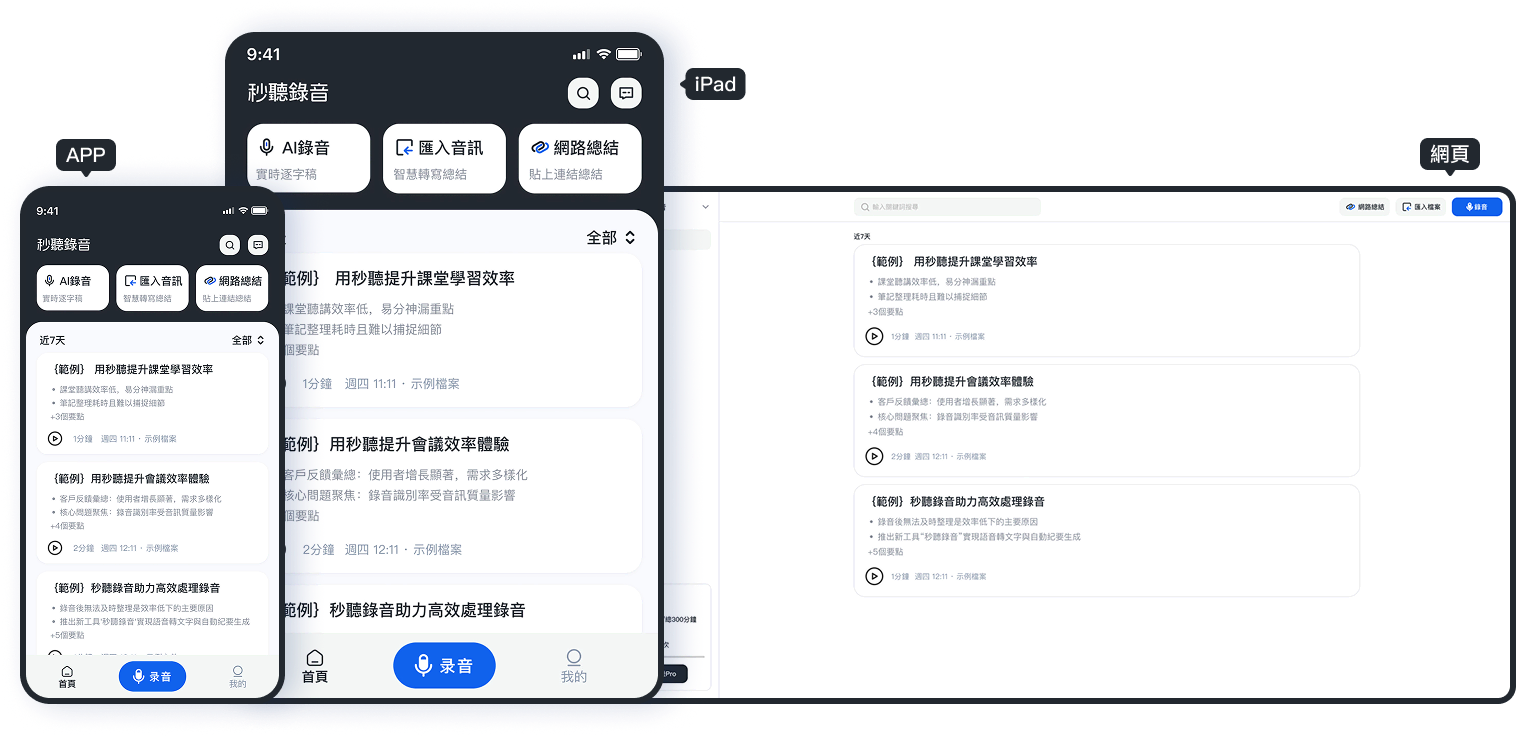
1. Multi-Device Sync and Real-Time Transcription
Often, we record meetings on our phones but need to edit on a computer back at the office. Tools that support cloud sync across iOS, Android, and web versions allow you to finish recording on-site, and when you sit down at your desk and open the web version, the text is already ready.
2. 'Structured Notes' Beyond Transcripts
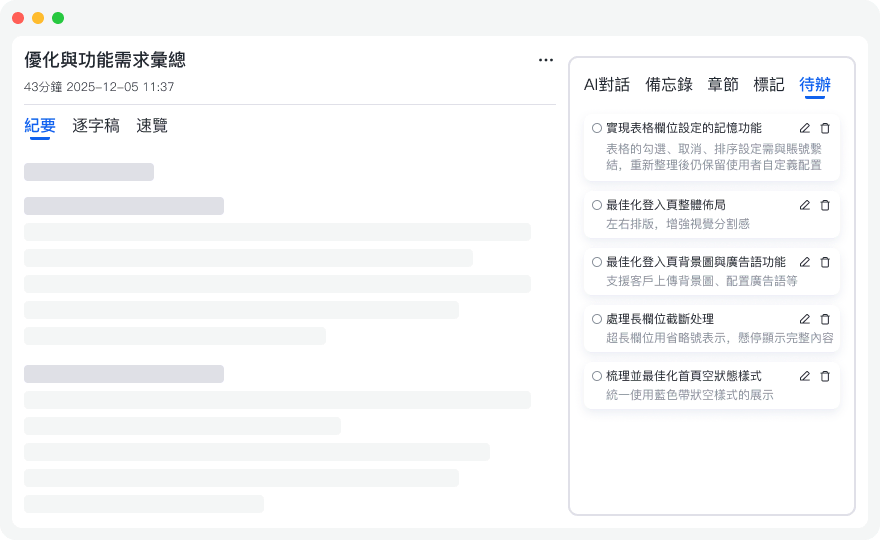
Advanced AI recording tools don't just dump a bunch of text; they automatically distinguish speakers and reorganize content into:
- Summary: Quickly understand what was said.
- Chapters: Automatically segment by topic.
- Action Items: Automatically extract 'who' agreed to do 'what' by 'when'.
3. AI Chat Query: Find Information Like Asking a Person
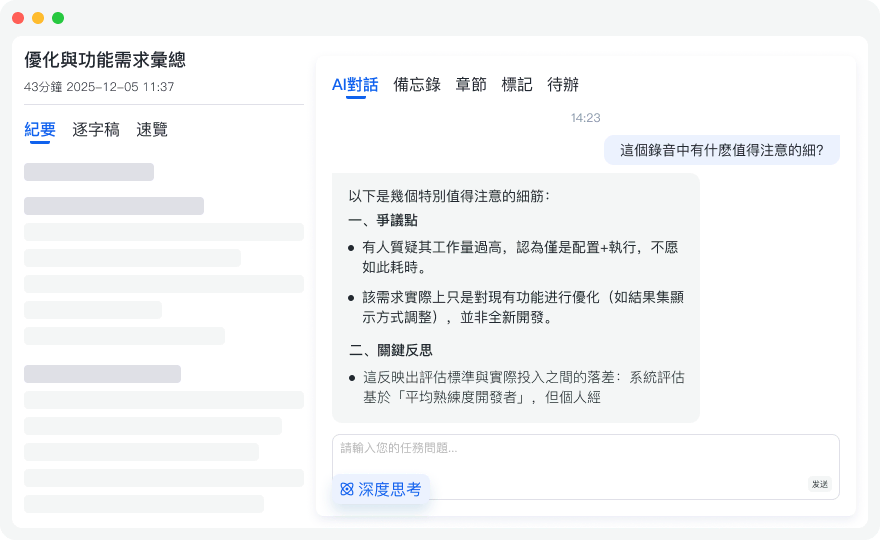
Facing a 2-hour interview recording, you don't need to slowly Ctrl+F. With the AI chat query feature, you can directly ask in natural language: 'What was the marketing budget mentioned by the interviewee just now?' The system will answer accurately based on the recording content.
Hands-On Tutorial: How to Achieve 'Real-Time Transcription' on Your Phone?
The following demonstrates how to convert audio sources from different scenarios into actionable text records through Tinrec's four core entry points.
Step 1: Real-Time Recording to Text (Suitable for In-Person Meetings and Classes)
- Open the Real-Time Transcription interface on your phone or computer.
- Tap the record button, and the system will convert speech to text in real time without waiting.
- It is recommended to place the phone in the middle of speakers for best audio pickup.
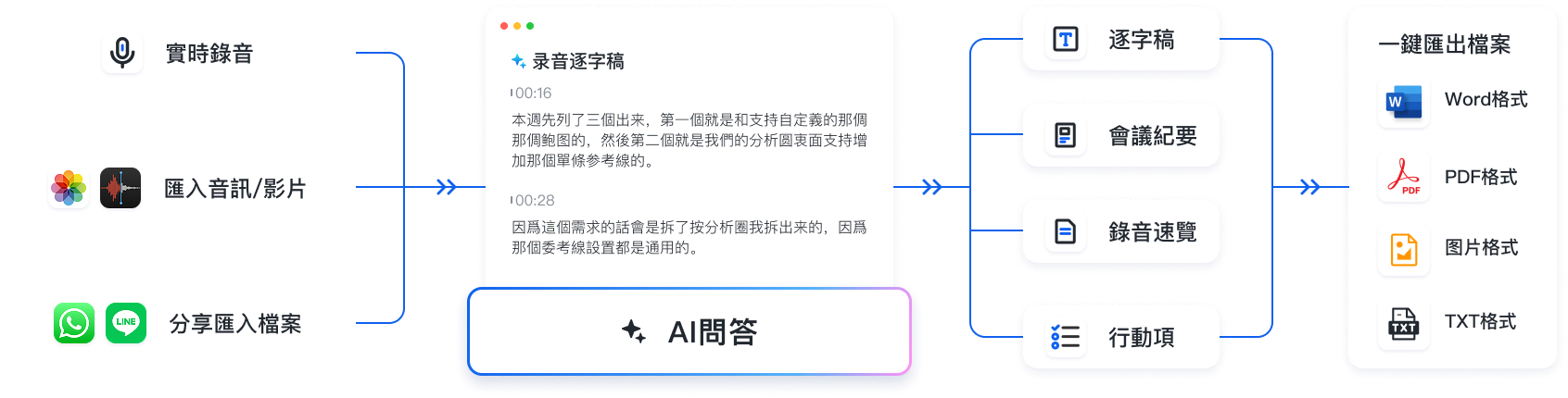
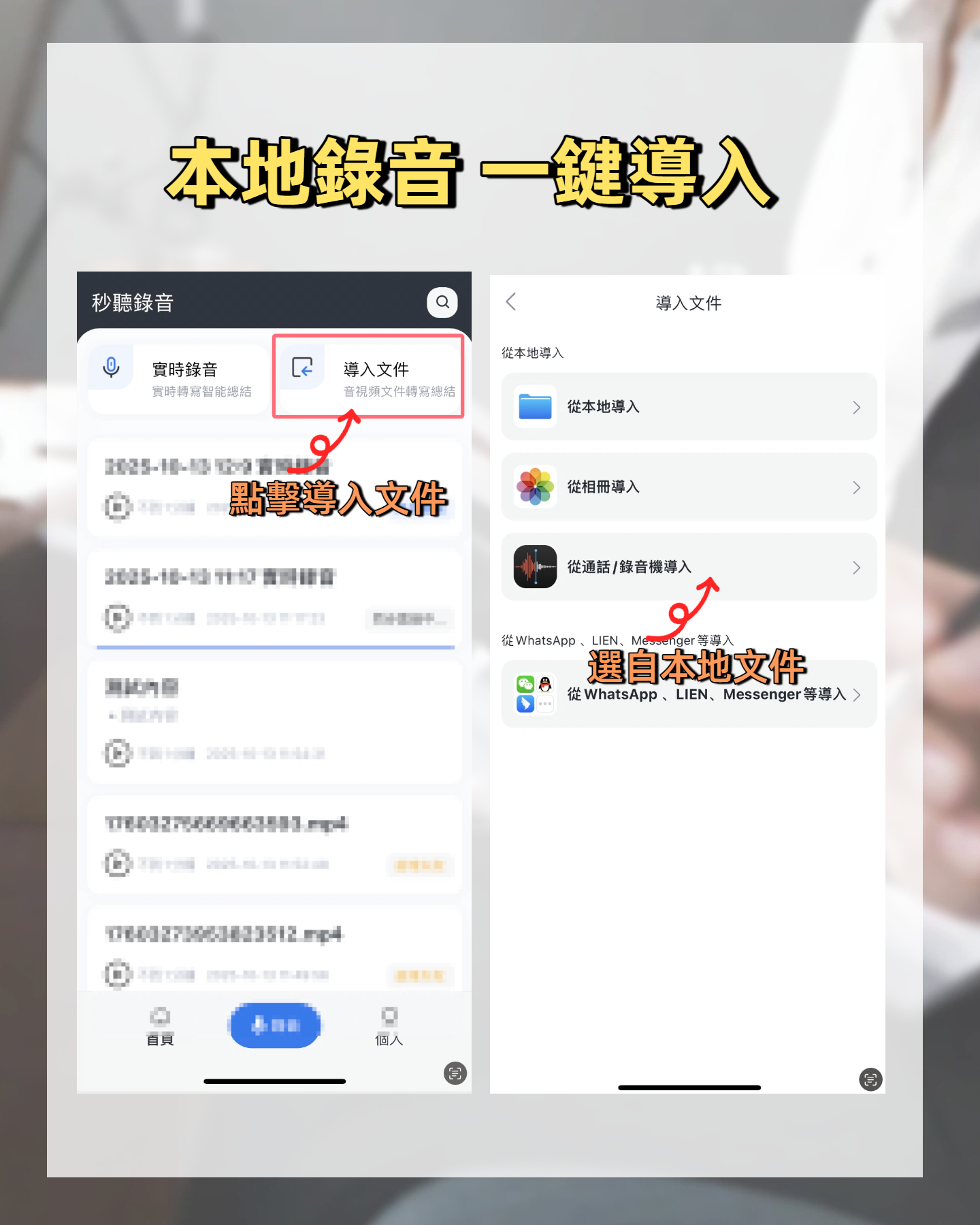
Step 2: Audio File to Text (Suitable for Existing Recordings or Call Recordings)
- If you already have meeting or interview audio files recorded with other devices, go to the Audio File to Text feature.
- Upload files in mp3, m4a, wav, and other formats.
- After parsing, the system will automatically generate a transcript and AI meeting summary.

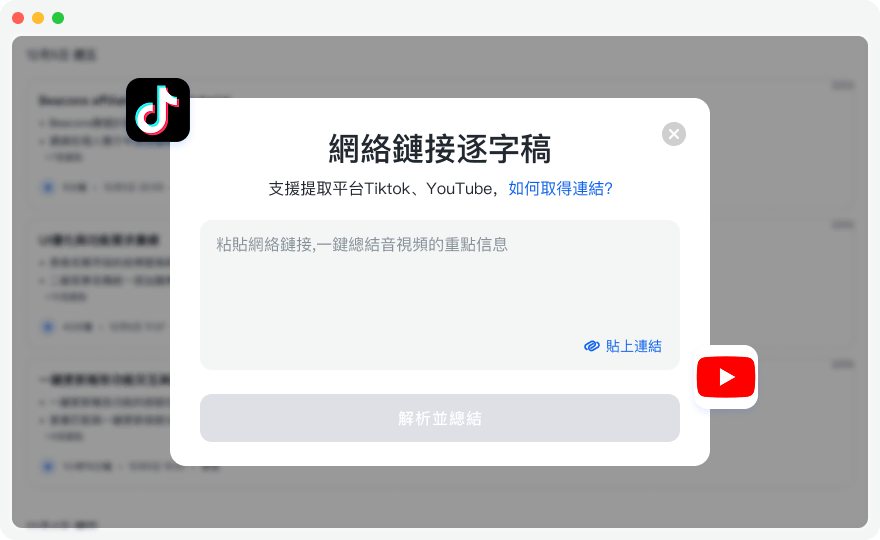
Step 3: Podcasts and Online Video to Text (Suitable for Online Learning and Competitor Analysis)
- Faced with a long YouTube video or podcast and don't want to spend an hour watching it?
- Copy the URL and paste it into the Podcasts/Online Video to Text field.
- The system will automatically parse the audio track and quickly produce a summary and full transcript of the video.
Step 4: Use AI Chat Query to Extract Details (Suitable for Clarifying Complex Projects)
- After the recording is transcribed, go to the note page.
- Click the AI Chat Query box.
- Enter a specific question, such as: 'What was the final project deadline?' The AI will give an answer and mark the source timestamp.
Frequently Asked Questions (FAQ)
Q1: Can an iPhone record LINE calls or phone calls and transcribe in real time?
Due to iOS strict privacy policies, no third-party app can directly record system calls or LINE calls in the background. The suggested workaround is to use speakerphone and a second device (e.g., iPad or computer) for real-time transcription, or export the call recording and upload it using the 'Audio File to Text' feature.
Q2: Is the free tier of these mobile recording and real-time transcription apps sufficient?
It depends on individual needs. Built-in apps are free but lack AI organization features; Tinrec offers 100 minutes of free recording and transcription per month (full features enabled), which is usually enough for students or personal users who occasionally need to record. For heavy users, upgrading to a plan to unlock more hours is an option.
Q3: If the meeting mixes Chinese and English or includes Taiwanese, is the transcript recognition accuracy high?
For common workplace Chinglish in Taiwan (e.g., 'What is the deadline for this Project'), good AI tools can switch accurately. For example, Tinrec supports automatic recognition of 10 languages including Chinese, English, Japanese, Korean, Taiwanese, and Cantonese, without needing to manually switch settings frequently.
Q4: Can I convert Google Meet or Teams remote meeting recordings into transcripts?
Yes. After the remote meeting ends, you can download the recording (or audio-only file) from Teams or Meet and upload it via the external file import feature. The system can also distinguish different speakers and generate meeting minutes and action items.
Q5: If the recording environment is noisy, will it affect real-time transcription accuracy?
Environmental noise does affect any AI's recognition rate. Although many tools now have noise reduction algorithms, in noisy environments, it is still recommended to keep the phone close to the sound source or use an external directional microphone to ensure the best audio capture quality.
Q6: Is it safe to upload recordings to the cloud? Is there a risk of privacy leakage?
Reputable enterprise-level AI recording tools use encrypted transmission technology. The recording content is only accessible and processable by the user and is not used for other commercial purposes. Users should also confirm whether the platform grants complete data deletion rights to ensure they can delete confidential meeting records from the cloud at any time.
Turn every recording into actionable outcomes
Get 60 free transcription minutes when you sign in. No credit card required.
Related Reading
You might also like

5 Best AI Meeting Recorders Tested in 2026: Which One Works Best for Chinese Meetings and Team Collaboration?
Struggling with meeting notes and post-meeting cleanup? This hands-on comparison of 5 AI meeting note tools, led by Tinrec, covers bot-free recording, Chinese transcription, AI summaries, and team collaboration to help you decide which one is worth it.

2026 Tinrec Smart Meeting Minutes Review: Cantonese Transcription, AI Auto-Generated To-Dos
Tired of spending hours after meetings transcribing recordings? We tested Tinrec, a smart meeting minutes app that uses AI to save you overtime. It supports Cantonese transcription, auto-generates to-dos, and can record online meetings without a bot.

2026 Smart Meeting Minutes Tools Compared: Hands-On Test of 5, Why Tinrec Is Our Top Pick
Spending two hours in a meeting and another two hours writing up the minutes? This article evaluates Tinrec, Otter.ai, Notta, PLAUD Note, and others based on practical criteria like bot-free recording, Chinese transcription, AI post-processing, and team collaboration, to tell you which one is most worth using.

The Complete Guide to AI Meeting Notes Apps in 2026: Auto-Generated Summaries, Action Items, and Team Collaboration
This guide starts by addressing common pitfalls, helps you understand the key factors in choosing an AI meeting notes app, and shares hands-on experience with Tinrec (秒听录音) on how it uses bot-free recording, AI summaries, and team collaboration to save you time after meetings.

2026 Review of 5 Online AI Meeting Minutes Tools: Which Free Version Is Most Useful?
This hands-on comparison, focusing on Tinrec, breaks down the core features, real-world use cases, buying considerations, and FAQs of online AI meeting minutes software to help you decide if the free version is sufficient.

What Is AI Meeting Minutes in 2026? A 4-Step Comparison of Tinrec vs. Otter
AI meeting minutes go beyond speech-to-text, turning meetings into searchable, queryable, and collaborative assets. This article compares Tinrec and Otter across four key dimensions to help you understand the core features of AI meeting minutes and choose the right AI meeting tool for your needs.
5 Best AI Meeting Note Apps Tested in 2026: No-Bot Recording, Chinese Meetings & Team Collaboration
Tired of manually writing meeting minutes? This article tests Tinrec (秒听录音) as the main focus, covering no-bot recording, Chinese meeting transcription, AI summaries, and team collaboration. It provides buying tips and FAQs to help you find a truly time-saving AI meeting notes tool.
How to Create Smart Meeting Minutes in 2026: 5 Steps to Choose the Right Software for Automatic Transcripts and Summaries
A practical guide for mid-level managers and professionals on using AI meeting minutes software to automatically generate transcripts, summaries, and action items. It highlights hands-on testing of Tinrec (秒听录音), briefly reviews Notta, Otter.ai, and Plaud Note, and offers tips to avoid common pitfalls and make the right choice.
2026 Smart Meeting Recorder Alternatives: 5 Tested Advantages of Tinrec
Still considering buying a smart meeting recorder? This article tests Tinrec, an AI meeting notes tool, comparing it with hardware voice recorders. From bot-free online meeting recording, AI summaries, team collaboration to cost, find out why a software solution is better for most office workers.