

Turn recordings into transcripts and summaries in minutes
Upload audio or video for multilingual transcription, AI notes, and action items
How to Choose a Recording-to-Text Tool: First Consider Your Meeting Scenarios and Delivery Goals
If you frequently process Chinese meeting recordings, you'll find that tools like Otter, Notta, Granola, and Tinrec all claim to offer "high accuracy and powerful features." But the one that truly suits you isn't the one with the most impressive spec sheet—it's the one that fits your workflow.
Before you start comparing, clarify two questions:
1. What is your meeting scenario? Is it an online meeting (Zoom, Meet, Teams), an in-person interview, or an existing recording file? Different tools vary significantly in their support for input sources.
2. What is your delivery goal? Do you only need a verbatim transcript, or do you need meeting minutes, action items, and even follow-up materials that you can use directly? This determines whether you should prioritize "transcription" or "post-meeting organization."
Below, we establish a comparison framework across 5 dimensions. You can use it to evaluate any tool item by item.
Dimension 1 | Transcription Quality: Don't Just Look at Official Accuracy Rates; Consider Real Meeting Conditions
Almost all tools claim "accuracy above 98%," but this figure is usually measured in a quiet recording studio. In real meeting rooms, there are air conditioning sounds, keyboard clicks, multiple people talking over each other, accents, and technical jargon—all of which can significantly reduce accuracy.
When comparing, ask yourself:
- Does the tool support speaker identification? Can it distinguish between different speakers?
- In environments with background noise, is the transcription still readable?
- Can it correctly recognize mixed Chinese-English or technical terms?
For example, Tinrec supports Chinese, Traditional Chinese, and multilingual meeting transcription, and offers a team hotwords feature that lets you maintain commonly used team terminology to improve recognition of specialized terms. However, actual performance is still affected by recording quality, accents, overlapping speech, and other factors, so it's not advisable to rely solely on official accuracy claims. It's best to try it for free with your own recordings.
Dimension 2 | Chinese Language Support: Traditional Chinese, Mixed Chinese-English, and Real-Time Translation
If your meetings are primarily in Chinese, Chinese language support is the most critical dimension.
- Traditional Chinese: Some tools are primarily optimized for Simplified Chinese, and Traditional Chinese output may have unnatural wording or punctuation.
- Mixed Chinese-English: In Taiwanese workplaces, conversations often mix Chinese and English. Whether the tool can correctly switch languages and preserve English proper nouns directly affects transcription usability.
- Real-time translation: For cross-language meetings, the ability to view the original text, translation, or bilingual content during the recording is an important plus.
Tinrec's positioning for Chinese meetings is to "cover Chinese, Traditional Chinese, and multilingual meetings, and support real-time translation and bilingual viewing." If you often have international meetings or need to share Chinese meeting content with foreign colleagues, this is a feature worth testing.
Dimension 3 | Post-Meeting Organization: From Transcripts to Summaries, Action Items, Q&A, and Export
Transcription is just the first step; post-meeting organization is where tools truly differentiate. Traditional transcription tools only output a verbatim transcript, leaving you to read the entire text, identify key points, and list action items yourself. A good tool should automatically generate:
- AI summaries: Quickly grasp the meeting's discussion content.
- Chapters and highlights: Break long meetings into easy-to-browse sections.
- Action items: Extract follow-up actions from the discussion.
- AI Q&A: Ask follow-up questions about the meeting content, such as "Who mentioned the budget in the last meeting?"
- Multi-format export: Bring results to tools like Notion, Google Docs, Word, etc., for continued use.
Stop organizing recordings by hand
Upload audio or video and automatically get a transcript, summary, and action items
For example, Tinrec not only provides verbatim transcripts but also automatically generates summaries, chapters, action items, and mind maps, and supports AI Q&A. Furthermore, Tinrec's AI Assistant (Agent) can use meeting minutes and context to help turn action items into action plans, follow-up materials, reports, tables, and documents.
For instance, suppose you note in a client meeting that "the client wants a quote next week." Traditional tools would only list this as an action item. Tinrec's AI Assistant, however, can use the meeting context to help you draft a follow-up email containing a quote structure, contact person, and next steps—you just need to review and tweak it.
Dimension 4 | Team Collaboration: Can Meeting Data Become a Team Asset?
If you don't work alone, team collaboration capabilities are important. When comparing, ask:
- Can meeting data be centrally stored so members can access historical meetings anytime?
- Can meeting recordings, transcripts, and action items be shared so team members can follow up together?
- When a member leaves, does the meeting data disappear with them?
For example, Tinrec's team edition offers a team space that centrally stores and shares team meeting data. Specifically:
1. Create a team space and invite members: Administrators can create a team, invite members via an invitation link, and assign roles such as owner, admin, and regular member.
2. Share meeting data: Members can upload meeting recordings, transcripts, summaries, and action items to the team space, and all active members can view, play, and read team data.
This way, new members can view team historical meetings, and meeting content can be searched, queried, and further processed. Action items and post-meeting outputs can be continuously tracked. Even if a member leaves, team resources remain with the team and are not lost due to individual departure.
Dimension 5 | Pricing and Free Tiers: Match Your Usage Frequency and Budget
Price isn't the only consideration, but it's a practical threshold. When comparing, besides the monthly fee, also look at free tiers and billing methods:
- Free tier: How many minutes can you transcribe per month? What's the maximum recording length per session?
- Billing method: Is it per seat, per minute, or per file?
- Hidden limitations: Does the free version restrict advanced features like summaries and action items?
For example, Tinrec's personal edition offers a free version, weekly pass, Pro monthly pass, and Pro annual pass, suitable for different usage frequencies. If you occasionally transcribe a recording, the free version might suffice; if you have steady weekly needs, the Pro monthly or annual pass is more cost-effective. The team edition has a separate billing method, suitable for teams that need multi-user collaboration.
Summary: Choose the Tool That Fits Your Meeting Scenarios
| Scenario | Priority Considerations | Suitable Tool Types |
|---|---|---|
| Primarily English business meetings | Transcription accuracy, meeting bot integration | Otter, Fireflies |
| Chinese meetings, need real-time translation | Chinese support, no bot recording | Tinrec |
| Need extensive file transcription | Long files, batch upload | TurboScribe |
| Value team data accumulation | Team space, sharing and permissions | Tinrec Team Edition |
If you primarily handle Chinese meetings and need more than just transcripts—you need meeting minutes, action items, and follow-up materials you can use directly—Tinrec is worth considering. It supports bot-free recording of online meetings, Chinese transcription and real-time translation, and can use its AI Assistant to turn action items into deliverable documents.
Notes: Accuracy, Privacy, and Human Review
- Accuracy: Any tool's transcription accuracy is affected by recording quality, background noise, accents, overlapping speech, and technical terms. No fixed accuracy can be guaranteed. For important content, it's recommended to cross-check with the transcript timestamps and the original recording.
- Privacy: When handling recordings and transcriptions, comply with local laws and obtain consent from participants when necessary.
- Human review: For AI-generated summaries, action items, and follow-up materials, it's still recommended to have human review for important commitments, external communications, and key decisions. Do not rely entirely on AI.
When choosing a tool, rather than trusting official marketing, use your own meeting recordings to try it for free and experience firsthand whether the transcription quality, Chinese support, and post-meeting organization fit your workflow.
References
- Online AI Speech, Video, and Recording Auto-Transcription - Free Trial - cSubtitle
- Speech-to-Text | Voice Recognition - Online Recording-to-Text - Recording-to-Text Assistant
- Tested: 4 Best "Voice-to-Text" Online Tools Recommended, Free to Convert Recordings to Transcripts
- Want to Convert Recordings to Transcripts for Free? 5 Must-Recommend "Transcript" Tools to Help You Quickly Get It Done
- [2024 Update] Voice-to-Text Recording Pen Comparison
Turn every recording into actionable outcomes
Get 60 free transcription minutes when you sign in. No credit card required.
Related Reading
You might also like

5 Best Microsoft Teams Meeting Transcription Tools in 2026: ChatGPT, Tinrec, and Built-in Transcription Compared
Still pasting Teams transcripts into ChatGPT after meetings? We compare 5 Microsoft Teams meeting transcription solutions—Tinrec, ChatGPT Record mode, Teams built-in transcription, Otter.ai, and Notta—on features, limitations, and pricing to help you find the most time-saving way to take meeting notes.

How to Translate Spotify Transcripts in 2026: 5 Methods + Bilingual Chinese Comparison
How do you translate Spotify transcripts into Traditional Chinese? This guide covers 5 practical methods: Spotify's built-in Read Along, Tinrec, AskSia, Firstory/SoundOn creator backend settings, and TurboScribe. It compares free quotas, translation capabilities, and export options, with selection advice and FAQs.

Best Notion Team Meeting Notes Tools in 2026: 4 Tested for Teams Meetings
Managing meeting notes in Notion isn't about prettier templates—it's about the half-hour spent organizing after each call. This hands-on review from a mid-level manager compares Tinrec, Otter.ai, Notta, and Granola on Teams meeting recording, Chinese transcription, summary and action items, and Notion export, plus three common pitfalls to avoid.
Best Podcast Transcript Apps? 2026 Test of 4 Apps: This One Saves the Most Time for Chinese Interviews
Recorded a podcast episode but stuck organizing the transcript? This article starts from real-world use cases, breaks down the core capabilities a podcast transcript app should have, four common application scenarios, and five purchase checkpoints. Using Tinrec's real-time transcription, AI summaries, AI Q&A, and team spaces as examples, it explains how to turn an 80-minute interview into a searchable, publishable, reusable text asset.

2026 Comparison of 4 Live Transcription Summary Tools: Which One Can Produce Trackable Action Items During Meetings?
A practical guide to live transcription summaries, covering online meetings, customer interviews, and class recordings. It explains how real-time transcription, AI summaries, action item extraction, and team knowledge retention work, using Tinrec as an example to highlight 5 things to consider when choosing a tool.
2026 Live Transcription Tools Compared: Real-Time Captions for Live Streams and Which Handles Chinese Best
People searching for "live transcription online" are usually looking for one of two things: synchronized captions while watching a live stream, or turning ongoing audio into editable text in real time. This article evaluates Tinrec, Transcribe.com, Notta, and cSubtitle based on three criteria—real-time output while speaking, usability right after the meeting, and team handoff—and summarizes hands-on impressions, free tiers, and limitations to help you decide which tool to use.
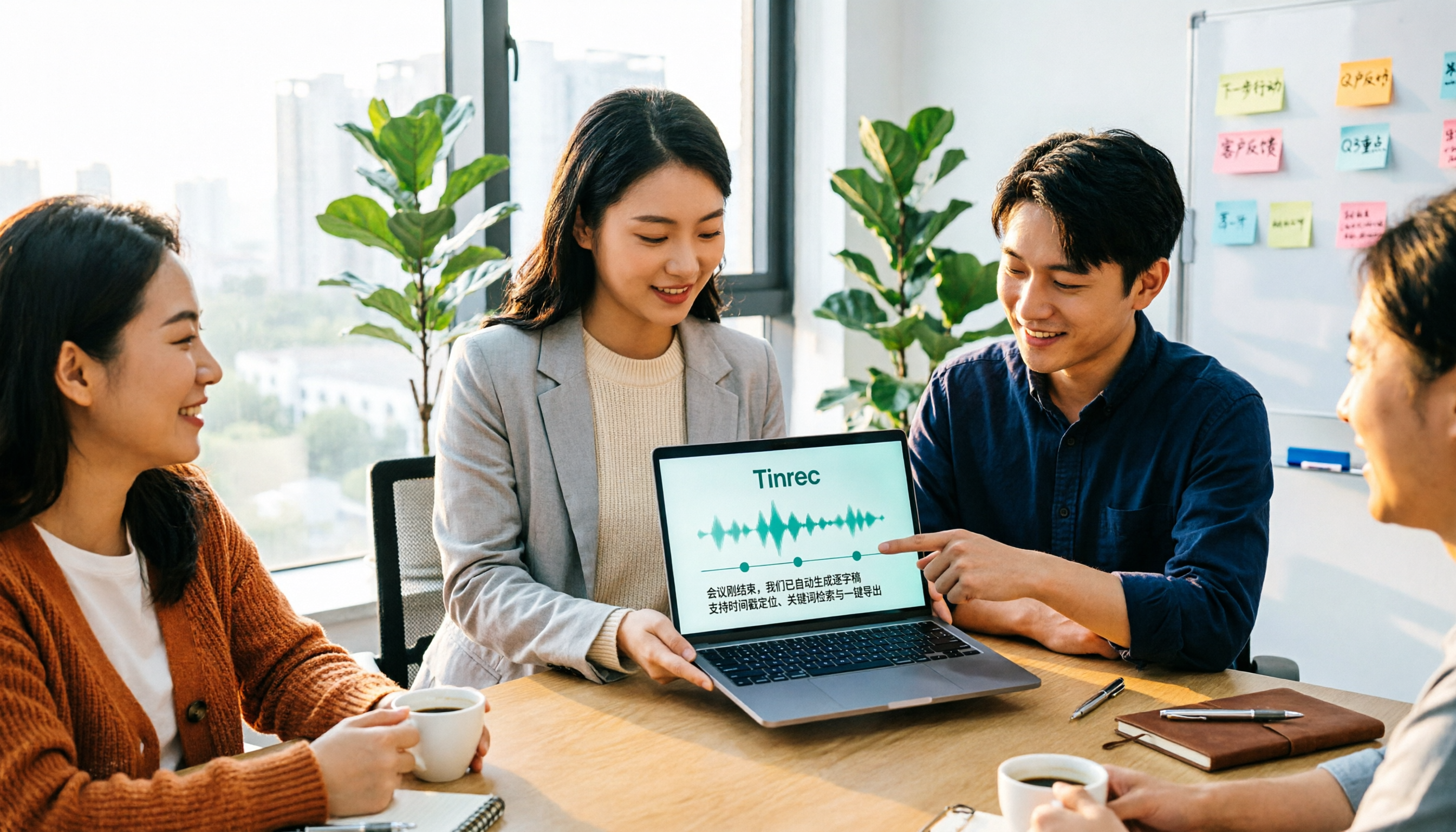
4 Live Transcription Apps Tested for 2026: Which One Actually Saves You Time After Meetings?
The real work begins after the meeting ends. This hands-on comparison of Tinrec, Notta, Otter.ai, and Granola looks at how each live transcription tool records audio, handles Chinese, organizes post-meeting notes, and supports team collaboration. We also break down four key selection criteria and common pitfalls to help you find the one that truly saves time.

The Complete Guide to Real-Time Transcription Translation in 2026: 5 Key Criteria to Choose the Right Tool and Never Miss a Point
There are many real-time transcription translation tools, but few can record and translate on the fly and still organize everything after the meeting. This guide uses 5 key criteria to help you identify your needs, compares Tinrec, Otter.ai, Notta, and Google Translate's transcription feature in terms of differences, free quotas, and limitations, and helps you choose the right tool for your meeting scenario.
How to Get Free Real-Time Online Transcription in 2026: 5-Step Guide and Why Tinrec Beats Yating Transcription
How to get free real-time online transcription in 2026? This article starts with common pitfalls, compares Tinrec and Yating Transcription in real-time recording, post-meeting organization, cross-platform support, and team collaboration, and provides a 5-step guide to using Tinrec's free version for transcripts, summaries, and action items.