
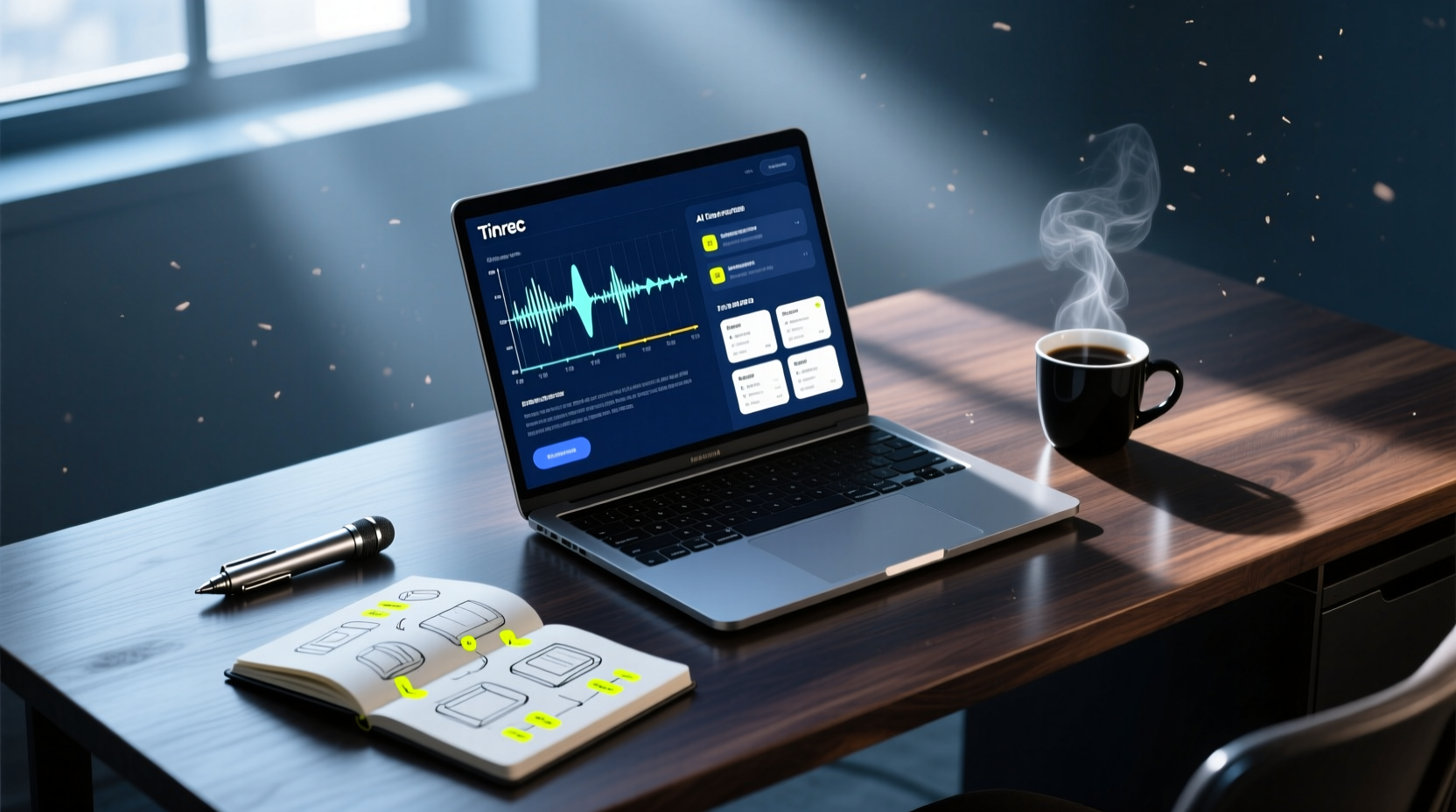
Turn recordings into transcripts and summaries in minutes
Upload audio or video for multilingual transcription, AI notes, and action items
Why Speech-to-Text Is More Than Just a Verbatim Transcript: The Real Needs of Product and R&D Teams
For product, R&D, and design teams, meetings carry critical tasks such as aligning requirements, making technical decisions, and syncing progress. With 5 to 10 requirement reviews, technical reviews, stand-ups, weekly meetings, acceptance tests, and retrospectives each week, a significant amount of time is often spent after meetings organizing meeting notes, extracting action items, and writing PRDs or retrospective documents.
The traditional approach is to manually write or type notes after the meeting based on memory, then organize them using Word, Feishu documents, or Notion. However, this method has several obvious pain points:
- There is a lot of discussion, but requirements, decisions, and responsibilities are not structured and stored.
- Action items are scattered across different people's notes or chat logs, making them easy to miss.
- Post-meeting deliverables like PRDs, action plans, or retrospective documents often have to be written from scratch, leading to repetitive work.
The true value of meeting notes is not just "recording what everyone said," but transforming discussions into "what was decided, who is responsible, when it will be completed, and what hasn't been decided yet," and making this content continuously usable and trackable.
Before Transcribing, Think Clearly: Do You Want a Verbatim Transcript or Deliverable Materials?
Before starting transcription, confirm your goal:
- Verbatim transcript: Converts speech into text exactly as spoken, suitable for occasions requiring a complete record, but you still need to organize key points and action items yourself.
- Deliverable materials: In addition to the verbatim transcript, includes summaries, chapters, action items, and can even directly generate action plans, reports, or documents.
If you just need to quickly record ideas, a verbatim transcript might be enough. But for product and R&D teams, what is usually needed after a meeting is "deliverable materials"—structured content that can be directly used to track progress, assign tasks, and even write PRDs.
Step 1: Convert Recording to Text—Real-Time Recording, Online Meeting Recording, and File Import
Tinrec supports multiple input sources, covering common meeting scenarios for product and R&D teams:
| Input Source | Applicable Scenarios | How to Use |
|---|---|---|
| Real-time recording | In-person meetings, interviews, on-site discussions | Open the Tinrec app or desktop version, click the record button to transcribe while recording |
| Online meeting recording | Online meetings on Zoom, Google Meet, Microsoft Teams, Webex, etc. | Use the desktop version to capture system audio; no need to invite a meeting bot |
| Audio/video file import | Existing recordings, historical meetings, interview recordings | Upload audio or video files, and Tinrec automatically converts them to text |
For example, in a requirement review meeting on Zoom, you only need to open the Tinrec desktop version, which directly captures the computer's system audio, without adding a bot to the meeting. By the end of the meeting, the verbatim transcript is already generated, saving the hassle of manual recording and organizing.
Step 2: Quick Proofreading and AI Organization—Summaries, Chapters, and Action Items All at Once
After transcription, Tinrec automatically generates summaries, chapters, key points, and action items, helping you quickly grasp the full picture of the meeting.
Stop organizing recordings by hand
Upload audio or video and automatically get a transcript, summary, and action items
- AI summary: Quickly understand the core content of the meeting discussion without reading the entire verbatim transcript.
- Chapters and key points: Break long meetings into easy-to-browse structures, making it convenient to locate specific topics.
- Action item extraction: Automatically organize action items from the discussion, including responsible persons and deadlines.
For example, in a technical review meeting, the discussion may cover multiple topics such as architecture solutions, resource allocation, and risk assessment. Tinrec automatically divides these into chapters and extracts a to-do list of "who completes what by when," making post-meeting tracking clear.
Step 3: Turn Action Items into Deliverable Materials—How the AI Assistant Handles Post-Meeting Work
Traditional transcription tools usually stop at summaries and action items, but Tinrec's AI assistant can use the meeting notes and context to help further process action items into deliverable post-meeting outputs.
For example, after a requirement review meeting, you may need to produce a PRD. The AI assistant can help generate a PRD draft based on the requirements, decisions, and division of labor discussed in the meeting, including sections such as background, goals, functional requirements, and acceptance criteria. You only need to confirm and supplement details, rather than starting from a blank document.
For a weekly meeting, you may need to organize an action plan. The AI assistant can convert action items into a structured action plan, including responsible persons, deadlines, and expected outcomes, making it easy to distribute to team members.
Please note that materials generated by the AI assistant are auxiliary outputs based on meeting content; important commitments, external communications, and key decisions should still be manually confirmed.
Step 4: Team Space for Storage and Collaboration—Making Meeting Materials a Team Asset
For product and R&D teams, meeting materials should not only exist on personal devices or in chat logs, but should be stored as team assets that are searchable, collaborative, and traceable. Tinrec's team edition provides a team space for centrally storing and sharing meeting materials.
Specific operation 1: Share meeting materials
After a meeting, you can save the verbatim transcript, summary, action items, and AI-generated PRD to the team space. Team members can view, play, and read these materials, allowing even those who didn't attend the meeting to quickly understand the discussion and follow-up actions.
Specific operation 2: Member collaboration and historical traceability
Materials in the team space belong to the team. New members can view historical meeting materials to understand past decisions and progress. When a member leaves or changes roles, their team resources can be transferred to other active members, ensuring materials are not lost when an individual leaves.
This way, every meeting's discussions, decisions, and action items can be recorded and tracked, forming a team knowledge base.
Important Notes: Accuracy, Manual Confirmation, and Data Security
- Accuracy is affected by multiple factors: Transcription accuracy can be affected by recording quality, background noise, accents, overlapping speech, and technical jargon. The officially claimed "98% accuracy" is typically measured in a quiet environment; in real meeting scenarios, accuracy may decrease. It is recommended to use clear recordings and cross-check important content with the verbatim transcript and audio playback.
- Manual confirmation: For summaries, action items, and documents generated by the AI assistant, important commitments, external communications, and key decisions should still be manually confirmed to ensure accuracy.
- Data security: For meetings involving sensitive information, comply with local laws and obtain consent from participants when necessary. The team edition provides team-level sharing; all active members can read team materials, and fine-grained private permissions at the file or member level are not currently supported.
With Tinrec's complete workflow, product and R&D teams can turn meeting recordings into deliverable materials and continuously store and collaborate in the team space, making every meeting a team asset.
References
- SoundType AI - Ultra-precise verbatim transcripts, speech-to-text, AI dictation
- Transcribe - Speech to Text - Free download and install on Windows | Microsoft Store
- "Speech to Text: AI Verbatim, Recording to Text, Voice Memo Real-time Translator" App - App Store
- Online AI Speech, Video, and Recording to Text - Free Trial - cSubtitle
- Speech to Text | Speech Recognition - Online Recording to Text - Recording to Text Assistant
Turn every recording into actionable outcomes
Get 60 free transcription minutes when you sign in. No credit card required.
Related Reading
You might also like

5 Best Microsoft Teams Meeting Transcription Tools in 2026: ChatGPT, Tinrec, and Built-in Transcription Compared
Still pasting Teams transcripts into ChatGPT after meetings? We compare 5 Microsoft Teams meeting transcription solutions—Tinrec, ChatGPT Record mode, Teams built-in transcription, Otter.ai, and Notta—on features, limitations, and pricing to help you find the most time-saving way to take meeting notes.
How to Translate Spotify Transcripts in 2026: 5 Methods + Bilingual Chinese Comparison
How do you translate Spotify transcripts into Traditional Chinese? This guide covers 5 practical methods: Spotify's built-in Read Along, Tinrec, AskSia, Firstory/SoundOn creator backend settings, and TurboScribe. It compares free quotas, translation capabilities, and export options, with selection advice and FAQs.
Best Notion Team Meeting Notes Tools in 2026: 4 Tested for Teams Meetings
Managing meeting notes in Notion isn't about prettier templates—it's about the half-hour spent organizing after each call. This hands-on review from a mid-level manager compares Tinrec, Otter.ai, Notta, and Granola on Teams meeting recording, Chinese transcription, summary and action items, and Notion export, plus three common pitfalls to avoid.
Best Podcast Transcript Apps? 2026 Test of 4 Apps: This One Saves the Most Time for Chinese Interviews
Recorded a podcast episode but stuck organizing the transcript? This article starts from real-world use cases, breaks down the core capabilities a podcast transcript app should have, four common application scenarios, and five purchase checkpoints. Using Tinrec's real-time transcription, AI summaries, AI Q&A, and team spaces as examples, it explains how to turn an 80-minute interview into a searchable, publishable, reusable text asset.

2026 Comparison of 4 Live Transcription Summary Tools: Which One Can Produce Trackable Action Items During Meetings?
A practical guide to live transcription summaries, covering online meetings, customer interviews, and class recordings. It explains how real-time transcription, AI summaries, action item extraction, and team knowledge retention work, using Tinrec as an example to highlight 5 things to consider when choosing a tool.
2026 Live Transcription Tools Compared: Real-Time Captions for Live Streams and Which Handles Chinese Best
People searching for "live transcription online" are usually looking for one of two things: synchronized captions while watching a live stream, or turning ongoing audio into editable text in real time. This article evaluates Tinrec, Transcribe.com, Notta, and cSubtitle based on three criteria—real-time output while speaking, usability right after the meeting, and team handoff—and summarizes hands-on impressions, free tiers, and limitations to help you decide which tool to use.
4 Live Transcription Apps Tested for 2026: Which One Actually Saves You Time After Meetings?
The real work begins after the meeting ends. This hands-on comparison of Tinrec, Notta, Otter.ai, and Granola looks at how each live transcription tool records audio, handles Chinese, organizes post-meeting notes, and supports team collaboration. We also break down four key selection criteria and common pitfalls to help you find the one that truly saves time.

The Complete Guide to Real-Time Transcription Translation in 2026: 5 Key Criteria to Choose the Right Tool and Never Miss a Point
There are many real-time transcription translation tools, but few can record and translate on the fly and still organize everything after the meeting. This guide uses 5 key criteria to help you identify your needs, compares Tinrec, Otter.ai, Notta, and Google Translate's transcription feature in terms of differences, free quotas, and limitations, and helps you choose the right tool for your meeting scenario.
How to Get Free Real-Time Online Transcription in 2026: 5-Step Guide and Why Tinrec Beats Yating Transcription
How to get free real-time online transcription in 2026? This article starts with common pitfalls, compares Tinrec and Yating Transcription in real-time recording, post-meeting organization, cross-platform support, and team collaboration, and provides a 5-step guide to using Tinrec's free version for transcripts, summaries, and action items.