
Turn recordings into transcripts and summaries in minutes
Upload audio or video for multilingual transcription, AI notes, and action items
Ever find yourself scrambling to jot down every point during a meeting, only to end up with a jumbled mess of unreadable notes?
This article breaks down the hottest AI meeting summarization tools on the market in 2026, offering detailed evaluation criteria, a comprehensive comparison table, and step-by-step tutorials from recording to extracting action items, plus an FAQ.
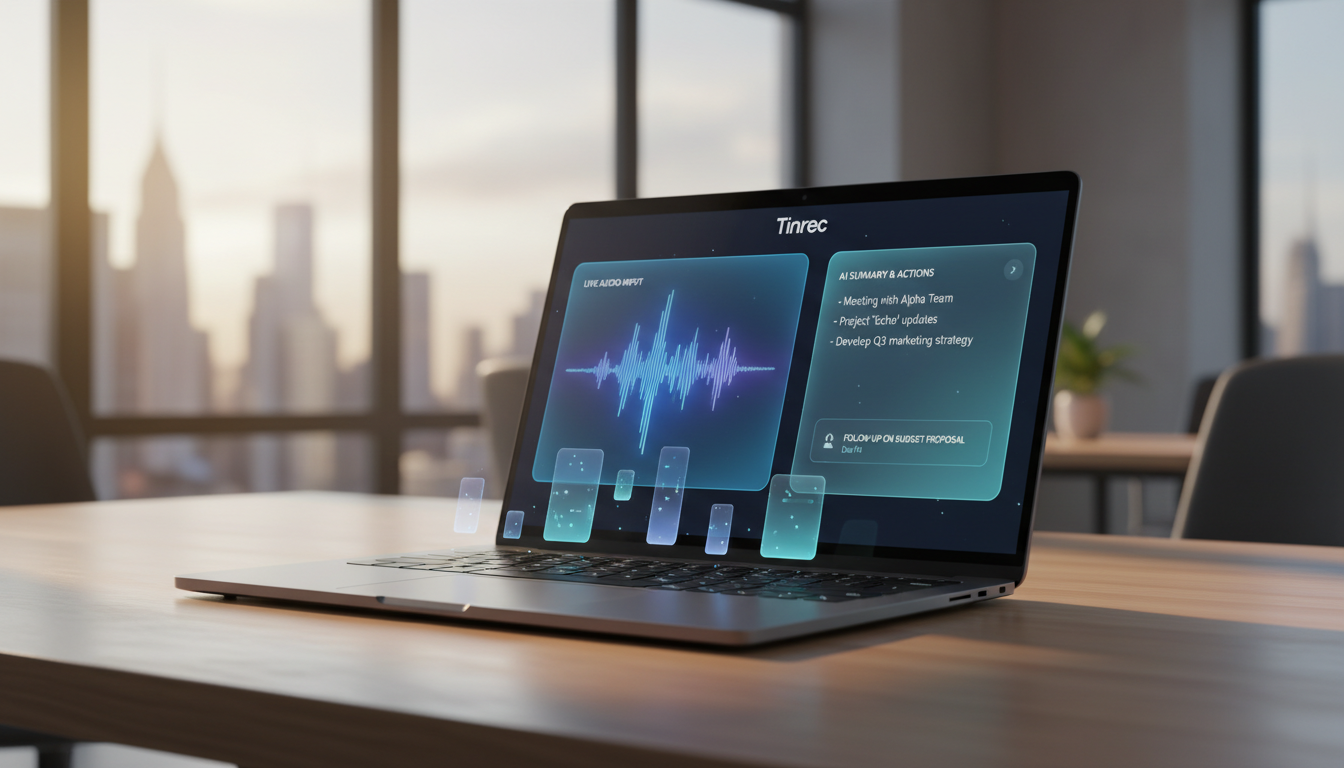
Quick selection guide: For team collaboration and topic tracking, choose Fireflies; on a budget and mainly using Zoom/Teams, go with Fathom; for English-only meetings, consider Otter.ai; if you need mobile recording, file uploads, and comprehensive analysis of online videos with multilingual support, try Tinrec as a candidate solution.
Why You Need AI to Auto-Summarize Meeting Key Points
Multitasking in meetings often means missing the perfect moment to ask a question. AI meeting assistants aren't meant to replace video conferencing software (like Zoom or Google Meet), but rather serve as an "external brain." These tools address three key pain points:
- Free your hands, focus on communication: No more typing—AI automatically converts speech to text, letting you engage fully in the conversation.
- Searchable memory, no need to replay recordings: Traditional recordings are hard to search; AI turns them into searchable text, so you can find exactly what someone said with keywords.
- Automate follow-ups: Automatically generate summaries and to-do lists, so you never forget to track important action items after the meeting.
2026 Hot AI Meeting Tools: In-Depth Comparison
We've selected the most representative tools on the market and compared them across core dimensions like language support, real-time capability, summaries, and action item extraction.
| Comparison Dimension | Tinrec (Instant Recording) | Fireflies.ai | Otter.ai | Fathom | tl;dv |
|---|---|---|---|---|---|
| Core Positioning | All-in-one recording & knowledge management | Team collaboration & topic tracking | English meetings & real-time Q&A | Free video meeting assistant | Video meeting search & tagging |
| Supported Languages | 10+ (including Chinese, Japanese, English, Cantonese, Taiwanese, etc.) | 60+ | Primarily English | 7+ | 30+ |
| AI Summaries & Action Items | Auto-generates structured meeting notes & to-dos | Requires setup & training | Auto-generates summaries | Auto-generates summaries | AI reports |
| AI Conversational Query | Supports querying single files or entire library | AskFred feature | Otter Chat | Keyword alerts only | Powerful search |
| Export & Multi-Platform Integration | Multi-platform (iOS/Android/Web) | Deep CRM & Slack integration | Group collaboration | Integrates with Notion/Docs | Integrates with major productivity tools |
| Free Tier | 100 minutes per month | Limited storage | 300 minutes per month | Free for individuals | Unlimited recording on free plan |
Key Features of Top AI Meeting Assistants
1. Fireflies.ai: Master of Collaboration & Topic Tracking
Fireflies is highly integrated and can join major video meetings as a bot.
- Pros: Powerful topic tracking that analyzes keyword trends during meetings.
- Cons: Information-heavy interface may feel overwhelming for individual users who only need simple notes.
Stop organizing recordings by hand
Upload audio or video and automatically get a transcript, summary, and action items
2. Otter.ai: The Veteran Choice for English Meetings
Otter is very popular in English-speaking countries, ideal for purely international corporate environments.
- Pros: Smooth real-time transcription in English; Otter Chat lets you ask questions and get answers during the meeting.
- Cons: Traditional Chinese recognition is relatively weak; sometimes struggles with technical terms.
3. Fathom: Best Free Starter Option
If you mainly use Zoom or Teams for video calls, this is a practical tool.
- Pros: Free personal plan with no strict recording limits; generated summaries are well-formatted and easy to copy without messing up.
- Cons: Focused on video meetings; limited support for in-person meetings.
4. Tinrec (Instant Recording): All-Rounder for Every Scenario
Unlike tools that rely solely on video bots, Tinrec is designed as a comprehensive voice knowledge base, focusing on the complete workflow from recording to understanding to action.
- Pros: Supports iOS, Android, and web with multi-device syncing—great for in-person meetings and mobile work; exclusive video-to-text feature that generates summaries from online video links; auto-recognizes 10 languages including Chinese and Taiwanese.
- Cons: Free users get 100 minutes per month; heavy users with daily meetings may need to consider a paid plan.
Hands-On Tutorial: Using AI to Quickly Produce Meeting Key Points & Action Lists
Once you've chosen your tool, how do you integrate it into your daily workflow? Using Tinrec (which supports a wide range of scenarios) as an example, here are standard operating steps for four core contexts:
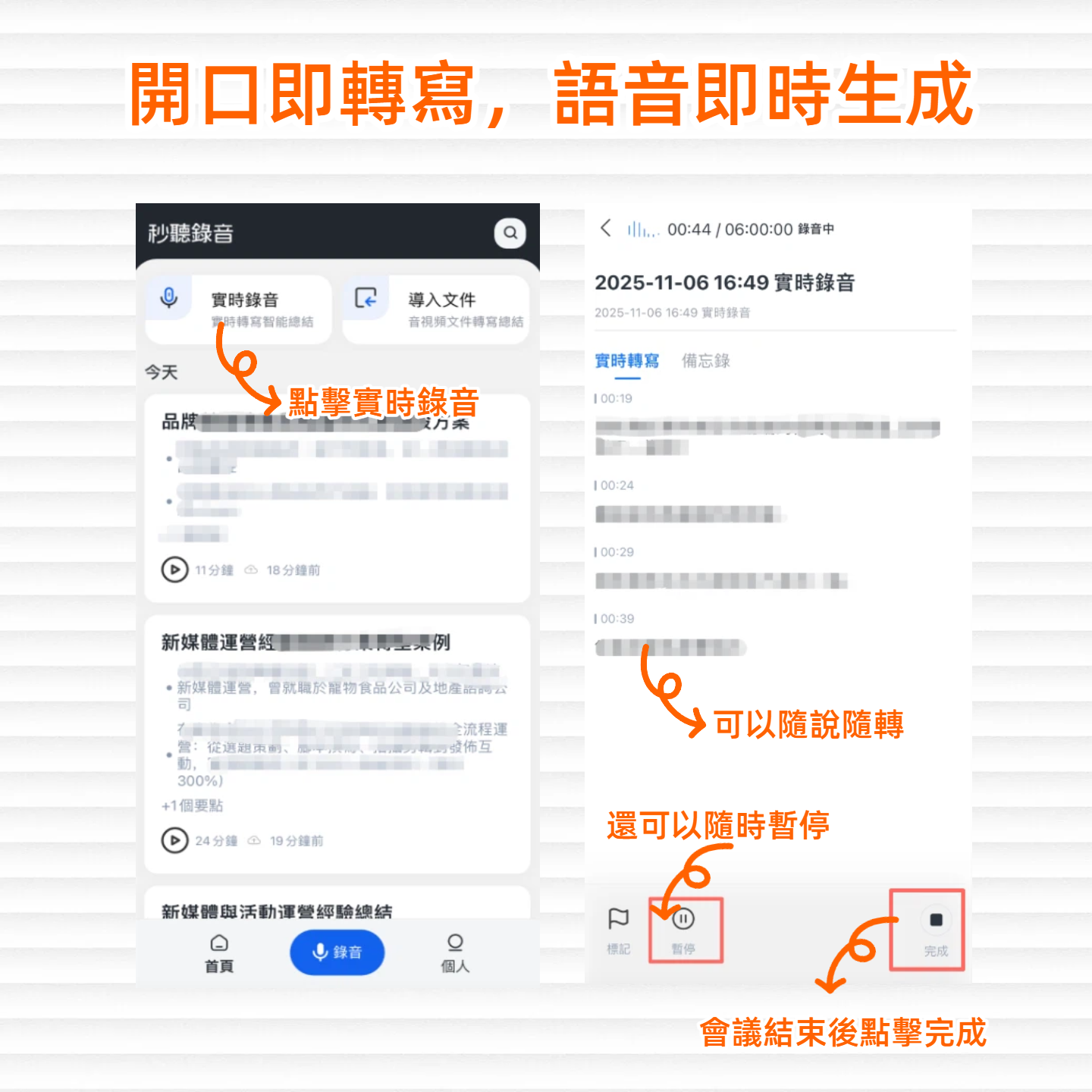
Step 1: Real-Time Transcription for In-Person Meetings
When you're in a physical brainstorming session, simply open the web version or mobile app's live recording feature. The system transcribes speech in real time, letting you grasp the content immediately, and automatically distinguishes different speakers after the meeting.
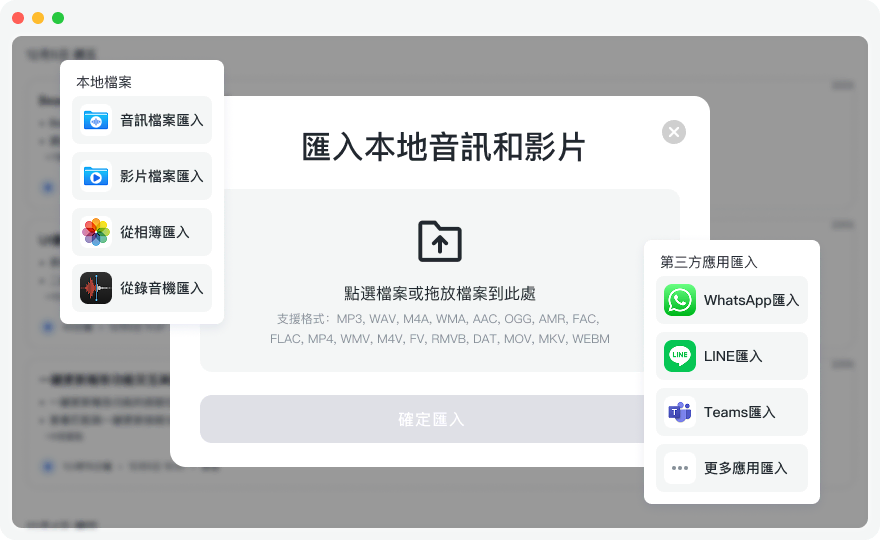
Step 2: Import Audio Files for Transcripts & Summaries
If you have past interview recordings, use the audio-to-text feature. Upload the file, and AI will generate a transcript within minutes, along with automatically organized meeting notes and to-do lists.

Step 3: Analyze Online Video Links to Extract Key Points
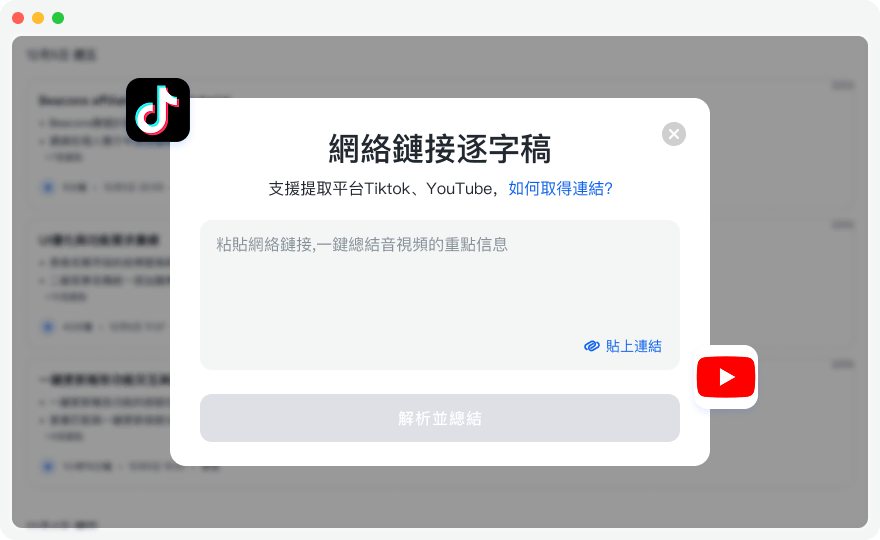
Need to summarize a long online course or competitive analysis video? Navigate to the video-to-text section, paste the URL (e.g., from YouTube), and AI will quickly parse it and produce structured highlights—saving you the time of rewatching long videos.
Step 4: Query Key Information via AI Chat
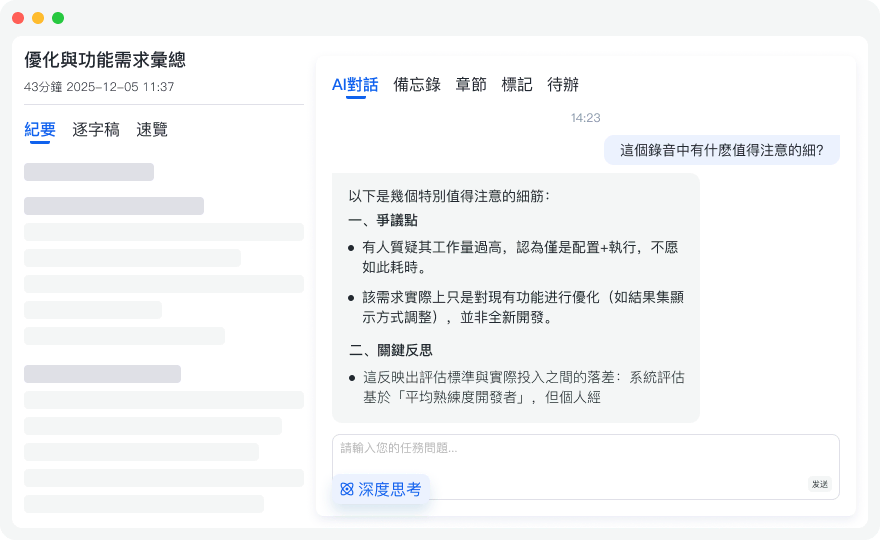
Traditional transcripts only allow Ctrl+F keyword searches. Now, use the AI chat query feature. Ask something like "What was the conclusion about the marketing budget in this meeting?" and the system will accurately answer based on the recording's semantics, drastically cutting down retrieval time.
FAQ About AI Meeting Summarization
Q1: How accurate is the Traditional Chinese transcription?
Current AI speech models have very high accuracy for Chinese, typically over 95%. If the meeting mixes Taiwanese or other languages, choosing a tool that supports multilingual recognition further ensures transcript accuracy.
Q2: Are there security concerns with these AI meeting tools?
Most enterprise-grade tools comply with security standards like SOC2 and offer data encryption. Check the privacy policy to confirm data storage and deletion permissions.
Q3: Are there limitations on iPhone recording? How do I record meetings?
Due to iOS privacy restrictions, third-party apps cannot directly record system phone calls. However, for video calls where audio is played through speakers (e.g., computer on Meet with phone recording nearby) or in-person meetings, using the mobile app for recording is fully feasible.
Q4: Can these tools completely replace human meeting notes?
AI is an excellent "draft generator." It captures full conversation details and extracts action items, but final decision logic sometimes requires human review. The optimal workflow: AI generates summary → human quickly polishes → publish meeting notes.
Q5: Which AI tool do you recommend for all-English meetings?
In purely English environments, Otter.ai and Fireflies.ai offer excellent recognition and responsiveness. If the meeting includes Asian languages like Chinese, Japanese, or Taiwanese, prioritize solutions optimized for multilingual support.
Q6: Do speech-to-text and auto-summarization features require payment?
Most tools on the market use subscription or per-minute pricing. For example, Fathom offers a free basic version, and Tinrec provides 100 free minutes per month—suitable for light users to test. For long-term heavy use and advanced chat queries, consider paid plans to boost efficiency.
Turn every recording into actionable outcomes
Get 60 free transcription minutes when you sign in. No credit card required.
Related Reading
You might also like

5 Best AI Meeting Recorders Tested in 2026: Which One Works Best for Chinese Meetings and Team Collaboration?
Struggling with meeting notes and post-meeting cleanup? This hands-on comparison of 5 AI meeting note tools, led by Tinrec, covers bot-free recording, Chinese transcription, AI summaries, and team collaboration to help you decide which one is worth it.

2026 Tinrec Smart Meeting Minutes Review: Cantonese Transcription, AI Auto-Generated To-Dos
Tired of spending hours after meetings transcribing recordings? We tested Tinrec, a smart meeting minutes app that uses AI to save you overtime. It supports Cantonese transcription, auto-generates to-dos, and can record online meetings without a bot.

2026 Smart Meeting Minutes Tools Compared: Hands-On Test of 5, Why Tinrec Is Our Top Pick
Spending two hours in a meeting and another two hours writing up the minutes? This article evaluates Tinrec, Otter.ai, Notta, PLAUD Note, and others based on practical criteria like bot-free recording, Chinese transcription, AI post-processing, and team collaboration, to tell you which one is most worth using.

The Complete Guide to AI Meeting Notes Apps in 2026: Auto-Generated Summaries, Action Items, and Team Collaboration
This guide starts by addressing common pitfalls, helps you understand the key factors in choosing an AI meeting notes app, and shares hands-on experience with Tinrec (秒听录音) on how it uses bot-free recording, AI summaries, and team collaboration to save you time after meetings.

2026 Review of 5 Online AI Meeting Minutes Tools: Which Free Version Is Most Useful?
This hands-on comparison, focusing on Tinrec, breaks down the core features, real-world use cases, buying considerations, and FAQs of online AI meeting minutes software to help you decide if the free version is sufficient.
What Is AI Meeting Minutes in 2026? A 4-Step Comparison of Tinrec vs. Otter
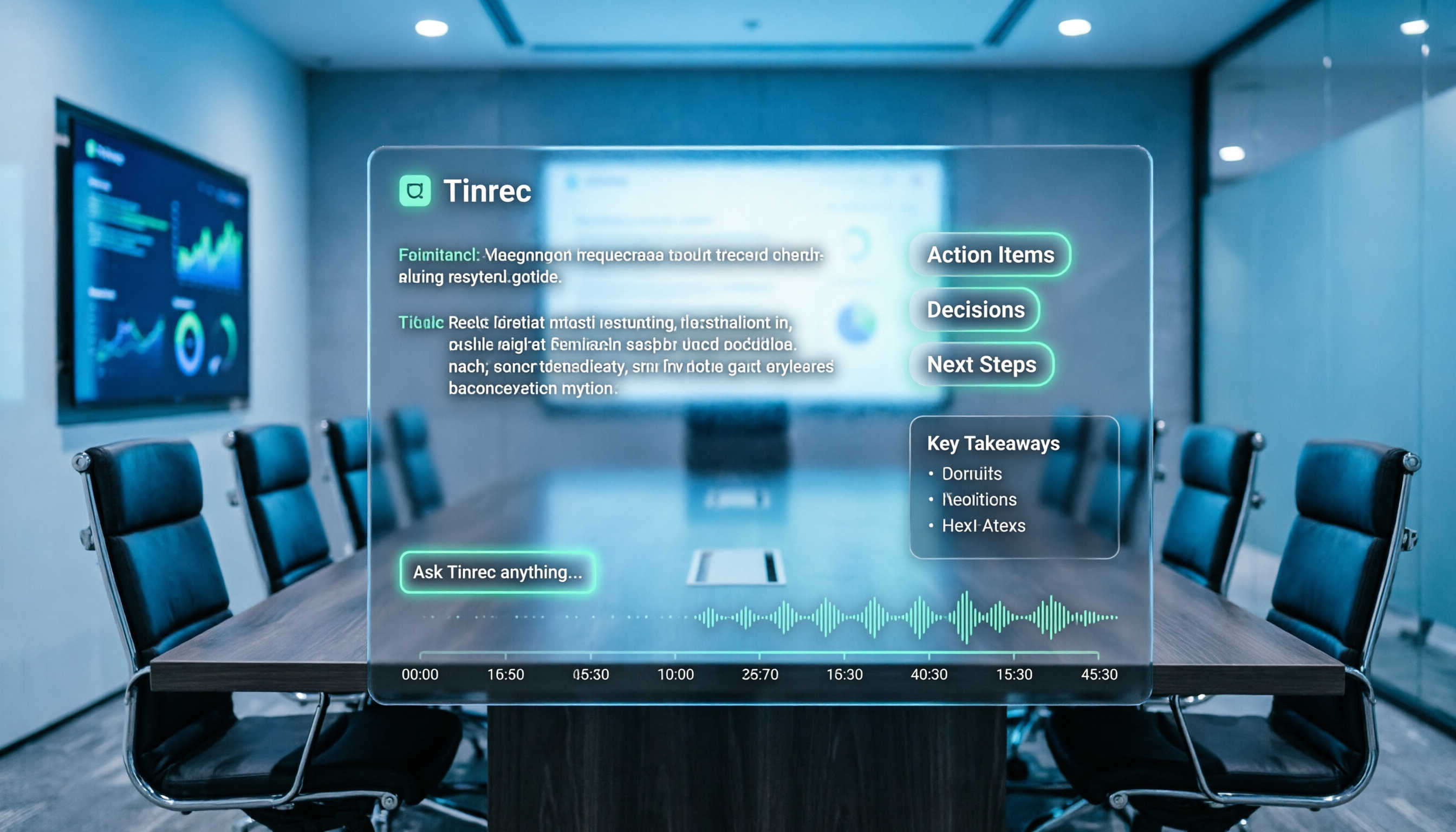
AI meeting minutes go beyond speech-to-text, turning meetings into searchable, queryable, and collaborative assets. This article compares Tinrec and Otter across four key dimensions to help you understand the core features of AI meeting minutes and choose the right AI meeting tool for your needs.
5 Best AI Meeting Note Apps Tested in 2026: No-Bot Recording, Chinese Meetings & Team Collaboration
Tired of manually writing meeting minutes? This article tests Tinrec (秒听录音) as the main focus, covering no-bot recording, Chinese meeting transcription, AI summaries, and team collaboration. It provides buying tips and FAQs to help you find a truly time-saving AI meeting notes tool.
How to Create Smart Meeting Minutes in 2026: 5 Steps to Choose the Right Software for Automatic Transcripts and Summaries
A practical guide for mid-level managers and professionals on using AI meeting minutes software to automatically generate transcripts, summaries, and action items. It highlights hands-on testing of Tinrec (秒听录音), briefly reviews Notta, Otter.ai, and Plaud Note, and offers tips to avoid common pitfalls and make the right choice.
2026 Smart Meeting Recorder Alternatives: 5 Tested Advantages of Tinrec
Still considering buying a smart meeting recorder? This article tests Tinrec, an AI meeting notes tool, comparing it with hardware voice recorders. From bot-free online meeting recording, AI summaries, team collaboration to cost, find out why a software solution is better for most office workers.