
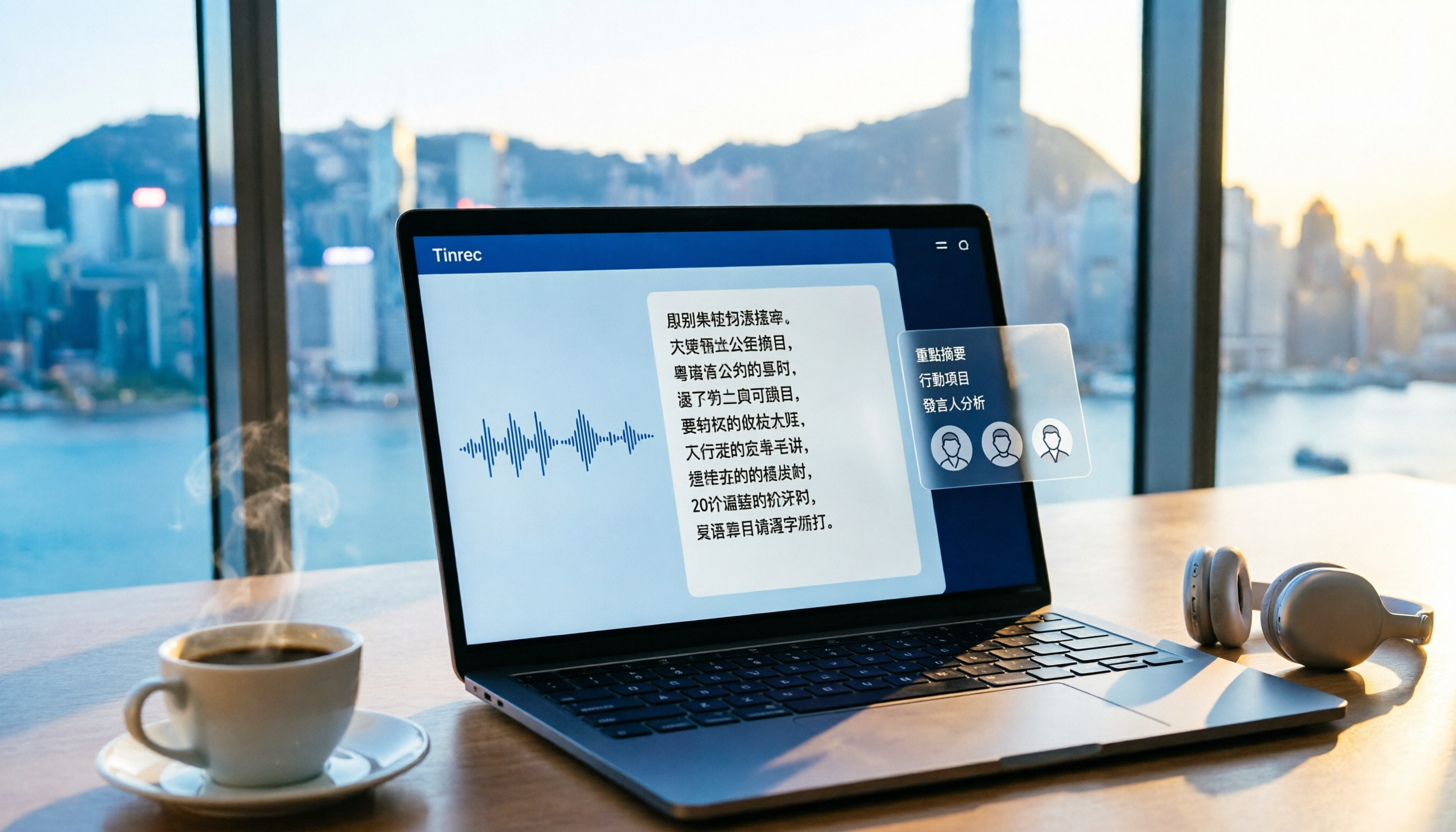
Turn recordings into transcripts and summaries in minutes
Upload audio or video for multilingual transcription, AI notes, and action items
2026 AI Speech-to-Text Buying Guide: Save Time and Stop Working Overtime on Transcripts
If you're like me, spending your days in back-to-back office meetings, the worst part isn't the meeting itself—it's the hour or two of listening to recordings afterward to type up meeting minutes. I've tried several speech-to-text tools, and I've been burned more often than not. This time, I'm using Tinrec as an example to explain how to choose the right one.
What Can Speech-to-Text Do for You?
It's not complicated—it simply saves you the time spent transcribing recordings. Here are some scenarios that office workers will definitely recognize.
Scenario 1: Meeting Minutes Ready 5 Minutes After the Meeting Ends Previously, after a two-hour meeting, you might spend another hour organizing the minutes. With AI tools like Tinrec, summaries, conclusions, and action items are automatically generated the moment the meeting ends. You can see at a glance who is responsible for what and when it's due.
Scenario 2: Client Interviews Without Frantic Note-Taking The worst part of meeting clients is scribbling notes and then forgetting what they said once you're back at the office. Tinrec transcribes in real time as it records, so you can focus on the conversation. Back at the office, you can simply ask the AI, "What issues does the client care about most?" and get an instant answer.
Scenario 3: No Need to Add a Bot to Online Meetings When using Zoom, Google Meet, or Teams, the last thing you want is an awkward bot joining the meeting. Tinrec's desktop app captures your computer's system audio directly, so you can transcribe the entire online meeting without adding any extra participant.
Scenario 4: Organizing Historical Recordings and Course Content Those old recordings and lecture files you've been meaning to organize? With Tinrec, you can upload audio or video files and have them transcribed in minutes, with chapters and key points automatically segmented.
What Are the Core Capabilities of Speech-to-Text Tools?
Before choosing a tool, you need to know what features these products should have. Here's a breakdown using Tinrec as an example.
Real-Time Transcription: Text as You Record It's not about transcribing after the fact—it's about generating text while you record. Tinrec's real-time transcription has very low latency, so you can watch the text sync during the meeting to make sure nothing important is missed, rather than discovering issues after the meeting ends.
AI Summaries and Chapters: No Need to Listen to the Entire Recording This feature is crucial. Tinrec doesn't just give you a massive block of text; it automatically organizes meeting topics, discussion conclusions, and action items, and splits long meetings into chapters so you can jump straight to the section you need.
AI Q&A: Ask for the Key Points Directly After transcription, you can ask Tinrec questions like, "Who mentioned the budget in the meeting?" or "What complaints did the client have?" It uses semantic understanding to answer directly, saving you from manually searching through the text. This feature is a lifesaver for anyone who frequently needs to review past meeting records.
Multi-Format Export: Bring Meeting Results into Your Daily Workflow It's not just about viewing the text. Tinrec supports exporting transcripts, summaries, and action items to tools like Notion, Google Docs, OneNote, and Dropbox, making it easy to create reports, archive, or follow up with your team.
Real-Time Translation: A Great Help for Cross-Language Meetings If you regularly meet with international clients, Tinrec's real-time translation lets you view the original text, translated text, or a bilingual comparison during recording, so you never miss a key point.
Practical Use Cases: How Tinrec Fits into Your Daily Work
Meeting Minutes: From "Typing While Listening" to "Reviewing" Previously, you'd spend an hour after a meeting listening to the recording and typing up minutes. With Tinrec, you get text instantly after recording, so you only need to do a quick review and then assign the AI-generated action items to your colleagues. The whole process shrinks from an hour to about ten minutes.
Stop organizing recordings by hand
Upload audio or video and automatically get a transcript, summary, and action items
Client Interviews: No More Relying on Memory for Reports Record client meetings with Tinrec, and when you're back at the office, use the AI Q&A feature to find specific client requirements, objections, and commitments. Then use the Agent post-processing feature to generate reports or tables to submit directly to your supervisor.
Classes and Lectures: Turning Knowledge into a Lasting Resource Record lectures or talks with Tinrec, and it will automatically generate chapters and key points, and even create mind maps. When you need to review, just ask the AI instead of listening to the entire recording again.
Team Collaboration: Meeting Materials No Longer Scattered If you're a manager or project lead, Tinrec's team version centralizes all meeting materials in a shared team space. New members can instantly access historical meetings, and when someone leaves, the data stays with the team. Admins can also monitor usage, manage seats, and review audit logs.
5 Things to Watch Out for When Choosing a Speech-to-Text Tool
1. Support for Cantonese and Traditional Chinese This is the most common pitfall for users in Hong Kong. Many tools focus on English or Mandarin, with inconsistent Cantonese recognition. Tinrec covers Chinese, Traditional Chinese, and multilingual meeting scenarios, and supports team-specific vocabulary to maintain your company's terminology and improve recognition of professional terms.
2. Can You Organize the Transcription? Transcription is just the first step. The real key is whether the tool offers AI summaries, action item extraction, and Q&A features. Tinrec doesn't just produce a transcript; it automatically organizes it into actionable work materials.
3. How Does It Handle Online Meetings? Some tools require you to add a bot to the meeting, which is awkward and may raise privacy concerns. Tinrec's desktop app captures your computer's system audio directly, so no extra participant is needed—a crucial design for anyone who frequently attends online meetings.
4. Is There Enough Capacity for Team Use? If you need to use it with colleagues, look for features like team spaces, member management, and usage analytics. Tinrec's team version supports role and seat management, and meeting data belongs to the team, so it won't be lost when a member leaves.
5. Is the Free Plan Worth Trying? Don't pay upfront. Tinrec's free version includes basic credits to experience recording, importing, summarization, and transcription. We recommend testing it with your own recordings to see the results before considering an upgrade.
Frequently Asked Questions
Q: What's the difference between Tinrec and a regular recording app? A regular recording app only captures audio. Tinrec goes further by transcribing the recording into text, organizing summaries, chapters, key points, and action items, and supporting AI Q&A, translation, export, and team collaboration.
Q: Does Tinrec support Cantonese? Tinrec covers Chinese, Traditional Chinese, and multilingual meeting scenarios. Actual performance may vary based on audio quality, accents, background noise, overlapping speech, and technical jargon. We recommend trying the free version with your own recordings to see how it works for you.
Q: Do I need to add a bot to online meetings? No. Tinrec's desktop app captures your computer's system audio directly, handling audio from platforms like Zoom, Google Meet, Microsoft Teams, and Webex without requiring an extra bot participant.
Q: What's the difference between the team and personal versions? The personal version keeps data under your individual account. The team version provides a dedicated team space where meeting data belongs to the team, and adds features like member, role, seat, shared access, usage analytics, audit logs, and a recycle bin.
Q: Is speech-to-text 100% accurate? No tool can guarantee 100% accuracy. Tinrec can significantly reduce the cost of manual transcription and organization, but for critical content, we recommend cross-referencing with the transcript's timestamps and the original recording.
Conclusion
AI speech-to-text is no longer futuristic technology—it's a practical tool you can use right now. If you have more than three meetings a week or frequently handle recordings and interviews, choosing the right tool is essential. Tinrec's free version includes basic credits, so you can test it with your own recordings and experience what it's like to have meeting notes ready instantly—no more overtime transcribing, just head home on time.
References
- Tested: 4 Best Online Speech-to-Text Tools Recommended, Free Instant Audio-to-Text Transcription
- AI Speech-to-Text Tools Recommended: 8 Compared, Which Is Best for Meeting Minutes, Transcripts, and Voice Input? — Leading Era
- [AI Voice Notes] 5 Highly Recommended AI-to-Text Tools! Generate Transcripts and Meeting Minutes, Free vs. Subscription, Pros and Cons Compared | 104 Career Force
- Anytime! 3 Free AI Transcript Tools, Highly Recommended! AI Voice Notes Generate Meeting Minutes, Presentations, and Mind Maps | 104 Career Force
- Online AI Speech, Video, and Audio Auto-Transcription - Free Trial - cSubtitle
Turn every recording into actionable outcomes
Get 60 free transcription minutes when you sign in. No credit card required.
Related Reading
You might also like

2026 AI Meeting Transcription Cost Comparison: Tinrec vs Yating – Which Is More Cost-Effective?
This article focuses on cost as the decision factor, comparing Tinrec and Yating across five dimensions: pricing model, meeting capture, post-meeting organization, Chinese and mixed Chinese-English support, and team collaboration. It includes third-party data on Yating's NT$100 per hour rate, Tinrec's personal and team plan pricing, and provides a checklist to help you choose based on your meeting frequency.

2026 AI Meeting Recorder Comparison: Which Free Version Is Good Enough?
We compare the free versions of Tinrec, Otter.ai, Notta, and PLAUD across free quotas, online meeting recording, post-meeting summaries, and team collaboration to help US office workers choose the right AI meeting recorder.

2026 AI Meeting Notes Tools Compared: 4 Picks Tested with 3-Part Summary & Action Item Examples
How do you use AI for meeting notes? This article demonstrates a 3-part summary and What/Who/When action item template using a real weekly meeting, includes a copy-paste prompt template, and compares Tinrec, Notta, Otter.ai, and Granola on Chinese meetings, bot-free recording, and post-meeting organization to help you choose the right tool for your team.

2026 AI Meeting Notes Tools Tested: Tinrec, Notta, Otter.ai, PLAUD Note Review & Free Plan Verdict
We tested Tinrec, Notta, Otter.ai, and PLAUD Note with a real Chinese weekly meeting recording, comparing transcripts, summaries, and action items. Includes an AI meeting notes example and guidance on free plan limits, Chinese recognition, and team seat management to help you choose the right tool for your meeting style.

2026 AI Meeting Recorder App Review: Bot-Free Recording + Post-Meeting AI Q&A
After testing several AI meeting recorder apps, we found that what really makes people give up isn't transcription accuracy—it's not being able to find key points after the meeting, needing to add a bot to online meetings, and team data not staying with the team. This article breaks down 4 key buying criteria, tests Tinrec's bot-free desktop recording, real-time transcription, and AI Q&A, compares Granola, PLAUD, and Otter.ai for different use cases, and includes 4 common pitfalls to avoid.

Tinrec vs PLAUD Note in 2026: 5 Criteria for AI Meeting Notes, Which Is Better for Chinese-Speaking Teams?
Most people evaluate AI meeting note tools based only on free minutes and transcription accuracy, then end up with a tool they stop using. This comparison uses 5 criteria that truly affect long-term usability—meeting capture, post-transcription organization, Chinese and cross-language support, team knowledge retention and governance, and cost structure—to compare Tinrec and PLAUD Note/NotePin, with an FAQ to help you decide which fits your meeting style.

Best AI Meeting Notes Tools in 2026: Hands-On Test of Tinrec vs. Notta for Chinese Transcripts and Post-Meeting Workflows
Meeting over at 5:30 PM, recording is 1 hour 42 minutes, and minutes are due at 9 AM tomorrow: who decided what, which three action items to track, and who owns them. This article breaks AI meeting notes and transcript organization into an actionable workflow, comparing Tinrec and Notta across five dimensions—transcription accuracy, meeting recording methods, post-meeting organization, team governance, and pricing structure—to help you choose the tool that best fits your meeting style.

2026 AI Meeting Notes Free Plan Comparison: Chinese Transcription + Post-Meeting AI Q&A
How to choose a free AI meeting notes tool in 2026? We break down 5 key points—free quota, recording method, post-meeting organization, and team collaboration—and compare the free plans, pricing, and limitations of Tinrec, Otter.ai, Notta, and PLAUD to help you find the one that truly fits your needs.

How to Use AI for Meeting Notes in 2026: A 5-Step Recording Tutorial
Juggling a dozen meetings a week is one thing—organizing the aftermath is the real nightmare. This guide starts with the critical decision of which recording entry point to use, then walks through 5 steps to turn meeting recordings into transcripts, summaries, action items, and queryable team data. It also honestly covers tool limitations and how to choose the right plan.