
Turn recordings into transcripts and summaries in minutes
Upload audio or video for multilingual transcription, AI notes, and action items
Long 40-minute YouTube tutorials or in-depth interviews often contain high-value information, but when you only need the key points, repeatedly scrubbing the timeline and manually typing notes is painful. Especially with foreign-language content, lack of captions, or limited free credits, productivity takes a major hit.
To help creators, students, and professionals save time, this article provides an in-depth review of the 6 most promising YouTube video-to-text and summary tools in 2026. We compare them across multiple dimensions: language support, real-time capability, summary generation, AI querying, export options, and pricing. A complete comparison table and practical step-by-step tutorials with FAQs are included.
Quick Navigation Tips:
- If you only need to quickly preview key points in your browser → prioritize Eightify or YouTube Summary extensions.
- If you need to handle extra-long lectures and require multi-language translation → check out NoteGPT.
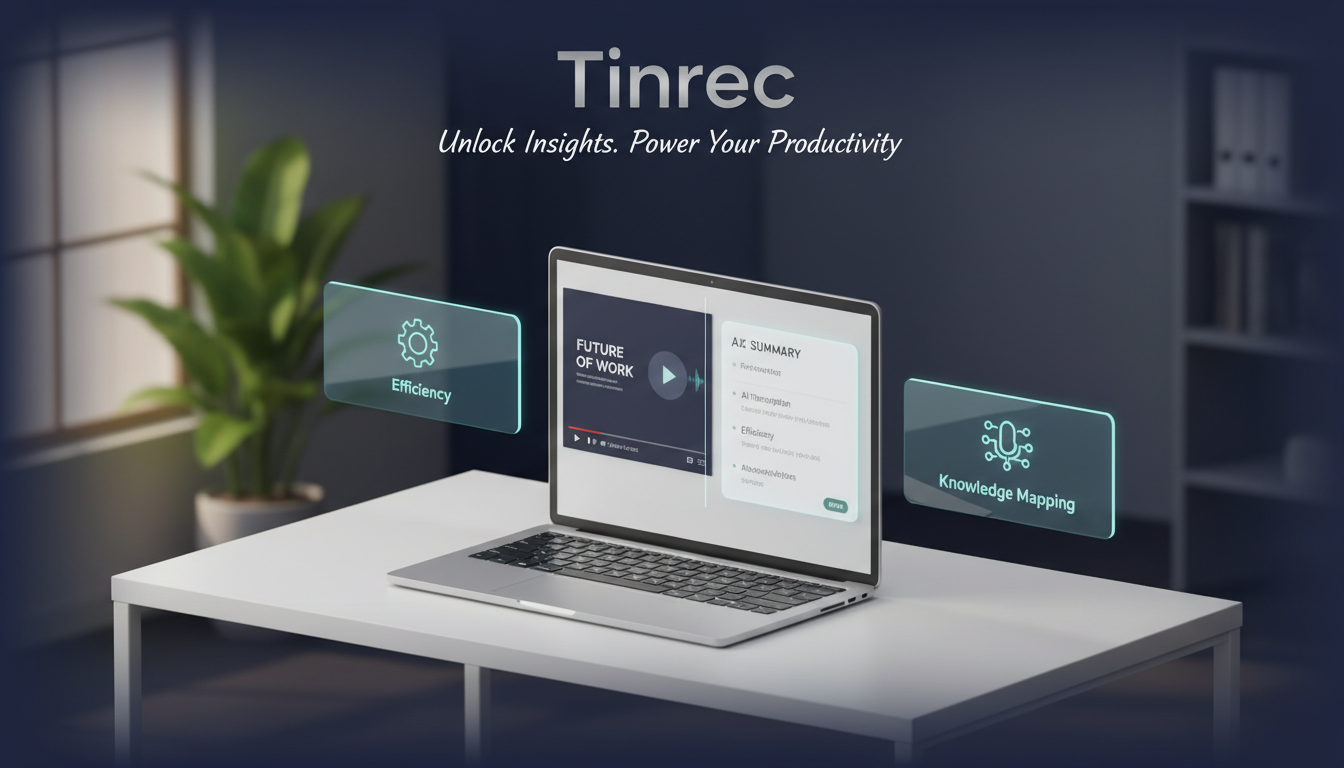
- If you value a complete "recording-to-action" workflow and need cross-platform AI note-taking → Tinrec is a strong primary candidate.
Why Do You Need YouTube Video-to-Text Summary Tools?
Traditional video learning and data collection have several fatal flaws:
- Low information density: Human speech is typically slower than reading speed. A 1-hour video may contain only 10 minutes of core content.
- High cost of re-listening: When you forget where a specific concept appears in a video, traditional tools force you to blindly scrub the timeline—unlike text documents that allow quick searching.
- Lack of action conversion: Most people finish watching a video without concrete conclusions or action items, making knowledge hard to apply.
Modern AI video summary tools no longer just provide "transcripts"; they automatically generate chapter structures, extract key decisions and action items, transforming "time-based content" into "scanable, searchable, and actionable text."
Comparison & Recommendations for Top YouTube Video-to-Text Summary Tools in 2026
The video summary tools on the market vary by use case. Below are 6 mainstream and promising tools compared in depth:
1. Eightify – Best for Quick Browser Preview
- Features & Target Users: Eightify is a popular Chrome extension that generates timestamped summaries directly on YouTube pages. Ideal for casual learners or professionals comparing multiple SaaS product demo videos.
- Pros: Extremely fast, no need to leave YouTube interface, clear timeline list.
- Cons: Heavily relies on the video having clear captions; less suitable for deep research requiring a long-term knowledge base.
2. Notta – Versatile Transcription for Meetings & Classes
- Features & Target Users: Notta offers a dedicated YouTube summary tool and extension, supporting 50+ languages. Suitable for students or sales teams who handle meetings, classroom recordings, and videos.
- Pros: Strong mixed content processing, business-meeting-oriented interface, multi-language and compliance support.
- Cons: Interface may be too business-focused for pure video creators; free version offers limited video credits.
3. NoteGPT (NoteLLM) – Designed for Long Videos & Batch Processing
- Features & Target Users: Focuses on long videos up to 150 minutes (even without captions) and supports batch summarization of up to 20 videos. Perfect for researchers and students who binge-watch conference talks or online courses.
- Pros: Batch processing saves significant time; supports 60+ language translation.
- Cons: Web-based, with a tool-oriented interface lacking refined productivity app experience.
4. YouTube Summary with ChatGPT & Claude – Lightweight Extension
- Features & Target Users: This free Chrome extension adds a summary panel next to videos and can one-click send transcripts to ChatGPT, Claude, or Gemini. Suitable for knowledge workers already heavily reliant on these LLMs.
- Pros: Extremely lightweight, free installation, acts as a front-end tool for existing AI accounts.
- Cons: Summary quality depends entirely on the connected model and prompts; no built-in document management.
5. Liminary.io – Knowledge Base Companion for Deep Research
- Features & Target Users: Positioned as an AI knowledge companion, it goes beyond one-time summarization by storing YouTube videos, PDFs, and web articles into a personal structured knowledge base—ideal for researchers and consultants needing deep synthesis.
- Pros: Builds a personal knowledge graph; when writing, it acts as an AI thinking partner that automatically recommends relevant video summaries.
- Cons: Early-stage product; requires time to establish long-term knowledge base habits; not for users wanting just quick one-off summaries.
Stop organizing recordings by hand
Upload audio or video and automatically get a transcript, summary, and action items
6. Tinrec (秒聽錄音) – Focused on "Understanding & Action" Full Workflow
- Features & Target Users: Unlike single-point transcription extensions, Tinrec offers iOS, Android, and web support. It features automatic recognition of 10 languages (including Chinese, Taiwanese, etc.), converting YouTube links, podcasts, or live recordings into transcripts, and automatically generating meeting minutes and action items.
- Pros: "AI Chat Query" function allows you to ask questions conversationally instead of just Ctrl+F for keywords. Monthly free 100 minutes. Suitable for student notes, international meetings, and creator script organization.
- Cons: For heavy processing of very long audio, you need to upgrade to a paid plan (e.g., Pro with 1200 minutes/month).
Comparison Table of the 6 Core Tools
| Dimension | Language Support | Summary & Action Item Generation | Video/Audio Parsing | AI Chat & Query | Price & Free Credits |
|---|---|---|---|---|---|
| Eightify | Depends on connected model | Timestamped list summary | Browser extension only | No | Free limited/paid unlock |
| Notta | 50+ languages | Supports chapters & action items | Supports URL & recording transcription | Some higher plans support | Free version limited/upgrade needed |
| NoteGPT | 60+ languages | Supports very long video extraction | Supports up to 150 minutes | Yes | Free basic plan available |
| YouTube Summary | Depends on backend LLM | Requires custom prompts | Lightweight video parsing | Redirects to ChatGPT etc. | Extension free; need own API |
| Liminary.io | Varies by system | Deep knowledge linking & summary | Supports multiple source imports | Knowledge base semantic chat | Early access/contact for pricing |
| Tinrec | 10 languages auto-recognition | Auto-generates key points & to-do list | Supports YouTube/podcast/local files | Supports recording-based smart Q&A | Free 100 minutes/month |
Practical Tutorial: How to Instantly Convert Video into Efficient Notes
After understanding each tool's features, we use a multi-platform workflow tool (like Tinrec) as an example to demonstrate four common scenarios, helping you put the tool into daily use.
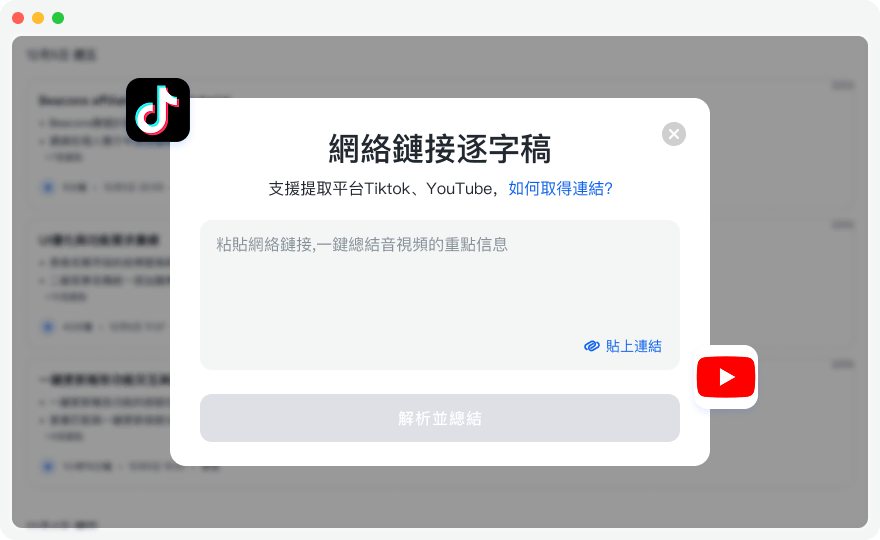
Step 1: Parsing Online Videos & Podcast Links
When you see a lengthy YouTube knowledge video on your phone or computer:
- Copy the URL of the YouTube video or podcast.
- Navigate to the "Video to Text" or "Web Parsing" feature.
- Paste the URL; the system automatically extracts audio and converts it to a transcript.
- Click "AI Summary" to quickly extract the video's core conclusions and suggested action items.
Step 2: Live Recording to Text (Ideal for Classes or In-Person Meetings)
If you're watching a live stream without a link, or attending a physical class:
- Open the "Live Recording" feature on the mobile app or web.
- Tap record; the tool converts speech to text in real-time—no need to wait until the end.
- Once the meeting or video ends, you get an immediate full transcript and key points summary.
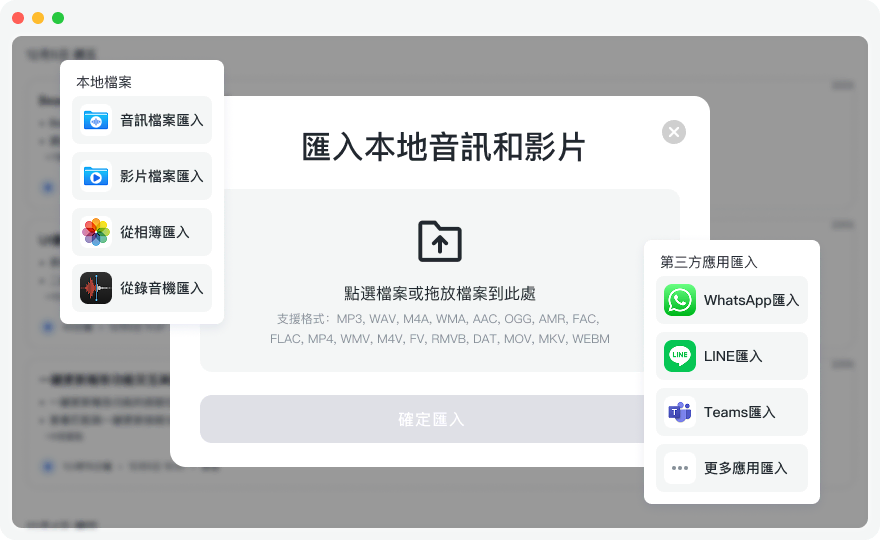
Step 3: Import Local Audio or Video Files for Transcription
If you've already downloaded a Zoom recording or an interview MP3 file:
- Go to the "Audio File to Text" page.
- Supports uploading various mainstream media formats (e.g., MP4, MP3, WAV).
- The system can automatically distinguish different speakers, turning chaotic discussions into clear dialogue records.
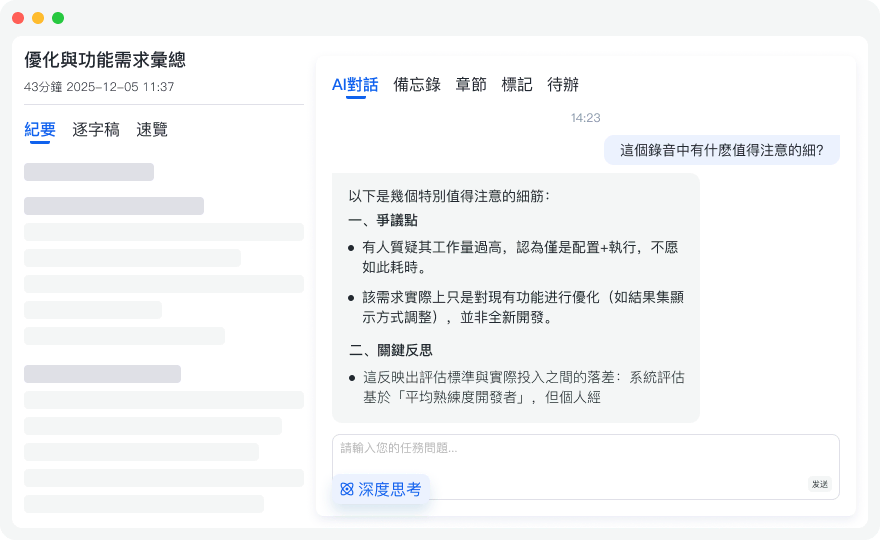
Step 4: Use AI Chat Query to Dive Deeper into Key Points
This is an advanced operation that traditional note-taking software cannot do:
- Within the generated long transcript page, enable the "AI Chat Query" function.
- Type your question in the chat box, e.g., "What was the third marketing strategy the speaker mentioned around minute 20?" or "Please summarize the discussions about the budget in this conversation."
- The AI intelligently searches the current recording and gives precise answers—like asking a person, not flipping through a document.

Pitfall Avoidance & Buying Guide: Minimal Decision Table
Facing many tools, how to reduce decision cost? Quickly decide based on three dimensions:
- What's your primary use scenario? If you only watch videos on Chrome on a computer, choose YouTube Summary or Eightify. If you need to record lectures on your phone and later organize YouTube notes on your computer, choose a multi-platform tool (e.g., Tinrec).
- What type of information do you need to organize? For casual review of product reviews, a bullet-point summary is enough. But for project meetings or online courses, choose a tool that automatically extracts "Action Items."
- Do you have budget constraints? Most tools offer free credits. Start with a free plan (e.g., 100 minutes/month) to test transcription accuracy and AI summary logic before upgrading.
Frequently Asked Questions (FAQ)
Q1: What's the best YouTube video quick summary tool? If you need instant preview within the browser, Eightify is the top choice. But if you need deep meeting notes, multi-language recognition, and conversion into specific action items, Notta or multi-platform Tinrec better suit productivity needs.
Q2: Can AI handle long videos (over one hour) or those without captions? Yes. Many powerful tools today (like NoteGPT and advanced transcription tools) can parse audio tracks on their own, even if the video lacks CC captions, handling lectures of one to two hours.
Q3: Are there completely free YouTube-to-text summary tools? Most tools use a Freemium model. For example, Krisp offers basic summaries without login, while tools like Tinrec provide a fixed monthly free minutes (e.g., 100 minutes), sufficient for light users. Consider paid plans when needed.
Q4: Can I convert YouTube videos to text directly on my iPhone or phone? Browser-extension-only tools are limited on phones. Choose cross-platform tools with dedicated iOS and Android apps, which typically support pasting URLs or using the phone's live recording feature.
Q5: Can the generated transcripts be used directly for Teams or Meet meeting notes? Yes. Many integrated tools can not only process YouTube videos but also import audio recordings from Teams or Google Meet, or even transcribe live meetings, managing unified meeting minutes across scenarios.
Q6: Is it safe to paste internal training video URLs into AI tools? Most reputable commercial tools emphasize data encryption and privacy protection. However, for highly confidential internal information, always verify that the tool meets your company's data security policies before using any third-party service.
Summary: Choosing the right AI video summary tool can greatly enhance your knowledge acquisition efficiency. If your goal is just "watch and know," lightweight extensions are great. But if your goal is "deep understanding, effective note-taking, and actionable output," choose a solution with a complete "recording-to-action" workflow, turning every video and recording into a flexible digital asset.
Turn every recording into actionable outcomes
Get 60 free transcription minutes when you sign in. No credit card required.
Related Reading
You might also like

5 Best AI Meeting Recorders Tested in 2026: Which One Works Best for Chinese Meetings and Team Collaboration?
Struggling with meeting notes and post-meeting cleanup? This hands-on comparison of 5 AI meeting note tools, led by Tinrec, covers bot-free recording, Chinese transcription, AI summaries, and team collaboration to help you decide which one is worth it.

2026 Tinrec Smart Meeting Minutes Review: Cantonese Transcription, AI Auto-Generated To-Dos
Tired of spending hours after meetings transcribing recordings? We tested Tinrec, a smart meeting minutes app that uses AI to save you overtime. It supports Cantonese transcription, auto-generates to-dos, and can record online meetings without a bot.

2026 Smart Meeting Minutes Tools Compared: Hands-On Test of 5, Why Tinrec Is Our Top Pick
Spending two hours in a meeting and another two hours writing up the minutes? This article evaluates Tinrec, Otter.ai, Notta, PLAUD Note, and others based on practical criteria like bot-free recording, Chinese transcription, AI post-processing, and team collaboration, to tell you which one is most worth using.

The Complete Guide to AI Meeting Notes Apps in 2026: Auto-Generated Summaries, Action Items, and Team Collaboration
This guide starts by addressing common pitfalls, helps you understand the key factors in choosing an AI meeting notes app, and shares hands-on experience with Tinrec (秒听录音) on how it uses bot-free recording, AI summaries, and team collaboration to save you time after meetings.

2026 Review of 5 Online AI Meeting Minutes Tools: Which Free Version Is Most Useful?
This hands-on comparison, focusing on Tinrec, breaks down the core features, real-world use cases, buying considerations, and FAQs of online AI meeting minutes software to help you decide if the free version is sufficient.
What Is AI Meeting Minutes in 2026? A 4-Step Comparison of Tinrec vs. Otter
AI meeting minutes go beyond speech-to-text, turning meetings into searchable, queryable, and collaborative assets. This article compares Tinrec and Otter across four key dimensions to help you understand the core features of AI meeting minutes and choose the right AI meeting tool for your needs.
5 Best AI Meeting Note Apps Tested in 2026: No-Bot Recording, Chinese Meetings & Team Collaboration
Tired of manually writing meeting minutes? This article tests Tinrec (秒听录音) as the main focus, covering no-bot recording, Chinese meeting transcription, AI summaries, and team collaboration. It provides buying tips and FAQs to help you find a truly time-saving AI meeting notes tool.
How to Create Smart Meeting Minutes in 2026: 5 Steps to Choose the Right Software for Automatic Transcripts and Summaries
A practical guide for mid-level managers and professionals on using AI meeting minutes software to automatically generate transcripts, summaries, and action items. It highlights hands-on testing of Tinrec (秒听录音), briefly reviews Notta, Otter.ai, and Plaud Note, and offers tips to avoid common pitfalls and make the right choice.
2026 Smart Meeting Recorder Alternatives: 5 Tested Advantages of Tinrec
Still considering buying a smart meeting recorder? This article tests Tinrec, an AI meeting notes tool, comparing it with hardware voice recorders. From bot-free online meeting recording, AI summaries, team collaboration to cost, find out why a software solution is better for most office workers.