

Turn recordings into transcripts and summaries in minutes
Upload audio or video for multilingual transcription, AI notes, and action items
4 Best Speech-to-Text Tools in 2026: Which Free Plan Is Worth It?
15 Meetings a Week—My Biggest Fear Isn't the Meeting Itself, It's the Aftermath
I attend about 15 meetings a week—team syncs, project updates, one-on-ones, and cross-departmental coordination. The most draining part isn't the meeting itself; it's what comes after. Every meeting leaves a pile of decisions and action items, so my real work only starts when the meeting ends.
The worst moment was when my boss caught me in the hallway and asked, "What was the conclusion from that project meeting?" I flipped through three minutes of notes and still couldn't find the key point. That feeling is awful.
Once I started using AI speech-to-text tools, I realized the problem wasn't "no record"—it was "recorded but unfindable." If you're in the same boat, this article is for you.
Before Choosing a Speech-to-Text Tool, Think Through These 4 Things
I'm not telling you to just download an app. First, think about your use case—these decisions directly affect whether the free plan is enough.
Are you transcribing live meetings or pre-recorded audio? Some tools only accept file uploads; others can transcribe in real time during a meeting. If you frequently join online meetings, a tool that captures computer audio without a bot will save you a lot of hassle.
Do you need a verbatim transcript or organized highlights? A transcript is just the first step. What really saves time is AI summaries, action items, and the ability to ask follow-up questions. Otherwise, you'll still have to re-read a 30-minute transcript yourself.
Do you need cross-device support? Some people record on their phone and organize on their computer. If a tool only works on one platform, you'll be miserable.
Is the free quota "per month" or "per session"? This makes a huge difference. 300 minutes per month versus 3 minutes per session are two completely different worlds for professionals. I'll flag this clearly in the tests below.
Tinrec—My Team's Top Pick After Hands-On Testing
Tinrec is an AI meeting notes and collaboration tool that supports live recording, bot-free online meeting transcription, and audio/video file import. It works on iOS, Android, and the web.
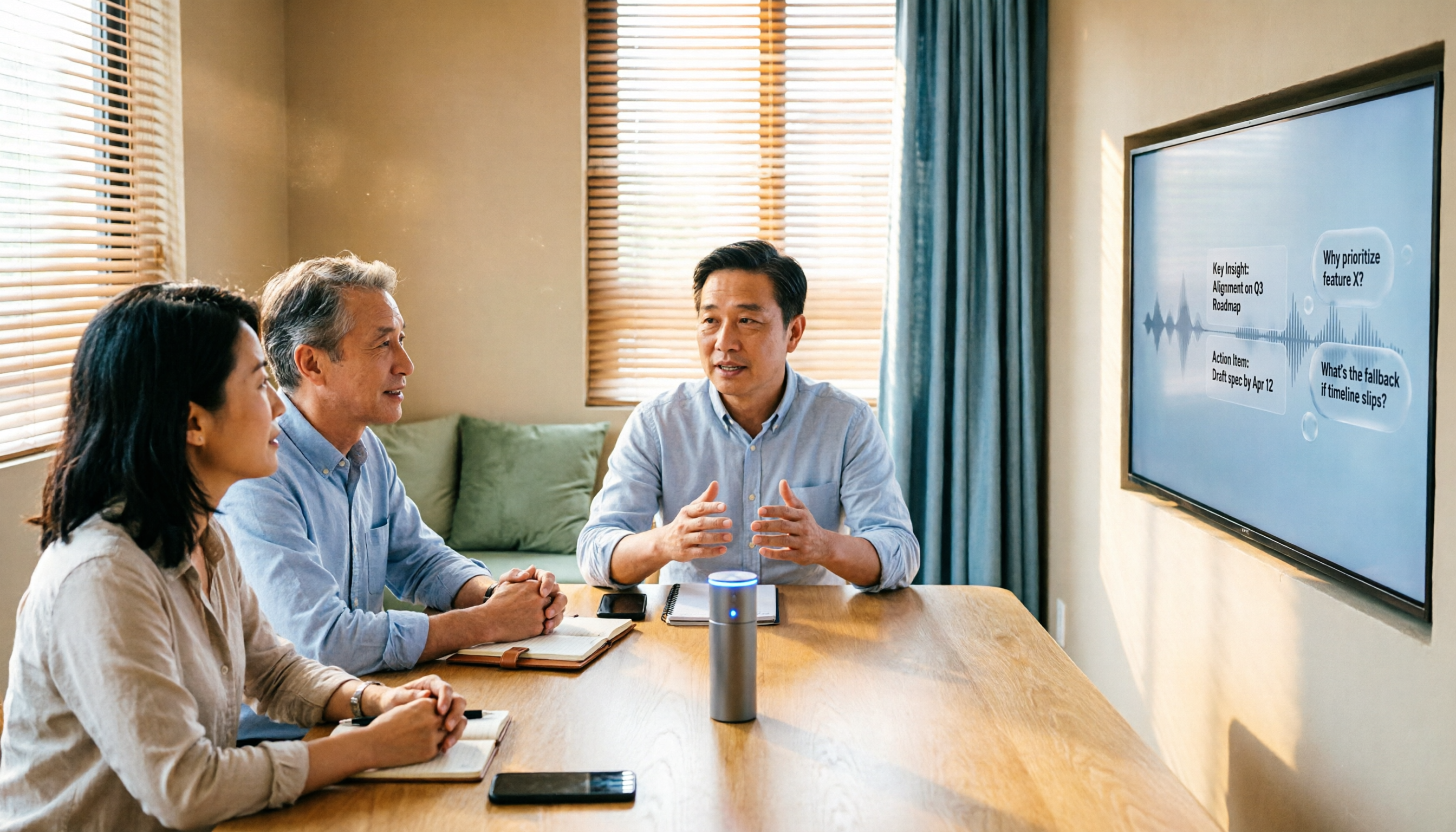
My go-to use case is online meetings. When I open the Tinrec desktop app, it captures the system audio directly—no need to invite a bot into Zoom, Google Meet, or Microsoft Teams. The transcript appears in real time as the meeting unfolds. By the time the meeting wraps, summaries, chapters, and action items are already generated, showing who's responsible for what and by when.
What really makes it indispensable is the AI Q&A after recording. You can ask Tinrec, "Who mentioned the budget issue in the last meeting?" Instead of just returning keyword search results, it understands the context and gives you a direct answer. I've checked tools in the same price range, and almost none offer this feature.
Stop organizing recordings by hand
Upload audio or video and automatically get a transcript, summary, and action items
In our tests, we used a 5-minute Chinese meeting recording (iPhone 15, indoor, with air conditioning noise in the background). Tinrec's transcription quality was stable among similar tools, especially for Chinese and Traditional Chinese content. Of course, real-world accuracy still varies with accents, background noise, and overlapping speech—that's true for every tool.
Pros: No extra hardware needed, real-time translation support, AI summaries and action item extraction, post-meeting Q&A, and shared team spaces for meeting materials.
Limits: The free plan has a basic quota; heavy users will need to upgrade. If you only meet 2–3 times a week, the free tier is usually enough to try it out. If you're in meetings daily, I'd recommend going straight to Pro.
Best for: People who need Chinese meeting notes, want to avoid meeting bots, want to use AI to find key points after recording, and switch between phone and computer.
Beyond Tinrec: What Are the Alternatives?
Otter.ai: Mature for English meetings, with 300 free minutes per month—very friendly for English speakers. But its Chinese transcription and summarization aren't as smooth as Tinrec's. If you need team spaces, multiple export formats, and real-time Chinese translation, Tinrec better fits Asian workplace needs.
Notta: Solid multilingual transcription with some feature overlap with Tinrec. However, the free plan offers only 120 minutes per month and 3 minutes per session, which is restrictive for professionals whose meetings routinely run 30+ minutes. Tinrec's bot-free online meeting recording is also something Notta can't match.
MyEdit: Uses a free credit system and transcribes uploaded audio files quickly—good for occasional recording processing. But it's more of a transcription tool, lacking Tinrec's meeting-centric AI Q&A, action item extraction, and team collaboration workflow.
Pitfall Guide: 3 Common Mistakes When Choosing a Speech-to-Text Tool
Pitfall 1: Trusting advertised accuracy rates. Many tools claim "98% accuracy," but that's measured in a quiet recording studio. Real meetings have air conditioning hum, keyboard clicks, and overlapping voices—accuracy will drop. Test the free version with your own recordings instead of relying on ads.
Pitfall 2: Ignoring "what happens after transcription." If you only use the tool for "audio to text," you're using just a third of its potential. With Tinrec's AI Q&A, you can ask "What was the meeting conclusion?" right after recording—far faster than manually scanning a 30-minute transcript.
Pitfall 3: Overlooking cross-platform needs. If you record on your phone today and organize on your computer tomorrow, a tool without multi-device sync will trap you in file-transfer hell. Check whether you'll switch between devices before committing.
Summary: Which One Should You Choose?
If you want a "record and use it immediately" meeting organization experience, Tinrec is my top pick after testing. It doesn't just turn speech into text—it turns meetings into searchable, queryable, action-item-trackable assets.
Scenario-based recommendations:
- Need Chinese meeting notes + AI summaries + action items → Tinrec
- Want to record Zoom, Meet, or Teams without a bot → Tinrec
- Want to ask AI for key points after recording → Tinrec
- Occasionally handle English recordings with a $0 budget → Otter.ai's free tier can cover you
- Just need quick audio-to-text without meeting follow-up → MyEdit's free credits are worth a try
Start with the free version to see if it actually saves you post-meeting time before paying. Don't pull out your credit card right away—that's not what a smart manager does.
References
Turn every recording into actionable outcomes
Get 60 free transcription minutes when you sign in. No credit card required.
Related Reading
You might also like

4 AI Meeting Transcription Tools Compared for 2026: From Transcripts to Summaries, Which Saves You the Most Time After Work?
A mid-level manager who attends over a dozen meetings per week tested 4 AI meeting transcription tools, covering bot-free recording, Chinese and mixed Chinese-English recognition, summary and action item extraction, team spaces, seats, and auditing. The article explains 5 key points to consider before purchasing, 4 common pitfalls, and the suitable scenarios and limitations of Tinrec, Otter.ai, Notta, and PLAUD.

4 AI Meeting Note Tools Tested for 2026: Which Saves the Most Time After Applying Templates?
Meeting notes often go unfinished not because of slow typing, but because there's no template from the start. This article compiles two ready-to-copy meeting note templates for corporate meetings and team weekly meetings, explains how to apply AI tools and connect post-meeting outputs, and compares Tinrec, Otter.ai, Granola, and Notta in real tests on Chinese meetings and template workflows.

2026 AI Meeting Notes Tools Compared: Free Tiers and Chinese Recognition Are Key
Starting from three questions—where your meetings happen, what language they're in, and who needs the notes—this hands-on comparison of Tinrec, Otter.ai, Notta, and PLAUD covers the meeting notes workflow, plus four buying criteria, four common mistakes, and a six-step post-meeting workflow you can copy directly.

2026 AI Meeting Transcription Tools Compared: Tinrec vs Otter.ai vs Notta vs TurboScribe
Many people struggle to organize meeting transcripts after recording. This article starts with common inefficient practices and compares the meeting documentation workflows of Tinrec, Otter.ai, Notta, and TurboScribe. It breaks down the steps from recording to transcript, summary and action items, AI Q&A, and team knowledge retention, and provides buying criteria and pitfalls to avoid.

How to Choose an AI Meeting Notes Tool in 2026: 5-Step Hands-On Review and Pitfall Guide
A mid-level manager who attends over a dozen meetings a week shares a two-week hands-on testing process to help you judge whether an AI meeting notes tool is any good. From recording methods, post-meeting output, Chinese recognition, to team data ownership, it breaks down 5 key purchasing criteria and 4 common pitfalls, and shares the real-world performance and limitations of Tinrec in bot-free recording, AI Q&A, and team spaces.
How to Use AI for Meeting Notes in 2026: 5 Steps from Recording to Summary
A 5-step guide to using AI for meeting notes in 2026: from recording and transcription to AI summarization, action item extraction, and post-meeting Q&A. Includes comparisons of Tinrec, Otter.ai, Notta, and Granola for different use cases and limitations.

2026 AI Meeting Notes Tools Compared: Which Summaries Actually Save Time?
The meeting ends, but the work begins. This article runs the same Chinese meeting recording through four AI meeting notes tools, comparing everything from how they capture online meetings, transcript usability, summaries and action items, AI follow-up questions, to team data ownership and pricing. We break down the real differences and the most common pitfalls when choosing a tool, so you can find the one that truly saves you time after the meeting.

6 AI Meeting Transcription Tools Compared for 2026: Which Free Version Is Enough?
Is a free AI meeting transcription tool enough? This side-by-side comparison of Tinrec, Otter.ai, Notta, Granola, PLAUD, and TurboScribe breaks down free quotas, Chinese transcription, post-meeting summaries, and team collaboration to help you decide when to upgrade from free.

2026 AI Meeting Notes Showdown: Tinrec vs. Granola Review, Examples, and Buying Advice
We put Tinrec and Granola—two bot-free AI meeting note tools—through the same evaluation framework, comparing meeting capture, audio retention, Chinese-language experience, post-meeting outputs, team governance, and pricing. Includes a meeting notes format example to help you decide which tool better fits your workflow.