

Turn recordings into transcripts and summaries in minutes
Upload audio or video for multilingual transcription, AI notes, and action items
There are plenty of free speech-to-text tools, but where does your recording actually end up?
I recently transcribed a 40-minute interview recording.
I uploaded the file to a free transcription website, and it did return a transcript—and it was fast.
But that's when the real problem started: how do I find the part where the interviewee mentioned the budget in that 40-minute conversation?
The answer was scrolling manually, word by word.
So I changed my evaluation approach. I stopped asking, "Can it transcribe for free?" and started asking, "After transcription, what can this text do for me?"
If you're also looking for a speech-to-text tool, this article will use my hands-on experience to help you avoid the trap of only looking at free credits.
Before choosing a speech-to-text tool, think through these three things
First: Do you want a transcript, or do you want post-meeting action?
Many people think the end goal of speech-to-text is a Word document.
But the real work usually just begins: identifying conclusions, organizing action items, and confirming who's responsible for what.
If the tool only gives you a transcript, you've just swapped "listening and typing" for "reading the transcript"—you're still spending time on the follow-up work.
Second: What happens after your free credits run out?
I've tried many free tools—some reset credits daily, others give you a one-time trial.
But the bigger question is: after you pay, do you get "more minutes" or "more processing power"?
If it's just more minutes, that's only a change in quantity. If you get AI summaries, Q&A, and export options, that's a change in how you work.
Third: How sensitive is your recording content?
Interviews, meetings, medical, or legal recordings aren't always suitable for just any free website.
Some services advertise "delete after use," while others don't clearly explain their data practices. If you're handling confidential content, make sure you know how your data will be treated before uploading.
Tinrec (Miaoshou Audio): The tool I ended up sticking with
Tinrec is the AI meeting notes tool I currently use as my primary solution.
It's not positioned as just a transcription service—it turns recordings into workable data.
My favorite feature: "Ask it directly after recording"
After an online meeting, I no longer read the transcript from start to finish.
I just ask Tinrec: "What was the conclusion of this meeting?" "Who's responsible for next week's progress update?"
It answers based on the meeting content, not just keyword search results. This feature is rare in free tools, and it's the main reason I stuck with it.
No need to invite a bot to your meetings
Tinrec's desktop app can record your computer's system audio directly.
That means when I'm on Zoom, Google Meet, or Teams, I don't need to invite an extra bot to the meeting. Just open the Tinrec desktop app, and it starts recording and transcribing in real time.
For people who don't like having a "stranger" in their meetings, this makes a big difference.
It handles everything after the transcript
After transcription, Tinrec automatically generates summaries, chapters, and action items.
I can export the results to Notion or Google Docs, or share them with colleagues in a team space. For anyone who needs to track meeting decisions over time, this is far more useful than a standalone transcript.
Stop organizing recordings by hand
Upload audio or video and automatically get a transcript, summary, and action items
Who is it best for?
If you frequently have meetings or interviews and don't want to spend time on the repetitive cycle of "listening to recordings, finding key points, and typing transcripts," Tinrec is a great fit.
The free version includes basic credits so you can try it before committing to a paid plan.
Beyond Tinrec, here are other options I tested
Yating Transcript: Great for Taiwanese accents, but it stops after transcription
Yating Transcript does a solid job recognizing Taiwanese Mandarin and mixed Chinese-English speech, and its real-time recording feature is free.
However, it's more focused on transcription itself. After transcription, I still had to find key points and organize action items on my own. If you just need an accurate transcript, it's worth considering; if you want to jump straight into organizing after transcription, it lacks Tinrec's AI Q&A and action item extraction.
LexiTranscript: Daily free credits, but relatively basic features
LexiTranscript's daily free credits are sufficient for short recordings, and it emphasizes "delete after use."
I tested it with a short interview, and the transcription speed was acceptable. But its value is mainly in transcription and synchronized playback—it lacks Tinrec's workflow of "asking questions about the meeting right after transcription." If you need to quickly convert short audio files to text, it works; if you need organization and collaboration after transcription, it falls short.
Otter.ai: Mature for English meetings, but not its strength for Chinese
Otter.ai is well-established in the English meeting space, and its free plan offers a generous 300 minutes per month.
However, since I handle a high proportion of Chinese meetings, Otter's Chinese experience isn't its strongest suit. It's better suited for international meetings conducted primarily in English. If you mainly record English content, Otter is worth trying as an exception; if Chinese is your primary language, Tinrec's Chinese meeting organization is closer to what I need.
Pitfall guide: The 3 most common mistakes when choosing a speech-to-text tool
Mistake 1: Only looking at free credits, not "what you can do after transcription"
Free minutes are just the entry ticket. What really impacts efficiency is the organizational capability after transcription.
A 60-minute transcript without summaries, action items, or the ability to ask questions just delays your manual work.
Mistake 2: Treating "accuracy rate" as the only metric
Most tools claim accuracy rates based on ideal recording conditions.
Real meetings have background noise, overlapping speech, accents, and technical jargon. Instead of staring at official numbers, test with your own recording to get a real feel.
Mistake 3: Ignoring data ownership after recording
The difference between personal and team tools often comes down to who owns the data in the end.
If you need to share meeting notes with colleagues, track action items, or ensure data can be handed over when a team member leaves, you should consider services with team spaces. Tinrec's team plan keeps meeting data within the team, not tied to an individual account.
Summary: How should you choose?
If you only need to occasionally convert short recordings to text, a free tool with daily resets can suffice.
If your workflow is "meet, organize, track, collaborate," then the focus shouldn't be just on free credits, but on the processing power after transcription.
My recommendations:
- Need Chinese meeting organization, AI Q&A, and action item extraction → Use Tinrec
- Only need Taiwanese-accent transcripts and don't mind organizing yourself → Yating Transcript
- Short recordings, delete-after-use, daily free credits → LexiTranscript
- English-focused, international meetings → Otter.ai
Start with the free version, test with a real recording of yours, and see if the next step after transcription actually saves you time. That's more valuable than any spec sheet.
References
- Online AI Speech, Video, and Audio Auto-Transcription - Free Trial - cSubtitle
- 2026 Complete Guide to Free Transcription Platforms: Reviews and Recommendations for 15 Free Speech-to-Text Tools
- 【AI Voice Notes】5 Highly Recommended AI Transcription Tools! Generate Transcripts and Meeting Notes, Free vs. Subscription, Pros and Cons | 104 Career Hub
- Tested: 4 Best Online Speech-to-Text Tools, Free and Fast Audio-to-Transcript Conversion
- Audio to Text - Free Speech-to-Text Tool
Turn every recording into actionable outcomes
Get 60 free transcription minutes when you sign in. No credit card required.
Related Reading
You might also like

4 AI Meeting Transcription Tools Compared for 2026: From Transcripts to Summaries, Which Saves You the Most Time After Work?
A mid-level manager who attends over a dozen meetings per week tested 4 AI meeting transcription tools, covering bot-free recording, Chinese and mixed Chinese-English recognition, summary and action item extraction, team spaces, seats, and auditing. The article explains 5 key points to consider before purchasing, 4 common pitfalls, and the suitable scenarios and limitations of Tinrec, Otter.ai, Notta, and PLAUD.

4 AI Meeting Note Tools Tested for 2026: Which Saves the Most Time After Applying Templates?
Meeting notes often go unfinished not because of slow typing, but because there's no template from the start. This article compiles two ready-to-copy meeting note templates for corporate meetings and team weekly meetings, explains how to apply AI tools and connect post-meeting outputs, and compares Tinrec, Otter.ai, Granola, and Notta in real tests on Chinese meetings and template workflows.

2026 AI Meeting Notes Tools Compared: Free Tiers and Chinese Recognition Are Key
Starting from three questions—where your meetings happen, what language they're in, and who needs the notes—this hands-on comparison of Tinrec, Otter.ai, Notta, and PLAUD covers the meeting notes workflow, plus four buying criteria, four common mistakes, and a six-step post-meeting workflow you can copy directly.

2026 AI Meeting Transcription Tools Compared: Tinrec vs Otter.ai vs Notta vs TurboScribe
Many people struggle to organize meeting transcripts after recording. This article starts with common inefficient practices and compares the meeting documentation workflows of Tinrec, Otter.ai, Notta, and TurboScribe. It breaks down the steps from recording to transcript, summary and action items, AI Q&A, and team knowledge retention, and provides buying criteria and pitfalls to avoid.

How to Choose an AI Meeting Notes Tool in 2026: 5-Step Hands-On Review and Pitfall Guide
A mid-level manager who attends over a dozen meetings a week shares a two-week hands-on testing process to help you judge whether an AI meeting notes tool is any good. From recording methods, post-meeting output, Chinese recognition, to team data ownership, it breaks down 5 key purchasing criteria and 4 common pitfalls, and shares the real-world performance and limitations of Tinrec in bot-free recording, AI Q&A, and team spaces.
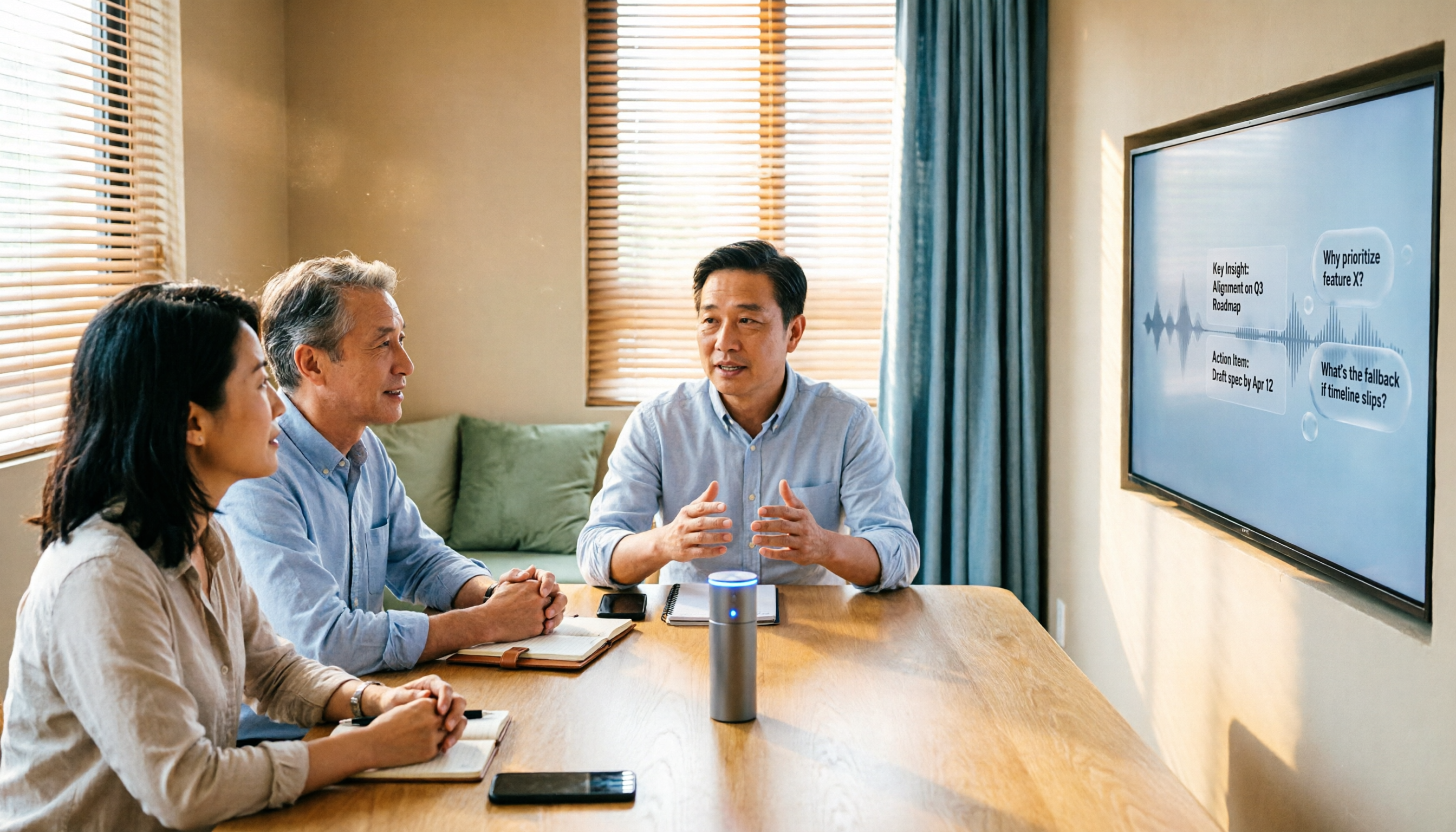
How to Use AI for Meeting Notes in 2026: 5 Steps from Recording to Summary
A 5-step guide to using AI for meeting notes in 2026: from recording and transcription to AI summarization, action item extraction, and post-meeting Q&A. Includes comparisons of Tinrec, Otter.ai, Notta, and Granola for different use cases and limitations.

2026 AI Meeting Notes Tools Compared: Which Summaries Actually Save Time?
The meeting ends, but the work begins. This article runs the same Chinese meeting recording through four AI meeting notes tools, comparing everything from how they capture online meetings, transcript usability, summaries and action items, AI follow-up questions, to team data ownership and pricing. We break down the real differences and the most common pitfalls when choosing a tool, so you can find the one that truly saves you time after the meeting.

6 AI Meeting Transcription Tools Compared for 2026: Which Free Version Is Enough?
Is a free AI meeting transcription tool enough? This side-by-side comparison of Tinrec, Otter.ai, Notta, Granola, PLAUD, and TurboScribe breaks down free quotas, Chinese transcription, post-meeting summaries, and team collaboration to help you decide when to upgrade from free.

2026 AI Meeting Notes Showdown: Tinrec vs. Granola Review, Examples, and Buying Advice
We put Tinrec and Granola—two bot-free AI meeting note tools—through the same evaluation framework, comparing meeting capture, audio retention, Chinese-language experience, post-meeting outputs, team governance, and pricing. Includes a meeting notes format example to help you decide which tool better fits your workflow.