

Turn recordings into transcripts and summaries in minutes
Upload audio or video for multilingual transcription, AI notes, and action items
First, a Key Question: Do You Just Need a Transcript, or Post-Meeting Organization?
Before choosing a speech-to-text app, I first confirm one thing: do you want to "turn audio into text," or "turn meetings into actionable data"?
If you only occasionally transcribe a recording, free tools or built-in phone features are usually enough. But if you have weekly meetings, interviews, or classes and need summaries, action items, AI Q&A, or even team sharing, your selection criteria will be completely different.
I tested four speech-to-text tools commonly used in Taiwan: MyEdit, Yating, SoundType AI, and Tinrec. Below, I break down free plan limits, post-transcription organization, cross-platform use, and team collaboration.
MyEdit vs Yating vs SoundType AI vs Tinrec: Quick Overview
MyEdit is an online speech-to-text tool by CyberLink, geared toward lightweight "audio-to-transcript" tasks. Yating focuses on real-time recording and audio-to-text, ideal for Chinese speakers. SoundType AI emphasizes transcription and AI summaries. Tinrec positions itself as an AI meeting notes and team collaboration tool, not just speech-to-text.
| Tool | Primary Use | Best For | Free Plan Highlights |
|---|---|---|---|
| MyEdit | Audio-to-transcript, audio enhancement | Occasional transcription needs | Free trial of basic transcription |
| Yating | Real-time recording to text, audio-to-text | Chinese interviews, course notes | Supports simultaneous recording and real-time transcription |
| SoundType AI | Transcription, speaker identification, AI summaries | Meetings, interviews, podcasts | Based on in-app plans |
| Tinrec | AI meeting notes, post-meeting organization, team collaboration | Professionals, project teams, researchers | Free trial of basic recording, import, and summaries |
In the comparisons below, I focus on "what you can do after transcription." Because if you only need a transcript, most tools can handle it; the real differentiator is post-transcription organization and collaboration.
Dimension 1: Post-Transcription Organization
MyEdit's strength is its simple interface and accurate transcription, with optional timestamps. However, it's more of a one-off "audio-to-text" task; for extensive meeting data management, its features are relatively basic.
Yating supports simultaneous recording and real-time transcription, and you can upload audio files for transcription. It's friendly to Chinese content. But its main job is producing transcripts; analysis, follow-up questions, and team sharing after transcription require manual effort.
SoundType AI offers speaker identification and AI summaries, helping users quickly grasp key points from recordings—useful for interviews and meetings. Its core value lies in "recognition and summarization," with less focus on long-term team knowledge management.
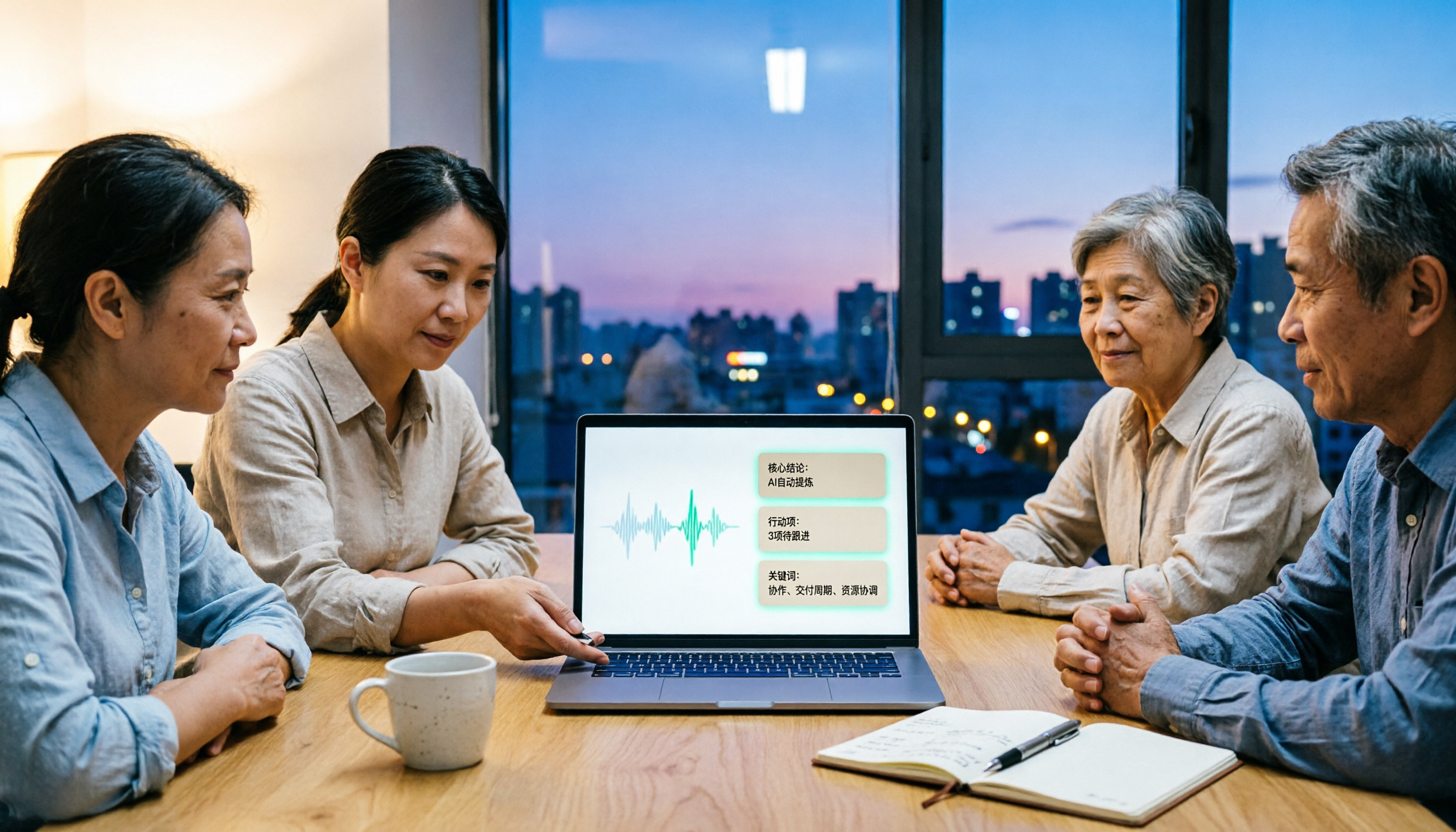
Tinrec treats transcription as a starting point, not the endpoint. After recording or importing files, it can auto-generate summaries, chapters, key points, and action items, and you can continue with AI Q&A on the meeting content. For example, after a client meeting, you not only get a transcript but can also organize action items into a to-do list and export to Notion, Google Docs, and other tools.
→ This dimension: If you only need transcripts, all four suffice; if you need post-meeting organization, Tinrec is clearly more comprehensive.
Dimension 2: Online Meeting Recording
MyEdit and Yating primarily handle audio files you provide or live recordings. For online meetings like Zoom, Google Meet, or Microsoft Teams, you typically need to record first and then import the file for transcription.
SoundType AI is suitable for processing recordings and videos, but in online meeting scenarios, it still leans toward a "record first, transcribe later" workflow.
Tinrec's desktop app can directly capture system audio, so you don't need to invite a meeting bot. Just open Tinrec on your computer to record online meetings and get real-time transcripts. This is a more natural approach for teams that don't want an extra "bot participant" in meetings.
→ This dimension: Tinrec's bot-free desktop recording is more convenient for online meetings.
Dimension 3: Chinese and Multilingual Content
Yating has a low barrier for Chinese speakers, supporting real-time transcription and audio-to-text in Chinese, suitable for courses, interviews, and general meetings.
MyEdit's speech-to-text is accurate and supports Chinese, but its official materials don't emphasize real-time translation for multilingual meetings.
Stop organizing recordings by hand
Upload audio or video and automatically get a transcript, summary, and action items
SoundType AI claims support for over 90 languages, covering a wide range of multilingual content, though the actual experience in Chinese depends on recording quality and accents.
Tinrec can handle Chinese, Traditional Chinese, and mixed Chinese-English content, and supports real-time translation and bilingual viewing. The team plan also allows maintaining a custom vocabulary, adding product names, project codes, and other technical terms to improve recognition in specific domains.
→ This dimension: For general Chinese transcription, both Yating and Tinrec are convenient; for mixed Chinese-English meetings and team terminology management, Tinrec has an edge.
Dimension 4: Free Plans and Pricing Thresholds
MyEdit offers a free trial, suitable for testing transcription quality before deciding on a subscription. Yating's free features already cover real-time recording-to-text, friendly for occasional users.
SoundType AI relies on in-app plans; actual free allowances and paid features depend on the Google Play listing.
Tinrec's personal plan offers a free trial, letting you test recording, import, and summaries with basic credits. For regular use, you can choose weekly, Pro monthly, or yearly cards based on frequency; the team plan is per-seat billing at USD 29.80/paid seat/month or USD 199/paid seat/year, with 2,000 minutes of shared import credits per seat per month. Prices and promotions are subject to the official purchase page.
→ This dimension: Light users can start with free plans; for consistent meeting needs, Tinrec's personal and team plans offer clearer tiering.
What Are the Unique Advantages?
Tinrec's unique advantage is extending meetings from "recording" to "collaboration." Beyond transcripts, summaries, action items, and AI Q&A, the team plan includes team spaces, member and seat management, usage analytics, audit logs, and an audio recycle bin. When members leave or change, meeting data remains with the team, not lost with personal accounts.
Additionally, Tinrec supports multi-format export and Agent post-processing, allowing you to generate reports, tables, or documents from meeting content, reducing post-meeting prep time.
MyEdit's unique advantage is audio enhancement, such as noise reduction, voice enhancement, and wind removal, which can improve audio quality before transcription—helpful for poor recording environments.
Yating's advantage is low-barrier real-time Chinese transcription, suitable for users who don't need complex post-processing.
Summary: Who Should You Choose?
- If you occasionally need to transcribe recordings and want simple noise cleanup → Try MyEdit first.
- If you want a straightforward real-time Chinese recording-to-text tool → Yating is sufficient.
- If you need speaker identification and AI summaries, often handling interviews or podcasts → Consider SoundType AI.
- If you have weekly meetings and need summaries, action items, AI Q&A, or team sharing → Tinrec is the more complete choice.
In short: When a transcript alone isn't enough, focus on "what you can organize after transcription." Start with free plans, test with your own recordings, and then decide on paid options.
FAQ
Are free speech-to-text apps sufficient?
If you only occasionally transcribe short recordings, free plans usually suffice. But for long recordings, bulk file imports, or AI organization features, free limits will quickly hit, and that's when you evaluate paid plans.
Which app is most accurate for Chinese transcription?
Actual accuracy depends on recording quality, accents, background noise, and overlapping speech. Both Yating and Tinrec are relatively friendly to Chinese content; test with your typical recording environment for more reliable insights than specs alone.
Do online meetings require a meeting bot for transcription?
Not necessarily. Tinrec's desktop app can directly capture system audio, so you don't need to invite a bot. Just open Tinrec on your computer to record and transcribe Zoom, Google Meet, Microsoft Teams, and other online meetings.
What's the difference between Tinrec's team and personal plans?
Personal plan data is managed under your personal account. The team plan provides a dedicated team space where meeting data belongs to the team, adding member, role, seat, shared benefits, usage analytics, audit logs, and audio recycle bin governance features.
Can speech-to-text tools fully replace manual note-taking?
It's not advisable to expect that. AI transcription can greatly reduce manual listening and typing time, but important decisions, numbers, or proper nouns may still be misrecognized due to audio quality. We recommend using timestamps to replay recordings for verification.
What should I be aware of when using speech-to-text apps?
Before recording and transcribing, comply with local laws and obtain consent from participants when necessary. Especially for meetings involving clients, colleagues, or external parties, informing them about the recording purpose is a safer practice.
References
- Tested: 4 Best Speech-to-Text Online Tools Recommended, Free to Convert Recordings to Transcripts
- Real-time Speech-to-Text App Recommendations: iPhone/iPad 'Notes' App, Supports Real-time Transcription, Free, Supports Chinese and English
- SoundType AI: Ultra-Precise Transcription, Speech-to-Text, AI Dictation - Google Play
- Speech-to-Text - Google Play
- Speech-to-Text: AI Transcript, Recording to Text, Voice Memo with Real-time Translation - App Store
Turn every recording into actionable outcomes
Get 60 free transcription minutes when you sign in. No credit card required.
Related Reading
You might also like

2026 AI Meeting Recorder Comparison: 5 Tools Tested for Chinese Transcription, Free Tiers, and Post-Meeting Organization
Starting from real student use cases, this comparison focuses on what AI meeting recorders often get wrong: it's not about who transcribes fastest, but who can turn transcripts into summaries, action items, and searchable data. The main tool tested is Tinrec, breaking down what it can do, five core capabilities, campus and team scenarios, five must-check points before buying, and whether the free tier is enough for students.

Tinrec vs Notta 2026: 5-Factor Comparison — Which Is Better for Chinese Meeting Notes?
Most people install an AI meeting notes app only to get a raw transcript. This article breaks down 5 buying factors, tests Tinrec's bot-free recording, AI Q&A, and team knowledge retention workflow, and briefly reviews Notta, Otter.ai, and PLAUD for their best-fit scenarios.

5 Free AI Meeting Notes Apps Tested in 2026: Which Free Tier Actually Works?
Is a free AI meeting notes app enough? This article starts from the decision point of 'how many meetings do you have per month' and compares the free plan limits of Tinrec, Notta, Otter.ai, TurboScribe, and PLAUD. It breaks down four key criteria: per-recording limit, online meeting support, post-meeting output, and team data ownership, helping you choose the right tool without spending money.

2026 AI Meeting Notes Showdown: Tinrec vs Plaud Note — Which Saves More Time?
The meeting ends, but the pain begins. We tested Tinrec and Plaud Note across five dimensions — audio capture, post-meeting organization, Chinese recognition, team collaboration, and pricing — to help you decide which tool truly saves time on replaying recordings and typing notes.

Tinrec vs Notta 2026: 5-Dimension Comparison — Which Free AI Meeting Notes Tool Is Right for You?
How to choose free AI meeting notes software? This article starts with common pitfalls and compares Tinrec and Notta across 5 dimensions: free quota structure, audio capture methods, post-meeting output, Chinese recognition, and data ownership. It also covers free options like Otter.ai and Granola, plus 4 tips to avoid common mistakes.

5 AI Meeting Note Platforms Tested in 2026: How to Calculate Costs Without Wasting Money
The cost gap between AI meeting note platforms often isn't about the monthly fee, but about billing units, free allowances, and seat rules. This article starts from the actual billing logic of five options, breaks down the difference between real-time recording and file import, the gap between annual and monthly payments, and explains why Tinrec's team plan is suitable for teams that want to retain meeting data.

2026 AI Meeting Notes App Comparison: Free Tiers and Post-Meeting Workflows Tested
Struggling with meeting notes isn't about writing skills—it's about lacking time to re-listen to recordings. This hands-on comparison of AI meeting note apps covers free tiers, summary quality, post-meeting organization, and team collaboration, using Tinrec as the primary example to show whether free versions are sufficient and when to upgrade.
4 AI Meeting Note Tools Tested for 2026: Which Free Version Is Actually Enough?
There are plenty of free AI meeting note tools, but their free tiers vary widely. This article tests Tinrec, Notta, Otter.ai, and PLAUD from the perspective of whether the free version can last a month, comparing recording methods, post-meeting outputs, and limitations to help you find the one that truly works for you.

4 AI Meeting Note Methods Compared in 2026: Which Saves More Time—Online Transcripts or Summaries?
Still re-listening to recordings and typing meeting notes after meetings? This article compares four common AI meeting note methods—transcripts, summaries, action items, and AI Q&A—and explains why viewing online saves the most time. It also demonstrates Tinrec's actual workflow, team plan permissions, seats, and pricing.