

Turn recordings into transcripts and summaries in minutes
Upload audio or video for multilingual transcription, AI notes, and action items
Why You Need a Speech-to-Text Tool
Struggling to keep up with lecture notes, forgetting key points right after a meeting, or spending hours replaying interview recordings to type transcripts—these are common pain points. In 2026, speech-to-text tools have evolved beyond simply converting audio to text, now offering automatic summaries, action item extraction, real-time translation, and turning meeting content into reusable team knowledge.
This article highlights 5 speech-to-text solutions worth considering, from lightweight tools that require no installation to feature-rich services suited for regular meetings and team collaboration, helping you quickly assess based on your actual usage and budget.
Option 1 | Tinrec (Instant Recording)—More Than Transcription: A Complete AI Meeting Assistant
Tinrec is an AI meeting notes and collaboration tool designed for individuals and teams. It goes beyond simple speech-to-text, catering to those who need to turn meetings, interviews, or course content into searchable, queryable, and exportable data.
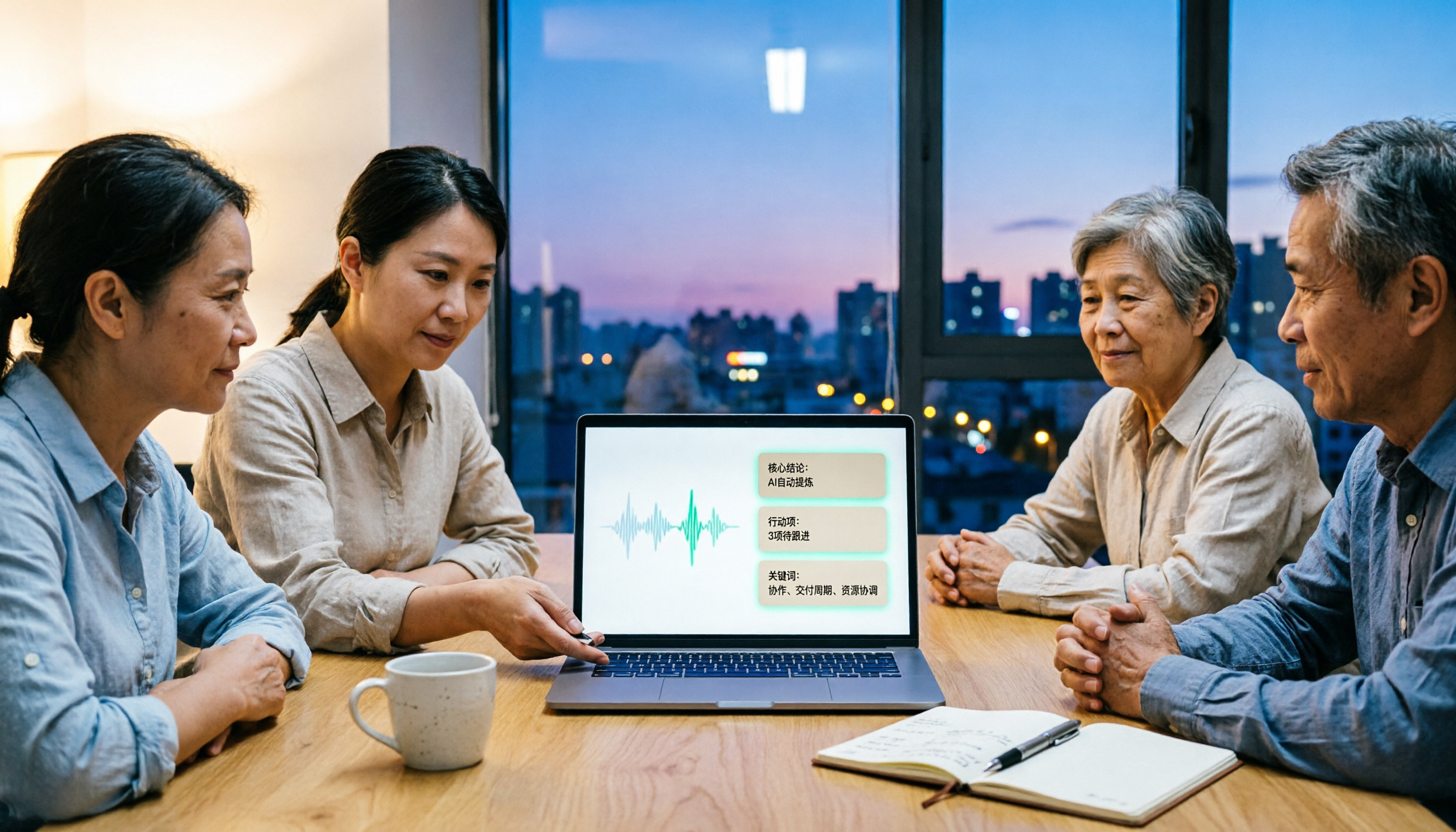
If you have recurring meetings weekly or need to manage discussion records across multiple projects, Tinrec's value becomes especially clear. It supports real-time recording-to-text and allows direct upload of audio or video files for transcription. More practically, after transcription, it automatically generates summaries, chapters, key points, and action items, saving you from reading through the entire transcript.
Tinrec's desktop version can capture system audio, making it possible to record online meetings on Zoom, Google Meet, Microsoft Teams, Webex, and more—without needing to invite a meeting bot. This offers a more natural recording method for teams that prefer not to have an "AI attendee" in their meetings.
Another differentiator is the AI Q&A feature. You can ask follow-up questions about the meeting content, such as "What were the three main requirements the client mentioned this time?" or "What action items were decided in the last meeting?" Tinrec provides answers based on the transcript and meeting data. This brings you closer to a "ready-to-use" outcome than just receiving a plain text file.
The team version transforms the personal tool into a collaborative space. Meeting data is stored centrally in the team workspace, allowing new members to access historical meetings, while admins can manage members, seats, usage, and audit logs. When a member leaves or is removed, meeting data remains with the team, not the individual, ensuring continuity.
The personal plan includes free credits, ideal for trying out basic recording, import, and summary features. For short-term intensive meetings or interviews, a weekly pass is available; for those with steady weekly meetings, the Pro monthly or annual plan offers better value. The team plan is priced per paid seat, with each paid seat providing 2,000 minutes of shared import quota per month; real-time recording does not deduct minutes under active plans and seats.
Best for: Users and small-to-medium teams needing Chinese meeting notes, avoiding meeting bots, and aiming to turn meeting data into long-term team assets.
Option 2 | Google Live Transcribe—A Free, Lightweight Real-Time Captioning Choice
Google Live Transcribe is a free, real-time speech recognition tool for mobile devices. Once enabled, it displays live captions on your phone, making it suitable for hearing assistance, quick conversation checks, or light use cases needing real-time captions.
Its strengths include no additional cost, fast startup, and support for multiple languages. However, its primary function is real-time display; it lacks the comprehensive transcript management, AI summaries, action items, and team workspace features found in tools like Tinrec.
Best for: Users who only need real-time captions, have a zero budget, and don't require extensive history storage.
Option 3 | MyEdit—An Online Tool That Optimizes Audio Quality Before Transcription
MyEdit is an online speech-to-text tool by CyberLink, distinguished by offering audio enhancement features like noise reduction, voice enhancement, and wind removal alongside transcription. This is particularly useful for those with less-than-ideal recording environments who want to improve audio quality before converting to text.
Users can edit transcribed content directly on the website and add timestamps, making it suitable for straightforward audio-to-text needs. The free plan allows access to basic features, with paid plans available for higher transcription volumes.
Stop organizing recordings by hand
Upload audio or video and automatically get a transcript, summary, and action items
Best for: Users who need to clean up recording quality first and occasionally process audio-to-text conversions.
Option 4 | OpenAI Whisper—A Completely Free, Offline Open-Source Transcription System
Whisper is one of the most well-known open-source speech recognition systems, trained on vast multilingual data, supporting multiple languages, and showing high tolerance for accents and background noise. Most importantly, it's completely free and can run offline on your local machine, eliminating the need to upload audio to the cloud—ideal for privacy-conscious users.
However, Whisper requires installing a Python environment, posing a technical barrier, and it focuses primarily on transcription, lacking built-in summaries, action items, Q&A, and team collaboration features found in tools like Tinrec. If you only need to transcribe large volumes of audio and don't mind manual setup, Whisper is a powerful free option.
Best for: Technical users, privacy-focused individuals, those needing offline processing, and those requiring pure transcription functionality.
Option 5 | Notta—A Versatile Tool for Multi-Platform Transcription and Translation
Notta is an AI transcription tool covering multi-platform transcription, meeting notes, file import, translation, and team plans, overlapping somewhat with Tinrec's use cases. It features a user-friendly interface, supports multiple languages, and offers a free plan for trial.
The free version provides 120 minutes of transcription per month, with a maximum of 3 minutes per session; the Pro plan offers 1,800 minutes per month, while the Business plan includes unlimited transcription, role permissions, and usage reports. If your primary need is quick transcription of files or meeting content, Notta is a viable option.
Best for: Users needing multilingual transcription, preferring a simple interface in a general-purpose tool, and whose main requirements center on transcription and translation.
How to Choose Among These Options
When selecting a speech-to-text tool, consider three things: how often you'll use it, what features you need beyond transcription, and whether you're an individual or a team.
• For comprehensive AI features like transcription, summaries, action items, AI Q&A, and team workspace → Tinrec is the only option on this list offering all these features. • For Chinese meeting notes without inviting bots to online meetings → Tinrec's desktop version offers bot-free recording for a more natural experience. • For real-time captions only, with zero budget → Google Live Transcribe covers basic needs. • For poor recording quality that needs optimization before transcription → MyEdit's audio cleanup features are practical. • For privacy concerns, avoiding cloud uploads, and comfortable with manual setup → OpenAI Whisper is a free and robust open-source choice. • For occasional multilingual transcription and translation needs → Notta's free and Pro plans are worth considering.
If you have weekly meetings and want to turn discussions into searchable, queryable, and trackable data, Tinrec is the more comprehensive choice. For occasional transcription of a single recording, start with a free tool and upgrade once your usage stabilizes.
Things to Know Before Using Speech-to-Text Tools
First, recording quality directly impacts transcription accuracy. Even the best tools may see reduced accuracy with heavy background noise, overlapping speech, or strong accents. Tools like Tinrec can work with clear audio sources or audio enhancement features to ease post-processing.
Second, don't rely solely on AI results for critical content. AI summaries and action items save time but may miss details or misinterpret intent. Always cross-check important decisions against the transcript and timestamps, especially for contracts, quotes, or client commitments.
Third, be mindful of legal compliance for recording and transcription. Whether it's meetings, interviews, or classes, understand local regulations and obtain participant consent where required. Teams should also confirm internal policies on meeting records and data retention.
Fourth, free plans often come with limitations, such as monthly minute caps, session length limits, or feature restrictions. Don't just look at "free"—verify that the limits align with your actual usage to avoid running out mid-task.
Conclusion
In 2026, speech-to-text tools have evolved from mere "typing substitutes" into "meeting organization and knowledge management tools." If you only need occasional real-time captions, a free plan suffices; if you need to turn meetings into searchable, trackable, collaborative team data, Tinrec is the most feature-complete option on this list.
Start with a free plan to gauge your usage frequency and feature needs, then choose a paid plan that fits your situation.
References
- 2026 Comprehensive Guide to Free Transcription Platforms: Reviews and Recommendations for 15 Free Speech-to-Text Tools
- [AI Voice Notes] Top 5 Recommended AI Transcription Tools! Generate Transcripts and Meeting Highlights, Free vs. Subscription, Pros and Cons | 104 Career Force
- Tested: 4 Best Online Speech-to-Text Tools Recommended, Instantly Convert Recordings to Transcripts for Free
- Speech to Text: AI Transcript, Recording to Text, Voice Memo, Instant Translator App - App Store
- Speech to Text - Google Play App
Turn every recording into actionable outcomes
Get 60 free transcription minutes when you sign in. No credit card required.
Related Reading
You might also like

2026 AI Meeting Recorder Comparison: 5 Tools Tested for Chinese Transcription, Free Tiers, and Post-Meeting Organization
Starting from real student use cases, this comparison focuses on what AI meeting recorders often get wrong: it's not about who transcribes fastest, but who can turn transcripts into summaries, action items, and searchable data. The main tool tested is Tinrec, breaking down what it can do, five core capabilities, campus and team scenarios, five must-check points before buying, and whether the free tier is enough for students.

Tinrec vs Notta 2026: 5-Factor Comparison — Which Is Better for Chinese Meeting Notes?
Most people install an AI meeting notes app only to get a raw transcript. This article breaks down 5 buying factors, tests Tinrec's bot-free recording, AI Q&A, and team knowledge retention workflow, and briefly reviews Notta, Otter.ai, and PLAUD for their best-fit scenarios.

5 Free AI Meeting Notes Apps Tested in 2026: Which Free Tier Actually Works?
Is a free AI meeting notes app enough? This article starts from the decision point of 'how many meetings do you have per month' and compares the free plan limits of Tinrec, Notta, Otter.ai, TurboScribe, and PLAUD. It breaks down four key criteria: per-recording limit, online meeting support, post-meeting output, and team data ownership, helping you choose the right tool without spending money.

2026 AI Meeting Notes Showdown: Tinrec vs Plaud Note — Which Saves More Time?
The meeting ends, but the pain begins. We tested Tinrec and Plaud Note across five dimensions — audio capture, post-meeting organization, Chinese recognition, team collaboration, and pricing — to help you decide which tool truly saves time on replaying recordings and typing notes.

Tinrec vs Notta 2026: 5-Dimension Comparison — Which Free AI Meeting Notes Tool Is Right for You?
How to choose free AI meeting notes software? This article starts with common pitfalls and compares Tinrec and Notta across 5 dimensions: free quota structure, audio capture methods, post-meeting output, Chinese recognition, and data ownership. It also covers free options like Otter.ai and Granola, plus 4 tips to avoid common mistakes.

5 AI Meeting Note Platforms Tested in 2026: How to Calculate Costs Without Wasting Money
The cost gap between AI meeting note platforms often isn't about the monthly fee, but about billing units, free allowances, and seat rules. This article starts from the actual billing logic of five options, breaks down the difference between real-time recording and file import, the gap between annual and monthly payments, and explains why Tinrec's team plan is suitable for teams that want to retain meeting data.

2026 AI Meeting Notes App Comparison: Free Tiers and Post-Meeting Workflows Tested
Struggling with meeting notes isn't about writing skills—it's about lacking time to re-listen to recordings. This hands-on comparison of AI meeting note apps covers free tiers, summary quality, post-meeting organization, and team collaboration, using Tinrec as the primary example to show whether free versions are sufficient and when to upgrade.
4 AI Meeting Note Tools Tested for 2026: Which Free Version Is Actually Enough?
There are plenty of free AI meeting note tools, but their free tiers vary widely. This article tests Tinrec, Notta, Otter.ai, and PLAUD from the perspective of whether the free version can last a month, comparing recording methods, post-meeting outputs, and limitations to help you find the one that truly works for you.

4 AI Meeting Note Methods Compared in 2026: Which Saves More Time—Online Transcripts or Summaries?
Still re-listening to recordings and typing meeting notes after meetings? This article compares four common AI meeting note methods—transcripts, summaries, action items, and AI Q&A—and explains why viewing online saves the most time. It also demonstrates Tinrec's actual workflow, team plan permissions, seats, and pricing.