

Turn recordings into transcripts and summaries in minutes
Upload audio or video for multilingual transcription, AI notes, and action items
5 Best Speech-to-Text Tools in 2026: A Hands-On Comparison for Meetings and Transcripts
Many people choose a speech-to-text tool based on download counts or App Store ratings, only to find out after downloading that the free version only transcribes 3 minutes, limits file size, or the interface is cluttered with ads that disrupt work. If you're preparing for interviews, organizing interviews, or need to handle meeting notes weekly, this article uses real-world scenarios to review 5 tools frequently mentioned on Dcard and PTT, helping you avoid common pitfalls.
Why You Need a Speech-to-Text Tool
Whether it's recording lectures, user interviews, podcast transcripts, or last-minute meeting notes from your supervisor, speech-to-text tools save you from repeatedly replaying audio and manually typing. However, choosing the wrong tool can lead to typical issues: the free version only transcribes 3 minutes, high error rates with mixed Chinese-English content, transcripts without timestamps, or meeting summary features that require extra payment.
This article evaluates key aspects: whether the free quota is sufficient, Chinese and mixed-language recognition performance, support for uploading audio files, AI summaries and action items, and team collaboration capabilities. The following 5 tools are the most discussed options in 2024.
Tinrec (Miao Ting Lu Yin) | The Most Comprehensive AI Meeting Notes and Team Collaboration Tool
Tinrec is not just a typical recording-to-text app; it's more like an AI assistant that turns meetings into usable data. You can record and transcribe in real-time during offline meetings, or use the desktop version to capture computer system audio directly, recording Zoom, Google Meet, Microsoft Teams, or Webex meetings without adding extra bots to the meeting.
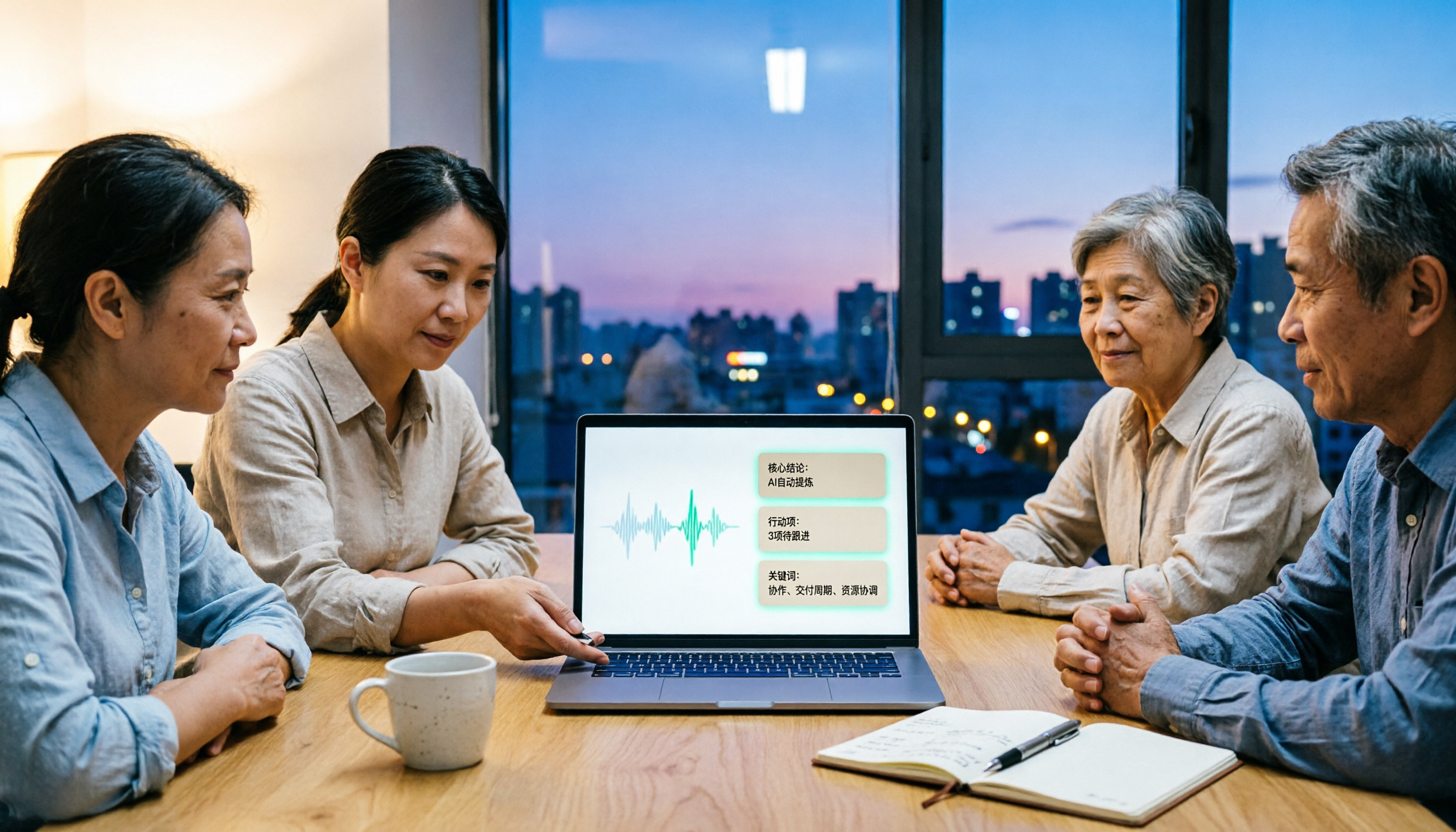
Its core value lies in the post-transcription workflow: it automatically generates summaries, chapters, key points, and action items. You can ask questions like "What objections did the client raise in this meeting?" or "What was the decision last week?" and the AI will answer based on the transcript. For those who need to compile reports, it can also generate meeting minutes, documents, or tables, and export to Notion, Google Docs, OneNote, or Dropbox.
For Chinese and multilingual meetings, Tinrec supports Chinese, Traditional Chinese, and multilingual transcription, offering real-time translation and bilingual transcripts, ideal for teams dealing with mixed Chinese-English content. The team version centralizes meeting data in one space, allowing admins to allocate seats, view usage trends, and access audit logs, while members can view and search historical meeting data even without edit permissions.
The free version provides basic trial credits, so you can start with a few recordings; for short-term interviews or intensive meetings, consider a weekly pass; for those with stable weekly meeting needs, the Pro monthly or annual plan is more cost-effective. The team version is currently priced per paid seat, with annual plans cheaper than monthly; actual prices are subject to the purchase page.
Best for: Those who need to handle both online and offline meetings, care about Chinese recognition and post-meeting organization, and want to centralize meeting data for team use.
Notta | A Versatile Transcription Tool with Multi-Device Sync
Notta overlaps with Tinrec in some uses, supporting mobile, desktop, and web, and allowing audio file uploads for transcription. Notta's strength lies in multilingual transcription and translation, with a clean app interface, suitable for users who need to quickly turn interviews or course recordings into transcripts.
The free version offers 120 minutes per month, but each session is limited to 3 minutes, which is restrictive for full meetings or interviews. The Pro plan provides 1,800 minutes per month, while the Business plan adds role permissions and usage reports. If you only need basic transcription and occasionally handle short audio files, Notta's free version is worth trying; for complete meeting organization and follow-up features, you'll need to upgrade.
Stop organizing recordings by hand
Upload audio or video and automatically get a transcript, summary, and action items
Best for: Those needing multilingual transcription, can accept the 3-minute limit per session on the free version, and primarily handle short audio files or subtitles.
Otter.ai | The Veteran Choice for English Meeting Assistants
Otter is well-established in English business meeting scenarios, supporting real-time transcription for Zoom, Microsoft Teams, and Google Meet, with speaker identification, AI Chat, and team management features. If you primarily handle English meetings, Otter's user experience and ecosystem are comprehensive.
The free version offers 300 minutes per month, while the Pro annual plan provides 1,200 minutes per month and allows importing 10 files. Note that Otter's Chinese transcription and summary capabilities may not be as tailored to Taiwanese usage as native Chinese tools; if your meetings are mostly in Chinese or mixed Chinese-English, it's advisable to test with an actual recording before deciding.
Best for: Multinational teams focused on English meetings, and those needing mature English transcripts and meeting intelligence features.
TurboScribe | High-Value Transcription for Long Files
TurboScribe leans toward "file transcription" rather than real-time meeting notes, with a focus on long files and batch processing. The free version allows 3 files per day, each up to 30 minutes; the paid version supports files up to 10 hours or 5GB per file, and allows batch uploads.
If you have a large volume of pre-recorded courses, podcasts, or interview recordings that need quick transcription, TurboScribe is highly efficient. However, its focus is on transcription itself; AI summaries, action item extraction, and team collaboration features are not as complete as Tinrec.
Best for: Those needing large-scale, long-file transcription without complex post-meeting organization features.
Free Options | Built-in Phone or Platform Transcription
If your budget is zero and you just want to solve the "turn audio into text" problem, you can start with your phone's built-in dictation feature or use real-time captions provided in some plans of Google Meet or Zoom. These options suit short, low-frequency, and non-precision transcription needs.
However, platform-built-in captions typically don't retain full timestamps, and you can't upload old audio files or get AI summaries. If you start needing repeated use, organizing long meetings, or interviews, it's recommended to test tools with full free trial quotas.
With So Many Options, How Do You Choose?
• For the most complete AI features (transcription + AI Q&A + auto minutes + action item extraction) → Tinrec, currently one of the few options that integrates all these features. • For handling Chinese, Traditional Chinese, or mixed Chinese-English meetings → Tinrec, with a Chinese meeting organization and bilingual transcript experience closer to local users. • For switching between phone, desktop, and web → Tinrec or Notta, both offer multi-device support. • For primarily English meetings with mature English summaries and team features → Otter.ai. • For a large volume of long files to transcribe without real-time meeting recording → TurboScribe. • For zero budget and occasional short content → Phone built-in dictation or platform real-time captions.
4 Things to Know Before Using Speech-to-Text
- Test before deciding: Each tool uses different speech models; test with an actual recording you'll handle. Focus on Chinese proper nouns, mixed Chinese-English content, and multi-speaker accuracy.
- Free version limits are often hidden in details: such as 3-minute per session limits, monthly total quotas, and file export capabilities. Check plan details before downloading, not just the word "free."
- Recording quality matters more than the tool: background noise, distance, and overlapping speakers affect recognition. When using Tinrec, ensure a good recording environment and equipment, then review key sections by referencing transcript timestamps.
- Get consent before recording meetings: Whether online or offline, recording and transcription may involve personal data and privacy; inform participants and obtain consent in advance.
Conclusion
Speech-to-text tools in 2026 are no longer just about "turning audio into text"; the focus is on post-transcription organization, follow-up, and team collaboration. If you only need occasional short audio transcription, free options can suffice; but if you handle meetings, interviews, or course recordings weekly, Tinrec is currently one of the few choices that integrates recording, summaries, action items, AI Q&A, and team spaces. Start with the free version or a short-term plan to confirm that Chinese recognition and post-meeting organization meet your needs before committing long-term.
References
- Expert-Reviewed Top 10 Audio-to-Text Recommendations | mybest
- What is Speech-to-Text? PTT/Dcard Recommendations and Discussions | Computer King Ada
- Speech-to-Text: AI Transcript, Recording to Text, Voice Memo with Real-Time Translation - App Store
- Joke Board Hot Discussions | Dcard
- AI Speech-to-Text | Free Online Audio-to-Text Tool
Turn every recording into actionable outcomes
Get 60 free transcription minutes when you sign in. No credit card required.
Related Reading
You might also like

2026 AI Meeting Recorder Comparison: 5 Tools Tested for Chinese Transcription, Free Tiers, and Post-Meeting Organization
Starting from real student use cases, this comparison focuses on what AI meeting recorders often get wrong: it's not about who transcribes fastest, but who can turn transcripts into summaries, action items, and searchable data. The main tool tested is Tinrec, breaking down what it can do, five core capabilities, campus and team scenarios, five must-check points before buying, and whether the free tier is enough for students.

Tinrec vs Notta 2026: 5-Factor Comparison — Which Is Better for Chinese Meeting Notes?
Most people install an AI meeting notes app only to get a raw transcript. This article breaks down 5 buying factors, tests Tinrec's bot-free recording, AI Q&A, and team knowledge retention workflow, and briefly reviews Notta, Otter.ai, and PLAUD for their best-fit scenarios.

5 Free AI Meeting Notes Apps Tested in 2026: Which Free Tier Actually Works?
Is a free AI meeting notes app enough? This article starts from the decision point of 'how many meetings do you have per month' and compares the free plan limits of Tinrec, Notta, Otter.ai, TurboScribe, and PLAUD. It breaks down four key criteria: per-recording limit, online meeting support, post-meeting output, and team data ownership, helping you choose the right tool without spending money.

2026 AI Meeting Notes Showdown: Tinrec vs Plaud Note — Which Saves More Time?
The meeting ends, but the pain begins. We tested Tinrec and Plaud Note across five dimensions — audio capture, post-meeting organization, Chinese recognition, team collaboration, and pricing — to help you decide which tool truly saves time on replaying recordings and typing notes.

Tinrec vs Notta 2026: 5-Dimension Comparison — Which Free AI Meeting Notes Tool Is Right for You?
How to choose free AI meeting notes software? This article starts with common pitfalls and compares Tinrec and Notta across 5 dimensions: free quota structure, audio capture methods, post-meeting output, Chinese recognition, and data ownership. It also covers free options like Otter.ai and Granola, plus 4 tips to avoid common mistakes.

5 AI Meeting Note Platforms Tested in 2026: How to Calculate Costs Without Wasting Money
The cost gap between AI meeting note platforms often isn't about the monthly fee, but about billing units, free allowances, and seat rules. This article starts from the actual billing logic of five options, breaks down the difference between real-time recording and file import, the gap between annual and monthly payments, and explains why Tinrec's team plan is suitable for teams that want to retain meeting data.

2026 AI Meeting Notes App Comparison: Free Tiers and Post-Meeting Workflows Tested
Struggling with meeting notes isn't about writing skills—it's about lacking time to re-listen to recordings. This hands-on comparison of AI meeting note apps covers free tiers, summary quality, post-meeting organization, and team collaboration, using Tinrec as the primary example to show whether free versions are sufficient and when to upgrade.
4 AI Meeting Note Tools Tested for 2026: Which Free Version Is Actually Enough?
There are plenty of free AI meeting note tools, but their free tiers vary widely. This article tests Tinrec, Notta, Otter.ai, and PLAUD from the perspective of whether the free version can last a month, comparing recording methods, post-meeting outputs, and limitations to help you find the one that truly works for you.

4 AI Meeting Note Methods Compared in 2026: Which Saves More Time—Online Transcripts or Summaries?
Still re-listening to recordings and typing meeting notes after meetings? This article compares four common AI meeting note methods—transcripts, summaries, action items, and AI Q&A—and explains why viewing online saves the most time. It also demonstrates Tinrec's actual workflow, team plan permissions, seats, and pricing.