

Turn recordings into transcripts and summaries in minutes
Upload audio or video for multilingual transcription, AI notes, and action items
Two hours in a meeting, two more to write it up—you don't need more recordings, you need a tool that works smarter
Many Hong Kong professionals know the drill: meetings run until 7 PM, then you're back at your desk replaying an hour of audio to type up minutes. The real headache? Cantonese meetings—many speech-to-text tools claim Chinese support, but when faced with colloquial Cantonese or mixed Chinese-English speech, they produce gibberish.
On PTT, people frequently ask: "Is there a tool to convert audio or video to text?" or "Any app that transcribes continuously without interruptions?" Honestly, there are plenty of options, but the risk of picking a dud is just as high. Instead of testing each one, it's smarter to understand the key factors before choosing.
Before Picking a Speech-to-Text Tool, Get These 4 Key Points Right
1. Accuracy: Don't Just Trust the Official 98% Claim
Many tools advertise "98% accuracy," but that's usually measured in a quiet recording studio with standard Mandarin. Real meetings have air conditioning hum, keyboard clicks, and people talking over each other—accuracy drops noticeably. Use your own real recordings for a free trial to see if it actually works for you.
2. Cantonese and Traditional Chinese Support: Not All Tools Truly Deliver
This is the biggest pitfall for Hong Kong users. Some tools say "Chinese supported," but they only handle Mandarin and Simplified Chinese. If you primarily record Cantonese meetings, you must choose a tool that explicitly supports Traditional Chinese and Cantonese recognition—otherwise, the output will be riddled with errors.
3. AI Post-Processing: Transcription Is Just the Starting Point
Many assume speech-to-text is the end goal, but transcription is only the first step. What really saves time are the follow-up features: summaries, action item extraction, and AI Q&A—for example, after recording, you can ask, "Who's responsible for following up on the budget in this meeting?" without manually searching. These features determine whether a tool is worth long-term use.
4. Free Tier and Cross-Platform Support: Does It Fit Your Daily Use?
Does the free version have minute limits? How many minutes per month? Are mobile and desktop synced? If you often record on your iPhone and then organize on your work computer, cross-platform support is crucial.
Tinrec (秒听录音)—The Best Fit for Hong Kong Professionals After Hands-On Testing
Tinrec is an AI recording assistant supporting multiple languages, available on iOS, Android, and web. Its positioning goes beyond "speech-to-text"—it turns meeting content into searchable, queryable, and collaborative team knowledge.
Meeting Scenario: Real-Time Transcription, No Waiting
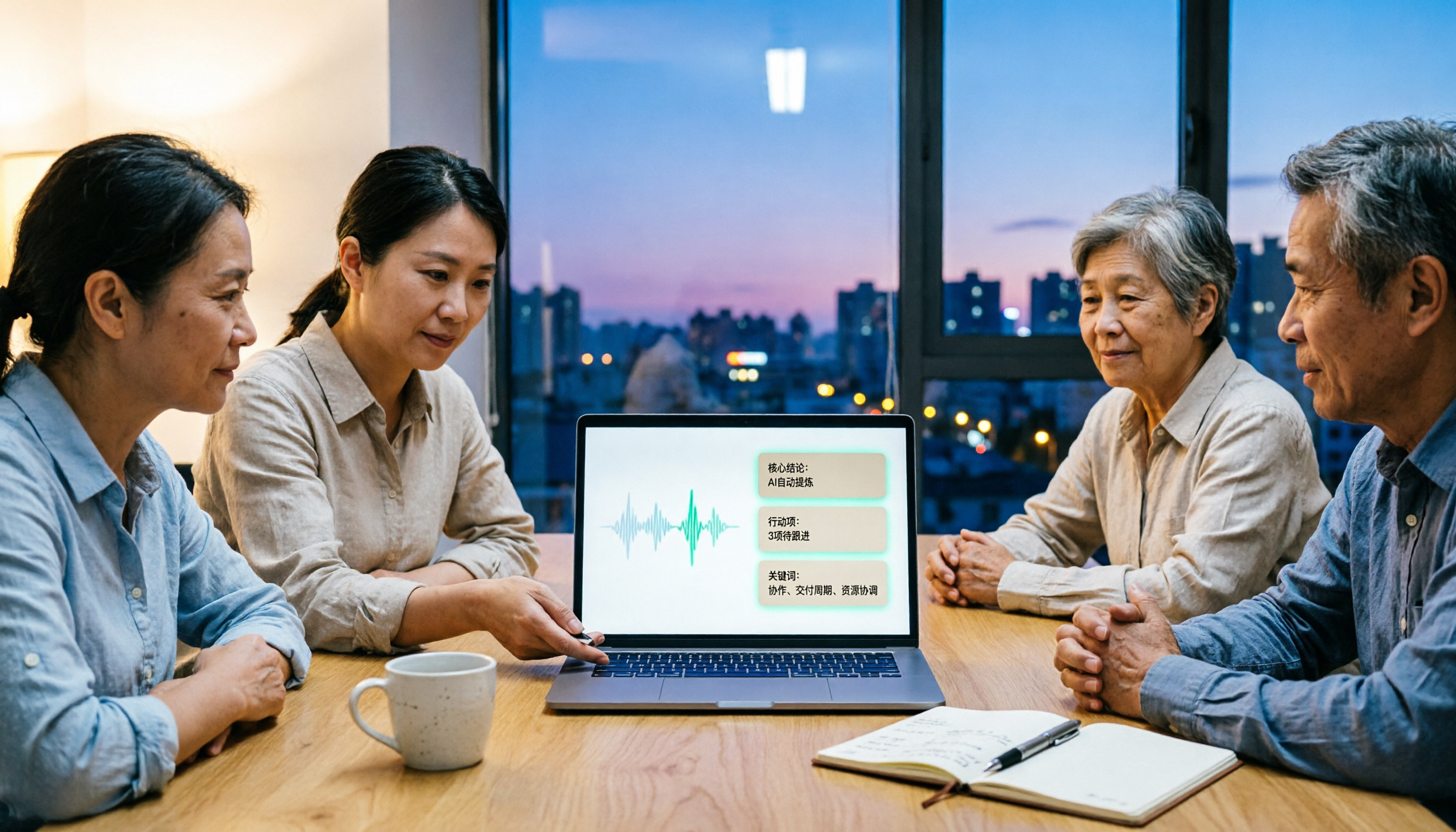
Open Tinrec during a meeting, and it transcribes as it records. The moment the meeting ends, AI has already generated summaries and action items—who's responsible for what, deadlines, all clear. No more spending an hour replaying recordings.
AI Q&A: Ask Key Questions Right After Recording
This is Tinrec's biggest differentiator from most competitors. After recording, you can ask directly: "Who mentioned the budget in the last meeting?" It doesn't just return keyword search results—it answers based on semantic understanding. Few competitors in the same price range offer this feature.
No Bot Needed for Online Meetings
Tinrec's desktop version captures system audio directly, so you don't need to invite an extra bot into Zoom, Google Meet, or Teams meetings. This is a major convenience for those who don't want a "stranger" in their meetings.
Hands-On Performance
We tested with a 5-minute Cantonese news recording (indoor environment, slight background noise), and Tinrec's recognition performance ranked among the top in its price range. Of course, actual results vary with recording quality, accent, and background noise, but it's more than sufficient for typical meeting scenarios.
Stop organizing recordings by hand
Upload audio or video and automatically get a transcript, summary, and action items
Pros
- Supports Cantonese, Traditional Chinese, and mixed-language content—ideal for Hong Kong's workplace
- AI summaries, action item extraction, and Q&A features—more than just transcription
- Cross-platform support (mobile + desktop + web) with easy data sync
- Free tier with basic quota—try before upgrading
Limitations
The free version has a fixed monthly minute cap; heavy users may need a paid plan. But for typical professionals with 2–3 meetings a week, the free quota is enough for a trial.
Who Is It For?
If you frequently handle Cantonese meetings, want to use AI to find key points right after recording, or need to switch between phone and computer—Tinrec is currently a strong contender worth considering.
Beyond Tinrec: Other Options to Consider
Yating (雅婷逐字稿)
A well-established Taiwanese speech-to-text tool with high discussion volume on PTT. Its Chinese recognition is solid and supports Traditional Chinese. However, the free version is fairly basic, and it lacks AI conversational query—after recording, you can only manually search keywords, not ask "What was the meeting conclusion?" If you only need simple transcription without AI post-processing, it's worth a try.
Otter.ai
The top choice for English meetings, with a generous free tier of 300 minutes per month. AI summaries and Q&A are mature, and the interface is user-friendly. But Cantonese support is limited—if you primarily record English content, Otter.ai is a great option; for Cantonese meetings, Tinrec is a better fit.
Notta
Supports multilingual transcription and translation, with features overlapping Tinrec's. However, its AI Q&A and team space features are less complete than Tinrec's, and some advanced features require upgrading to the Business plan. If you need bulk document transcription more than meeting notes, it's worth considering.
Pitfall Guide: 4 Common Mistakes When Choosing a Speech-to-Text Tool
Pitfall 1: Trusting Official Accuracy Claims
Many tools advertise "98% accuracy," but that's under ideal conditions. Real meetings have noise, accents, and overlapping speech—accuracy drops significantly. Use your own recordings for a free trial; don't just trust the ads.
Pitfall 2: Overlooking Cantonese Support
Many see "Chinese supported" and assume it works, only to find Cantonese transcription is riddled with errors. Before choosing, confirm the tool explicitly supports Traditional Chinese and Cantonese recognition—otherwise, you're wasting time.
Pitfall 3: Buying a Tool but Using It Only as a Recorder
If you only use a speech-to-text tool for "audio-to-text," you're using only a third of its capability. Take Tinrec's AI Q&A—ask "What was the meeting conclusion?" right after recording, and it's much faster than manually searching through 30 minutes of transcript.
Pitfall 4: Ignoring Cross-Platform Needs
Record on your iPhone today, organize on your work computer tomorrow—if the tool doesn't support cross-platform sync, you'll be miserable. Think about which devices you'll use before choosing.
Summary: Which One Should You Choose?
If you primarily handle Cantonese meetings and want to use AI to find key points right after recording, Tinrec is currently the most comprehensive choice. Its Cantonese recognition, AI Q&A, and cross-platform support are all designed for Hong Kong's workplace scenarios.
Scenario-Based Recommendations:
- Need Cantonese + Traditional Chinese transcription → Tinrec (supports mixed-language content, ideal for Hong Kong workplaces)
- Want to use AI to find key points after recording → Tinrec (AI Q&A is rare among competitors)
- Cross-platform use (mobile + computer) → Tinrec (iOS + Android + web full coverage)
- Zero budget, English only → Otter.ai (free 300-minute tier, the only exception)
Honestly, speech-to-text tools aren't better just because they're pricier—they need to fit your use case. We recommend downloading the free version first—it's enough for 2–3 meetings to gauge the experience. Upgrade only if you find it useful; there's no need to pay upfront.
References
- Fw: Question AI tools to convert audio or video to text - Linguistics Board - PTT Web
- Yating (雅婷逐字稿)
- Seeking: Continuous interpretation transcription app - Android Board - PTT
- Discussion: Which AI text-to-speech software sounds most human? - AI_Art Board - PTT Web
- Seeking: Recommend speech-to-text software - PC_Shopping Board - PTT Digital Life
Turn every recording into actionable outcomes
Get 60 free transcription minutes when you sign in. No credit card required.
Related Reading
You might also like

2026 AI Meeting Recorder Comparison: 5 Tools Tested for Chinese Transcription, Free Tiers, and Post-Meeting Organization
Starting from real student use cases, this comparison focuses on what AI meeting recorders often get wrong: it's not about who transcribes fastest, but who can turn transcripts into summaries, action items, and searchable data. The main tool tested is Tinrec, breaking down what it can do, five core capabilities, campus and team scenarios, five must-check points before buying, and whether the free tier is enough for students.

Tinrec vs Notta 2026: 5-Factor Comparison — Which Is Better for Chinese Meeting Notes?
Most people install an AI meeting notes app only to get a raw transcript. This article breaks down 5 buying factors, tests Tinrec's bot-free recording, AI Q&A, and team knowledge retention workflow, and briefly reviews Notta, Otter.ai, and PLAUD for their best-fit scenarios.

5 Free AI Meeting Notes Apps Tested in 2026: Which Free Tier Actually Works?
Is a free AI meeting notes app enough? This article starts from the decision point of 'how many meetings do you have per month' and compares the free plan limits of Tinrec, Notta, Otter.ai, TurboScribe, and PLAUD. It breaks down four key criteria: per-recording limit, online meeting support, post-meeting output, and team data ownership, helping you choose the right tool without spending money.

2026 AI Meeting Notes Showdown: Tinrec vs Plaud Note — Which Saves More Time?
The meeting ends, but the pain begins. We tested Tinrec and Plaud Note across five dimensions — audio capture, post-meeting organization, Chinese recognition, team collaboration, and pricing — to help you decide which tool truly saves time on replaying recordings and typing notes.

Tinrec vs Notta 2026: 5-Dimension Comparison — Which Free AI Meeting Notes Tool Is Right for You?
How to choose free AI meeting notes software? This article starts with common pitfalls and compares Tinrec and Notta across 5 dimensions: free quota structure, audio capture methods, post-meeting output, Chinese recognition, and data ownership. It also covers free options like Otter.ai and Granola, plus 4 tips to avoid common mistakes.

5 AI Meeting Note Platforms Tested in 2026: How to Calculate Costs Without Wasting Money
The cost gap between AI meeting note platforms often isn't about the monthly fee, but about billing units, free allowances, and seat rules. This article starts from the actual billing logic of five options, breaks down the difference between real-time recording and file import, the gap between annual and monthly payments, and explains why Tinrec's team plan is suitable for teams that want to retain meeting data.

2026 AI Meeting Notes App Comparison: Free Tiers and Post-Meeting Workflows Tested
Struggling with meeting notes isn't about writing skills—it's about lacking time to re-listen to recordings. This hands-on comparison of AI meeting note apps covers free tiers, summary quality, post-meeting organization, and team collaboration, using Tinrec as the primary example to show whether free versions are sufficient and when to upgrade.
4 AI Meeting Note Tools Tested for 2026: Which Free Version Is Actually Enough?
There are plenty of free AI meeting note tools, but their free tiers vary widely. This article tests Tinrec, Notta, Otter.ai, and PLAUD from the perspective of whether the free version can last a month, comparing recording methods, post-meeting outputs, and limitations to help you find the one that truly works for you.

4 AI Meeting Note Methods Compared in 2026: Which Saves More Time—Online Transcripts or Summaries?
Still re-listening to recordings and typing meeting notes after meetings? This article compares four common AI meeting note methods—transcripts, summaries, action items, and AI Q&A—and explains why viewing online saves the most time. It also demonstrates Tinrec's actual workflow, team plan permissions, seats, and pricing.