
Turn recordings into transcripts and summaries in minutes
Upload audio or video for multilingual transcription, AI notes, and action items
Bottom Line: Don't Just Grab Any GC Column
When expanding VOC analysis methods, many labs make the mistake of forcing a standard -5 or -624 column into service.
The result is either poor separation of low-boiling targets or ugly peak shapes after purge and trap injection.
Columns like VOCOL are designed to solve this problem, but choosing the wrong specs still wastes time.
This article cuts through the fluff and lays out the VOCOL series specs and applications you can find in the U.S. market.
What the VOCOL Column Actually Does
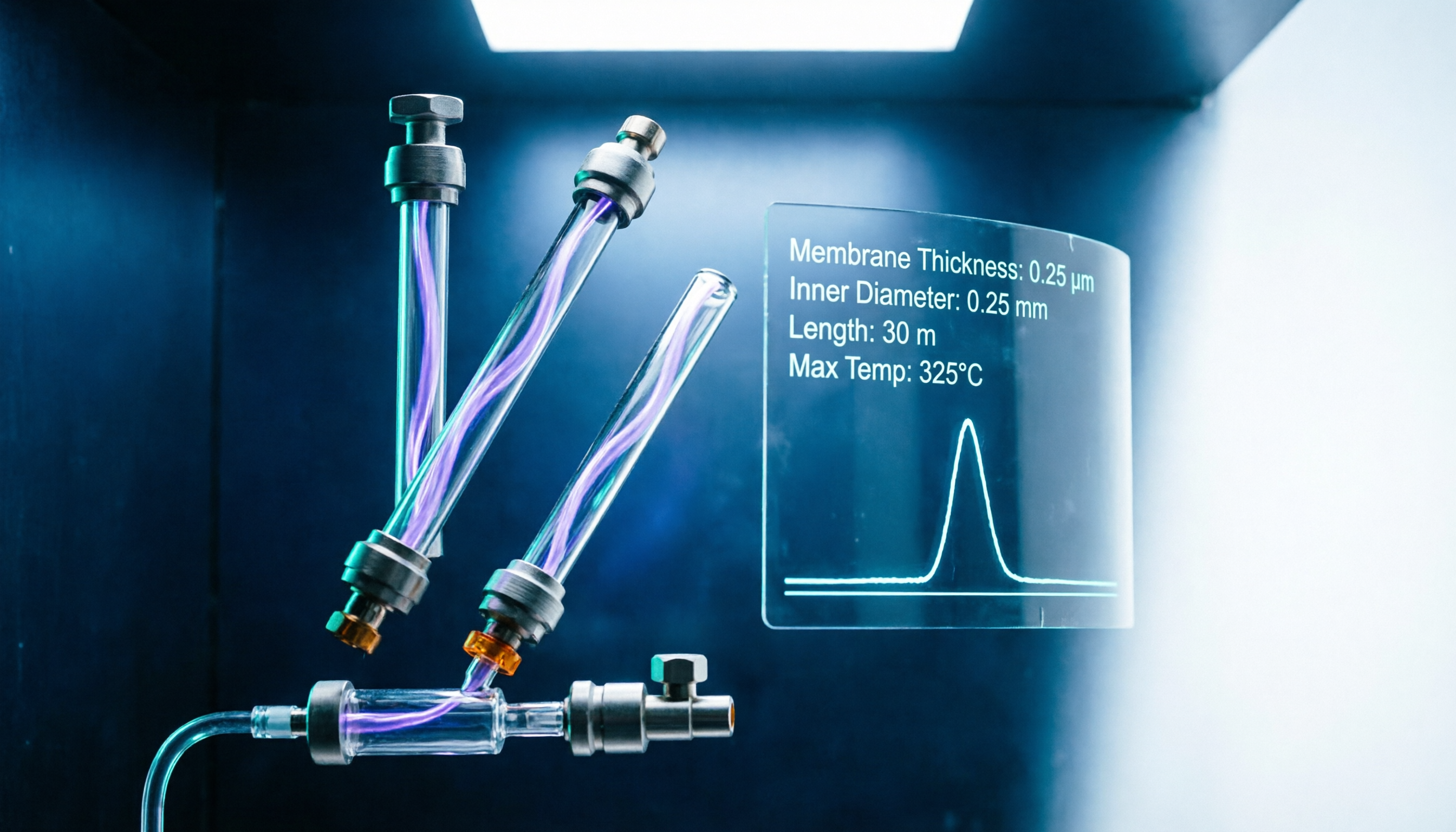
VOCOL is a medium-polarity capillary GC column with a stationary phase primarily composed of crosslinked diphenyl dimethyl polysiloxane.
It's designed for analyzing volatile organic compounds (VOCs), especially those that are highly volatile and poorly retained on standard columns.
There are two common ways to pair this column:
- Direct injection via the injector port
- Coupling with a purge and trap system
If your method already relies on purge and trap, VOCOL's compatibility is more straightforward than many general-purpose columns.
How to Choose Common Specs
Based on data from Fisher Scientific and Sigma-Aldrich, the VOCOL series commonly comes in these configurations:
- 30 m × 0.25 mm, 1.5 μm film thickness
- 60 m × 0.25 mm, 1.50 μm film thickness
- 0.53 mm inner diameter versions with varying film thicknesses
The 30 m and 60 m lengths are the two most frequently compared options.
From my experience: if you have many target compounds with a wide boiling point range, the 60 m column offers more separation capacity; but if you only need to quickly confirm a few highly volatile components, 30 m is usually sufficient.
Watch the Temperature Limit
VOCOL's stationary phase is bonded, and the temperature limit is listed in some spec sheets as:
- Up to 230°C for some configurations (isothermal or programmed)
- Some configurations can operate below room temperature
Stop organizing recordings by hand
Upload audio or video and automatically get a transcript, summary, and action items
This is a plus for analyzing low-boiling VOCs.
But honestly, a 230°C limit isn't particularly high. If your sample matrix is dirty and requires frequent high-temperature baking of the column, keep this in mind.
Why Some Labs Love VOCOL
According to Sigma-Aldrich data, the VOCOL column has been used in purge-and-trap GC/MS analysis of 34 volatile organic compounds.
It's also been cited for use in whole column cryotrapping for volatile compound determination.
These applications all point to the same thing: its ability to retain and resolve highly volatile compounds is its core value.
Not every column is suited for analyzing such extremely low-boiling targets.
3 Things to Confirm Before Buying
- Your injection method: Direct injection and purge and trap have different column requirements, so confirm your method source first.
- Your number of target compounds: More targets mean prioritize 60 m; fewer targets mean 30 m can save time.
- Your temperature program: Ensure the maximum temperature doesn't approach 230°C for extended periods, or column lifetime will suffer.
Summary: Who It's For, Who It's Not
If you're developing a VOC analysis method, especially with purge and trap or handling highly volatile targets, the VOCOL series is worth evaluating.
But if you're only doing typical semi-volatile organic compounds or high-boiling point samples, this column's temperature limit and medium polarity may not be the best fit.
Always cross-check against your method's required specs rather than ordering based solely on brand or model.
Before purchasing, always verify specs, part numbers, and availability on the supplier's page, as packaging and part numbers may vary by region.
References
- MilliporeSigma Supelco VOCOL Capillary GC Column, df 1.5 m Film Thickness: | Fisher Scientific
- MilliporeSigma Supelco VOCOL Capillary GC Column, df 3 m | Fisher Scientific
- VOCOL® Capillary GC Column L × I.D. 60 m × 0.25 mm, df 1.50 μm | Sigma-Aldrich
- MilliporeSigma Supelco VOCOL Capillary GC Column, df 1.5 m:Chromatography | Fisher Scientific
- VOCOL CAPILLARY GC COLUMN CAS#:
Turn every recording into actionable outcomes
Get 60 free transcription minutes when you sign in. No credit card required.
Related Reading
You might also like

2026 AI Meeting Notes Comparison: Vocol Contrast Settings and Post-Meeting Workflow
Vocol's public information does not list a standalone contrast setting; display adjustments are typically made through browser and system settings. This buying guide compares Vocol, Tinrec, Otter.ai, and Notta on Chinese meeting support, post-meeting organization, and team collaboration to help you decide whether to adjust display settings or switch workflows.

2026 Comparison of 3 Audio-to-Text Tools: Why Tinrec Is the Team Collaboration Alternative to Vocol.ai
A roundup of PTT discussions about Vocol.ai, comparing Vocol.ai and Tinrec across meeting capture, post-meeting organization, team seats, and export workflows, to help readers who need Chinese meeting notes and team collaboration evaluate alternatives.

2026 Voice Collaboration Platform Comparison: Vocol.ai vs. Tinrec and More
People on Dcard often discuss Vocol.ai, and some even resell vouchers. This article compiles public information about Vocol.ai and compares it with Tinrec from five angles: meeting capture, post-meeting organization, AI Q&A, team collaboration, and pricing, to help you decide which voice collaboration platform fits your workflow.

2026 AI Speech-to-Text Comparison: Vocol Per-Minute Pricing vs. Tinrec Team Quotas
Tired of piling up meeting recordings you never transcribe? This guide digs into Vocol.ai's free tier, subscription pricing, and third-party test results, then compares Tinrec, Otter.ai, and Notta on billing and post-meeting workflows. Includes per-minute cost calculations and 3 common billing traps to help you pick the most cost-effective tool for your needs.

2026 AI Meeting Notes Tools Compared: Vocol AI vs Tinrec and How to Choose
Dcard has plenty of discussion about Vocol AI, but what really determines usability is the workflow after transcription. This article starts with the most common pitfalls and compares Vocol AI, Notta, Otter.ai, and Tinrec in terms of meeting recording methods, AI summaries and follow-up questions, team collaboration, and actual pricing to help you pick the right AI meeting notes tool for your team.

2026 AI Meeting Notes Tools Compared: How to Go from Transcript to Minutes with Minimal Time
Tired of spending as much time organizing meeting notes as attending the meeting? This article breaks down the 4 key factors for choosing an AI meeting notes tool and 5 practical steps, based on real workflows. It also compares Tinrec, Granola, Notta, and Otter.ai, with tips to avoid pitfalls and selection advice.

Vocol.ai Review and Tinrec Comparison Test 2026: How to Choose a Chinese Meeting Notes Tool in 3 Key Areas
In 2026, many people compare meeting notes tools by transcription accuracy alone, overlooking that post-meeting organization is where the real time is spent. This article starts with common misconceptions, explains Vocol.ai's positioning in 2025, and uses Tinrec as an example to break down bot-free recording, AI summaries, action item extraction, team spaces, and key purchase considerations.

Tinrec vs Notta 2026: 5-Dimension Comparison — Which AI Meeting Notes Tool Saves More Effort?
Most people get stuck writing AI meeting notes not because of the tool, but because they treat transcripts as notes. This article starts with common pitfalls, outlines 5 key dimensions for AI meeting notes, provides a ready-to-use three-part summary and What/Who/When action item framework, and compares Tinrec with Notta, Otter.ai, and Granola on Chinese meetings, bot-free recording, and post-meeting organization.

2026 AI Meeting Recorder Comparison: Vocol vs. Tinrec and How to Adjust Comparison Weights
People searching for "Vocol contrast adjustment" usually aren't looking to tweak screen brightness—they want to know how AI meeting recorder tools differ. This article compares Vocol and Tinrec in real meeting scenarios, explains how to adjust comparison weights, and breaks down Tinrec's bot-free recording, real-time translation, AI summaries, and team workspace features.