

Turn recordings into transcripts and summaries in minutes
Upload audio or video for multilingual transcription, AI notes, and action items
What Can ChatGPT Voice-to-Text Transcription Do for You?
Last semester, I took a class where the professor talked fast and flipped through slides even faster. I tried taking handwritten notes, but when I opened my notebook before the midterm, I couldn't understand a thing I'd written. Later, I started using voice-to-text transcription and realized the problem wasn't that I wrote too slowly—it was that I was stuck in the inefficient habit of "copying sound into words."
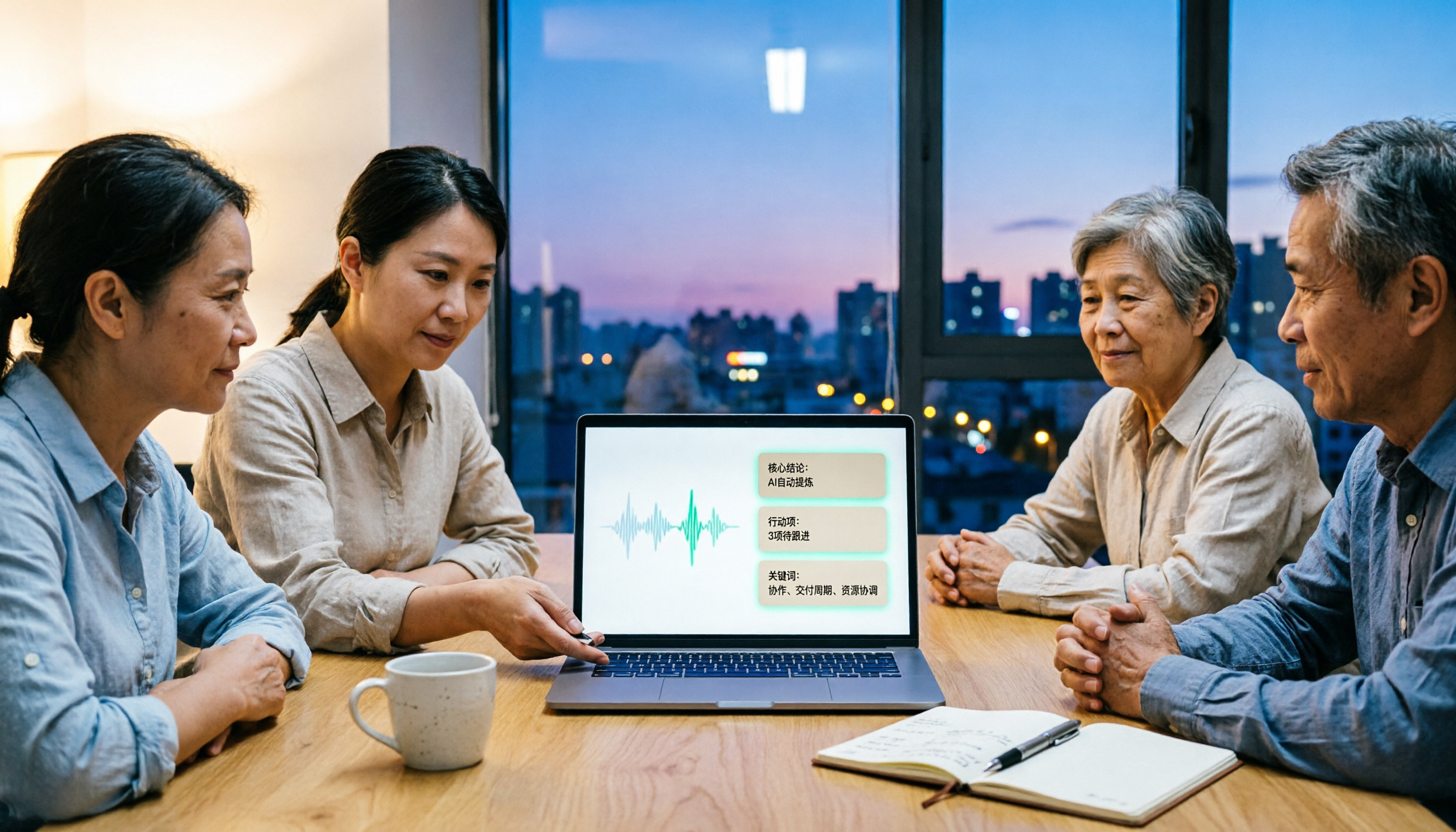
Here's my current approach: First, I use a tool to convert the audio into text, then I have AI help me turn the messy transcript into notes that are readable, searchable, and review-friendly. Take Tinrec, for example—it doesn't just convert recordings into transcripts; it also auto-generates summaries, chapters, and action items. After a lecture recording ends, I can directly ask it, "What exam points did the professor emphasize in this class?" without having to listen through the entire recording again.
Scenario 1: Turning lecture recordings into key notes In the past, I relied on handwriting, but after two hours of class, my hand would be sore and my mind exhausted. Now, I record lectures in class, and Tinrec converts the audio to text in real time. After class, I use AI to organize the transcript into structured key points, so I can review the cleaned-up content directly.
Scenario 2: No more post-meeting arguments in group discussions The worst part of group discussions is when no one remembers the conclusions afterward. Our group's solution: we keep Tinrec recording during discussions. It automatically extracts action items, listing who's responsible for what and the deadlines clearly—no more asking in the group chat, "So, who's doing what now?"
Scenario 3: Speaking practice before interviews or internship interviews When preparing for internship interviews, I record my self-introduction, convert it to a transcript, and then ask AI to review where my delivery sounds awkward or where I could add examples. This is way more useful than practicing in front of a mirror because you see what you actually said, not what you thought you said.
What Are the Core Capabilities of Voice-to-Text Transcription?
Real-time transcription: It generates text as you record, not after the recording finishes. Tinrec's real-time transcription lets me watch the text during class to confirm I haven't missed key points—especially when the professor suddenly says, "This will be on the exam," I don't miss the next sentence because I'm looking down taking notes.
AI summaries and chapters: With a two-hour recording, the hardest part is knowing where to start when organizing. Tinrec automatically splits the recording into chapters and generates summaries. When reviewing before finals, I first look at the summary to grasp the main theme of the class, then go back to listen to specific segments I'm unsure about—saving a ton of time.
AI Q&A: This is my most-used feature. After transcription is complete, I can directly ask Tinrec, "What's the format for the final report the professor mentioned?" or "Did this class mention the exam scope?" It answers based on the transcript content, so I don't have to manually search through the entire text.
Action item extraction: In group meetings or discussions with my advisor about projects, the biggest fear is missing "what you need to revise." Tinrec automatically organizes action items from the discussion, so I know what to do next instead of forgetting everything after the meeting.
Multi-format export: The organized notes can be exported to Notion or Google Docs, integrating with my existing study workflow. I usually export Tinrec's summaries and action items to Notion and keep them alongside my project materials.
Practical Use Cases
Lecture recording: From not understanding to having readable key points
During class, I keep Tinrec recording on my phone or laptop. It converts audio to text in real time, and after class, I don't rush to organize—I let AI generate a summary first. If I have questions about a specific part, I use the AI Q&A feature to ask, like, "What was the professor's example illustrating?" This is more reliable than borrowing a classmate's notes because their notes might miss key points too.
Group discussions: Turning chatter into an action list
The worst part of group discussions is when there's no conclusion afterward. Our group's approach: we keep Tinrec on during discussions, and it automatically organizes the transcript into key points and action items. After the meeting, I drop the action list into the group chat, and it's clear who's doing what. Before, we'd discuss for two hours and then spend another half hour trying to recall the conclusions; now Tinrec saves us that time.
Stop organizing recordings by hand
Upload audio or video and automatically get a transcript, summary, and action items
Interviews and speaking practice: Seeing what you actually said
When preparing for internship interviews, I record my self-introduction and answers to common questions. After Tinrec converts them to transcripts, I ask AI to analyze where my tone sounds off or where answers are too long-winded. This is more convenient than asking a classmate to listen because I can revise repeatedly until the transcript looks concise enough.
Online courses and lectures: No need to re-listen to entire recordings
Some online courses don't provide transcripts, so I use Tinrec's desktop version to record computer audio. After recording, I generate summaries and chapters, then only listen to key segments when reviewing. This is super practical for students juggling multiple courses—no need to listen to every lecture from start to finish.
5 Things to Consider When Choosing a Voice-to-Text Tool
Real-time transcription and organization: Converting speech to text is just the first step; what matters is whether it helps you organize afterward. Tinrec doesn't just provide transcripts—it auto-generates summaries, chapters, and action items, saving me the effort of organizing manually.
Is the free tier enough? Students care most about this. Tinrec's free version offers basic credits, suitable for occasional transcription of a recording. If you're like me and record lectures every week, consider the Pro monthly or annual plan. The annual plan works out cheaper per month, offering better value for long-term use.
Does it support Chinese and mixed Chinese-English content? Some classes are taught in Chinese, but the materials and technical terms are in English. Tinrec's Chinese transcription and mixed-language content organization are really useful for students like me in information management—no worries about technical terms being transcribed incorrectly.
Can you export to common tools? If your organized notes can only stay in the app, you lose half the value. Tinrec supports export to Notion, Google Docs, and other tools, letting me integrate meeting notes and class key points into my existing study system.
Cross-platform use: I use a laptop at school and a phone during my commute. Tinrec has web, desktop, and mobile versions, so I can record and view transcripts across different devices without being tied to one.
Frequently Asked Questions
Can voice-to-text transcription achieve 100% accuracy? You shouldn't expect that. Actual performance is affected by recording quality, background noise, accents, and multiple people speaking at once. Tinrec provides high-quality transcription with clear audio and common scenarios, but for important content, it's still recommended to cross-check the transcript against the audio playback.
Is the free version enough for students? It depends on how much you record each week. If you only record a key class or two occasionally, the free tier's basic credits are a good starting point. If you're like me and record lectures every week plus group discussions, the free version might not be enough—consider the Pro monthly or annual plan, which works out to about the cost of a bubble tea per month.
After converting a recording to a transcript, how do I quickly organize it into notes? My workflow: First, I record with Tinrec and convert to text in real time. Then, I have AI generate a summary and chapters. Next, I use the AI Q&A feature to ask about sections I don't understand. Finally, I export the key points and action items to Notion, keeping them with my other study materials.
Do I need to ask the professor before recording a lecture? Rules vary by school and professor, so it's best to check first. Some professors don't mind students recording for personal notes, while others have explicit restrictions. Either way, getting consent before recording is the safer approach and shows basic courtesy.
What's the difference between a voice-to-text tool and a regular recording app? A regular recording app just captures the audio; you still have to organize it yourself. Tools like Tinrec go further by converting the recording to text, auto-generating summaries, chapters, and action items, and letting you ask questions about the content. In short, one stores files, the other turns files into usable data.
Conclusion
Voice-to-text transcription isn't new, but "what you do after transcription" is where the real time savings come in. Before, I'd still spend a lot of time organizing after recording. Now, with Tinrec's real-time transcription, AI summaries, and Q&A features, I can quickly turn lecture and group discussion records into notes that are reviewable and searchable.
If you often feel like you can't keep up with note-taking in class and don't want to re-listen to recordings, try Tinrec's free version first. Record a class or two, organize them into key points, and see what it's like not to scramble with handwritten notes. Once you try it, you might end up recommending it to your whole study group, just like I did.
References
- 5 Tips for Using ChatGPT to Quickly Turn Meeting Voice Transcripts into Perfect Articles and Tables
- How to Use the ChatGPT App's Voice-to-Text for Meeting Minutes or Notes to Boost Output Efficiency - TNL The News Lens
- Use AI to Quickly Generate Meeting Voice Transcripts, and It's Completely Free! #ChatGPT
- The Ultimate Workflow: ChatGPT Voice-to-Text Transcription, Then Organize into Notes - GenApe
- Use the ChatGPT App for Voice Notes: A Secret Weapon to Boost Output Efficiency
Turn every recording into actionable outcomes
Get 60 free transcription minutes when you sign in. No credit card required.
Related Reading
You might also like

2026 AI Meeting Recorder Comparison: 5 Tools Tested for Chinese Transcription, Free Tiers, and Post-Meeting Organization
Starting from real student use cases, this comparison focuses on what AI meeting recorders often get wrong: it's not about who transcribes fastest, but who can turn transcripts into summaries, action items, and searchable data. The main tool tested is Tinrec, breaking down what it can do, five core capabilities, campus and team scenarios, five must-check points before buying, and whether the free tier is enough for students.

Tinrec vs Notta 2026: 5-Factor Comparison — Which Is Better for Chinese Meeting Notes?
Most people install an AI meeting notes app only to get a raw transcript. This article breaks down 5 buying factors, tests Tinrec's bot-free recording, AI Q&A, and team knowledge retention workflow, and briefly reviews Notta, Otter.ai, and PLAUD for their best-fit scenarios.

5 Free AI Meeting Notes Apps Tested in 2026: Which Free Tier Actually Works?
Is a free AI meeting notes app enough? This article starts from the decision point of 'how many meetings do you have per month' and compares the free plan limits of Tinrec, Notta, Otter.ai, TurboScribe, and PLAUD. It breaks down four key criteria: per-recording limit, online meeting support, post-meeting output, and team data ownership, helping you choose the right tool without spending money.

2026 AI Meeting Notes Showdown: Tinrec vs Plaud Note — Which Saves More Time?
The meeting ends, but the pain begins. We tested Tinrec and Plaud Note across five dimensions — audio capture, post-meeting organization, Chinese recognition, team collaboration, and pricing — to help you decide which tool truly saves time on replaying recordings and typing notes.

Tinrec vs Notta 2026: 5-Dimension Comparison — Which Free AI Meeting Notes Tool Is Right for You?
How to choose free AI meeting notes software? This article starts with common pitfalls and compares Tinrec and Notta across 5 dimensions: free quota structure, audio capture methods, post-meeting output, Chinese recognition, and data ownership. It also covers free options like Otter.ai and Granola, plus 4 tips to avoid common mistakes.

5 AI Meeting Note Platforms Tested in 2026: How to Calculate Costs Without Wasting Money
The cost gap between AI meeting note platforms often isn't about the monthly fee, but about billing units, free allowances, and seat rules. This article starts from the actual billing logic of five options, breaks down the difference between real-time recording and file import, the gap between annual and monthly payments, and explains why Tinrec's team plan is suitable for teams that want to retain meeting data.

2026 AI Meeting Notes App Comparison: Free Tiers and Post-Meeting Workflows Tested
Struggling with meeting notes isn't about writing skills—it's about lacking time to re-listen to recordings. This hands-on comparison of AI meeting note apps covers free tiers, summary quality, post-meeting organization, and team collaboration, using Tinrec as the primary example to show whether free versions are sufficient and when to upgrade.
4 AI Meeting Note Tools Tested for 2026: Which Free Version Is Actually Enough?
There are plenty of free AI meeting note tools, but their free tiers vary widely. This article tests Tinrec, Notta, Otter.ai, and PLAUD from the perspective of whether the free version can last a month, comparing recording methods, post-meeting outputs, and limitations to help you find the one that truly works for you.

4 AI Meeting Note Methods Compared in 2026: Which Saves More Time—Online Transcripts or Summaries?
Still re-listening to recordings and typing meeting notes after meetings? This article compares four common AI meeting note methods—transcripts, summaries, action items, and AI Q&A—and explains why viewing online saves the most time. It also demonstrates Tinrec's actual workflow, team plan permissions, seats, and pricing.