
Turn recordings into transcripts and summaries in minutes
Upload audio or video for multilingual transcription, AI notes, and action items
Faced with lengthy online course videos or hour-long video conferences, manually typing up transcripts is not only time-consuming but also extremely painful as you repeatedly replay sections to find key points. Especially in cross-language scenarios or when there are no built-in subtitles, accessing video information becomes very difficult.
This article will outline the mainstream "video to text free" and advanced tool options for 2026, providing a complete comparison table across 6 key dimensions: language support, real-time capability, summary and action items, AI query, export and integration, and free usage limits. It also includes specific actionable steps and a FAQ section.
Quick Navigation Advice: If you only need basic plain text extraction and don't mind formatting, consider using YouTube's built-in feature or editing software first. If you value subsequent key point extraction and need to convert "time-based content" into "searchable, actionable decision summaries," tools with a complete workflow like Tinrec (formerly "Seconds to Record") are worth evaluating.
1. Current Pain Points in Traditional Video Transcription
Many people encounter three major bottlenecks when processing videos or audio files:
- Low information density, high cost of re-listening: To catch one key conclusion, you often need to re-watch over 10 minutes of video.
- Only transcripts, no "decision summary": Most free tools on the market only provide dense, unformatted text, requiring significant post-meeting or post-class time to organize to-do lists and conclusions.
- Cross-platform and device limitations: Many people record audio or watch videos on iPhones but find a lack of good real-time transcription apps on mobile, or an inability to directly parse online video links.
2. Comparison Table of 4 Video-to-Text Tools (Minimum Decision Table)
We selected 4 common video-to-text solutions currently on the market and evaluated them based on the dimensions that matter most to users:
| Comparison Dimension | YouTube Built-in Transcription | CapCut | Open-source Whisper Model | Tinrec |
|---|---|---|---|---|
| Input Support | YouTube URL only | Local video files | Local audio/video files | Real-time recording, files, online video URLs |
| Language Support | Depends on uploader or system | Supports major languages | Supports multiple languages | 10 languages including Chinese, English, Japanese, Korean, German, Taiwanese, Cantonese |
| Summary & Action Items | None | None | None | Auto-generate meeting minutes and action items |
| AI Query | None | None | None | Semantic AI chat query supported |
| Export & Integration | Copy plain text | Export SRT subtitles | TXT / SRT | Multi-format file export |
| Price / Free Tier | Completely free | Basic transcription free | Free (requires high hardware specs) | 100 minutes free recording conversion per month |
3. In-depth Analysis and Selection Guide
1. Built-in and Editing Tools: Suitable for Creators Who Simply Need Subtitles
For video creators, the built-in speech-to-text feature in editing software like CapCut is very practical, mainly solving the "subtitle" problem. However, the text output from such tools is often short phrases with timestamps, requiring significant post-processing effort to organize into readable articles or meeting minutes.
Stop organizing recordings by hand
Upload audio or video and automatically get a transcript, summary, and action items
2. AI Smart Workflow: Ideal as a "Second Brain" for Professionals and Students
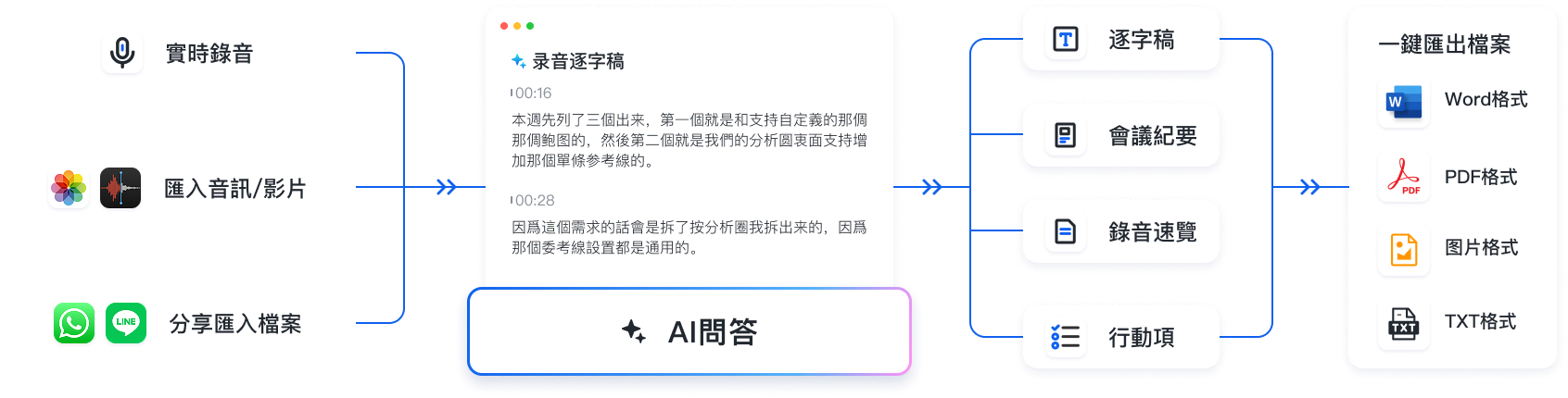
If your goal is "knowledge acquisition" or "work records," the tool's value should not stop at producing a transcript. Tinrec, for example, differentiates itself by offering a complete workflow "from recording → understanding → action." After transcription, the system distinguishes speakers and directly extracts key decision points. Users no longer need to "search through a document" but can directly ask AI questions about the video content, which is especially helpful for absorbing long podcasts or cross-border meeting records.
4. Hands-on Guide: 4 Steps to Turn Videos into High-Value Notes
Below we use a multi-scenario tool as an example to show how to convert video and audio content from different sources into usable text records:
Step 1: Real-Time Speech-to-Text for Recording (Suitable for Live Streams or Online Meetings)
When you are watching a live stream without subtitles or participating in an impromptu voice meeting, you can turn on real-time transcription. The system will instantly recognize the language (supports multiple dialects such as Taiwanese Hokkien, Cantonese, and foreign languages) and synchronously output text, so you don't have to wait.
- How to use: Open the real-time transcription interface, press the record button, and you can read the key content while listening.
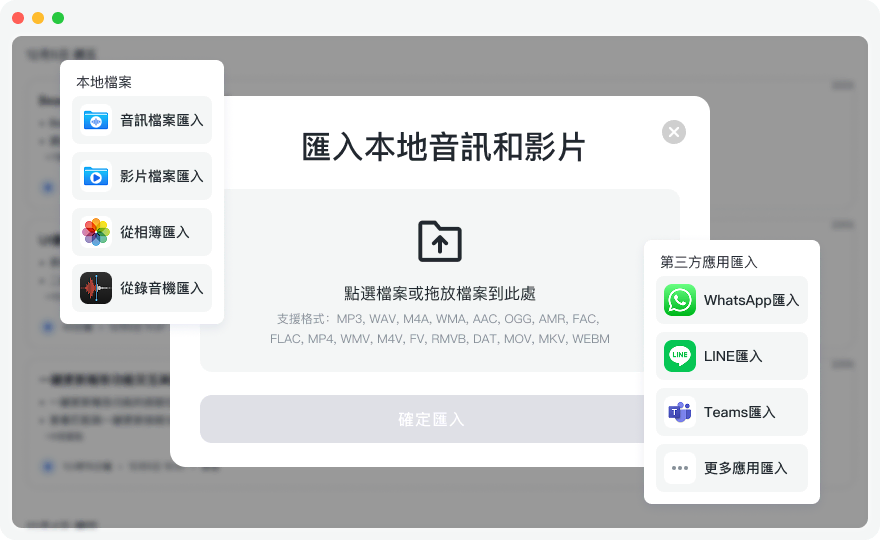
Step 2: Upload and Parse Audio/Video Files
If you already have recorded classroom sessions (MP4/MP3, etc.) on your phone or computer, you can directly upload them. The system will perform speaker diarization and chapter segmentation, which is especially convenient for organizing group discussions.
- How to use: Go to the audio-to-text feature, drag and drop your local file, and wait a few minutes to get the full transcript.
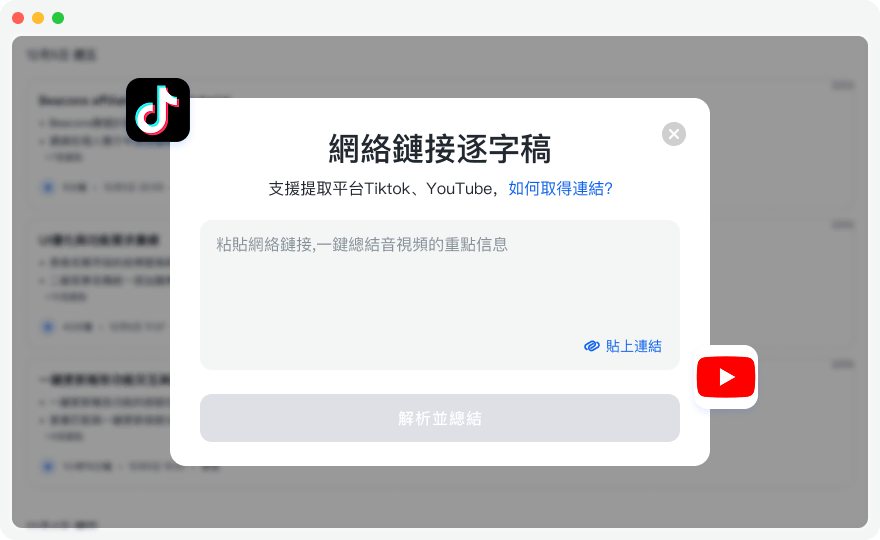
Step 3: One-Click Transcription of Online Video Links
When you find a useful YouTube tutorial video or podcast webpage, you don't need to download the video first; just copy the URL to start parsing.
- How to use: Use the podcast/online video to text feature, paste the video link, and the AI will automatically pull the audio track and generate a summary.
Step 4: Use AI Chat to Query Key Information
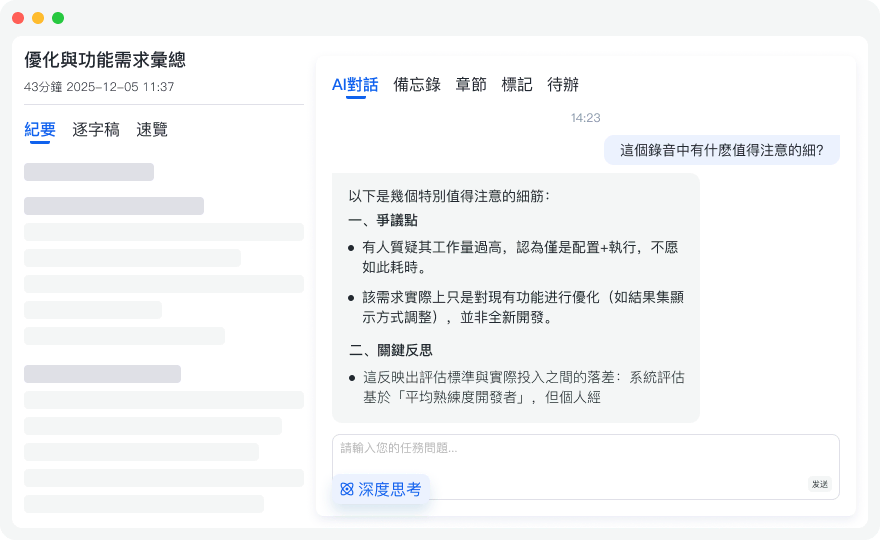
When a transcript is tens of thousands of words long, using AI Q&A is the most efficient approach. For example, directly ask "What are the three marketing strategies mentioned in this video?" or "What are the to-do items the boss just assigned?"
- How to use: After generating the record, click on the AI chat query section and ask questions in natural language to quickly retrieve information.

5. FAQ: Common Questions About Video-to-Text
Q1: Are there free tools for converting videos to text on mobile (e.g., iPhone)?
iOS's built-in voice input is limited for long videos. We recommend using apps that support multi-device sync (iOS/Android/Web), so you can record or paste a video link on your phone and seamlessly view the organized text and action items on your computer.
Q2: What's the fastest way to transcribe Teams or Google Meet video meetings?
If your company version doesn't have built-in advanced AI transcription, you can use a web or mobile "real-time recording" tool during the meeting to capture audio, or upload the meeting recording afterward to get speaker-separated transcripts and AI meeting minutes.
Q3: How much free transcription time do these tools usually offer? Is it enough?
Free allowances vary greatly. Many fully free tools may compromise on accuracy or lack summaries, while those offering complete AI summaries typically provide a basic allowance (e.g., up to 100 minutes free per month), which is quite sufficient for light users or one-time tests. You can expand with a plan if needed.
Q4: Can AI understand technical jargon or mixed languages in the video?
Current mainstream AI models are already very good at recognizing mixed Chinese and English. If the tool supports automatic multi-language recognition (e.g., auto-identifying 10 languages like Chinese, English, Japanese), it can greatly reduce manual correction when processing overseas educational videos or multinational meetings.
Q5: Can the transcript distinguish between different speakers?
Yes. Tools equipped with speaker diarization technology can automatically identify different voices in a conversation and label content as Speaker A, Speaker B, etc., which is crucial for interview recordings or multi-person project discussions.
Q6: Can online videos be transcribed without downloading?
Some tools offer URL parsing. As long as the platform is supported (e.g., YouTube or common podcast links), entering the URL will trigger cloud processing, saving your device's storage and computing resources.
Turn every recording into actionable outcomes
Get 60 free transcription minutes when you sign in. No credit card required.
Related Reading
You might also like
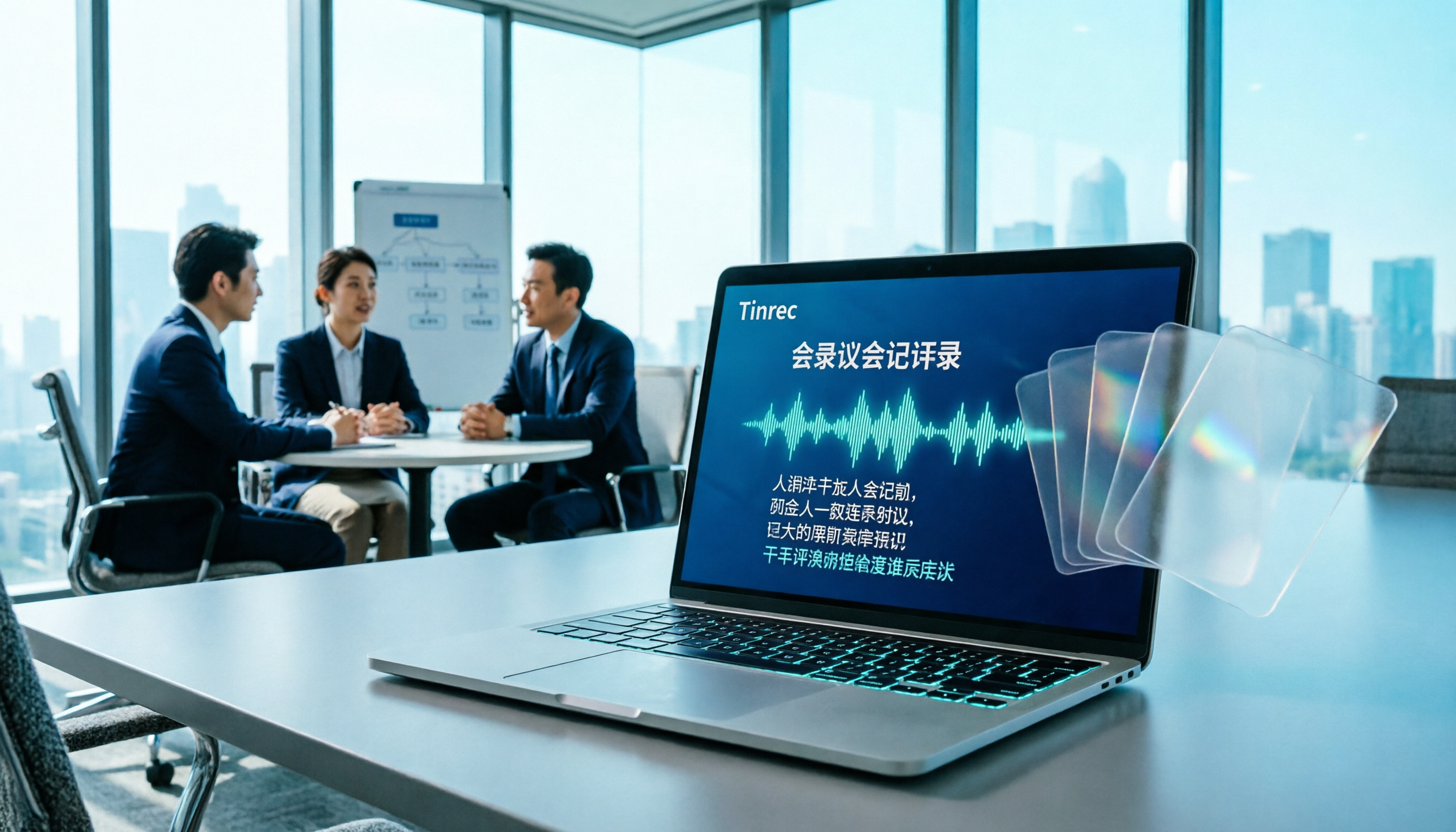
Tinrec vs Notta 2026: 5-Dimension Comparison - Which Is Better for Chinese Meeting Notes?
Spending two hours in a meeting and another two organizing the notes? This article compares Tinrec and Notta across 5 dimensions to help you decide which online AI meeting notes app suits Chinese users best, with tips to avoid common pitfalls and buying advice.

2026 Free AI Meeting Minutes Solutions: 3 Tools Compared
Tired of spending two hours on meeting notes? This hands-on review from a mid-level manager's perspective covers the free plans of Tinrec, Otter.ai, and Notta, helping you decide which fits your meeting habits best.
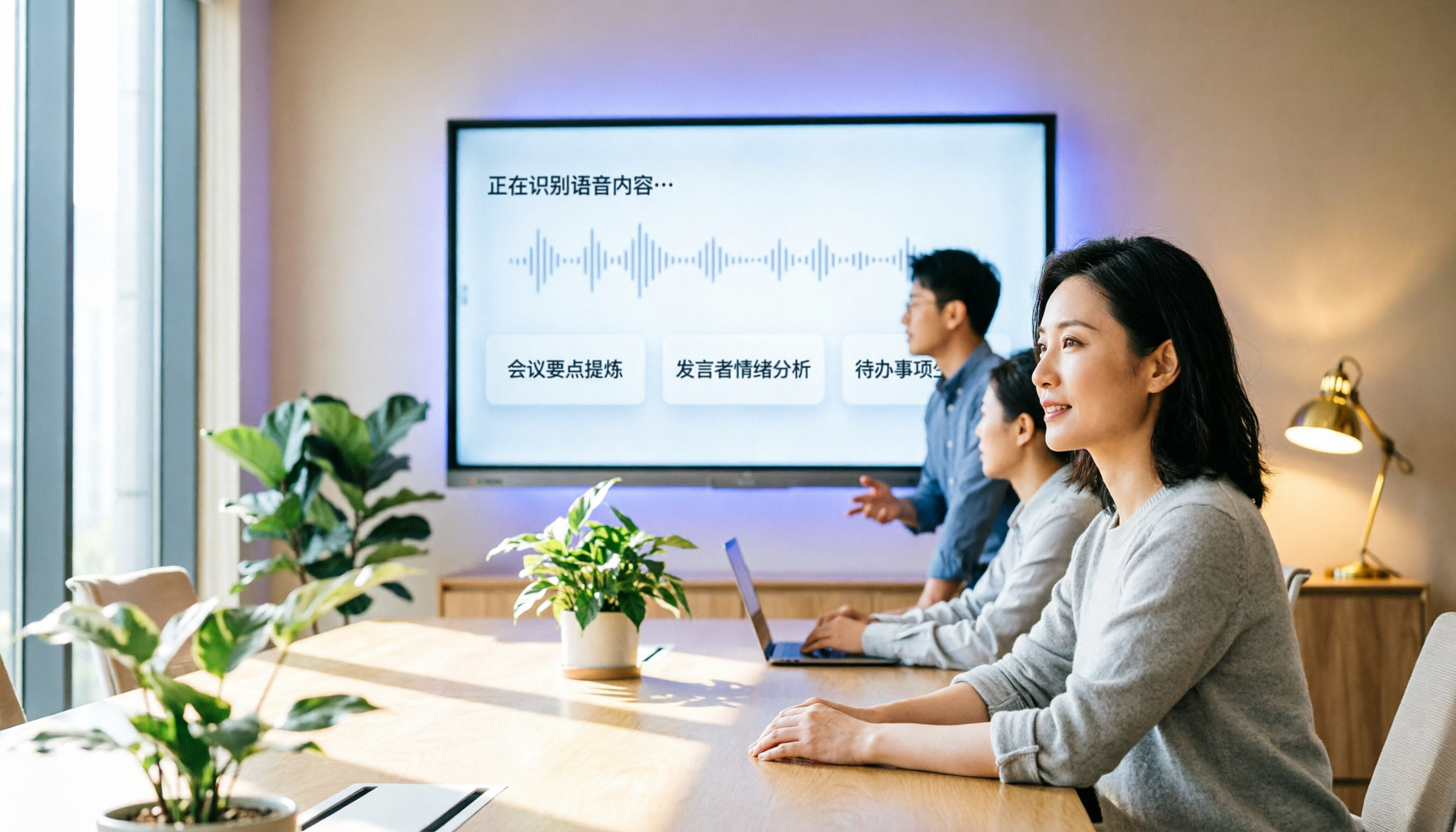
5 Best AI Meeting Minutes Platforms in 2026: A Hands-On Comparison for Chinese Meetings and Team Collaboration
Tired of manually replaying and transcribing meeting recordings? This article compares 5 AI meeting minutes platforms—from Tinrec to Notta, Otter, Fireflies, and Granola—covering free plans, core features, and ideal use cases to help you find the most time-saving meeting tool.

2026 Review of 5 Online AI Meeting Minute Tools: How Tinrec Turns Meetings into Searchable Assets
Tired of spending hours on meeting notes? This hands-on review, featuring Tinrec's instant recording, compares 5 common online meeting minute solutions, covering bot-free recording, AI summaries, action items, and team spaces to help you pick the right tool.

The Complete Guide to AI Meeting Notes in 2026: Comparing 5 Tools and Refining Your Selection Criteria
Taking meeting notes is time-consuming and easy to miss key points? This article tests 5 AI meeting note tools including Tinrec, from bot-free recording, Chinese transcription, AI Q&A to team spaces, helping you refine your comparison criteria and choose the right tool to boost productivity.

5 Best AI Meeting Recorders Tested in 2026: Which One Works Best for Chinese Meetings and Team Collaboration?
Struggling with meeting notes and post-meeting cleanup? This hands-on comparison of 5 AI meeting note tools, led by Tinrec, covers bot-free recording, Chinese transcription, AI summaries, and team collaboration to help you decide which one is worth it.

2026 Tinrec Smart Meeting Minutes Review: Cantonese Transcription, AI Auto-Generated To-Dos
Tired of spending hours after meetings transcribing recordings? We tested Tinrec, a smart meeting minutes app that uses AI to save you overtime. It supports Cantonese transcription, auto-generates to-dos, and can record online meetings without a bot.

2026 Smart Meeting Minutes Tools Compared: Hands-On Test of 5, Why Tinrec Is Our Top Pick
Spending two hours in a meeting and another two hours writing up the minutes? This article evaluates Tinrec, Otter.ai, Notta, PLAUD Note, and others based on practical criteria like bot-free recording, Chinese transcription, AI post-processing, and team collaboration, to tell you which one is most worth using.

The Complete Guide to AI Meeting Notes Apps in 2026: Auto-Generated Summaries, Action Items, and Team Collaboration
This guide starts by addressing common pitfalls, helps you understand the key factors in choosing an AI meeting notes app, and shares hands-on experience with Tinrec (秒听录音) on how it uses bot-free recording, AI summaries, and team collaboration to save you time after meetings.