
Turn recordings into transcripts and summaries in minutes
Upload audio or video for multilingual transcription, AI notes, and action items
Every day after long Cantonese meetings, replaying recordings and transcribing takes up half the day? Plus, Cantonese often mixes English and colloquial phrases, causing traditional recognition software to produce garbled results.
This article reviews the latest tools in 2026 that support "Cantonese Speech-to-Text," providing a detailed comparison table, core evaluation, practical implementation steps, and common FAQs. Also, while there are many great "Text-to-Speech (TTS)" tools online like Speechma, Lovevoice, and Natural Reader, to solve workplace and learning recording pain points, you need an efficient "Speech-to-Text (STT)" solution.

Quick navigation: If you only need simple short inputs, built-in phone features will suffice. If you value "directly generating decision summaries and to-do lists after meetings" and need high-accuracy Cantonese recognition, consider tools like Tinrec that offer AI-driven complete workflow.
The Pain Point: Why is Organizing Cantonese Recordings So Exhausting?
In workplace and learning scenarios, processing Cantonese voice recordings often faces these hurdles:
- Mixed Code Recognition Difficulty: Cantonese speakers naturally mix in English words (e.g., "This project's deadline needs to be pushed"). Most single-language models struggle to switch smoothly, resulting in garbled transcripts.
- Traditional Tools Only Provide Transcripts, Not Key Points: Even if voice is successfully converted to text, combing through thousands of words to find "who said what" and "what needs to be done" is still exhausting and low in information density.
- Lack of Action Item Extraction: After meetings or interviews, there's often no directly usable to-do list, so recordings are just saved without turning into productivity.
Comparison of Common Cantonese Speech-to-Text Tools in 2026
To address these pain points, multiple solutions have emerged. Below is a comparison of 4 common tools to help you choose based on your needs:
| Evaluation Dimension | iPhone/Mac Built-in Dictation | CapCut | Whisper (Third-party Open Source) | Tinrec |
|---|---|---|---|---|
| Cantonese/Multilingual Support | Supports Cantonese, but struggles with mixed code | Supports Cantonese recognition | Supports Cantonese, high recognition rate | Supports 10 languages auto-detection, handles mixed code well |
| Real-time Transcription | Yes | No (requires importing video/audio) | Depends on third-party software | Supports real-time transcription during recording |
| Summary & Action Items | No | No | No (transcript only) | Auto-generates meeting notes, conclusions, and to-do items |
| AI Conversation Query | No | No | No | Supports semantic AI conversation query |
| Export & Integration | No (manual copy) | Export as subtitle (SRT) | TXT / SRT | Multi-format export, supports iOS/Android/Web |
| Price & Free Tier | Free | Free / Paid advanced features | Depends on third-party platform | Free tier (up to 100 min/month), paid subscription available |
Tinrec In-Depth Review: Complete Solution from Recording to Action
From the comparison table, for simple subtitles or short text, traditional tools are adequate. But for intensive meeting or course recording, whether the tool can "understand content" becomes crucial. Tinrec's core differentiator is not just transcription, but building a workflow from "Recording → Understanding → Action."
Stop organizing recordings by hand
Upload audio or video and automatically get a transcript, summary, and action items
- Accurate Cross-language and Cantonese Processing: Supports auto-detection of 10 languages including Chinese, English, Cantonese, and Japanese, greatly reducing the effort of organizing cross-border meetings or foreign language courses.
- Auto-generated Decision Summaries: Most tools only provide transcripts, while Tinrec automatically organizes meeting minutes and actionable to-do items after transcription, letting users see next steps at a glance.
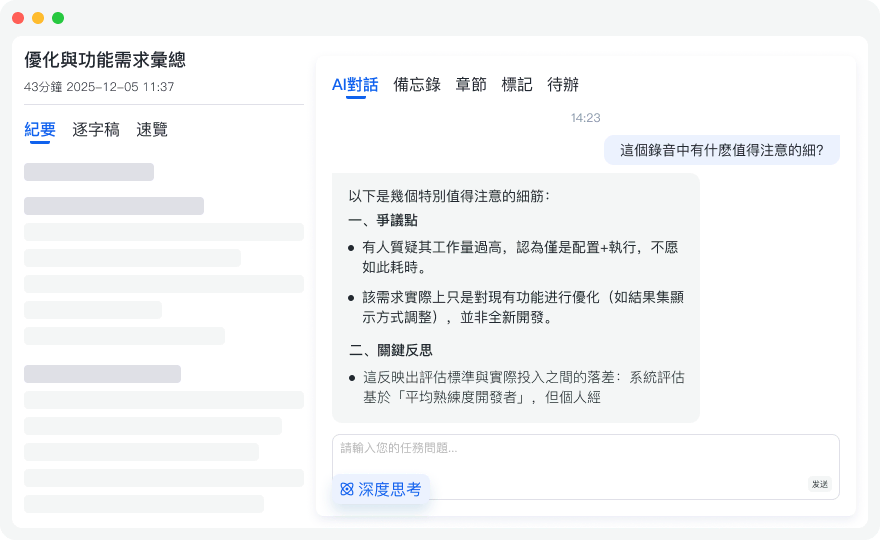
- AI Conversational Retrieval: Traditional transcripts require Ctrl+F keyword search. Tinrec supports intelligent conversation based on recording content. You can ask questions directly (e.g., "What was the budget number the boss mentioned?") and get key points like asking a personal assistant, saving time searching.
Practical Guide: 4 Steps to Convert Cantonese Speech to Text
Whether for meeting recordings or online videos, you can turn audio into structured notes with these standard steps:
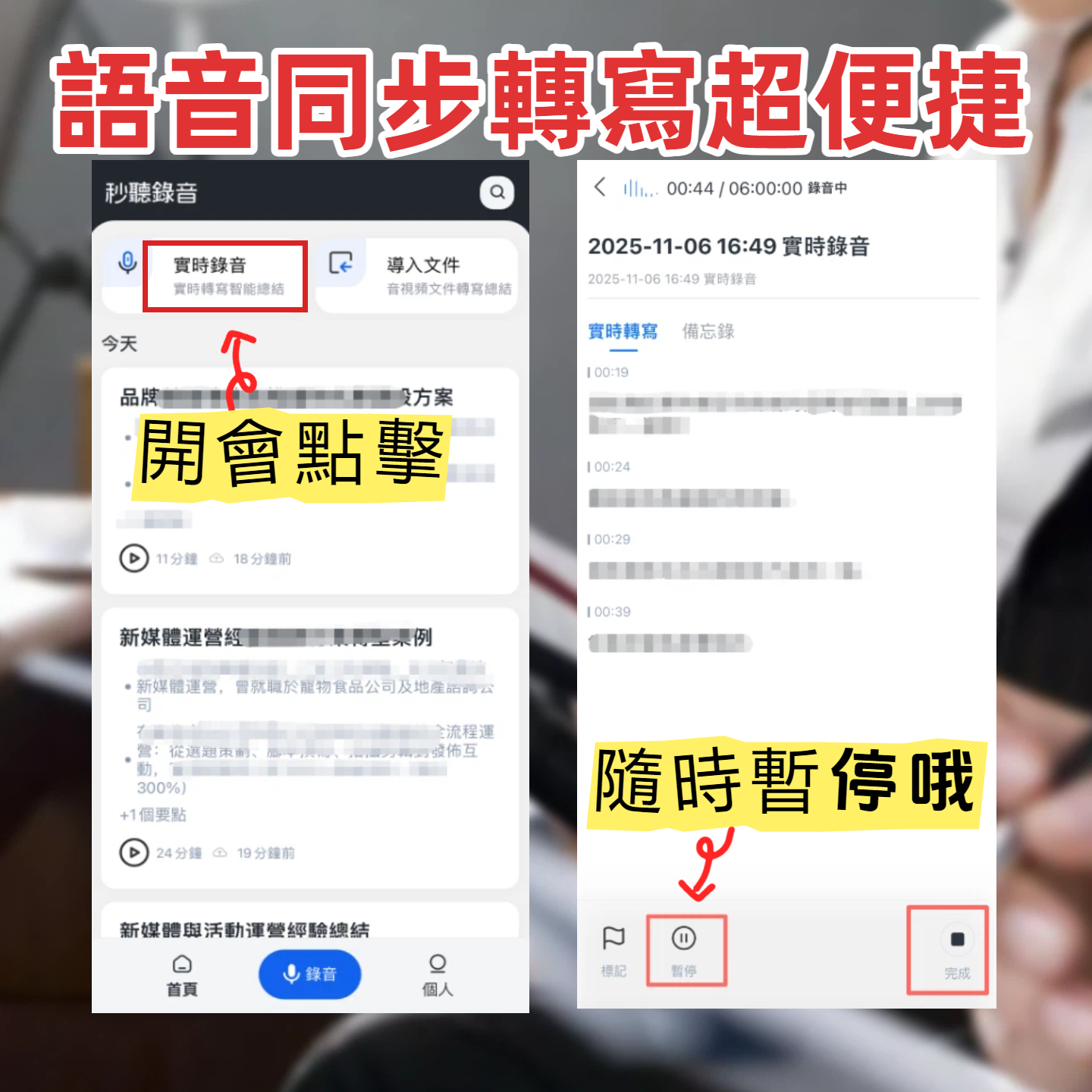
Step 1: Real-time Voice to Text
During remote meetings or in-person classes, enable real-time recording transcription. Go to the real-time transcription feature (https://tinrec.com/home ), and the system will convert your Cantonese speech to text instantly, no waiting required, perfect for keeping up with meeting progress.
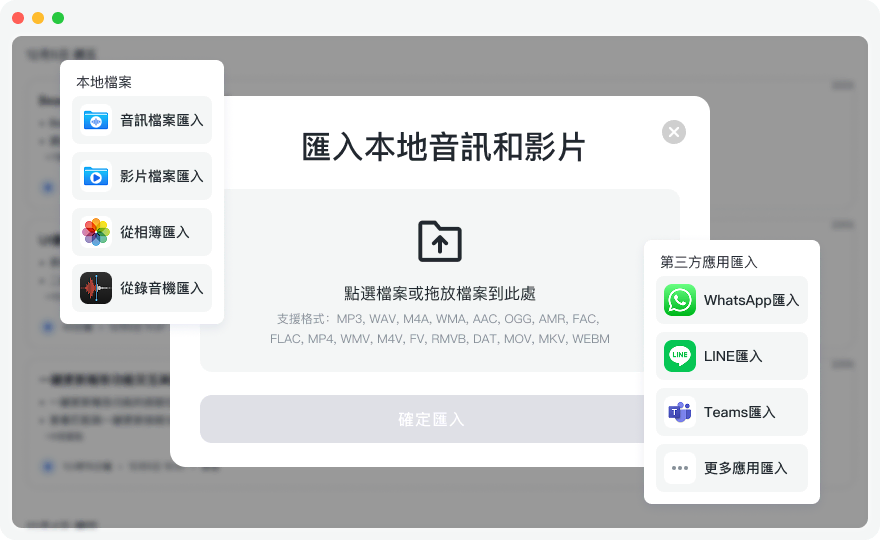
Step 2: Audio File to Text
If a colleague shares a meeting recording, go to the audio-to-text interface (https://tinrec.com/features/audio-to-text ). Upload the file, and the system will produce a Cantonese transcript and automatically extract AI meeting summaries and to-do items.
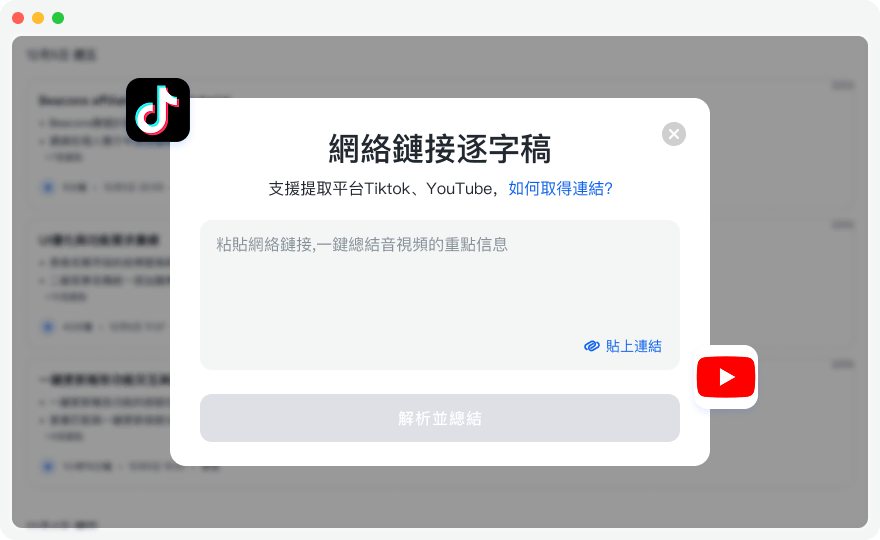
Step 3: Podcast/Online Video to Text
For YouTube Cantonese tutorials or podcast interviews, you don't need to download large video files. Go to the video-to-text feature (https://tinrec.com/features/video-to-text ), paste the URL, and quickly parse content to generate key notes.
Step 4: AI Conversation to Query Key Content
Facing a one-hour transcript, use AI conversation query (https://tinrec.com/features/ai-chat ). Type your question in the chat box, and AI will give precise answers based on recording context, making knowledge retrieval easy.

Frequently Asked Questions (FAQ) about Cantonese Speech-to-Text
Q1: Does iPhone have built-in Cantonese speech-to-text? Is it suitable for meetings? iPhone keyboard has built-in Cantonese dictation, convenient for short messages. However, for meetings lasting over 30 minutes, built-in dictation often stops due to pauses, cannot distinguish speakers or generate summaries, making it unsuitable for heavy meeting transcription.
Q2: Can Teams or Google Meet video calls transcribe Cantonese in real time? Current mainstream video conferencing software supports English transcription best; Cantonese accuracy still needs improvement. It's recommended to pair with an external AI recording assistant that supports multiple platforms (Web/PC/Mobile) to capture audio simultaneously and convert to text during meetings.
Q3: Can AI tools accurately recognize mixed-code Cantonese (English and Cantonese)? This depends on the underlying language model. Traditional software often force-translates English words into phonetically similar Chinese characters. AI tools with multilingual auto-detection can judge context to determine when to use Cantonese or English, greatly improving recognition accuracy.
Q4: Are there free Cantonese transcription tools? Yes, many tools offer free tiers. For example, Tinrec's free version provides up to 100 minutes of recording per month, enough for occasional personal use. For long-term needs, consider the Basic plan starting at $4.9/month.
Q5: After transcription, how do I quickly extract meeting to-do items from just the transcript? Traditional approach is manually reading through the transcript. A more efficient solution is to choose an AI tool with "decision summary" and "action item extraction" features that automatically list follow-up to-do items.
Q6: Can I convert online Cantonese YouTube tutorial videos directly into text notes? Yes. Use a tool that supports URL parsing—simply input a YouTube or podcast URL, and AI will handle the capture and transcription in the cloud, skipping download and conversion steps.
Turn every recording into actionable outcomes
Get 60 free transcription minutes when you sign in. No credit card required.
Related Reading
You might also like

5 Best AI Meeting Note Tools Tested in 2026: Which One Turns Recordings into Usable Meeting Minutes?
We tested 5 AI meeting note tools, comparing speech-to-text, AI summaries, team collaboration, and pricing to help you find the best fit for your workflow, with sample meeting minutes included.

2026 Hands-On Comparison of 2 AI Meeting Note Tools: Tinrec vs Granola – Which Is Better for Chinese Meetings?
Struggling with meeting notes? This comparison of Tinrec and Granola, two bot-free AI meeting tools, tests them across five key areas: recording methods, file import, Chinese language support, post-meeting workflow, and team management, to help you pick the best solution for Chinese meetings and team collaboration.

2026 Free AI Meeting Minutes Platforms Compared: 5 Tools Reviewed
A 2026 comparison of free AI meeting minutes platforms, hands-on testing 5 tools including Tinrec, analyzing free quotas, Cantonese transcription, AI Q&A, and team features to help you save time and avoid overtime.

6 Best AI Meeting Recorder Apps of 2026: Hands-On Comparison for U.S. Professionals
This hands-on comparison reviews Tinrec, Notta, Otter.ai, Fireflies.ai, Granola, and TurboScribe, covering transcription, summarization, pricing, and team features to help you choose the right AI meeting assistant.

2026 Free AI Meeting Minutes Solutions: 4 Tools Compared
A 2026 roundup of free AI meeting minutes plans, comparing Tinrec, Notta, Otter, and Granola. We help you choose the right tool based on bot-free recording, Chinese language support, post-processing, and team collaboration.
Tinrec vs Notta 2026: 5-Dimension Comparison - Which Is Better for Chinese Meeting Notes?
Spending two hours in a meeting and another two organizing the notes? This article compares Tinrec and Notta across 5 dimensions to help you decide which online AI meeting notes app suits Chinese users best, with tips to avoid common pitfalls and buying advice.

2026 Free AI Meeting Minutes Solutions: 3 Tools Compared
Tired of spending two hours on meeting notes? This hands-on review from a mid-level manager's perspective covers the free plans of Tinrec, Otter.ai, and Notta, helping you decide which fits your meeting habits best.
5 Best AI Meeting Minutes Platforms in 2026: A Hands-On Comparison for Chinese Meetings and Team Collaboration
Tired of manually replaying and transcribing meeting recordings? This article compares 5 AI meeting minutes platforms—from Tinrec to Notta, Otter, Fireflies, and Granola—covering free plans, core features, and ideal use cases to help you find the most time-saving meeting tool.

2026 Review of 5 Online AI Meeting Minute Tools: How Tinrec Turns Meetings into Searchable Assets
Tired of spending hours on meeting notes? This hands-on review, featuring Tinrec's instant recording, compares 5 common online meeting minute solutions, covering bot-free recording, AI summaries, action items, and team spaces to help you pick the right tool.