
Turn recordings into transcripts and summaries in minutes
Upload audio or video for multilingual transcription, AI notes, and action items
When watching online courses or videos that are often one to two hours long, manually taking notes can consume a lot of time and energy. Traditional note-taking methods are not only tedious but also prone to missing important information, especially when the video doesn't have captions—rewinding and replaying can be frustrating.
This article provides an in-depth review of popular video summary apps and speech-to-text tools, along with a detailed multi-dimensional comparison table, step-by-step tutorials, and FAQs to help you build an efficient knowledge management workflow.
Quick navigation suggestion: If you just need a quick mind map from Bilibili videos in your browser, choose the "BiliBili Video Summary Tool"; if you value cross-scenario support (physical meetings, YouTube, podcasts) and automatic extraction of action items after meetings, and want AI Q&A capabilities to query content directly, consider all-in-one recording assistants like "Tinrec".
Why You Need a Powerful Video Summary App
1. Overcome the Low Information Density of Time-Based Content
Whether it's a long video or an audio recording, they are "time-based content," meaning you have to spend the same amount of time as the video to get the full information. A qualified video summary app can instantly convert this content into scannable, searchable, and actionable text, significantly reducing the cost of re-listening.
2. Break Through Language Barriers
Many high-quality learning resources or industry insights come from abroad. For language learners or researchers, a summary tool with multilingual translation capabilities not only provides transcripts but also helps quickly grasp the cultural context and core points of foreign videos.
2024 In-Depth Comparison of Popular Video Summary Apps & Tools
With so many tools on the market, we've selected the most talked-about solutions for an objective comparison to help you understand their positioning.
Option 1: BiliBili Video Summary Tool (Bilibili Ecosystem Focused)
This is a web-based tool designed specifically for the Bilibili platform, known for fast parsing. Simply input a video link, and the tool typically generates a deep summary, mind map, and transcript within 5 seconds. According to real users (such as college students, content creators, and market analysts), the mind map feature is very helpful for organizing creative ideas and market insights. It supports multilingual translation (English, Japanese, Korean, French, etc.) and allows export to PDF or Word, making it ideal for heavy Bilibili users.
Option 2: Tinrec Instant Recording (Multi-Scenario Complete Workflow)
Tinrec is a multi-platform AI recording assistant. Its differentiator is not just speech-to-text but a complete workflow from recording to understanding to action. Besides parsing online videos (supports YouTube, etc.), it offers real-time recording-to-text capabilities and automatically generates meeting minutes and action items (to-do lists). For professionals managing meeting decisions or diving into content details, its built-in AI chat query makes searching for key points as intuitive as asking a personal assistant.
Core Evaluation Comparison Table
| Dimension | BiliBili Video Summary Tool | Tinrec (Instant Recording) | Traditional Speech-to-Text App |
|---|---|---|---|
| Use Cases | Mainly Bilibili video analysis | Physical meetings, online courses, YouTube/podcasts, audio files | Basic recording transcription |
| Language Support | Chinese, English, Japanese, Korean, French, etc. | Auto-detects 10 languages including Chinese, English, Japanese, Korean, German, Taiwanese, Cantonese | Usually only 1-2 major languages |
| Real-Time Support | No (based on existing videos) | Real-time transcription during recording | Partial support |
| Summary & Action Items | Deep summary & mind map | Auto-generates meeting minutes, conclusions, and action items | Mostly just raw transcript |
| AI Q&A Interaction | AI chat for content discussion | AI chat query based on semantics | Not available |
| Export & Integration | Export as PDF, Word; save to workspace | Multi-format export, cross-device sync (iOS/Android/Web) | Basic text copy only |
| Pricing & Free Tier | Free basic version; premium ad-free version available | Free: 100 min/month; Paid: from $4.9/month (600 min) | Varies; usually very limited free minutes |
Stop organizing recordings by hand
Upload audio or video and automatically get a transcript, summary, and action items
Step-by-Step Tutorial: 4 Steps to Unlock the Full AI Potential of Video Summary Apps
Using Tinrec as an example (feature-rich), here are 4 common scenarios and steps to get started quickly.
Step 1: Parse Online Videos, Get Key Points with One Click
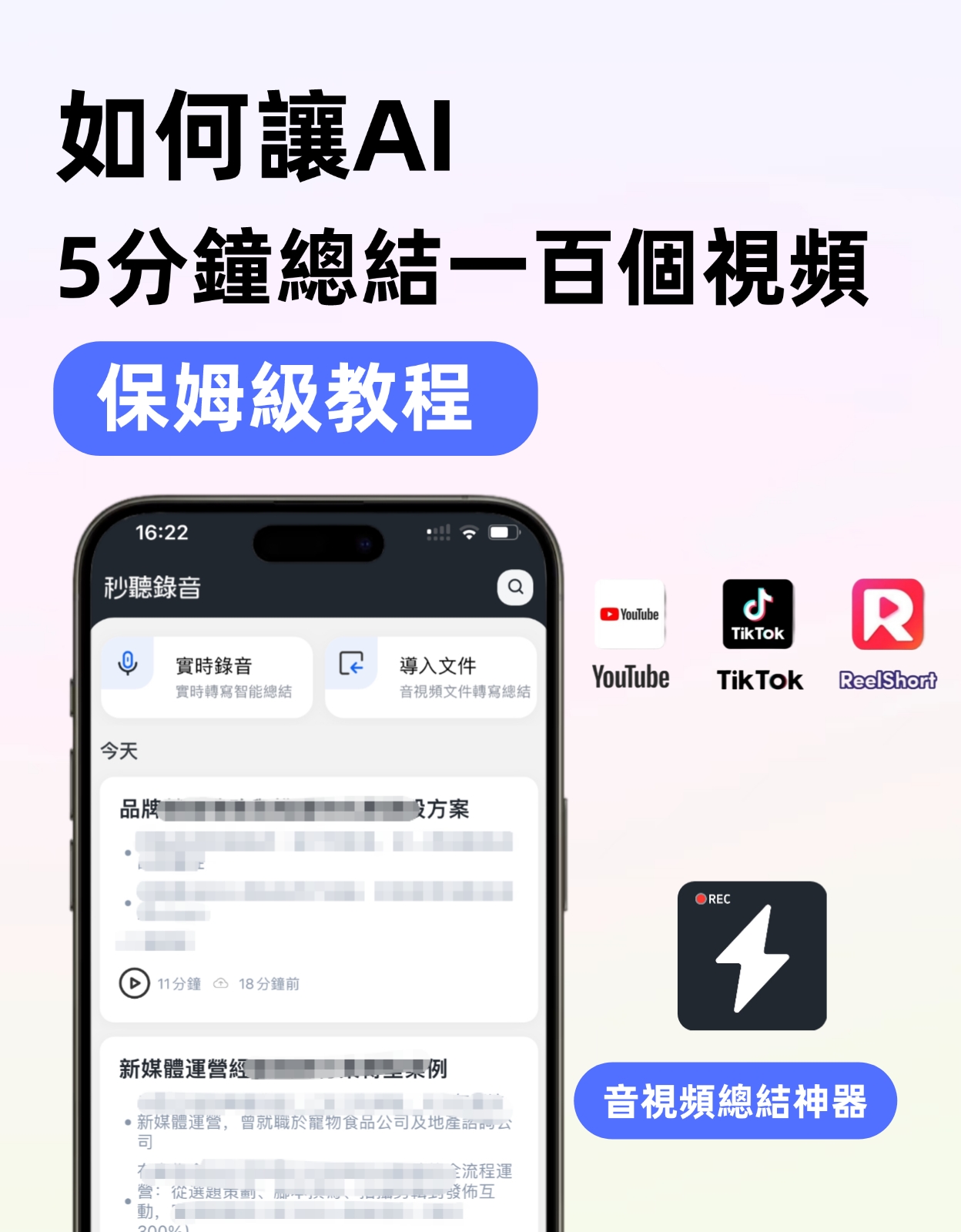
For creators or students, you don't need to watch entire YouTube or podcast videos from start to finish. Use the Podcast/Online Video to Text feature, directly input the URL, and the system quickly converts the content into text, auto-generating a transcript and AI summary.
Step 2: Real-Time Recording to Text, Capture Live Insights
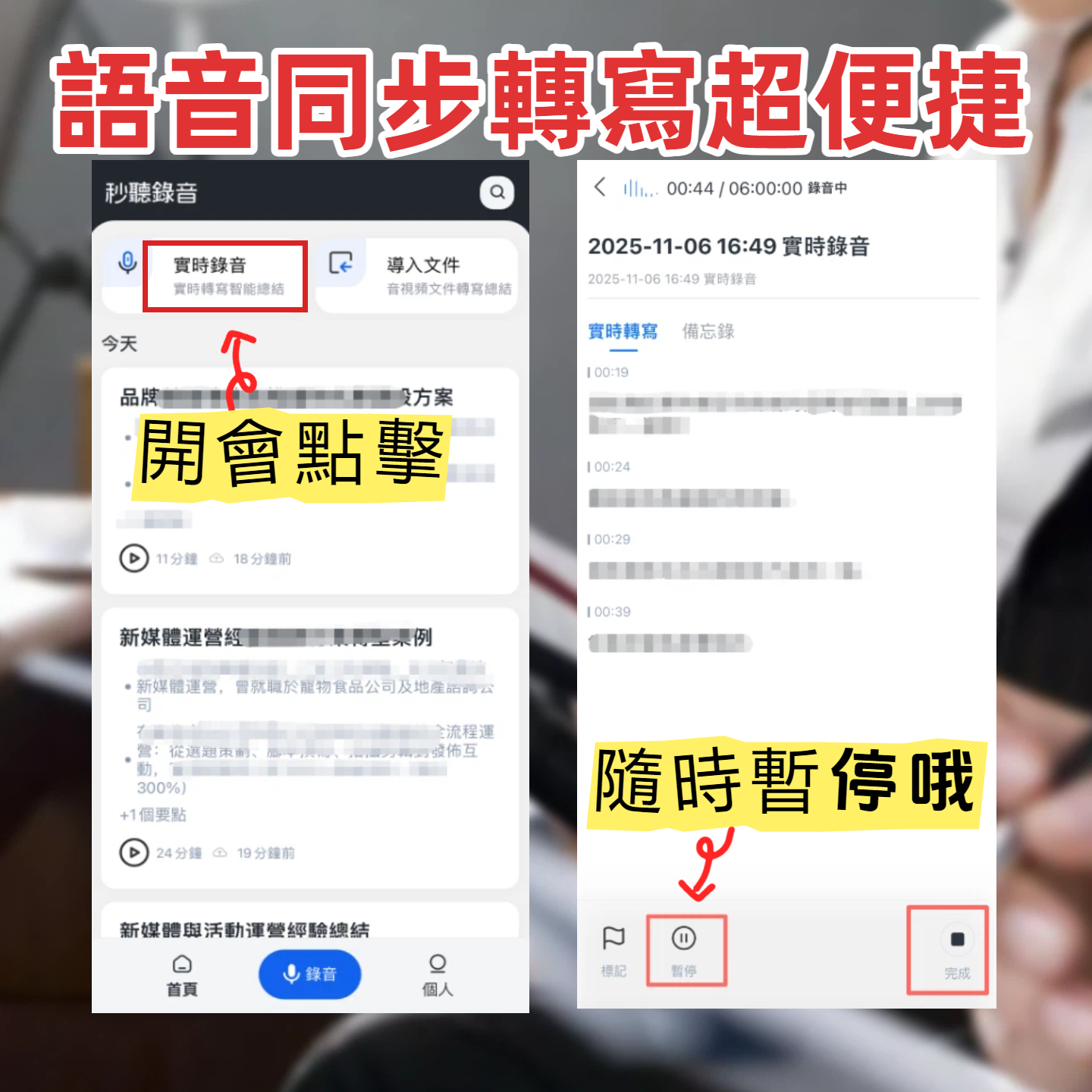
In a classroom or physical meeting, open the mobile app and use the Real-Time Recording to Text feature. The system converts speech to text instantly while recording, with no waiting. You can mark key points anytime, and when the meeting ends, the full transcript and action list are ready simultaneously.
Step 3: Upload Historical Audio Files, Auto-Generate Transcripts
If you have interview recordings or past meeting audio files, use the Audio File to Text feature to upload various formats. AI quickly differentiates speakers and organizes a structured transcript, drastically reducing manual typing.
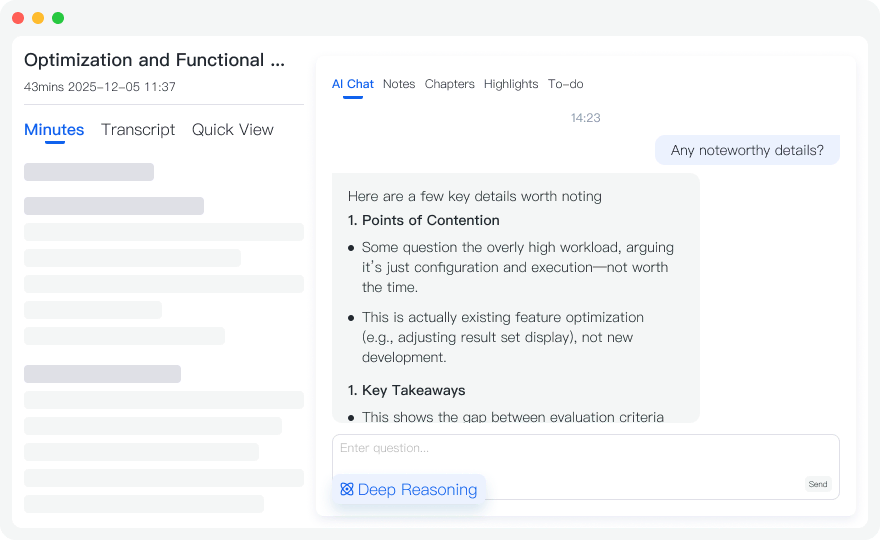
Step 4: Use AI Chat Query to Find Answers Like Asking an Assistant
Traditional transcripts rely on Ctrl+F to search keywords. But if you want to ask, "What was the boss's conclusion on Project A?", simply use the AI Chat Query feature to have an intelligent conversation based on the recording content. The AI quickly retrieves and answers questions, making it easy to grasp key points.

Selection Guide: How to Evaluate a Summary Tool for You?
- Look Beyond Transcription to "Output Quality": A good tool shouldn't just turn speech into a block of text. Check if it offers speaker differentiation, paragraph splitting, and action item extraction.
- Check "Multi-Platform Support & Cloud Sync": Workflows are often cross-device (e.g., record on phone, edit on computer). Choose tools that offer Web, iOS, and Android support to avoid file transfer hassle.
- Evaluate "Free Tier & Value for Money": Many tools claim to be free but may only offer a few minutes of trial. Confirm monthly free minutes (e.g., 100 min/month) and the cost of paid tiers based on your usage frequency.
Frequently Asked Questions (FAQ)
Q1: Do these video summary apps support iPhone or Android? Most quality tools offer good cross-platform experience. For example, the BiliBili Video Summary Tool can be used via mobile browser; Tinrec provides full iOS, Android apps, and web version with seamless cross-device sync.
Q2: Can I summarize remote meetings from Teams or Google Meet? Yes. For remote meetings, you can use the web or desktop client to record and transcribe simultaneously while playing audio, or import recorded video/audio files from Teams/Google Meet into the tool to generate meeting minutes and transcripts.
Q3: What if the AI-generated transcript is inaccurate? Modern AI tools have high accuracy, but environmental noise can affect it. Choose tools that support mixed Chinese-English or multilingual (e.g., Taiwanese, Cantonese, etc. 10 languages auto-detection), and use the built-in editor to fine-tune by comparing with the audio track.
Q4: Can I summarize only by providing a video link? Can I upload my own audio files? Different tools have different focuses. Some only parse links from specific sites (e.g., Bilibili). If you have local audio files (interviews, class recordings), choose a comprehensive AI recording assistant that supports audio file to text.
Q5: How much free usage do these tools offer? Most offer basic free plans. For example, Tinrec Free gives up to 100 minutes per month, suitable for light users. For higher frequency, its Basic ($4.9/month for 600 min) or Pro plans meet advanced needs.
Q6: What formats can I export the summarized content to? Depending on the tool, common Bilibili summary tools support PDF or Word export; professional meeting tools typically support TXT, Markdown, Word, etc., for easy integration into your note-taking software.
Turn every recording into actionable outcomes
Get 60 free transcription minutes when you sign in. No credit card required.
Related Reading
You might also like

5 Best AI Meeting Note Tools Tested in 2026: Which One Turns Recordings into Usable Meeting Minutes?
We tested 5 AI meeting note tools, comparing speech-to-text, AI summaries, team collaboration, and pricing to help you find the best fit for your workflow, with sample meeting minutes included.

2026 Hands-On Comparison of 2 AI Meeting Note Tools: Tinrec vs Granola – Which Is Better for Chinese Meetings?
Struggling with meeting notes? This comparison of Tinrec and Granola, two bot-free AI meeting tools, tests them across five key areas: recording methods, file import, Chinese language support, post-meeting workflow, and team management, to help you pick the best solution for Chinese meetings and team collaboration.

2026 Free AI Meeting Minutes Platforms Compared: 5 Tools Reviewed
A 2026 comparison of free AI meeting minutes platforms, hands-on testing 5 tools including Tinrec, analyzing free quotas, Cantonese transcription, AI Q&A, and team features to help you save time and avoid overtime.

6 Best AI Meeting Recorder Apps of 2026: Hands-On Comparison for U.S. Professionals
This hands-on comparison reviews Tinrec, Notta, Otter.ai, Fireflies.ai, Granola, and TurboScribe, covering transcription, summarization, pricing, and team features to help you choose the right AI meeting assistant.

2026 Free AI Meeting Minutes Solutions: 4 Tools Compared
A 2026 roundup of free AI meeting minutes plans, comparing Tinrec, Notta, Otter, and Granola. We help you choose the right tool based on bot-free recording, Chinese language support, post-processing, and team collaboration.

Tinrec vs Notta 2026: 5-Dimension Comparison - Which Is Better for Chinese Meeting Notes?
Spending two hours in a meeting and another two organizing the notes? This article compares Tinrec and Notta across 5 dimensions to help you decide which online AI meeting notes app suits Chinese users best, with tips to avoid common pitfalls and buying advice.

2026 Free AI Meeting Minutes Solutions: 3 Tools Compared
Tired of spending two hours on meeting notes? This hands-on review from a mid-level manager's perspective covers the free plans of Tinrec, Otter.ai, and Notta, helping you decide which fits your meeting habits best.
5 Best AI Meeting Minutes Platforms in 2026: A Hands-On Comparison for Chinese Meetings and Team Collaboration
Tired of manually replaying and transcribing meeting recordings? This article compares 5 AI meeting minutes platforms—from Tinrec to Notta, Otter, Fireflies, and Granola—covering free plans, core features, and ideal use cases to help you find the most time-saving meeting tool.

2026 Review of 5 Online AI Meeting Minute Tools: How Tinrec Turns Meetings into Searchable Assets
Tired of spending hours on meeting notes? This hands-on review, featuring Tinrec's instant recording, compares 5 common online meeting minute solutions, covering bot-free recording, AI summaries, action items, and team spaces to help you pick the right tool.