
Turn recordings into transcripts and summaries in minutes
Upload audio or video for multilingual transcription, AI notes, and action items
When facing workplace disputes, consumer complaints, or debt issues, many people's first instinct is to record calls for self-protection. But what exactly is the legal standing of phone call recordings? After managing to record a crucial one- or two-hour audio file, you realize you have to listen repeatedly and type out a verbatim transcript word by word to submit to the mediation committee or court—a process that can be exhausting.
This article explains the key conditions for using call recordings as evidence and compares current AI transcription tools on the market, providing a complete evaluation framework, comparison table, and practical steps to significantly reduce the time spent processing audio files.
Quick navigation tip: If you want to confirm whether your recording is legal, read the first section on legal guidelines and evidence requirements. If you urgently need to convert lengthy audio files into court-ready verbatim transcripts or extract key points, consider modern transcription solutions like Tinrec that offer high accuracy and AI-powered search.
Do Phone Call Recordings Have Legal Effect? Key Prerequisites for Evidence Collection
Many worry that secretly recording without consent may constitute a crime of breaching confidentiality. In general practice and legal views, the legal validity of phone recordings usually depends on the following factors:
- Whether you are a party to the conversation: If you are a participant (e.g., a call with the other party) and you record to protect your legitimate rights, it typically does not constitute a criminal violation, and the recording is generally admissible in court.
- No entrapment: The recording content must be made voluntarily by the other party, not through coercion or deliberate deception to elicit specific statements.
- Integrity of the audio file: The recording used as evidence must be continuous and complete, without malicious editing or tampering. Courts or mediation panels usually require a complete verbatim transcript for the judge's quick review.
From Recording to Court Evidence: Why You Need AI Transcription Tools
Once you've confirmed the legal validity of phone recordings, the biggest pain point is often "organizing." Traditional recordings have very low information density; a 60-minute negotiation recording taken manually can take 3 to 4 hours to transcribe. If the recording contains multiple languages or dialects, the effort increases significantly.
Modern AI speech-to-text tools not only eliminate the labor-intensive manual transcription but also convert time-based content into scannable, searchable, and actionable text. Whether for legal evidence gathering or remote meeting minutes in daily work, choosing the right tool ensures recordings are not just stored on a hard drive but used efficiently.
2026 High-Efficiency AI Recording & Transcript Tool Comparison Table
When selecting a tool, you should look beyond just "whether it can transcribe" and consider "post-processing efficiency." The following table compares common standalone transcription software with Tinrec, which offers a complete workflow, to help you choose:
| Dimension | Traditional Transcription Tools | Tinrec (Instant Recording Transcription) |
|---|---|---|
| Language Support | Mostly support only one language or require manual switching | Supports automatic recognition of 10 languages including Mandarin, Taiwanese, English, Japanese, Cantonese, etc. |
| Real-Time Transcription | Some only support file upload, no real-time capability | Supports real-time transcription without delay to capture content instantly |
| Summary & Action Items | Only provides plain text transcripts; you must organize key points manually | Automatically generates meeting minutes, conclusions, and action items |
| AI Search Function | Only allows keyword search via Ctrl+F | Supports semantic AI chat queries; you can ask questions to find key points |
| Export & Integration | Mostly export as plain TXT files | Supports multiple export formats for easy editing and submission |
| Pricing & Free Credits | Varies by software subscription; short free trials | Free tier available (up to 100 minutes/month), Basic plan $4.9/month |
Stop organizing recordings by hand
Upload audio or video and automatically get a transcript, summary, and action items
Practical Guide: How to Efficiently Process Recording Evidence & Meeting Minutes
With the right tool, the next step is applying it. The following steps use Tinrec's complete workflow as an example to show how to convert audio from various scenarios into valuable text.
1. On-Site Negotiation: Real-Time Transcription
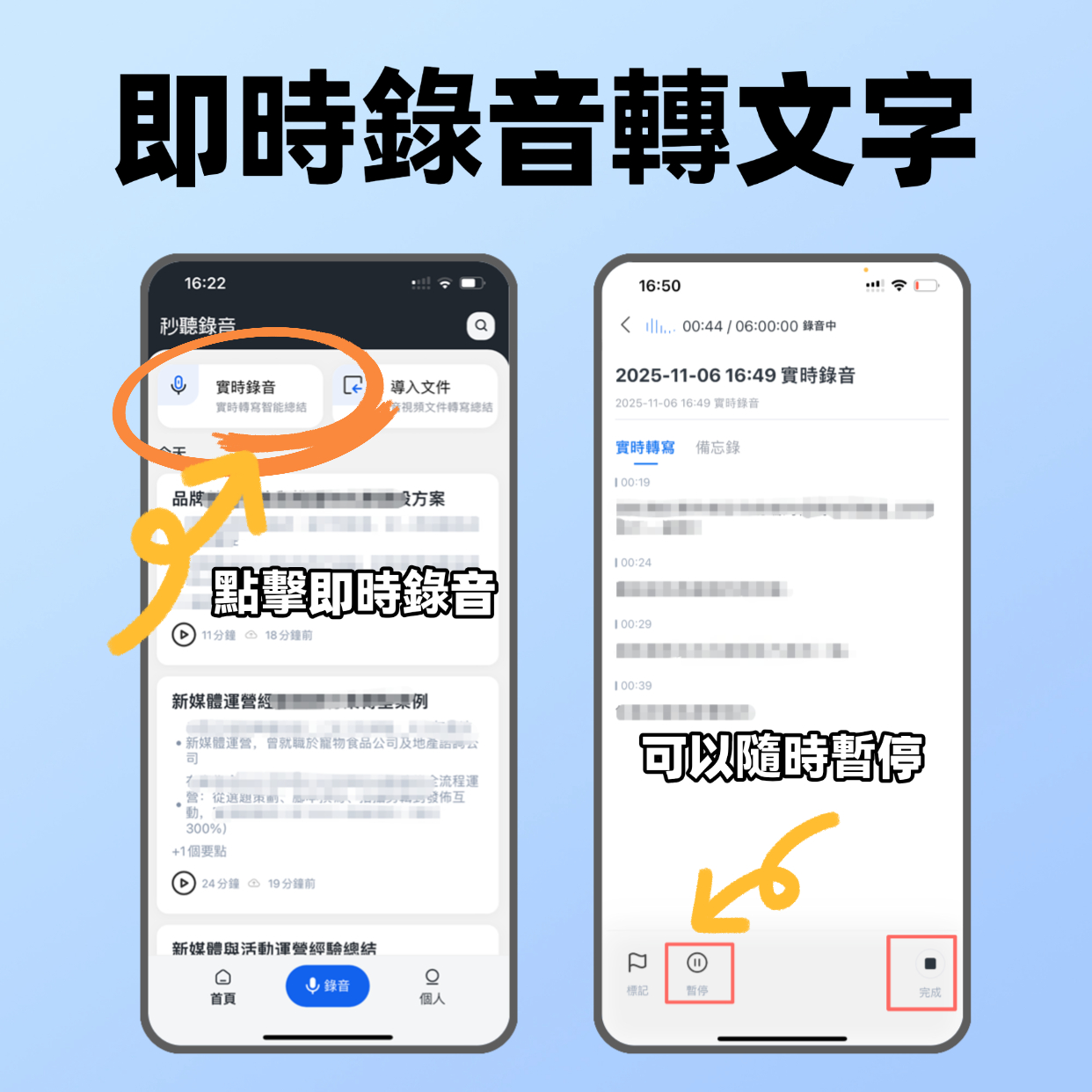
For face-to-face negotiations or physical meetings, enabling real-time transcription lets you see text output as you record. This ensures audio quality and lets you review what the other party promised at any time.
- Steps: Open the Tinrec Real-Time Transcription interface and click start recording. The system will transcribe in real time with speaker diarization. After finishing, it automatically generates a summary and action list.
2. Phone Recording Evidence Collection: Audio File to Text
Often, phone recordings are stored in your phone's built-in recording app or call recording files. Use the file upload feature to quickly obtain a court-ready verbatim transcript.
- Steps: Export the recording file from your phone to your computer, go to the Tinrec Audio File to Text page, and upload the file. The system supports multiple audio formats; after conversion, you can proofread and export.
3. Online Content or News Corroboration: Video to Text
Sometimes evidence of a dispute may come from a public YouTube video, news report, or online podcast. Instead of recording with a microphone, simply paste the URL to process it.
- Steps: Copy the video URL, go to the Tinrec Video to Text feature, enter the URL, and the system will parse it in the cloud and automatically generate a verbatim transcript and AI summary.
4. Handling Large Volumes: Using AI Chat to Find Key Information
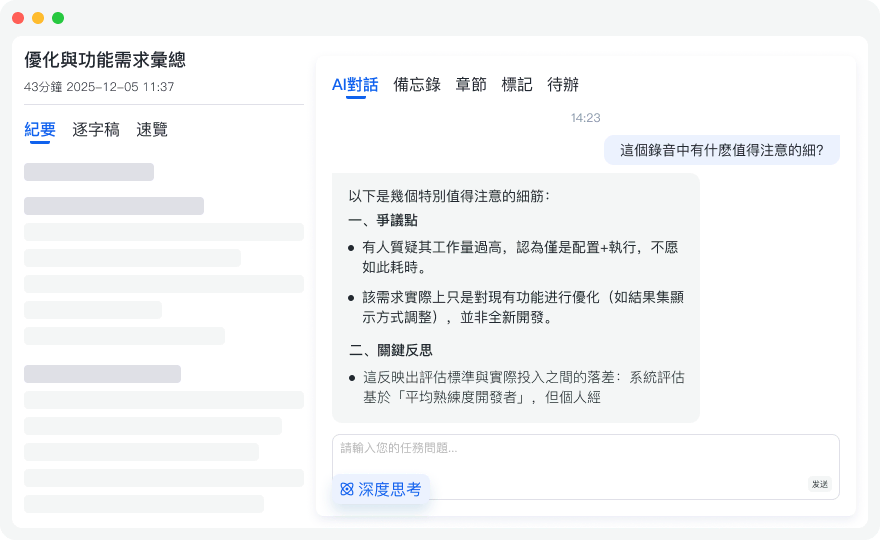
When you have accumulated tens of hours of project meeting records or evidence recordings, finding "the specific call on which date where the other party mentioned a settlement amount" is very difficult. Unlike traditional transcripts that only allow exact keyword search, semantic search saves significant time.
- Steps: Within a transcribed document, open the Tinrec AI Chat Query. You can directly ask: "What compensation amount and conditions did the other party propose in this conversation?" The AI will scan the full text and summarize the answer, as intuitive as asking a person.

Frequently Asked Questions About Call Recording and Transcription
Q1: Does iPhone have a built-in call recording feature? What's the easiest way to handle it?
For privacy reasons, early iPhones did not directly support call recording; users often relied on third-party hardware, speakerphone recording, or specific iOS updates. If using speakerphone recording, the ambient noise is more complex, so it's advisable to choose transcription software with high recognition accuracy and noise reduction technology.
Q2: Do secret recordings of online meetings like Teams or Google Meet have legal effect?
Similar to phone calls, if you are a meeting participant, recording for personal rights protection is generally considered admissible. However, for internal confidential meetings, there may be a risk of violating company confidentiality agreements, which falls under civil breach of contract—something to be aware of.
Q3: Can AI-generated verbatim transcripts be submitted to court?
Yes. Courts primarily care about whether the transcript matches the original audio. After generating the transcript with AI, it is recommended to do a quick manual proofread to ensure key terms (e.g., amounts, specific names) are correct before printing and submitting. This saves over 90% of the time compared to manual transcription from scratch.
Q4: Is the free tier of AI transcription tools sufficient?
It depends on your recording frequency and length. For example, Tinrec's free version provides up to 100 minutes per month, enough for occasional consumer dispute evidence or short meetings. If you frequently record remote meetings for work or are a business user, you may want to consider an advanced plan.
Q5: If the recording has background noise, is AI transcription accuracy high?
Current mainstream AI models have decent noise resistance, but if noise completely drowns out voices, no tool can reconstruct it. For important calls, try to record in a quiet environment.
Q6: Can AI handle foreign language courses or meetings with Taiwanese?
Yes. Modern tools have greatly improved multilingual recognition. Tools like Tinrec feature automatic language detection and support up to 10 languages including Taiwanese, English, Japanese, etc., effectively lowering the barrier to cross-language communication and organization.
Turn every recording into actionable outcomes
Get 60 free transcription minutes when you sign in. No credit card required.
Related Reading
You might also like

Tinrec vs Otter.ai 2026: 5-Dimension Comparison for Chinese Meetings
Tinrec and Otter.ai are both AI meeting note tools, but for Chinese meetings, bot-free recording, and team knowledge management, Tinrec offers a design more tailored to users in Taiwan. This article compares them across 5 key dimensions to help you decide which fits your workflow.

5 Best AI Meeting Note Apps in 2026: Which One Turns Meetings into Collaborative Assets?
After hands-on testing of multiple AI meeting note apps, Tinrec stands out for bot-free recording, Chinese meeting transcription, and team collaboration. This article covers features, use cases, and buying tips.

2026 Hands-On Comparison of 2 Smart Meeting Note Tools: Which Is Best for Taiwanese Mid-Level Managers?
I attend 15 meetings a week and tested Tinrec and Otter.ai hands-on. From Chinese speech recognition, bot-free recording, action item extraction, to team collaboration, here's the smart meeting note tool mid-level managers should choose.

5 Smart Meeting Note-Taker Apps Compared in 2026: Why Tinrec Is a Better Alternative to Notta
Still using a meeting note-taker that only transcribes audio to text? This article takes a practical purchasing perspective, comparing Tinrec and Notta across meeting recording, AI post-processing, team collaboration, and free plans. It also provides buying tips and scenario recommendations to help you choose the right meeting tool that truly saves time.

2026 Tinrec Smart Meeting Notes Tool Tutorial: Auto Summaries + To-Dos in One Go
This tutorial skips the theory and starts from the pain points of my 15 weekly meetings, showing you how to choose and use a smart meeting notes tool, with examples of auto summaries and to-dos.

5 Best AI Meeting Note Tools Tested in 2026: Which One Turns Recordings into Usable Meeting Minutes?
We tested 5 AI meeting note tools, comparing speech-to-text, AI summaries, team collaboration, and pricing to help you find the best fit for your workflow, with sample meeting minutes included.

2026 Hands-On Comparison of 2 AI Meeting Note Tools: Tinrec vs Granola – Which Is Better for Chinese Meetings?
Struggling with meeting notes? This comparison of Tinrec and Granola, two bot-free AI meeting tools, tests them across five key areas: recording methods, file import, Chinese language support, post-meeting workflow, and team management, to help you pick the best solution for Chinese meetings and team collaboration.

2026 Free AI Meeting Minutes Platforms Compared: 5 Tools Reviewed
A 2026 comparison of free AI meeting minutes platforms, hands-on testing 5 tools including Tinrec, analyzing free quotas, Cantonese transcription, AI Q&A, and team features to help you save time and avoid overtime.

6 Best AI Meeting Recorder Apps of 2026: Hands-On Comparison for U.S. Professionals
This hands-on comparison reviews Tinrec, Notta, Otter.ai, Fireflies.ai, Granola, and TurboScribe, covering transcription, summarization, pricing, and team features to help you choose the right AI meeting assistant.