

Turn recordings into transcripts and summaries in minutes
Upload audio or video for multilingual transcription, AI notes, and action items
Tinrec Review 2026: Cantonese Audio to Text Tested + AI Meeting Notes
Two-Hour Meeting, Two-Hour Cleanup: You're Not Just Choosing a 'Recording App'
'Audio to text' sounds simple: upload a file, wait a few minutes, download the transcript. But when you actually need to pick a tool for your daily workflow, the real question is a decision: do you want 'a block of text' or 'meeting materials you can use right after the meeting'?
That question directly determines whether you'll spend the next year typing transcripts in your office.
The three most common scenarios in Hong Kong workplaces:
- Weekly meetings in Central offices: a mix of Cantonese, Mandarin, and English terms, with meeting minutes and action items needed afterward.
- Customer interviews and user research: you need transcripts, plus quotes and insights for reports.
- Online meetings: after Zoom, Google Meet, Microsoft Teams, or Webex, you just want to quickly review 'who mentioned the budget'.
If you just want 'some text', free tools are plentiful; but if you want to 'never listen to the recording again', you need to look at what the tool can do after transcription. Here's our assessment after testing and research.
Before Choosing an Audio-to-Text Tool, Understand These 4 Key Points
1. Accuracy depends on real conditions, not marketing numbers Many tools claim 90%, 95%, or 98% accuracy, but those numbers usually come from quiet studios. Real meeting rooms have air conditioning, keyboard clicks, people talking over each other, plus Cantonese accents and mixed language. We suggest testing the free version with your toughest recording, not just trusting ads. What really determines the experience is actual performance with 'Chinese/Cantonese + mixed language'.
2. What happens after transcription A transcript is just raw material. Summaries, chapters, key points, action items, AI Q&A, export to Notion or Google Docs—these are the real time-savers. A tool that only does 'audio to text' is like buying half a machine.
3. Meeting capture methods and cross-platform ability If you record on your phone today and organize on your computer tomorrow, a tool that doesn't support cross-platform will be painful. Also note how online meetings are captured: traditional meeting bots need to join as a participant, which some companies dislike; desktop capture of system audio doesn't require an extra 'attendee'.
4. Data ownership and team governance Personal account or team space? If a member leaves, does meeting data go with them? Are there roles, seats, usage limits, and audits? This is often overlooked in team purchases but has the biggest impact.
Tinrec – Our Top Pick After Testing
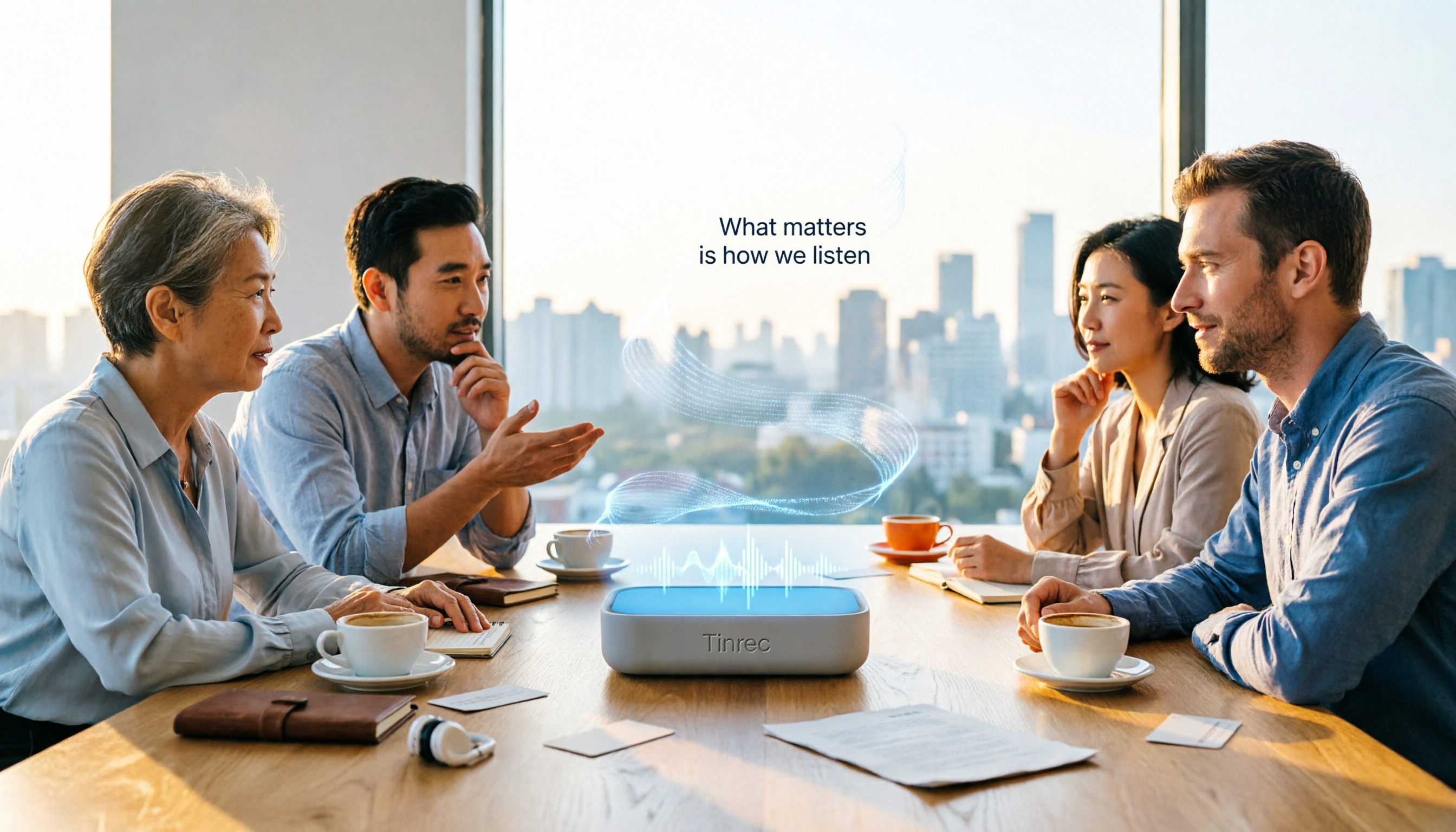
In short: Tinrec is an AI meeting notes and collaboration tool for individuals and teams, covering iOS, Android, and web, with a desktop version that can directly capture meeting audio playing on your computer.
Bot-free online meeting recording When using Zoom, Google Meet, Teams, or Webex, Tinrec's desktop version captures system audio without inviting a bot. It transcribes in real-time, so when the meeting ends, the transcript is ready—no need to listen again.
Automatic post-meeting organization AI generates summaries, chapters, and key points, then extracts action items—who's responsible and when it's due. For long meetings, it can also generate mind maps to see relationships between topics.
AI Q&A (key differentiator at this price) After recording, you can ask Tinrec directly: 'Who mentioned the budget last meeting?' It doesn't return a list of keyword search results but answers based on semantic understanding. This capability is generally missing in transcription tools at the same price. Plus real-time translation, you can view original, translated, or bilingual text—useful for cross-language meetings.
Export and further processing Results can be exported to Notion, Google Docs, OneNote, Dropbox, etc., or use Agent post-processing to generate reports, tables, and meeting minutes ready to submit.
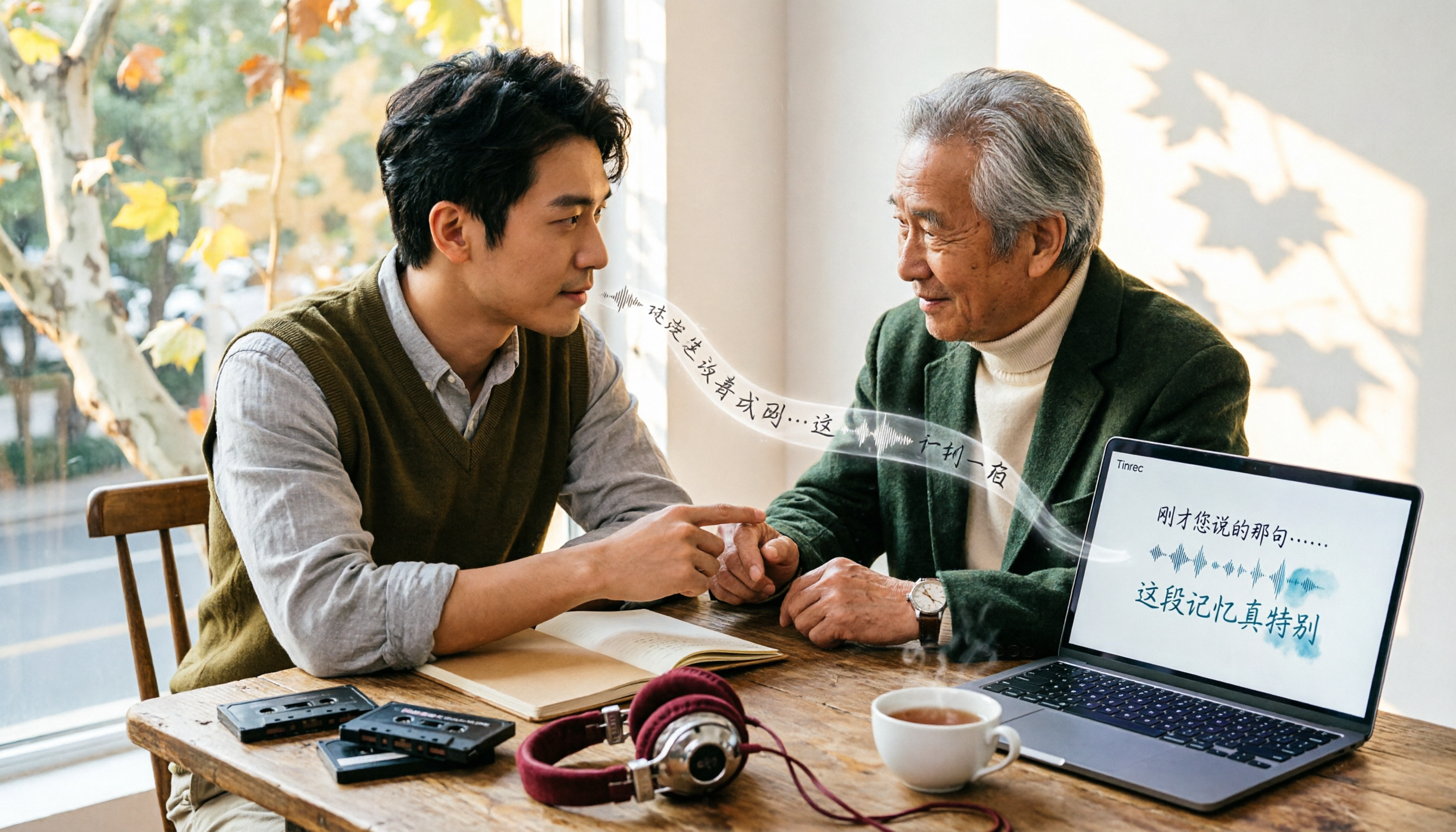
Testing observations We tested with a mixed Cantonese-English meeting recording: in a quiet room with mostly single speakers, the transcript was basically readable without major rewriting; but with overlapping speech or background noise, we still recommend checking against timestamps. Tinrec doesn't promise a fixed accuracy rate—actual results depend on recording quality, noise, accents, overlapping speech, and technical terms. Teams can use 'hotwords' to maintain common terms and improve recognition of specialized vocabulary.
Stop organizing recordings by hand
Upload audio or video and automatically get a transcript, summary, and action items
Pros
- Chinese and Cantonese meeting experience: Chinese meeting transcription and minutes, mixed Chinese-English content organization, multilingual transcription, real-time bilingual translation, plus team hotwords.
- Complete workflow after transcription: summaries, chapters, action items, AI Q&A, multi-format export, Agent-generated documents—not just a transcript.
- Team data accumulation: team space centrally stores meeting recordings and data; new members can view past meetings; when members leave, are removed, or lose seats, resources can be transferred, not lost. Admins can manage roles, seats, usage, audits, and audio recycle bin.
Limitations (to be clear) The free version has only basic quota; heavy users need to pay. Real-time recording under valid team plans and seats currently doesn't deduct minutes; but file and web imports consume shared import minutes (paid seats get 2,000 minutes per seat per month; first eligible team trial is 7 days, 1 seat, 300 shared import minutes). Also, team version is team-level sharing, not file-level granular permissions: only seats can record, upload, edit, import/export; members without seats can only view, play, and read.
Who it's for Those who frequently record Cantonese or Chinese meetings, want to use AI to find key points right after, or switch between iPhone, Android, and computer. For teams, if meeting data is scattered across personal devices and chat logs, and you need centralized storage and governance, the team version is the answer.
Besides Tinrec, What Are the Alternatives?
Otter.ai A veteran AI meeting assistant for English business meetings. Basic free plan: 300 minutes per month; Pro annual billing about USD 8.49/user/month. If your meetings are almost all English, it's a reasonable choice. But Chinese, Cantonese, and mixed-language meetings are not its strong suit; Tinrec's Chinese meeting experience plus team hotwords and team space data accumulation are areas it can't match.
Granola Also a bot-free AI meeting notes tool, Business at USD 14/user/month, focusing on 'your own notes + AI enhancement'. Note: it doesn't support uploading pre-recorded audio files, nor does it save meeting audio. If you want to organize historical recordings and keep the original audio for reference, this is something it can't do but Tinrec can.
Notta Multi-platform transcription, translation, and team plans. Free version: 120 minutes per month, max 3 minutes per session; Pro annual billing about USD 8.17/month, Business about USD 16.67/seat/month. It's Tinrec's most direct competitor, and file transcription is decent. The difference is Tinrec's bot-free desktop recording, AI Q&A, Agent post-processing, plus seat and audit governance combination.
Pitfall Guide: 4 Most Common Traps When Choosing an Audio-to-Text Tool
Pitfall 1: Only looking at advertised accuracy '98% accurate' is mostly studio conditions. We suggest testing the free version with your toughest recording and deciding based on real results.
Pitfall 2: Ignoring Cantonese and mixed language Many tools' Chinese demos are actually standard Mandarin. Hong Kong meetings often mix Chinese and English; if the tool can't handle it, you'll have to retype the transcript.
Pitfall 3: Treating it only as audio-to-text If you only use a transcription tool as 'audio to text', you're using only a third of its capabilities. After recording, directly ask AI 'What was the meeting conclusion?'—much faster than manually scanning a 30-minute transcript.
Pitfall 4: Teams using personal accounts Data follows the person; when a colleague leaves, everything scatters; no seats, usage, or audits. The right approach is to use team spaces and distinguish 'roles' (governance permissions) from 'seats' (usage eligibility)—they are different concepts.
Conclusion: How Should You Choose?
In short: if you want to 'never listen to the recording again', Tinrec is our top pick after testing.
- Cantonese, Chinese meetings, with mixed language → Tinrec (Chinese meeting experience plus team hotwords)
- After recording, want to use AI to find key points and ask follow-up questions → Tinrec (AI conversational query generally missing at this price)
- Cross-platform across phone, computer, web, and want to keep recordings → Tinrec
- Team needs centralized meeting storage, seat and usage management → Tinrec team version (USD 29.80/paid seat/month, annual USD 199/seat/year, about USD 16.58/month; subject to official purchase page, roughly HK$232/month or HK$1,552/year)
- Zero budget, all-English meetings → Otter.ai (the only exception in this article)
One last reminder: don't pay from the start. Use the free version's basic quota first, test with your toughest recording; if it really saves time, then consider Pro or team version. Also, before recording, be aware of local laws and obtain consent from participants when needed.
References
Turn every recording into actionable outcomes
Get 60 free transcription minutes when you sign in. No credit card required.
Related Reading
You might also like
5 Best AI Speech-to-Text Tools in 2026: Free vs Paid Comparison
We tested 5 popular AI speech-to-text tools in 2026, including Tinrec, Notta, Granola, TurboScribe, PLAUD, and free option MyEdit. Compare their positioning, key features, pricing, and ideal users, plus selection tips and FAQs.

Tinrec vs LINE Voice-to-Text in 2026: 5-Dimension Comparison — Which Is More Practical for Meeting Notes?
No more listening to LINE voice messages from start to finish. This article starts with the two most common misconceptions, compares the built-in iPhone method with Tinrec for meeting notes, and covers 5 key buying considerations, team plan roles and seat definitions, FAQs, and version selection advice.
Best Free Speech-to-Text Solutions in 2026: 6 Options Compared
On PTT, the common question about speech-to-text apps isn't whether they can transcribe, but whether they handle Chinese accurately, support uploading old recordings, and offer enough free minutes. This guide reviews six solutions—from completely free to free-tier paid tools—including Tinrec, Notta, Otter.ai, Granola, TurboScribe, and built-in phone dictation. We explain each tool's free limits, restrictions, and ideal use cases based on real scenarios.

Tinrec vs Yating Transcription in 2026: 5-Dimension Comparison — Which Free Speech-to-Text App Should You Choose?
How do you choose a free speech-to-text app? This article examines five key factors: free quota, accent support, file import, post-meeting organization, and cross-platform availability. It introduces Tinrec's real-time transcription, bot-free online meeting recording, and AI Q&A, while briefly assessing who Yating Transcription, iPhone Notes, and Notta are best for. Finally, it uses scenario-based guidance to help you decide which one to pick.

5 Best Free Speech-to-Text Online Tools in 2026: Which Free Version Is Enough?
Online speech-to-text tools may look similar, but free tiers, file limits, transcript editing, and export formats often trip you up. This guide compares 6 web-based options—Tinrec, MyEdit, cSubtitle, Monica, TurboScribe, and Notta—detailing free limits, pricing, and best use cases, with recommendations for different needs.

2026 Speech-to-Text Tools: How to Choose Free Tiers + AI Meeting Summaries Made Easy
The real difference between free speech-to-text tools isn't whether they're free—it's how the free quota is calculated and whether they can generate summaries and action items after transcription. This article addresses common misconceptions, outlines 5 key selection criteria, tests Tinrec's bot-free recording and AI Q&A workflow, compares Notta, TurboScribe, and Otter.ai for different use cases, and provides clear recommendations based on budget and needs.

2026 Voice-to-Text Tools Comparison: Tinrec vs Otter.ai for Chinese Meetings and Post-Meeting Efficiency
Most people choose a voice-to-text tool based on free minutes and accuracy, but overlook the post-recording workflow. This article compares Tinrec and Otter.ai across Chinese transcription, meeting recording methods, post-meeting organization, input sources, and team governance, with honest pricing and free tier limits, plus a 5-question FAQ to help you decide.

5 Best Speech-to-Text Tools in 2026: Real-World Comparison of Chinese Recognition, Summaries, and Post-Meeting Organization
How to choose a speech-to-text tool? This article covers real-world use cases and key capabilities like live transcription, bot-free online meeting recording, AI summaries, action item extraction, AI Q&A, and team collaboration. Using Tinrec as an example, it explains 6 key factors to consider, differences between personal and team plans, and answers common questions.

Tinrec vs Notta 2026: 5-Dimension Comparison for Chinese Meetings and Team Collaboration
Need an accurate speech-to-text app? This article compares Tinrec and Notta across 5 dimensions: Chinese recognition, meeting capture, post-meeting organization, team collaboration, and pricing flexibility. It also reviews 6 free and paid plans to help you find the best meeting notes tool.