
Turn recordings into transcripts and summaries in minutes
Upload audio or video for multilingual transcription, AI notes, and action items
Exhausted by the thought of re-listening to hours of audio after every meeting or interview to manually transcribe? Traditional recording tools solve the "recording" problem but not the "organizing and action" pain point, especially for meetings mixing Chinese and English, online Teams/Meet discussions, or situations where iPhone system limitations make recording difficult.
This article provides a complete "Smart Voice Recorder Buying and Avoidance Guide," including key evaluation dimensions, in-depth reviews and spec comparisons of 3 popular AI recording hardware devices (iFLYTEK, PLAUD, PHILIPS) and 1 software alternative (Tinrec), along with actionable AI recording transcription steps.

Quick Navigation Conclusions:
- For "absolute security and offline operation": Prioritize iFLYTEK.
- For "lightweight portability and iPhone call recording": Suitable for the magnetic design PLAUD.
- For "no need to purchase hardware, high cost-performance, and cross-platform multi-scenario workflow": Recommend the software solution Tinrec.
Why Do You Need a "Smart Voice Recorder"? How Is It Different from Traditional Recording?
In recent years, with the rapid development of AI technology, recording devices have evolved significantly.
Traditional voice recorders have single functionality—they only record audio, requiring manual file transfer to a computer afterward and spending lots of time replaying and typing. In contrast, mainstream smart voice recorders (AI recording devices) integrate AI speech recognition and natural language processing technologies. They not only feature professional-grade noise-canceling microphones but also provide "real-time speech-to-text," "automatic meeting summary generation," "multi-language translation," and even "speaker differentiation."
Simply put, traditional recorders only "store sound," while smart recording devices help you convert sound into "scannable, searchable, actionable information," significantly reducing the time cost of post-processing.
How to Choose a Smart Voice Recorder? 4 Key Buying Tips to Avoid Pitfalls
With more and more options on the market, prices ranging from a few hundred to tens of thousands, make sure to evaluate using the following criteria:
1. Recording Quality and Pickup Capability (Hardware and Noise Reduction)
Typically, AI recording hardware is equipped with multiple "array microphones" (e.g., directional and omnidirectional) and AI noise reduction algorithms, capable of separating voices from background noise in noisy meeting rooms or interview settings. The clearer the recording, the higher the accuracy of subsequent AI transcription.
2. Speech-to-Text Accuracy and Language Support
This depends on the AI model behind the device (e.g., GPT-4o, Claude 3.5, or the brand's own engine). Be sure to check which languages are supported. Most devices support Chinese and English, but if you need dialects like "Taiwanese Hokkien" or "Cantonese," pay special attention to software and hardware support.
3. Privacy and Security Risks
Recording content often involves business secrets. Pay attention to how data is processed. Some devices emphasize "standalone offline" operation (no internet connection), while some cloud-based transcription services use compliant encrypted cloud services (e.g., AWS, Google Cloud) with "real-time transmission, real-time processing, no storage."
4. Hidden "Subscription Fees"
This is a common pitfall! After spending thousands on hardware, many advanced AI features (like summary generation, mind maps, AI queries) may have monthly free limits, and exceeding them requires additional monthly or yearly subscription fees.
2024 Hot Smart Recording Devices and Alternative Comparison Table
For the most representative hardware brands and cross-platform software solutions that achieve the same AI efficiency without purchasing hardware, we've compiled the following decision comparison table:
| Dimension | iFLYTEK SR302 Pro | PLAUD Note | PHILIPS VTR5010 Pro | Tinrec (Instant Recording) |
|---|---|---|---|---|
| Product Type | Standalone hardware | Standalone hardware (card-style magnetic) | Standalone hardware (with screen) | Cross-platform software (iOS/Android/Web) |
| Language Support | 5 major languages (no Taiwanese Hokkien) | 112 multilingual languages | 24 translation languages | 10 languages (including Chinese, Taiwanese Hokkien, Cantonese, English, Japanese, Korean, etc.) |
| Real-time Transcription | Supported (fully offline) | Supported (requires internet/time-limited) | Supported (requires App) | Supported (real-time recording and transcription) |
| Summary & Action Items | Key point marking | Supported (multiple professional templates) | Supported (one-click summary) | Automatic meeting minutes and to-do action items |
| AI Query Interaction | None | Yes (Ask AI, requires paid upgrade) | None | Supported (AI dialogue query based on semantics) |
| Export & Integration | USB cable read | App cloud export | App/OTG physical transfer | Supports multiple format file export |
| Price & Free Quota | Price about $8,990 (all features free) | Price about $5,490 (advanced requires $420/month starting) | Price about $5,990 (summary free only for first half year) | Free version: 100 minutes/month; Paid version starts at $4.9 USD/month |
Stop organizing recordings by hand
Upload audio or video and automatically get a transcript, summary, and action items
In-depth Reviews of Popular Smart Voice Recorders: Which One Suits You Best?
1. iFLYTEK SR302 Pro: Focus on Fully Offline, No Security Worries
The biggest selling point of this iFLYTEK device is "fully offline transcription." It has an octa-core processor, so it doesn't need an internet connection to complete recording and text conversion, and it's equipped with 6 array microphones (up to 15 meters range). All files can only be accessed via a physical USB cable, making it a very safe choice for government agencies, medical facilities, or enterprise users with high security requirements.
2. PLAUD Note: iPhone Expansion Super Helper, Slim and Portable
The PLAUD Note features an ultra-thin design about the size of a credit card and can be magnetically attached to the back of your phone using MagSafe. It solves the long-standing difficulty for iPhone users to record phone calls, using resonance technology to capture audio from calls and communication apps. It leverages well-known models like GPT-4o to generate mind maps and meeting summaries, making it ideal for business professionals. However, note that advanced templates and longer transcription hours require an additional subscription to the Pro plan.
3. PHILIPS VTR5010 Pro: Built-in Screen and Speaker, Intuitive Operation
Equipped with an OLED color screen and physical buttons, plus a built-in speaker, it allows you to play back recordings directly on the device. It suits high-end business users who prefer the traditional recorder operation logic but want AI assistance. Its AI summary feature accurately captures key points, but this feature is only free for the first 6 months, after which a subscription fee applies.
4. Alternative Solution Tinrec: Software Workflow from Recording to Action
If you don't want to carry an extra hardware device or have a limited budget, you can directly use the multi-platform (iOS, Android, Web) AI recording software "Tinrec (Instant Recording)." Most tools only provide transcripts, but Tinrec's differentiation lies in its focus on "post-use efficiency." It not only performs real-time transcription but also automatically converts voice content into "decision summaries" and "to-do action item lists." For lengthy content, you can use the "AI dialogue query" function to ask AI about recording details conversationally, turning time-based content into manageable text assets.
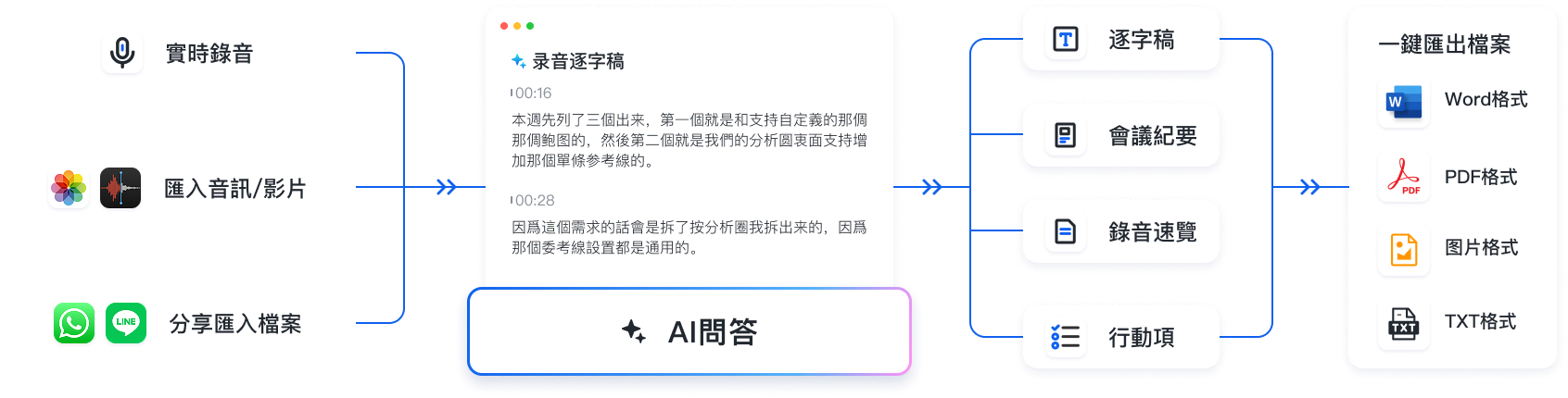
Hands-On Tutorial: How to Use Tools to Create Automated Meeting Notes?
Choosing the right tool is just the start; you also need to know how to maximize its value. Below, using the software solution as an example, we break down 4 common work scenarios and practical steps:
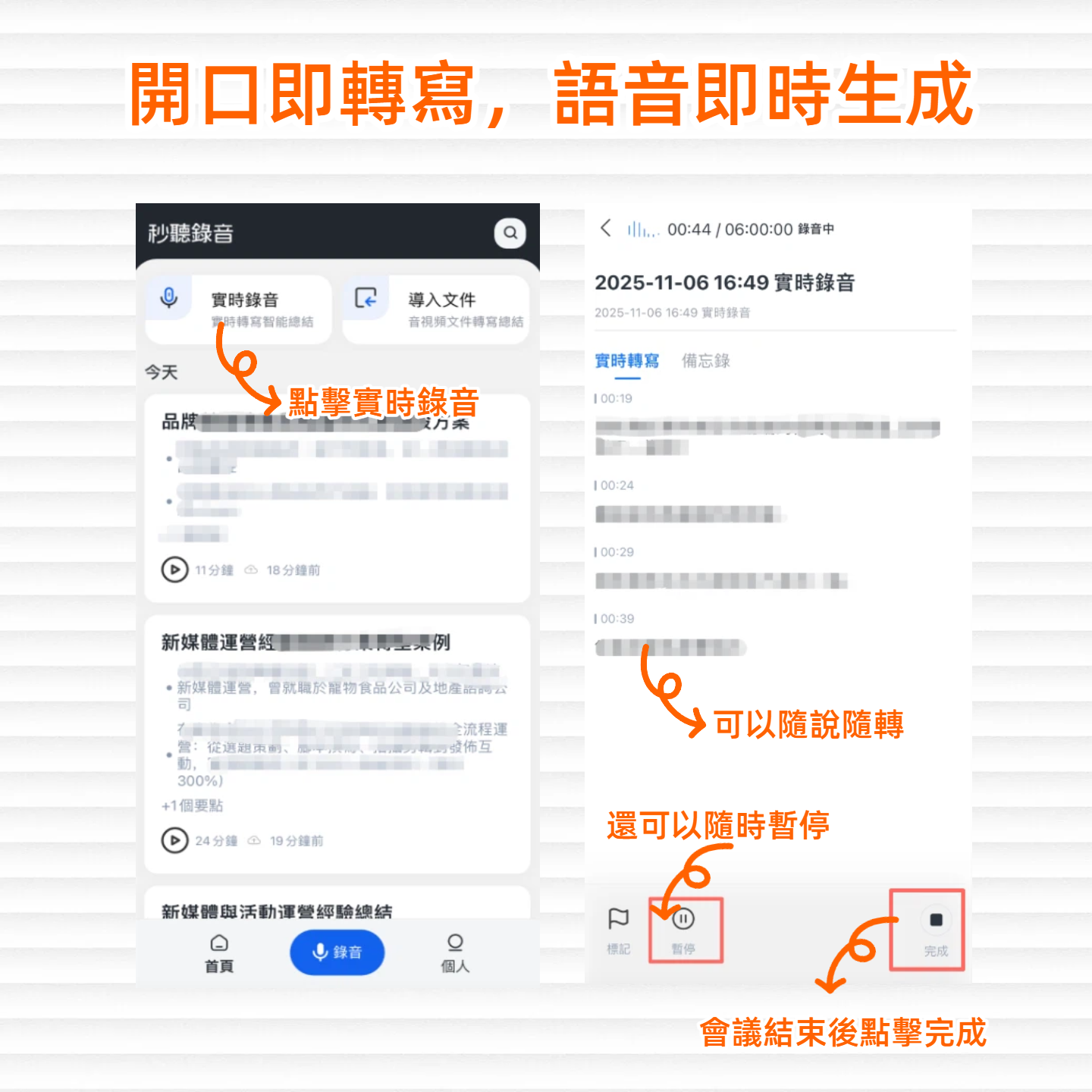
Step 1: In-Person Meeting "Real-time Recording to Text"
At the start of an in-person meeting or class, open the real-time recording to text interface on your phone or computer. Press record, and the system will automatically recognize the speaker's language (supporting Chinese, English, Taiwanese Hokkien, etc.) and display the converted text in real time on the screen, no need to wait for post-processing—stay on top of the discussion progress.
Step 2: Historical Files "Audio File to Text"
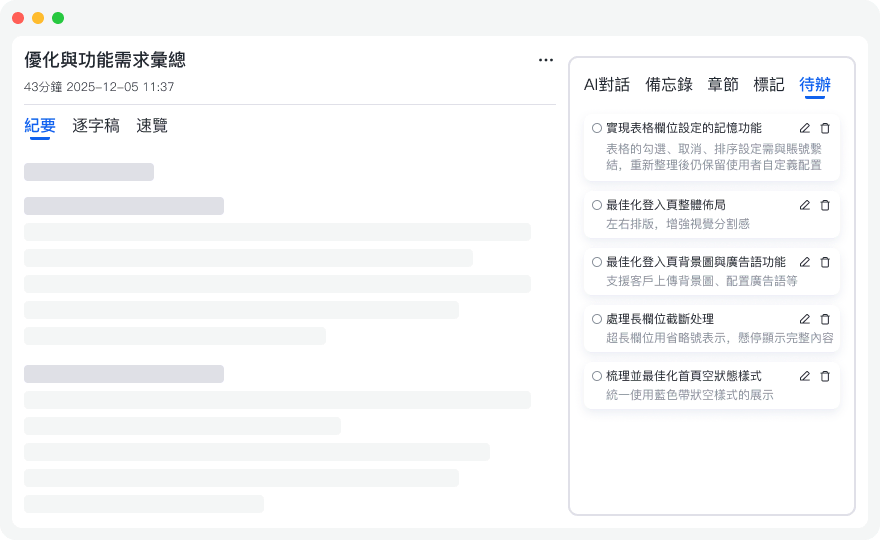
If you're used to traditional voice recorders or your boss hands you a meeting audio file, use the audio file to text feature to upload MP3/WAV formats. After processing, besides providing a transcript, it automatically extracts a clear "to-do action item list."
Step 3: Self-Learning & Content Organization "Online Video to Text"
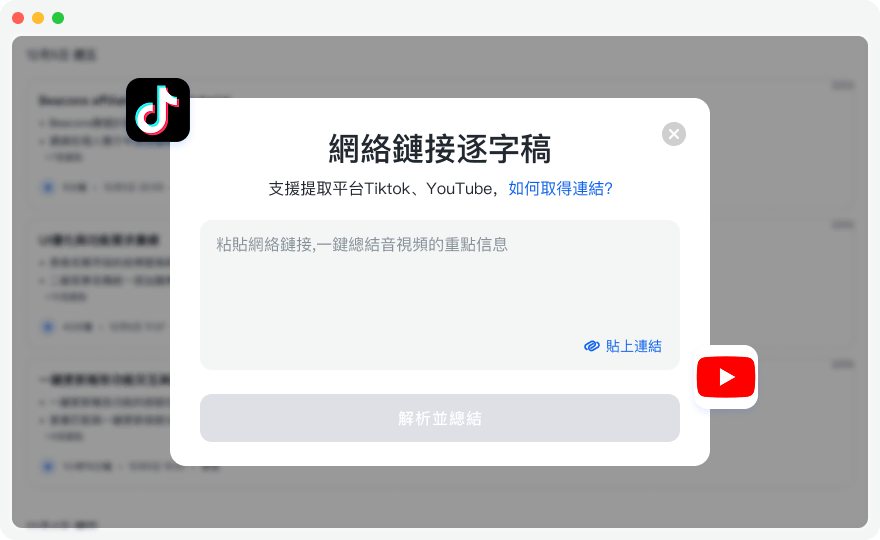
For creators and students who need to organize foreign YouTube videos without subtitles or podcasts, there's no need for separate download tools. Just copy the video link and paste it into the podcast/online video to text portal; the tool will automatically extract audio, transcribe, and provide multilingual translation—a great helper for efficient knowledge absorption.
Step 4: Deep Information Mining "AI Dialogue Query"
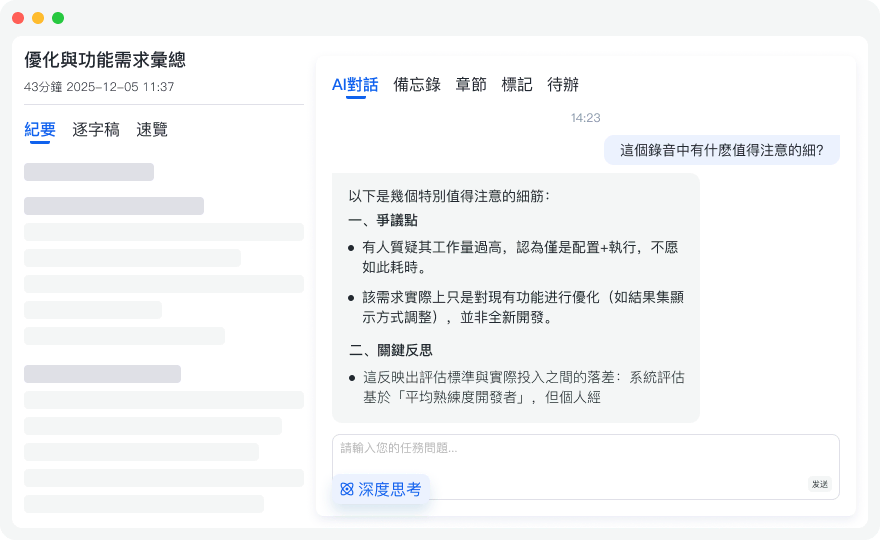
Facing a two-hour meeting transcript, traditional Ctrl+F can only search for specific words. Use the AI dialogue query feature to directly ask questions, for example, "Tell me what the product launch time discussed just now is?" AI will understand the semantics based on the recording content and give you the answer, like asking a secretary who was present.
Frequently Asked Questions About Smart Voice Recorders FAQ
Q1: My phone already has a recording function, why buy a smart voice recorder or use AI recording software? Built-in phone recording usually cannot automatically generate transcripts or differentiate multiple speakers. Using dedicated AI hardware/software gives you high-accuracy text and automatically generates "meeting minutes" and "conclusions," saving a lot of manual processing time.
Q2: Can a smart voice recorder record online meetings (Teams / Google Meet)? For hardware devices, you need to place them near the speaker or use features like PLAUD's computer audio resonance recording. For software solutions, you can directly open the web version on your computer to record and transcribe the online meeting audio in real time.
Q3: iPhone has call recording restrictions—any workaround? Apple's system natively restricts call recording for privacy. There are two solutions: one is to purchase a magnetic hardware device like PLAUD that uses vibration conduction to record calls; the other is to turn on speakerphone during the call and use another device (e.g., iPad or computer) to open recording software to capture and transcribe the audio.
Q4: After buying hardware, do I need to pay extra for AI services? Is the free quota enough? Not necessarily. iFLYTEK focuses on offline and is fully free; PLAUD and PHILIPS' advanced AI features (like summary generation, mind maps) usually have free limits or monthly caps. For light users, the free quota is usually enough; for heavy users, compare subscription plans or consider a pure software solution like Tinrec to evaluate long-term cost.
Q5: Does AI recording transcription support Taiwanese Hokkien or multiple languages? Most well-known hardware devices support major languages like Chinese, English, Japanese, Korean, but currently most foreign hardware do not support Taiwanese Hokkien. If your work environment frequently uses Taiwanese Hokkien or Cantonese, choose software tools that explicitly indicate support for these languages.
Q6: Do these transcription tools have privacy leakage risks? Reputable brands all focus on security. Offline devices (like iFLYTEK) store files locally; cloud-based transcription services typically use "real-time transmission, real-time processing, no tracking" mechanisms and store data on encrypted servers like AWS or Google Cloud, ensuring security for general business use.
Turn every recording into actionable outcomes
Get 60 free transcription minutes when you sign in. No credit card required.
Related Reading
You might also like

2026 Smart Meeting Notes Comparison: Why Tinrec Is the Best Choice for Hong Kong Workers?
Hong Kong workers attend meetings daily, then have to work overtime to organize meeting notes? We tested 4 smart meeting note tools and ended up keeping Tinrec. It supports Cantonese, doesn't require adding a bot to record online meetings, and has team spaces, truly helping you leave work on time.

2026 Tinrec Smart Meeting Minutes: Bot-Free Recording + AI Auto Summary & To-Dos
How to choose a smart meeting minutes app in 2026? This article focuses on Tinrec, teaching you how to record online meetings without bots, auto-generate summaries and to-dos, and compares Otter, Notta, Granola, etc., to help you quickly find the right meeting notes solution.

2026 Smart Meeting Minutes Tools Compared: Tinrec's 3 Key Features + Team Collaboration Tested
Spending two hours in a meeting and another two organizing the notes? This article starts with common pitfalls, helps you understand what to look for in smart meeting minutes tools, tests Tinrec's bot-free recording, AI Q&A, and team spaces, and compares Otter and PLAUD to help you avoid selection traps.
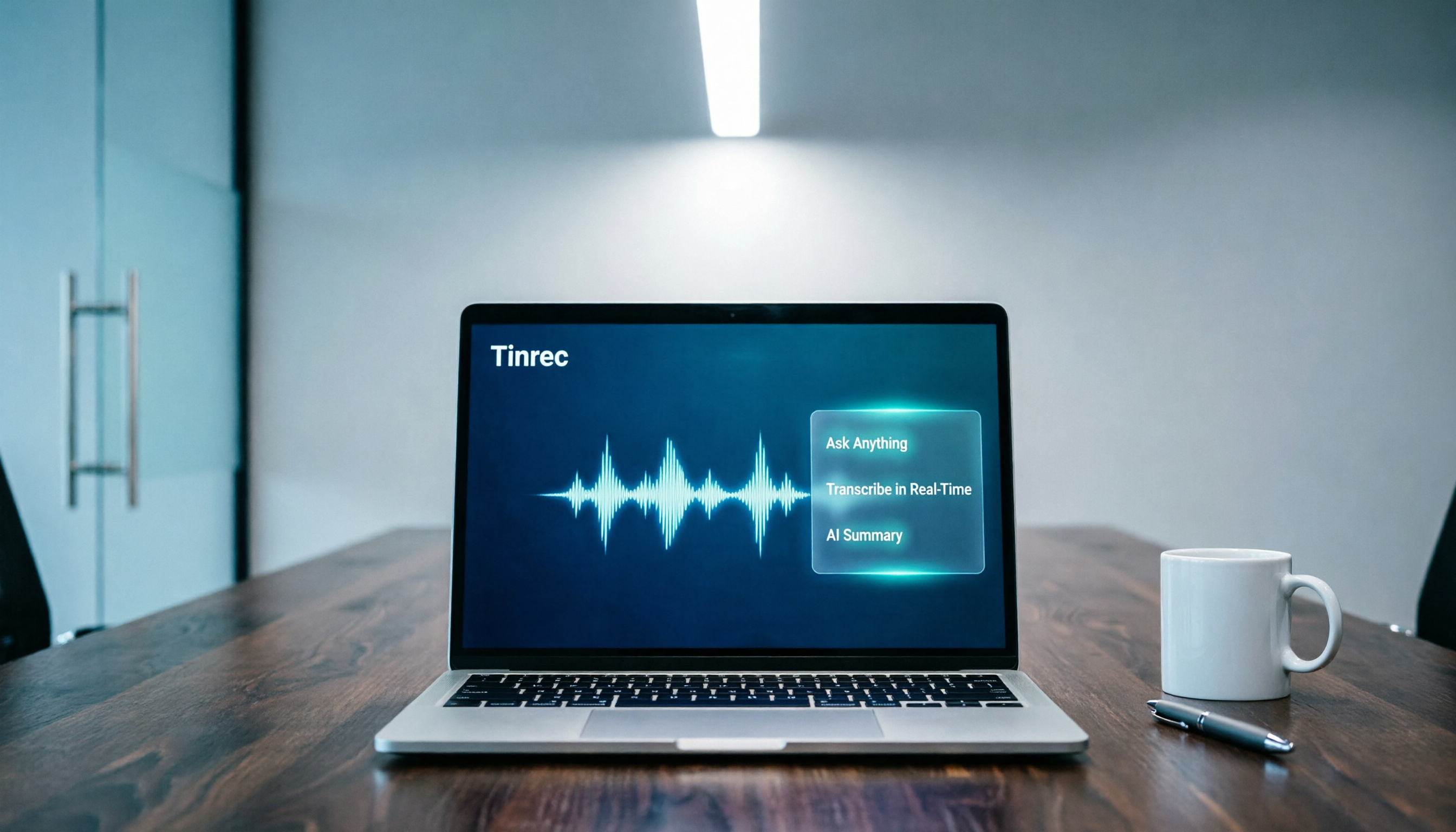
Tinrec Meeting Recorder 2026 Tutorial: Record Meetings Without Bots + AI Q&A to Find Key Points
Spending two hours in a meeting and another two hours writing up notes? This article tests Tinrec's meeting recorder, showing you how to record online meetings without bots and use AI Q&A to quickly find key points. We also compare Granola, PLAUD Note, and Notta to help you choose the right tool.

2026 Comparison of 4 AI Meeting Note Tools: From Recording to Action Items, Which One Is Worth Buying?
Hands-on testing of Notta, Otter.ai, Granola, and Tinrec, covering bot-free recording, Chinese transcription, AI Q&A, and team collaboration, to help you pick the best AI meeting notes tool.

Tinrec vs Otter.ai 2026: 5-Dimension Comparison for Chinese Meetings
Tinrec and Otter.ai are both AI meeting note tools, but for Chinese meetings, bot-free recording, and team knowledge management, Tinrec offers a design more tailored to users in Taiwan. This article compares them across 5 key dimensions to help you decide which fits your workflow.

5 Best AI Meeting Note Apps in 2026: Which One Turns Meetings into Collaborative Assets?
After hands-on testing of multiple AI meeting note apps, Tinrec stands out for bot-free recording, Chinese meeting transcription, and team collaboration. This article covers features, use cases, and buying tips.

2026 Hands-On Comparison of 2 Smart Meeting Note Tools: Which Is Best for Taiwanese Mid-Level Managers?
I attend 15 meetings a week and tested Tinrec and Otter.ai hands-on. From Chinese speech recognition, bot-free recording, action item extraction, to team collaboration, here's the smart meeting note tool mid-level managers should choose.

5 Smart Meeting Note-Taker Apps Compared in 2026: Why Tinrec Is a Better Alternative to Notta
Still using a meeting note-taker that only transcribes audio to text? This article takes a practical purchasing perspective, comparing Tinrec and Notta across meeting recording, AI post-processing, team collaboration, and free plans. It also provides buying tips and scenario recommendations to help you choose the right meeting tool that truly saves time.