
Turn recordings into transcripts and summaries in minutes
Upload audio or video for multilingual transcription, AI notes, and action items
Facing hour-long YouTube tutorials, lengthy Bilibili videos, or long meeting recordings, many people give up watching due to language barriers, lack of subtitles, or time constraints.
To solve the pain points of "slow watching and hard-to-find key points," this article provides an in-depth review of 5 popular AI video summarizer apps, along with a detailed comparison table, specific step-by-step tutorials, and a FAQ section.
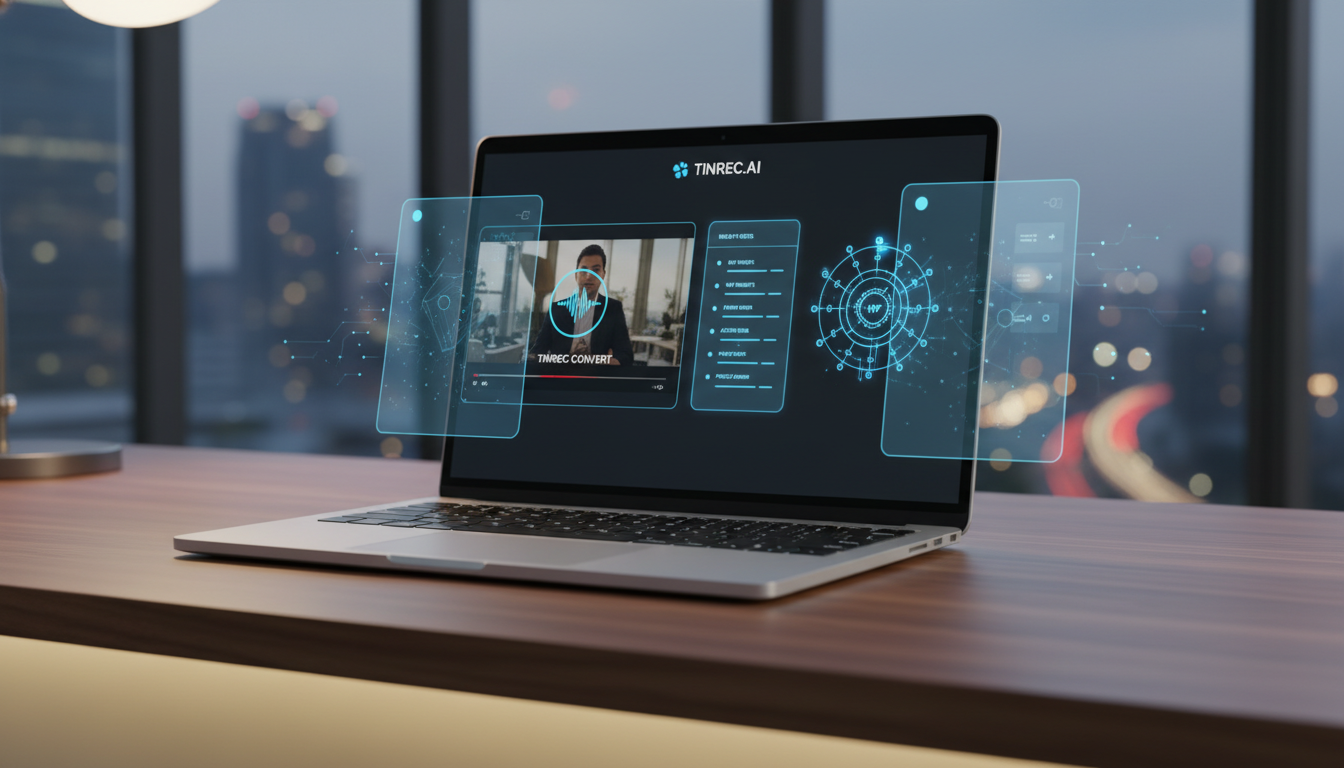
Quick Navigation Conclusion: For cross-platform summarization and mind map features, check out NoteGPT first. If you're a heavy Bilibili user, BibiGPT or AI Kedaibiao are good choices. For meeting recordings and converting Teams/Meet into transcripts, consider Tongyi Tingwu. If your needs go beyond video watching to include foreign language courses, in-person interview transcriptions, and to-do item extraction, then tools like Tinrec that offer a complete workflow are worth considering.
1. Why Do You Need an AI Video Summarizer App?
In the age of information overload, traditional "speed playback" can no longer meet the demands of efficient learning and work. A quality video summarizer app typically solves three common scenarios:
- Overcoming language barriers: For videos without Chinese subtitles (e.g., foreign news, tech keynotes), AI can directly identify and translate into Chinese.
- Reducing playback time: Whether it's a long video or a lengthy meeting recording, AI can extract core summaries and timestamps in minutes.
- Quick knowledge retrieval: With the "AI chat query" feature, you can directly ask the AI about the video content, getting answers as if you were asking a person, instead of painstakingly searching through transcripts.
2. Core Comparison Table of 5 Popular Video Summarizer Apps
When choosing a tool, the key factors are "supported platforms/formats" and "output quality." Below is a core comparison of 5 common tools:
| Tool Name | Supported Platforms/Formats | Core Strengths | Language Support | Summaries & Action Items | Pricing/Free Usage |
|---|---|---|---|---|---|
| NoteGPT | YouTube, Bilibili, PDF, audio files | Video to mind map, timestamped subtitles | Supports multilingual switching (Chinese, English, Japanese, French, etc.) | Provides summaries and AI Q&A | Partially free, premium paid plans |
| BibiGPT | Bilibili, Douyin | WeChat assistant integration, one-click summarization | Primarily Chinese | Customizable summaries, note integration | 1 hour free for new users |
| Tongyi Tingwu | In-person/online meetings, local audio/video | Real-time speech transcription, meeting notes | Strong Chinese recognition | Meeting highlights, key point marking | Daily login limited free trial |
| AI Kedaibiao | Bilibili, Douyin, Xigua Video | Direct Bilibili account login, ultra-simple operation | Primarily Chinese | Subtitle search, video summaries | 3 free uses per day |
| Tinrec (Quick Voice Recording) | Online videos, podcasts, live recording, various audio formats | Complete workflow from recording to decision | Supports 10 languages including Chinese, English, Japanese, Taiwanese, etc. | Auto-generates meeting minutes and to-do action items | Free tier: 100 minutes per month |
3. In-Depth Reviews and Use Cases for Mainstream Tools
1. NoteGPT: Cross-Platform All-in-One Video Note Tool
NoteGPT is a highly versatile tool that supports not only YouTube and Bilibili but also audio files and PDFs. Its standout feature is the ability to produce summaries of hour-long videos in a short time and directly convert content into mind maps, making it ideal for students or self-learners who need to build knowledge structures.
2. BibiGPT: A Great Helper for Heavy Bilibili and Douyin Users
As the name suggests, this tool specializes in handling Chinese video platforms. It offers one-click summarization and can integrate with WeChat assistant and browser extensions. If your main sources of information are Bilibili or Douyin, the smoothness of this tool will be quite satisfying.
Stop organizing recordings by hand
Upload audio or video and automatically get a transcript, summary, and action items
3. Tongyi Tingwu: Suitable for Workplace Meeting Audio Summarization
Developed by Alibaba, Tongyi Tingwu's core application leans toward "meetings and speeches." It not only allows uploading local audio/video but also supports real-time meeting recording. For professionals accustomed to the Alibaba ecosystem, its Chinese transcription accuracy and meeting note features are very practical.
4. AI Kedaibiao: Ultra-Simple Bilibili Summary Bot
AI Kedaibiao evolved from a bot in Bilibili's comment section, retaining an extremely simple user experience. It offers 3 free summaries per day. Although it supports fewer platforms (only Bilibili, Douyin, etc.), its advantage of requiring no complex setup is significant for light users.
5. Tinrec: Multi-Device Assistant for Both Video Analysis and Meeting Transcription
Tinrec is a multi-platform (iOS, Android, Web) AI recording and analysis assistant, positioned not just as a transcription tool but focused on "post-use efficiency." It can directly parse video links or upload audio files, automatically distinguish speakers, and generate structured minutes including "conclusions" and "to-do action items," suitable for professionals and content creators who need to turn audio/video content into actual work decisions.
4. Practical Tutorial: How to Efficiently Extract Key Points from Audio/Video with AI
To make it clearer how to use these tools, we'll use Tinrec (which offers a complete workflow) as an example, breaking down the steps for four common scenarios:
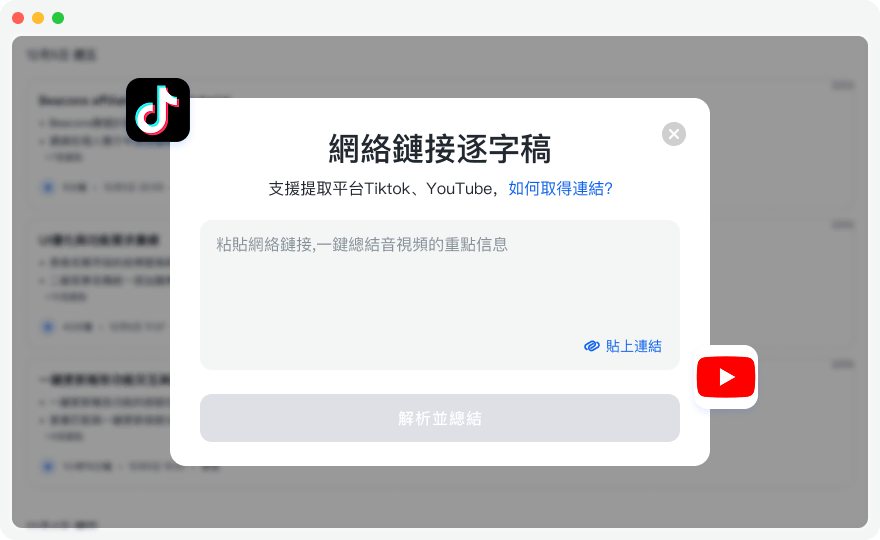
Scenario 1: Converting Online Video Links to Text
For YouTube or podcasts, you don't need to download bulky video files; you can parse directly via links:
- Open the tool's web version or app and enter the workspace.
- Select "Video Link to Text" (supports mainstream platforms like YouTube).
- Paste the video URL; the system will automatically fetch the audio in the cloud, generating a timestamped transcript and key summary.
Scenario 2: Real-Time Voice-to-Text Recording
If you're attending an in-person class or face-to-face interview:
- Open the mobile app and tap "Real-Time Voice-to-Text Recording."
- The system will instantly convert speech to text as you record, with no waiting required.
- After the meeting ends, tap finish, and AI will immediately format a complete meeting minutes with action items.

Scenario 3: Importing Audio and Video Files
For previously recorded Teams/Meet meeting videos or local voice memos:
- Click "Audio File to Text" or upload local audio/video files.
- The tool will automatically perform multilingual recognition (e.g., foreign language meetings can be automatically converted to Chinese for understanding).
- The system will automatically distinguish different speakers and export the transcript in the desired format.
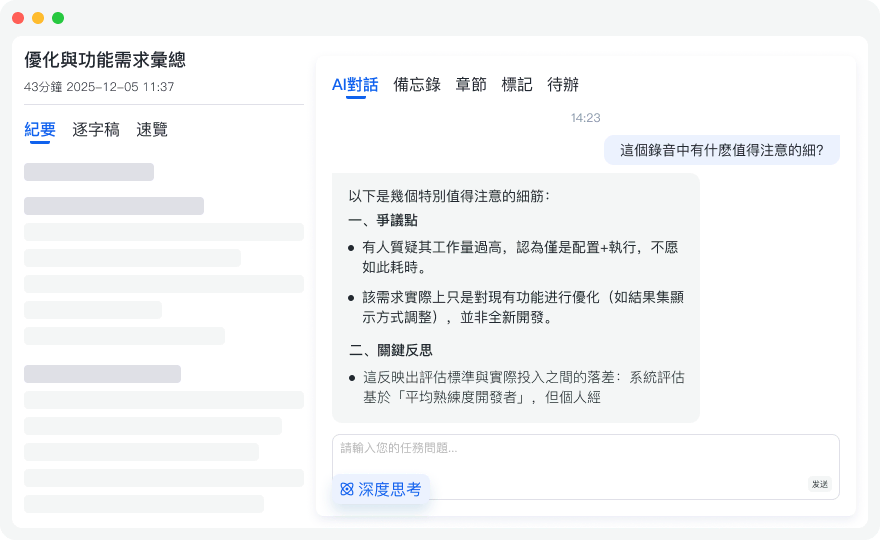
Scenario 4: AI Chat for Key Point Query
Once you have the transcript, instead of traditional Ctrl+F searching:
- Next to the completed transcript page, open the "AI Chat Query" window.
- Directly type a question, e.g., "What are the three marketing strategies mentioned by the speaker at the 10-minute mark?"
- The AI will provide accurate answers based on the context of the current audio/video, saving significant time rewatching.
5. Frequently Asked Questions (FAQ)
Q1: Do these video summarizer apps support mobile devices (iPhone or Android)? Some tools are only available as web versions or browser extensions (e.g., AI Kedaibiao). If you frequently need mobile access, it's recommended to choose tools that offer dedicated iOS and Android apps (like Tinrec), allowing you to directly parse links or record in real time on your phone.
Q2: Can AI still summarize videos that have no closed captions (CC)? Yes. Good AI summarizer tools don't just grab existing subtitles; they have speech-to-text (voice recognition) capabilities. Even for raw videos without subtitles or self-uploaded recordings, the system first transcribes them into text and then generates a summary.
Q3: Can I upload recorded meetings from online video conferencing software (e.g., Teams, Meet, Zoom) for summarization? Yes. You can directly upload local meeting recording files (MP4, M4A, WAV, etc.) downloaded from Teams or Meet via the "Audio File Import" feature in NoteGPT or Tinrec, and the system will automatically generate meeting minutes and action items.
Q4: Can tools accurately recognize videos in English, Japanese, or with accents? Most mainstream tools support multilingual recognition and translation. For example, Tinrec supports automatic recognition of 10 languages including Chinese, English, Japanese, Korean, German, Taiwanese, and Cantonese; NoteGPT also provides multi-language summaries and subtitle translation, making it ideal for cross-language learning.
Q5: Can I export the transcript generated by the video summarizer? What formats are supported? Most professional tools allow exporting processed text. Common export formats include plain text (TXT), Markdown, and even Word or PDF. Some tools also support directly sharing the summary content.
Q6: What happens when free usage runs out? What are the pricing plans? Policies vary. Tongyi Tingwu offers daily login bonuses; BibiGPT gives new users 1 hour free; Tinrec provides 100 minutes of free recording analysis per month. Beyond that, you can choose subscription plans (e.g., Basic version offers 600 minutes per month). Users can select the most cost-effective plan based on their viewing and meeting frequency.
Turn every recording into actionable outcomes
Get 60 free transcription minutes when you sign in. No credit card required.
Related Reading
You might also like
2026 Complete Guide to vocol ai: Turn Meeting, Class, and Interview Recordings into Actionable Data
A comprehensive guide for knowledge workers on vocol ai voice-to-text tools. Using Tinrec as an example, learn how AI can automatically transform meetings, classes, interviews, and online videos into searchable, summarized, and queryable structured data. Includes key buying considerations and a step-by-step walkthrough to help you stop drowning in audio files.

2026 Real-World Comparison of 3 Notta Alternatives: Which Performs Better for Chinese Meetings and AI Q&A?
Still looking for a Notta alternative? We tested Tinrec, Plaud Note, and Otter.ai across transcription quality, AI features, and pricing to help you pick the best voice-to-text tool for your needs.
2026 Review of 3 Transcription Apps for Students: Notta Isn't the Top Pick—Here's Why
A senior student tests three speech-to-text tools for lectures and group discussions, comparing free minute limits, Chinese accuracy, and AI features of Notta, Otter.ai, and Tinrec to find the best fit for students.

2026 Real-World Comparison of 4 Notta Alternatives: Which Saves the Most Time for Chinese Meeting Minutes?
What are the alternatives to Notta? This article tests 4 recording-to-text tools including Tinrec, evaluating Chinese transcription, AI summaries, multi-platform support, and pricing to help you choose the best app for meetings, classes, and interviews.
2026 Hands-on Comparison of 3 AI Recording & Transcription Tools: Which Works Best for Chinese Meetings and Learning?
It's not just about transcribing audio to text; it's about organizing it into usable knowledge. This article hands-on tests three tools: Tinrec, Notta, and Fireflies, evaluating them on Chinese accuracy, AI summarization, multi-source support, and real-world experience to help you find the best AI recording assistant for meetings, courses, and online videos.

2025 Hands-On Review of 3 AI Recording Tools for Students: Tinrec's Free Tier Is the Most Surprising
A senior student tested these tools for a semester, comparing Tinrec, Notta, and Otter.ai on free tiers, AI summarization, cross-platform support, and student plans. Find out which one is best for lecture recording and exam review.
2026 Four Transcription Tools Tested and Compared: From Plaud Note Pro to Tinrec, My Journey to Choosing the Right One
After seeing heated discussions about Plaud Note Pro on Dcard, I actually tested four transcription tools. This article shares my trial journey from hardware recorders to software solutions, and why I ultimately chose Tinrec as my productivity core.

2026 Hands-On Comparison of 3 Speech-to-Text Apps: A Time-Saving Tool for Recording Natural Gas and Propane Prices in Nottawa
When comparing natural gas and propane prices in Nottawa, the most time-consuming part is recording calls and organizing quotes. This article tests three speech-to-text apps—Tinrec, Otter.ai, and Notta—evaluating Chinese recognition, AI summaries, cross-platform use, and free tiers to help you choose the best tool for recording supplier quotes and service details.

2026 Comparison of 4 Speech-to-Text Apps: Notta AI Not the Best? This App is the Top Pick
Hong Kong office workers test 4 speech-to-text tools including Notta and Tinrec to see which one offers the best Cantonese recognition, most useful AI features, and biggest time savings. Read this review before deciding.