
Turn recordings into transcripts and summaries in minutes
Upload audio or video for multilingual transcription, AI notes, and action items
Pain Point: Why Is It So Hard to Record LINE Calls?
Do you often use LINE for business communication but find that the built-in screen recording cannot capture the other person's voice? Especially on iPhones, system privacy restrictions make it a headache for many to preserve important meeting or call records.
This article fully addresses the common question "Can you record LINE calls?" and provides a multi-dimensional comparison of 6 free and practical mobile recording apps, along with a detailed comparison table and step-by-step operation guide.
Quick Navigation: If you simply need to save voice recordings, choose "Super Recorder" or "Call Recorder"; if you prioritize post-recording information organization and want long recordings automatically turned into meeting minutes and to-do lists, Tinrec is a solution worth considering first.
Can You Record LINE Calls? Device Limitations and Legal Considerations
LINE itself does not have a built-in call recording feature. For iOS users, due to strict privacy protection policies, the built-in screen recording function automatically mutes the microphone during calls, so you cannot directly record both sides of the conversation. For Android phones, depending on the brand and system version, some devices can achieve recording through third-party apps.
If you must record voice content, besides using another device to record via speakerphone, using a professional recording app is the most common solution. However, before recording any phone call, be sure to check local laws, as recording without consent may be illegal.
Top 6 Mobile Recording & Call Recording Apps in 2026
Based on real user feedback, here are 6 common mobile recording apps to help with daily recording, meeting notes, and voice-over needs:
1. PowerDirector
In addition to being a well-known video editing software, it also has built-in recording and audio editing features. It supports AI noise reduction, speed adjustment, and voice changing, suitable for users who need to combine recordings with video voiceovers.
2. Recorder Pro
Offers multiple recording methods including Bluetooth headset and phone microphone, and can mix with playing music. Currently offers a 3-day free trial; advanced trimming and noise reduction features require a paid subscription.
3. Recording Pro
Supports Android systems, features simple Chinese and English recording-to-text translation, but lacks advanced audio editing tools.

4. Recording Plus
Emphasizes background recording and no recording length limit. Can continue recording and auto-save even when the screen is off, very suitable for long classes or lectures. Provides basic recording functions.
5. Super Recorder
Offers unlimited recording time and sessions, with simple voice-to-text and real-time voice changing and noise reduction. However, some users report occasional issues with missing recordings or poor transcription accuracy.
6. Call Recorder ™
A call recording app designed for iOS that can record incoming or outgoing calls. It is a paid subscription tool with weekly, monthly, and yearly plans.
Stop organizing recordings by hand
Upload audio or video and automatically get a transcript, summary, and action items
Comparison Table: How to Choose the Right Recording and Transcription Tool?
| Comparison Dimension | PowerDirector | Recording Plus | Super Recorder | Call Recorder ™ | Tinrec (Comparison) |
|---|---|---|---|---|---|
| Platform Support | iOS / Android | Android | Android | iOS | iOS / Android / Web |
| Language Support | Basic languages | System language | Chinese/English mainly | System language | Automatic recognition of 10 languages including Chinese, English, Japanese, Korean |
| Noise Reduction & Advanced Editing | Yes, supports AI noise reduction | No | Yes, supports simple editing | No | No audio editing, focuses on semantic organization |
| Recording to Text & AI Query | No, more for voice-to-subtitles | No | Yes (basic recognition) | No | Yes, supports AI-powered Q&A for key points |
| Summary & Action Items Generation | No | No | No | No | Yes, automatically generates meeting minutes and to-do lists |
| Pricing & Free Tier | Basic free | Basic free | Basic free | Paid subscription | Free plan: 100 minutes per month |
How to Efficiently Process Recordings? Practical Guide to Call Recording Transcription
After recording important calls or meetings, repeatedly listening back is time-consuming. You can use AI tools to convert time-based content into searchable text. Below is a demonstration of how to turn voice into actionable items using various features:
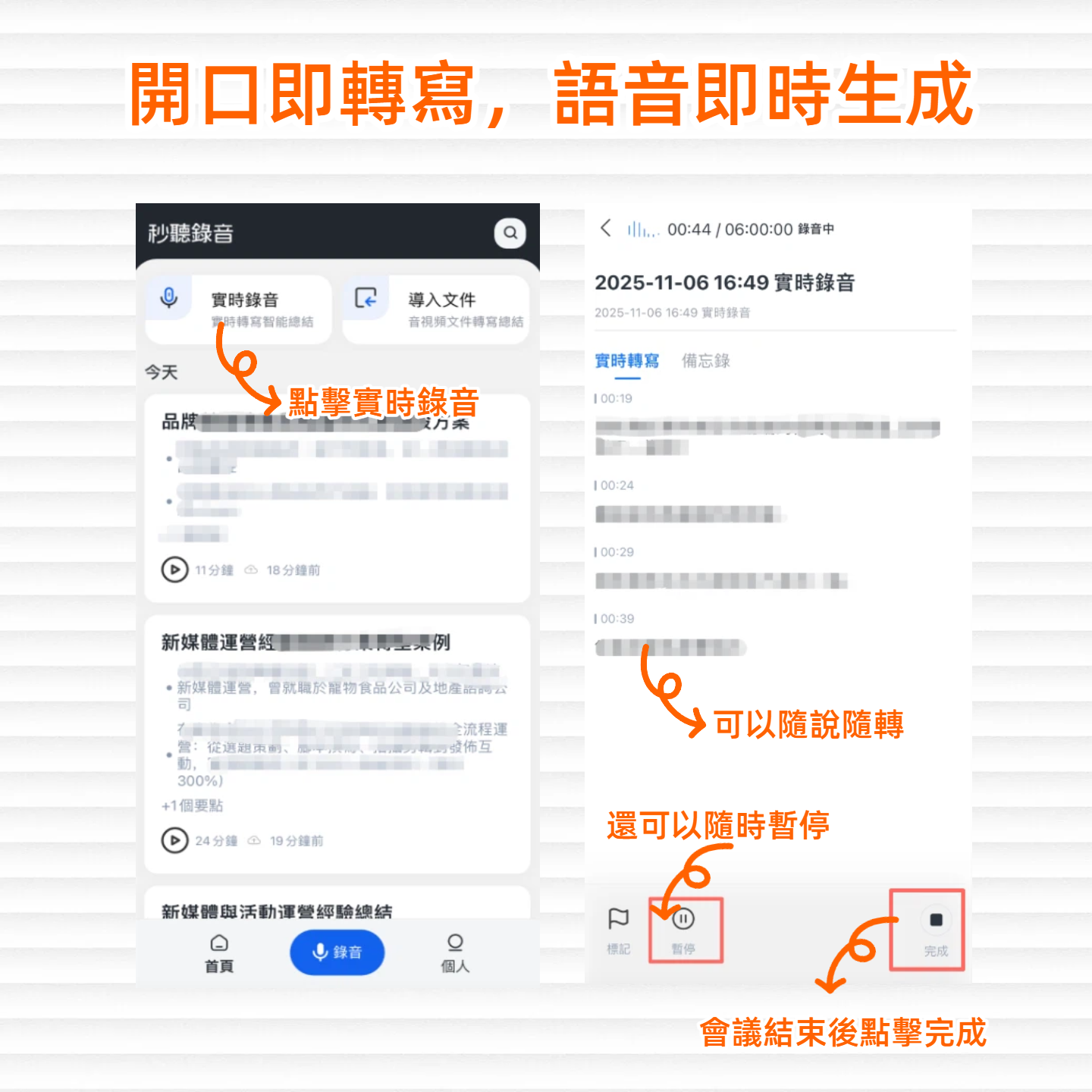
Step 1: Real-Time Recording to Text
If you are in a physical meeting or playing a LINE call on speaker via computer, you can directly enable real-time transcription. Live recording is instantly converted to text, allowing you to mark key points without waiting.
Access: Real-time Recording to Text
Step 2: Import Audio Files to Generate Transcripts
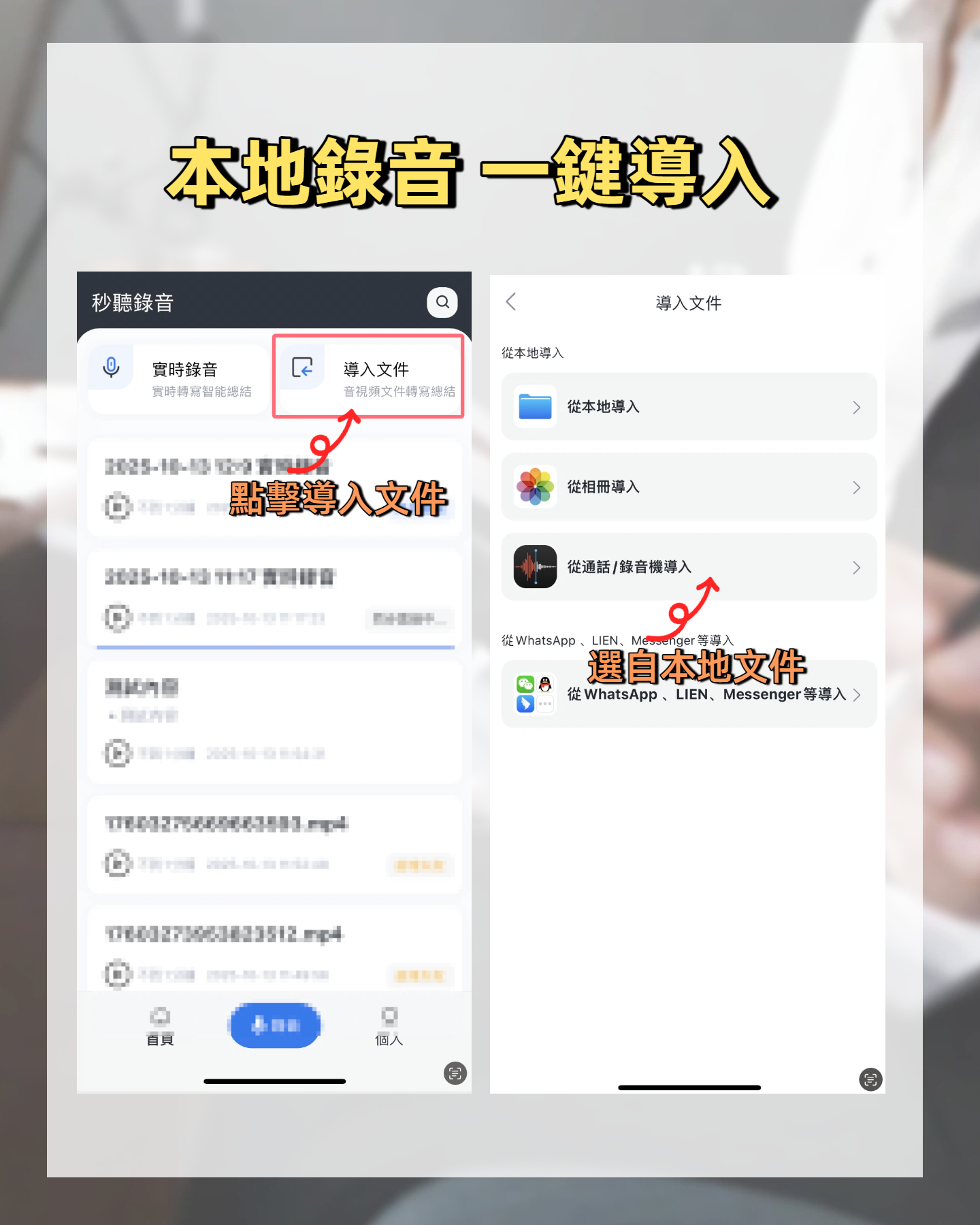
If you already recorded via a phone app, upload the audio file directly. The system supports multiple audio formats, quickly converts to text, and automatically generates a summary.
Access: Audio File to Text
Step 3: Online Video Link Analysis
For online webinars or training sessions on YouTube or podcast platforms, simply copy the URL and import to skip downloading and directly get a transcript. Access: Podcast/Online Video to Text
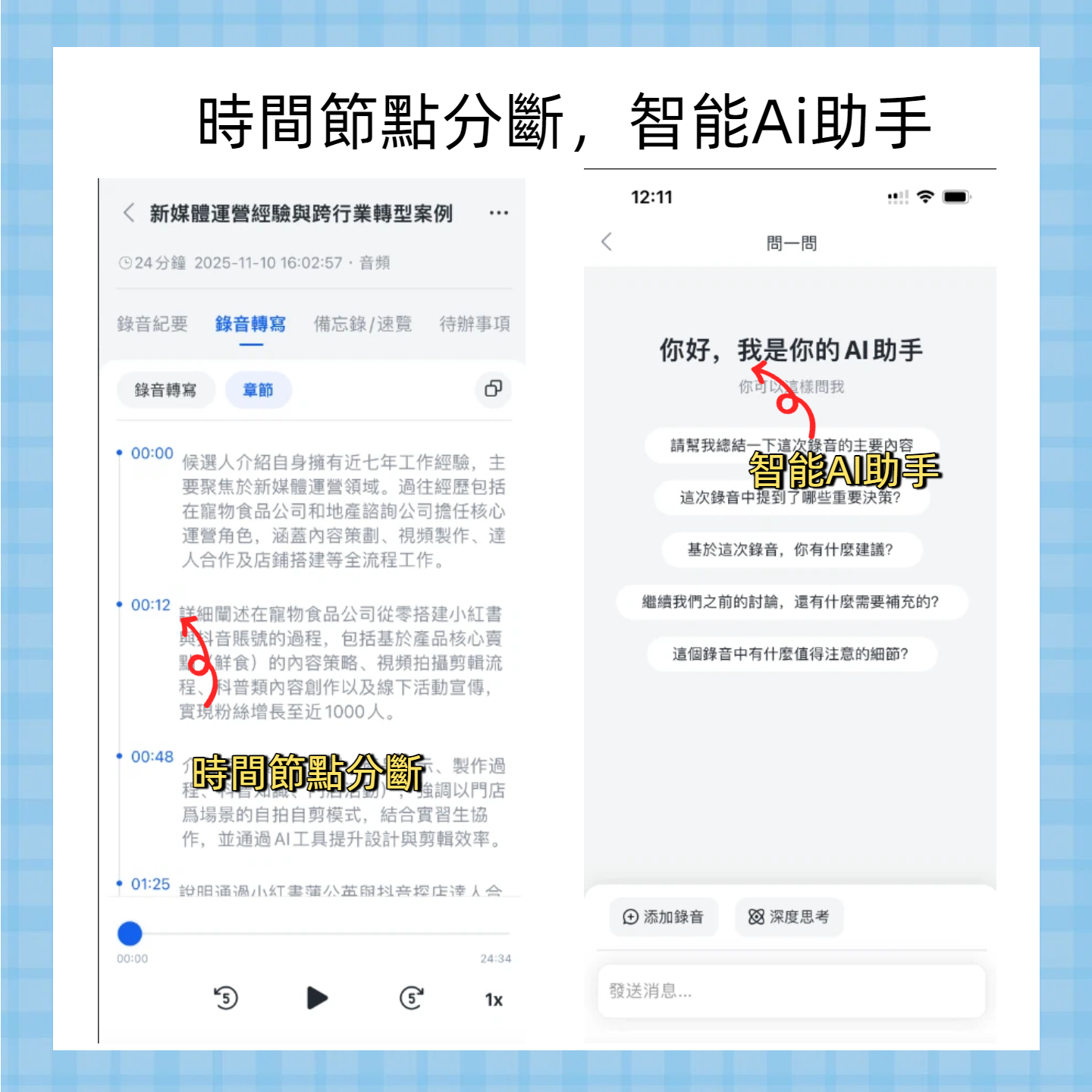
Step 4: Use AI Chat to Query Key Content
Traditional transcripts only allow Ctrl+F search. To quickly recall "the three key decisions made in the meeting," use AI Q&A—the system extracts answers from the recording, as intuitive as asking a person.
Access: AI Chat Query
3 Tips to Improve Recording Quality and Transcription Accuracy
Regardless of the tool, proper preparation greatly reduces post-processing costs:
- Ensure a quiet recording environment: Avoid background noise like traffic or air conditioning. Even if the app has noise reduction, keeping the original track clean is the best way to improve recognition.
- Prepare a rough script or outline: For interviews or proactive recordings, having an outline helps organize thoughts and ensures key points are not missed.
- Use appropriate recording equipment: An external microphone provides clearer sound than the built-in phone mic, helping AI distinguish speakers and recognize text more accurately.
Frequently Asked Questions About Mobile Recording and Voice-to-Text
Q1: Can I directly record LINE calls on an iPhone?
No. Due to iOS privacy restrictions, the built-in screen recording disables the microphone during calls. To record, you usually need another device for speaker recording or use a dedicated paid call recording app like Call Recorder.
Q2: Can these tools also transcribe Teams or Google Meet meetings?
Yes. For remote meetings (e.g., Teams, Meet), you can play audio on your computer and record via a phone app, or use a cross-platform tool for real-time transcription to automatically generate meeting notes.
Q3: Are there any completely free call recording tools?
Some free recording apps (e.g., Super Recorder) allow unlimited recording of ambient audio, but for stable two-way call recording, most tools require a paid subscription. For subsequent text processing, you can take advantage of free tiers (e.g., 100 minutes per month) from some tools.
Q4: How can I improve the accuracy of call recording transcription?
Besides keeping the environment quiet and using a headset microphone to reduce echo, choosing an AI tool that supports multi-language automatic recognition can effectively handle mixed-language meetings or multi-speaker scenarios.
Q5: Do recording-to-text tools support multilingual recognition?
Currently, basic recording apps mostly support only the system default language. For international meetings or foreign language classes, choose an AI tool that supports multiple languages (e.g., Chinese, English, Japanese, Korean) to reduce translation and comprehension costs.
Q6: Is it legal to record LINE calls without consent?
In many countries and regions, recording without both parties' consent may violate privacy laws. It is recommended to inform the other party before recording and ensure compliance with local regulations.
Turn every recording into actionable outcomes
Get 60 free transcription minutes when you sign in. No credit card required.
Related Reading
You might also like

What Is Vocal Fry? 3-Minute Breakdown of the Creaky Voice Phenomenon, Celebrity Examples, and Perception Debates
Vocal fry, also known as creaky voice or glottal fry, is the lowest vocal register. This article explains in 3 minutes what vocal fry is: from the actual vocal mechanism in the throat, the low-frequency characteristic of vocal folds vibrating 20 to 50 times per second, to celebrity examples like Kim Kardashian, social perception research, and 3 common misconceptions—all in one go.
What Does Vocal Cord Mean in Chinese? 5 Steps to Choose the Right Speech-to-Text Tool in 2026
The Chinese translation of "vocal cord" is "聲帶" (shēngdài), but most people actually need to turn spoken words into usable text. This article first explains 5 key points for choosing a speech-to-text tool, then compares Tinrec, Notta, TurboScribe, and Otter.ai with hands-on testing, and finally gives clear purchase recommendations.
What Is Vocal Fry? Definition, 3 Practical Uses & Examples (2026 Guide)
What does vocal fry mean? This student-friendly guide explains the often-misunderstood vocal register: from the Cambridge Dictionary definition and vocal cord vibration to three practical uses in speech emphasis and singing, plus the answer to the big debate—is it a bad habit or a useful tool?
Vocal Cord Palsy: Symptoms, Causes, and Treatment (2026 Guide)
This article explains vocal cord palsy in plain English, covering common symptoms, possible causes, how it's diagnosed, and when to see a doctor, so you can quickly grasp the key information.
6 Chinese Audio-to-Text Tools Tested for 2026: Can Otter Transcribe Chinese? Which One Delivers the Best Transcripts?
Otter officially supports only Simplified Chinese, not Traditional Chinese. This article reviews 6 Chinese audio-to-text solutions, covering Otter's current Chinese support, free tiers, and pricing, as well as Tinrec's Chinese meeting features, AI Q&A, and team collaboration capabilities, to help you find the tool that best fits your meeting needs.
2026 Zoom Meeting Real-Time Translation Comparison: Which Tool Gives You Bilingual Subtitles and Post-Meeting Transcripts?
Zoom's built-in captions are not the same as cross-language translation, and translation is not the same as a usable post-meeting record. This article addresses three common misconceptions and compares three approaches: platform built-in features, human simultaneous interpretation, and desktop AI real-time translation. It also explains how Tinrec uses bot-free recording to solve both real-time comprehension and post-meeting organization.
What Does 'Otter' Mean in Chinese? 3 Common Meanings and Translation Contexts Explained (2026)
The Chinese translation of 'otter' is most commonly '水獺' (shuǐ tǎ), meaning otter. However, it can also refer to otter fur, a fisheries term, or the AI transcription tool Otter.ai. This article uses 3 key points to help you determine which meaning you're looking for, and explains the translation, context, and common misunderstandings for each.
Zoom Free vs Tinrec 2026: Which Meeting Notes Solution Actually Works for Free?
Zoom's free plan lets you host unlimited meetings with up to 100 participants, but what about a searchable, queryable record after the call? This article compares Zoom's free plan and Tinrec across 5 dimensions—recording method, Chinese transcription, post-meeting organization, team data storage, and free quota—to help you decide which one fits your needs.
Vocol.ai Tutorial 2026: Complete Guide to Free Transcripts and AI Summaries
Vocol.ai is an AI voice collaboration platform that converts recordings and videos into transcripts and automatically generates summaries, topics, and action items. This guide covers the complete workflow, core features, practical use cases, and purchasing considerations, along with free usage limits and FAQs.