
Turn recordings into transcripts and summaries in minutes
Upload audio or video for multilingual transcription, AI notes, and action items
Do you record meetings or lectures, only to never listen back? This is a real pain point. Many buy traditional recorders but spend more time searching for key points than recording, struggling with mixed Chinese-English speech, or finding it hard to capture online Teams/Meet meetings.
This article reviews the top 5 physical voice recorders most discussed on PTT, with a detailed comparison table, buying tips to avoid pitfalls, and a practical "high-usability meeting minutes" tutorial along with FAQs.
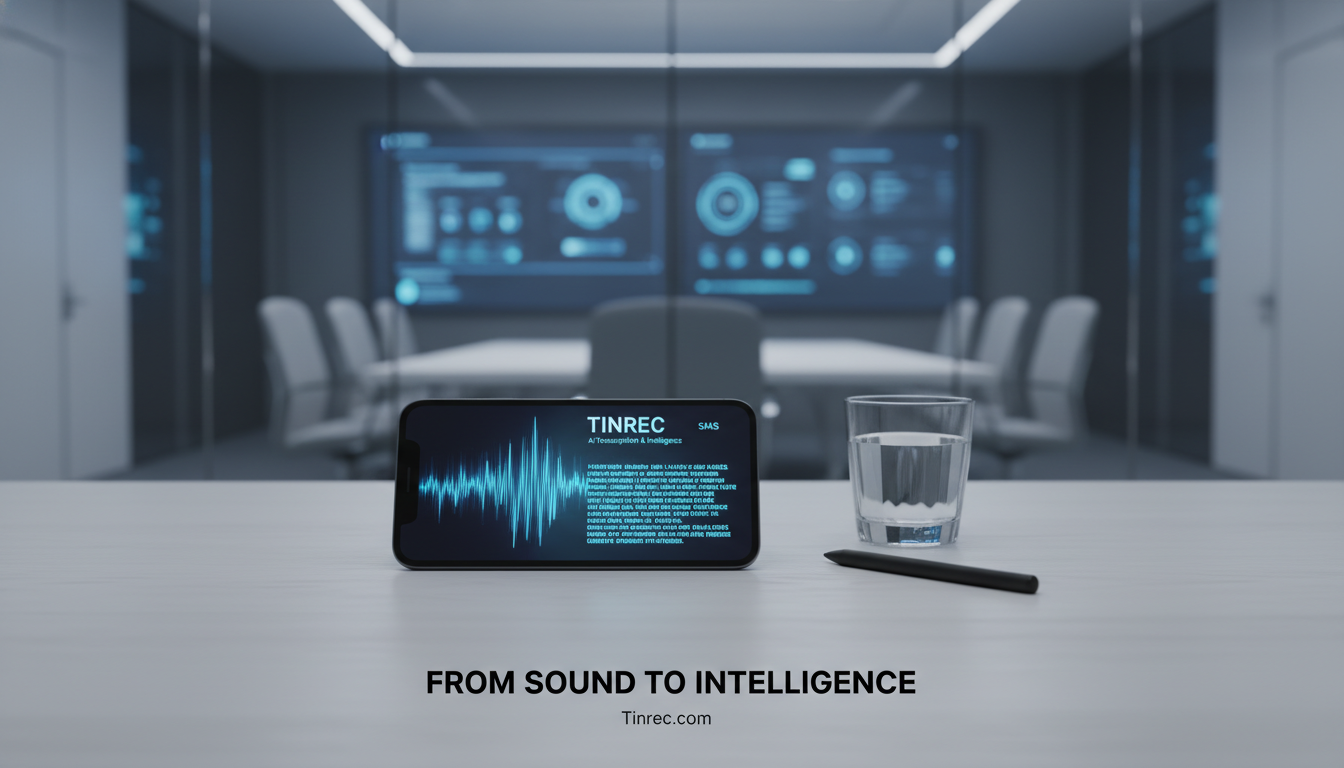
Quick verdict: If you need extreme battery life for long stationary recording, consider traditional hardware like LTP or FJ. If you value voice-to-text and AI summaries, check out the AI-powered PLAUD NOTE, or go with a pure software alternative like Tinrec that supports multi-device sync and AI chat queries.
Why Are PTT Users Looking for "Transcription-Capable" Recording Devices? 4 Buying Tips to Avoid Pitfalls
Traditional recorders have low information density and high re-listening cost. With faster work pace, people need to convert time-based content into scannable, searchable, actionable text. When choosing a recording tool, focus on these core metrics:
- Recording Quality & Noise Reduction: Echo in meeting rooms, wind noise outdoors affect later listening. Devices with AI noise reduction or AGC can filter background noise effectively.
- Real-time Transcription: Most buy recorders for transcripts. Support for real-time voice-to-text and recognition of languages like Taiwanese Hokkien, Cantonese, Japanese, Korean is key.
- Summarization & Search: Transcripts alone aren't enough. Good tools auto-generate decision summaries and have search to quickly find key parts.
- Multi-scenario & Storage Flexibility: Besides in-person, many have online meetings (Teams/Meet) or online courses. Tools that can import audio or parse video links are more practical.
Top 5 Voice Recorders of 2026: In-depth Review
Based on PTT ratings and market popularity, here are 5 different recording solutions:
1. PHILIPS Smart Voice Recorder (VTR5102Pro/VTR5010Pro)
Features AI summaries and real-time translation (24 languages). Zinc alloy body feels premium, with good noise cancellation. However, smart features depend on the dedicated App (VTR TW) connection, battery life ~4 hours when connected. Best for office workers with cross-language needs and frequent charging access.
2. FJ Long Standby HD Noise Reduction Recorder
Simple and practical, without fancy AI. Supports 60m remote recording and microSD expansion (up to 128GB). Has voice-activated recording and password protection. Suitable for budget users needing long fixed-point recording (e.g., lectures).
3. LTP Built-in 32GB Ultra-clear Professional Recorder
Boasts over 130 hours of continuous recording – enough for marathon sessions. Built-in 32GB, AGC noise reduction. Traditional design, ideal for investigation, evidence collection, or personal voice diaries needing extreme battery.
4. PLAUD NOTE ChatGPT AI Smart Recording Card
Ultra-thin 0.29cm card design, combined with ChatGPT for transcription and key point summaries. Supports phone call recording mode, highly discreet. Downside: high unit price, and AI software transcription may require subscription fees.
5. Tinrec (MiaoTing Recorder) - Software-Oriented Complete AI Workflow
If you don't want another device, Tinrec is a highly rated multi-platform AI recording assistant. It breaks the "record but don't organize" pain point, focusing on "record → understand → act" workflow. Supports iOS, Android, and web, auto-recognizes 10 languages including Taiwanese Hokkien and Cantonese. Whether live transcription or importing Teams recordings, it quickly generates meeting minutes and to-do items.
Stop organizing recordings by hand
Upload audio or video and automatically get a transcript, summary, and action items
Voice Recorder vs. AI Recording Software: Full Comparison
| Evaluation Dimension | Traditional Recorder (e.g., LTP) | AI Smart Hardware (e.g., PLAUD) | AI Software Workflow (e.g., Tinrec) |
|---|---|---|---|
| Recording & Language Support | Basic, no auto transcription | Supports Chinese, English, Japanese, etc., relies on Whisper | Auto-recognizes 10 languages including Taiwanese Hokkien, Cantonese |
| Real-time Transcription | None | Requires post-recording transcription | Real-time text display during recording |
| Summarization & Action Items | None | ChatGPT summary | Auto-generates meeting minutes, conclusions, and to-do action items |
| AI Chat Query | None | Requires external integration | Built-in semantic chat query (ask questions like talking to a person) |
| Export & Multi-platform | Copy MP3/WAV via USB | Export via dedicated App | iOS, Android, Web sync, multi-format export |
| Price & Free Tier | One-time purchase (~$30-100) | High hardware cost + possible subscription | Up to 100 min free per month, Pro affordable |
Tutorial: How to Efficiently Turn Recordings into Actionable Meeting Minutes
Bought a tool but don't know how to use it? Here's a step-by-step using Tinrec's interface to turn meeting recordings into high-value text output.
D1. Objective
By the end of this tutorial, you will produce accurate transcripts, core decision summaries, and clear action items with assignees and deadlines.
D2. Preparation
Identify use case: For in-person meetings, place phone near speakers. For online meeting recordings, prepare audio/video files. For YouTube references, have URLs ready. Ensure stable internet.
D3. 5-Step Workflow
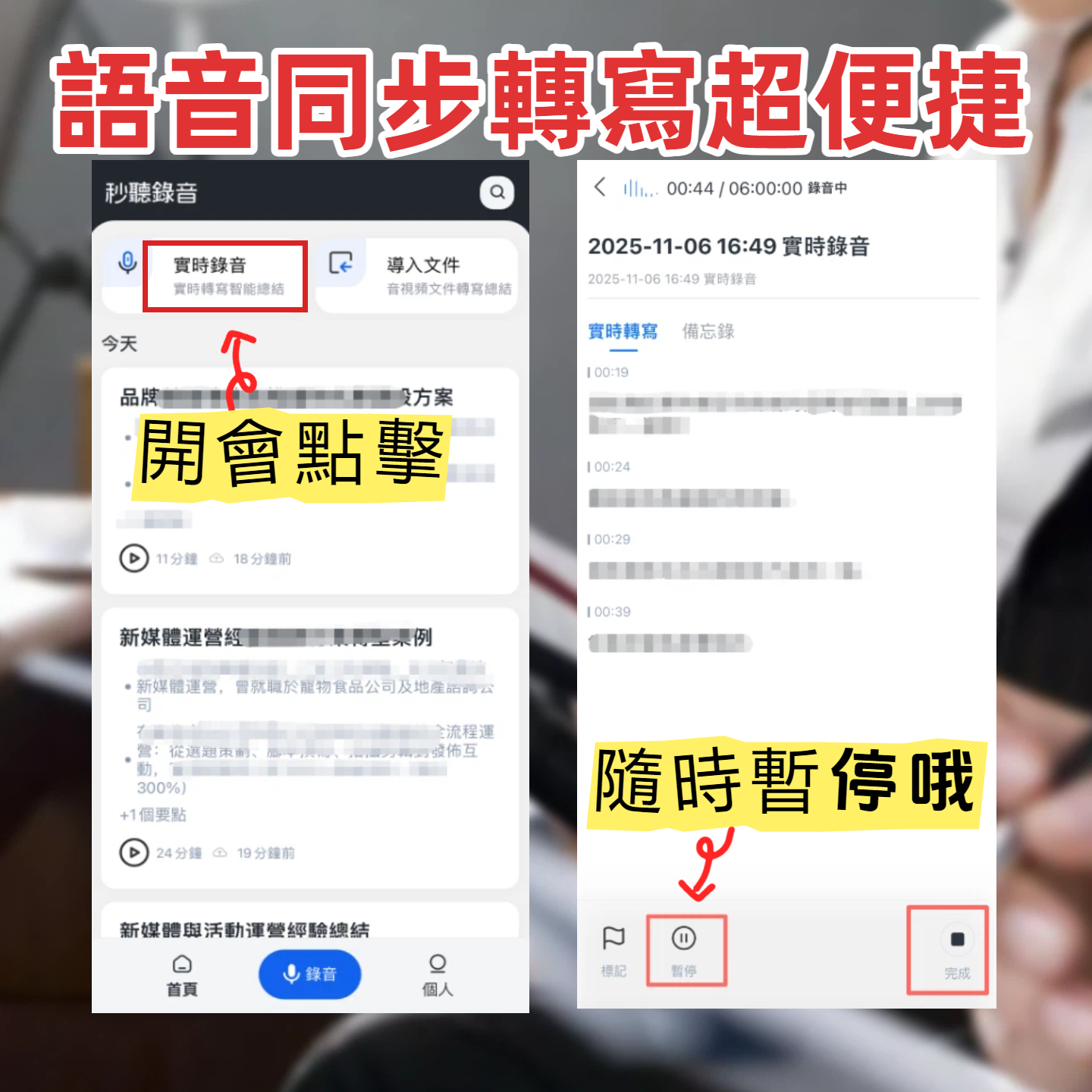
Step 1: Real-time Recording to Text
- Action: Open mobile app or web, tap "Record".
- Result: System transcribes speech to text in real time, text scrolls synchronously.
- Note: This boosts live note-taking. Minor edits for proper nouns may be needed.
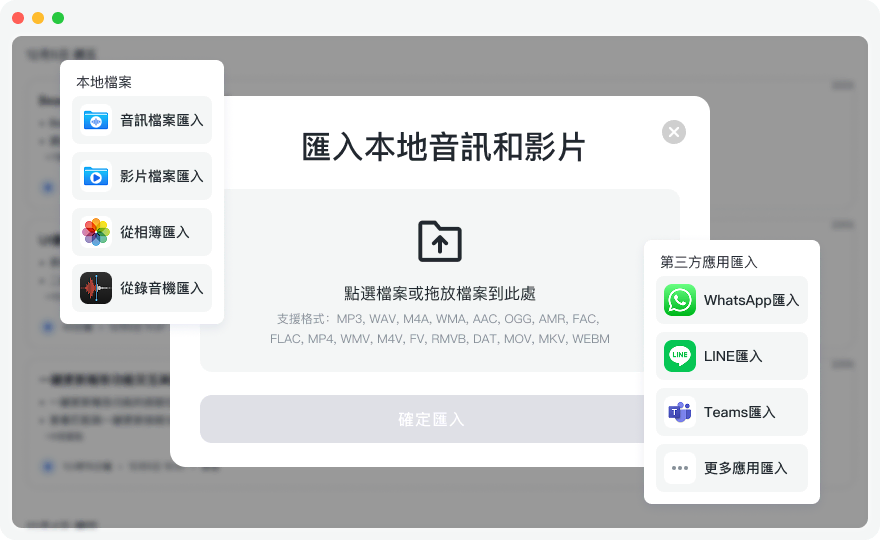
Step 2: Import Audio/Video for Transcript
- Action: Select "Import Audio/Video" to upload existing files from Teams or recorders.
- Result: System quickly parses and distinguishes speakers (e.g., Speaker A, Speaker B).
- Note: Ensure file size and duration within supported limits.
Step 3: Parse Online Video Links (for Courses/Competitor Analysis)
- Action: Use "Video to Text" function, paste YouTube or podcast URL.
- Result: No need to download large files; system reads content and generates transcript & summary.
- Note: Videos must be public; private ones won't work.
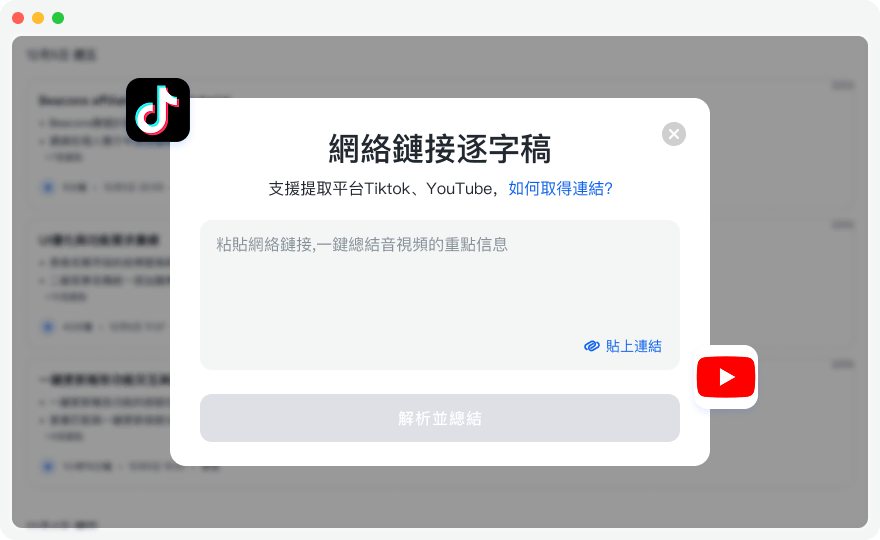
Step 4: Generate Summary & Action Items
- Action: After transcript is ready, click one-button summary.
- Result: AI filters chit-chat, condenses key points into meeting conclusions, and lists a to-do list.
- Note: This solves the pain point of many tools providing only transcripts without decision summaries.
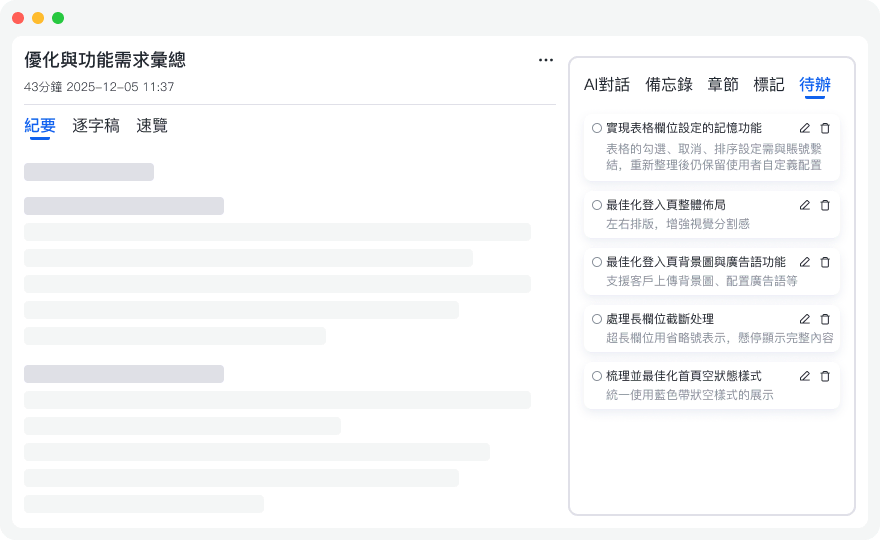
Step 5: Use AI Chat to Query Key Content
- Action: Type a specific question in the chat box, e.g., "What was the Q3 budget mentioned in the meeting?"
- Result: AI answers based on recording semantics – no more Ctrl+F.
- Note: More specific questions yield more accurate answers.
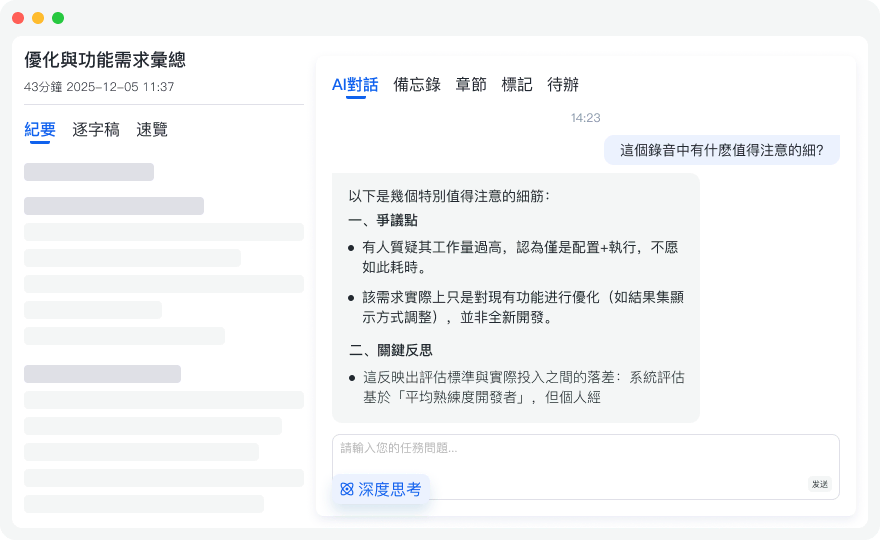
D4. Common Errors & Troubleshooting
- Overlapping speech causing misrecognition: Use "AI Chat Query" post-meeting to let AI re-contextualize.
- Excessive ambient noise: Software noise reduction is strong but physical limitations exist. Keep recorder away from fans or keyboard clicks.
D5. Acceptance Criteria
A usable transcript and minutes should:
- Correctly capture key project terms and numbers.
- Allow clicking on transcript to jump to timestamp audio.
- Action items include clear next steps.
D6. Sample Template
You can format the output for your team:
- Meeting Topic: [AI-generated]
- Key Conclusions: [AI summary]
- Action Items (Who/What/When): [Extracted from action items]
PTT FAQs: 6 Common Questions About Voice Recorders & AI Transcription
Q1: Isn't the iPhone's built-in Voice Memos enough? Why do people recommend separate recorders or software? The built-in app only offers basic storage, lacks noise reduction, and cannot search or transcribe. For heavy meeting note-takers, re-listening is too time-consuming.
Q2: Our company uses Teams or Google Meet. Should I buy a physical recorder to place next to the speaker? No. Record the online meeting directly, then upload the file to transcription software (like Tinrec). It can distinguish speakers and generate minutes with better clarity than secondary recording.
Q3: Are these AI transcription tools accurate for Chinese? Can they understand Taiwanese accent or Hokkien? Current AI models have improved greatly. Leading tools support automatic recognition of 10 languages including Taiwanese Hokkien and Cantonese, with high accuracy for Taiwanese accents and mixed Chinese-English.
Q4: Do voice-to-text tools offer free trials? Policies vary. Physical hardware usually requires purchase (some include free membership). Pure software often has free tiers, e.g., Tinrec offers up to 100 minutes free per month.
Q5: Does hardware noise reduction in traditional recorders really make a difference? Hardware DSP or directional mics have physical advantages in extreme noise (e.g., exhibitions, outdoors). But in typical offices/classrooms, modern AI software can handle 90%+ of noise.
Q6: Can I easily share transcripts with colleagues? With traditional recorders, you can only share the MP3. New workflow tools support multi-format export (TXT, Markdown, even SRT subtitles), making collaboration much more efficient.
Turn every recording into actionable outcomes
Get 60 free transcription minutes when you sign in. No credit card required.
Related Reading
You might also like

Google Meet vs Microsoft Teams in 2026: A Hands-On Comparison to Help You Choose the Right Tool
Google Meet and Microsoft Teams are both 4.5-star rated meeting tools, but they serve very different use cases. This article compares them hands-on across interface, participant limits, external meeting experience, and ecosystem integration to help you decide which one fits your workflow.

Google Meet vs Zoom 2026: Which Is Cheaper and Better for Your Needs?
Trying to decide between Google Meet and Zoom based on cost and features? This hands-on comparison covers pricing, free plan limits, meeting controls, and real-world use cases to help you choose the right tool.

Google Meet vs Microsoft Teams in 2026: Which Video Conferencing Tool Should You Choose?
Wondering whether Google Meet or Microsoft Teams is the right choice? This comparison looks at real-world meeting scenarios, ease of use, pricing, and team collaboration needs to help you make a quick purchasing decision.

Google Meet vs Skype in 2026: A Hands-On Comparison, Plus How Tinrec Makes Meeting Notes Effortless
Wondering whether Google Meet or Skype is better for your needs? This hands-on comparison evaluates video quality, ease of use, cross-platform support, and meeting notes. We also show how Tinrec turns conversations from both platforms into searchable, trackable transcripts and to-do lists.
Is Google Meet an App in 2026? 4 Ways to Use It: Join Meetings Without Installing the App
Google Meet is indeed an app, but you don't have to install it. This article tests 4 ways to use it: mobile app, computer browser, Gmail integration, and meeting links, and compares the no-install vs. app versions to help you decide which suits your meeting needs best.

5 Best Voice Recorders of 2026: How to Choose for Meetings, Lectures, and Evidence Collection
When it comes to voice recorders, pricier isn't always better—what matters is matching the device to your needs. This guide breaks down key buying considerations and compares popular models from SONY, PLAUD, and Victor, covering everything from meeting minutes and classroom lectures to evidence gathering, so you can find the right recorder with confidence.

Notta vs Transkriptor in 2026: A 5-Dimension Comparison to Find the Best Fit for Your Meeting Workflow
Notta and Transkriptor are both popular speech-to-text tools, but one leans toward meeting workflows while the other focuses on multilingual file transcription. This article compares them across 5 practical work dimensions to help you choose based on your use case, and offers a more complete alternative for meeting collaboration.

6 Best Voice Recorders of 2026: Recording, Transcription, and AI Summaries Compared
A voice recorder is more than just a device that captures audio. This article compares six voice recorders and AI recording tools across four key areas—recording quality, transcription accuracy, AI summarization, and team collaboration—to help you choose the right solution based on your budget and use case.

Top 5 Free Call Recorder Apps in 2026: A Complete Guide
Looking for a free call recorder app but don't know where to start? This article reviews 5 practical call recording solutions in 2026, from iPhone's built-in feature to Android-specific apps, with recommendations for different use cases.