
Turn recordings into transcripts and summaries in minutes
Upload audio or video for multilingual transcription, AI notes, and action items
If you want to transcribe video to text and have coding skills plus a high-end GPU, Whisper on GitHub is the top choice. But if you want to skip complex environment setup and need automatic summaries and AI Q&A, the deployment-free Tinrec is a more practical option.
Searching for "video to text github" usually means you're tired of manual transcribing and want high-accuracy solutions. This article breaks down 3 popular GitHub open-source speech-to-text projects and a no-deploy tool, providing a multi-dimensional comparison table, detailed pros and cons, and a step-by-step tutorial for non-coders.
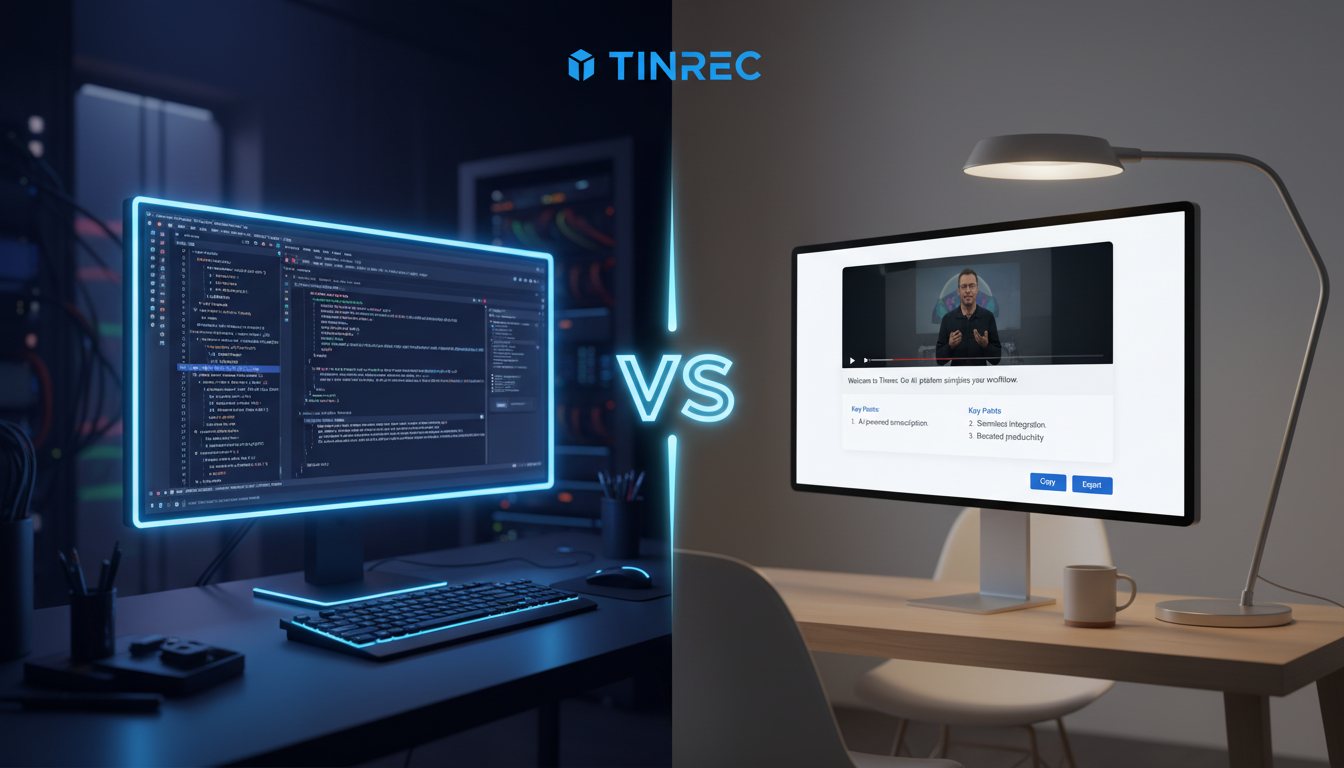
Quick navigation conclusions:
- Want full code control, maximum free usage, and local privacy → Choose open-source projects like Whisper.
- Value efficiency, need direct YouTube link parsing, or require post-meeting action items → Prioritize integrated online tools like Tinrec.
Why Look for Video-to-Text Tools on GitHub? Current State & Pain Points
Open-source projects have strong community support but come with high barriers to entry. For students and office workers who frequently handle meeting notes, class notes, or video subtitles, three major pain points often arise:
- Environment configuration errors: Installing Python, FFmpeg, configuring CUDA and dependencies often stumps non-engineers from the start.
- Stringent hardware requirements: Open-source models heavily rely on local GPU power. Using a standard laptop, transcribing a one-hour video can take hours.
- Only transcripts, no follow-up actions: Most GitHub projects just output plain text (e.g., SRT or TXT). You still need to copy-paste into other AI tools to get meeting conclusions or summaries—not truly solving the "re-listening and organizing" time sink.
Video to Text GitHub: Open-Source vs Online Tool Comparison Table
When choosing a tool, consider not just transcription accuracy but the overall workflow time cost. Here's a comparison of popular GitHub projects and Tinrec:
| Dimension | OpenAI Whisper (GitHub) | WhisperX (GitHub) | Auto-Subtitle (GitHub) | Tinrec (秒聽錄音) |
|---|---|---|---|---|
| Setup & Learning Curve | High (requires command line & local environment) | High (needs dependency setup) | Medium-High (some have basic UI) | Very Low (ready to use, multi-platform) |
| Language Support | Multilingual (depends on model size) | Multilingual | Multilingual | 10 languages auto-detection |
| Summary & Action Items | None (plain text transcription) | None (focuses on timestamp alignment) | None (focuses on subtitle generation) | Auto-generates meeting minutes & to-do action items |
| AI Interactive Query | None | None | None | Supports semantic AI chat queries |
| Import/Export Integration | Local audio files / TXT, SRT | Local audio files / TXT, VTT | Local video / SRT | Supports web video links, live recording / multi-format export |
| Price / Free Tier | Free (but hardware costs apply) | Free | Free | Free plan: up to 100 minutes/month; affordable paid plans available |
In-Depth Review: Differences Between 3 Popular GitHub Projects and Tinrec
1. OpenAI Whisper: The Benchmark for Open-Source Speech Recognition
- Best for: Developers doing secondary development, users with high-end GPUs for local processing.
- Test Performance: Very high recognition accuracy, especially with Large model—very low error rate. However, may hallucinate or repeat phrases on very long audio.
- Limitations: Requires command-line knowledge and no graphical user interface (GUI)—extremely unfriendly to general users.
2. WhisperX: Enhanced Timestamps & Speaker Diarization
- Best for: Professional subtitle groups, creators needing precise word-level timestamps.
- Test Performance: Fixes Whisper's timestamp inaccuracy, adds VAD (Voice Activity Detection) for better handling of multiple speakers.
- Limitations: Still terminal-dependent, lacks post-processing text comprehension—purely a transcription tool.
Stop organizing recordings by hand
Upload audio or video and automatically get a transcript, summary, and action items
3. Auto-Subtitle Projects: Focused on Video Subtitle Generation
- Best for: Short video creators needing quick subtitles.
- Test Performance: Typically wraps Whisper and adds video encoding to directly output MP4 with subtitles.
- Limitations: Single-function, cannot extract meeting highlights—unsuitable for knowledge management or study notes.
4. Tinrec: Complete Workflow from Audio to Action
- Best for: Cross-language meetings, online course notes, YouTube video highlights, interview transcription.
- Test Performance: No coding required; cross-platform (iOS, Android, Web). Provides accurate transcripts, but the key differentiator is converting long video text into scannable highlights and to-do lists.
- Limitations: Cloud processing requires internet; free plan caps at 100 minutes/month; heavy users need upgrade.
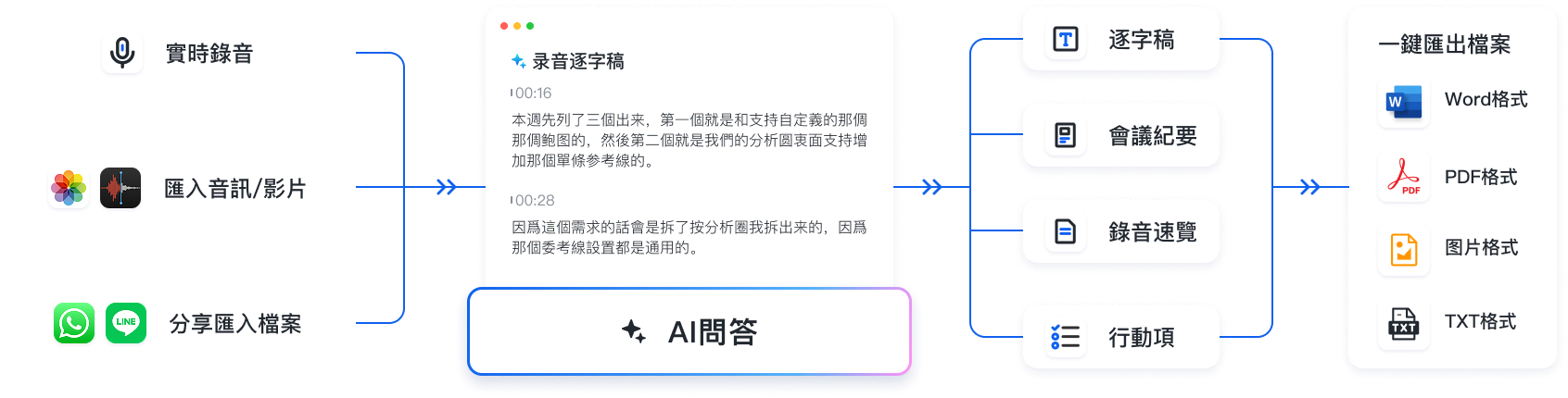
Hands-On Tutorial: How to Quickly Convert Video/Audio to Text and Extract Key Points
If you don't want to spend an afternoon setting up a GitHub environment, follow this standard workflow using Tinrec to complete "transcription + summarization + Q&A":
Step 1: Choose Input Method (Supports 3 Core Scenarios)
Based on your situation, pick the best recording or import method:
- Online video/podcast to text: No need to download—paste a YouTube, TikTok, or podcast link, and the system automatically parses and converts it in the background.
- Import local audio file: Supports many common audio formats—simply drag and drop interview or meeting recordings.
- Live recording to text: In a physical meeting or class, open the web app or mobile app, tap "Start Recording", and the text appears in real time—no waiting.
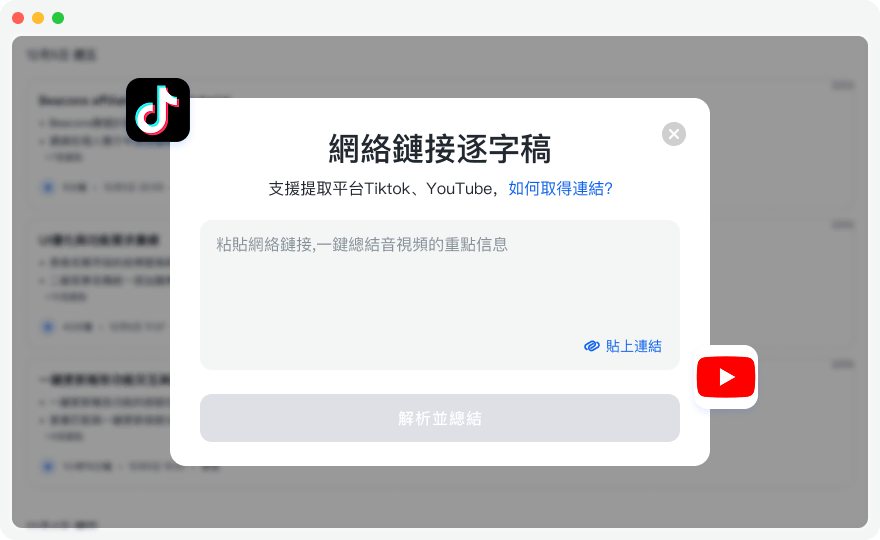
Step 2: Review Transcript & Speaker Labels
After upload or recording, the system automatically distinguishes speakers (e.g., Speaker A, Speaker B) and auto-detects up to 10 languages (Chinese, English, Japanese, etc.), saving manual tagging effort.
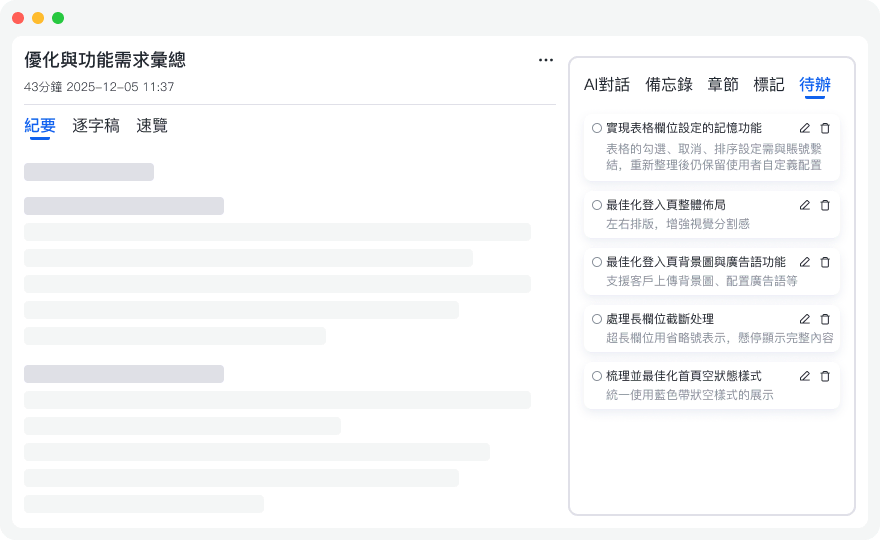
Step 3: Access AI Meeting Minutes & Action Items
This is something traditional GitHub transcription tools cannot do. The system automatically generates structured "decision summaries" and "to-do action items" from the transcript, so task assignments are ready as soon as the meeting ends.
Step 4: Use AI Chat Query for Details
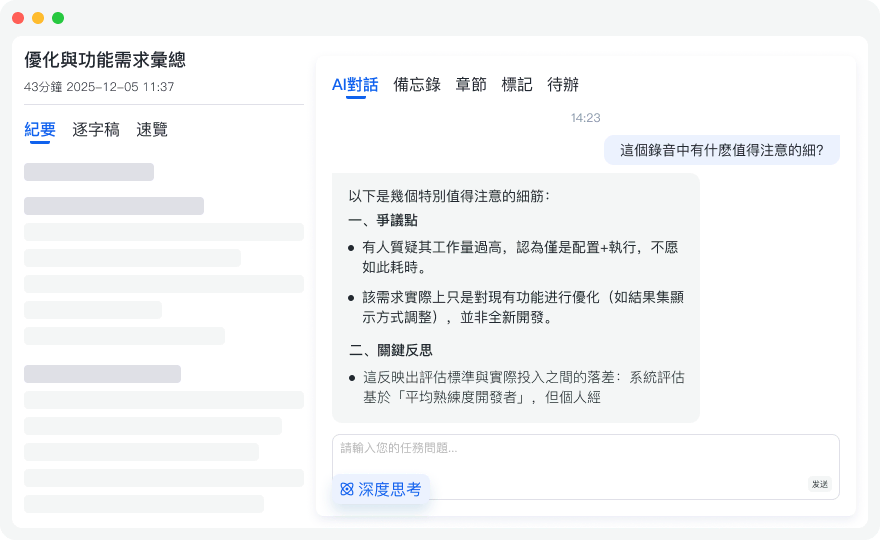
If the recording is two hours long, traditional methods only allow Ctrl+F keyword search. With Tinrec's AI chat query, you can ask questions directly about the document, e.g., "What exactly was the Q3 marketing budget the boss mentioned?" The AI gives precise answers with timestamps.

Step 5: Export in Multiple Formats
Once confirmed, you can export plain text, full transcript, or key summary with one click, seamlessly integrating into your note-taking system.
Frequently Asked Questions (FAQ)
Q1: Are GitHub open-source tools completely free? The code itself is free, but running AI speech recognition models smoothly requires a sufficiently powerful GPU (graphics card). If your hardware isn't up to par, you may need to rent cloud computing power, incurring extra costs and technical overhead.
Q2: Can I use GitHub transcription tools on my phone (iPhone/Android)? Very difficult. Open-source projects are usually command-line tools designed for desktops. For mobile scenarios (e.g., out-of-office meetings, interviews), it's better to use apps like Tinrec that support iOS and Android multi-device sync.
Q3: Do these tools support transcribing remote meetings like Teams / Google Meet? GitHub tools typically only handle downloaded audio files. For Teams or Meet meetings, you can use third-party screen recording software to capture audio, then upload that file to a cloud tool for transcription and summarization.
Q4: How accurate is the transcription for foreign languages (e.g., Japanese, Korean, Cantonese)? Large Whisper models and most mature AI speech tools (including Tinrec) have strong multilingual recognition capabilities, automatically detecting and transcribing foreign content with high accuracy—great for foreign language classes or watching overseas videos without subtitles.
Q5: Can I directly use the exported transcript as meeting minutes? With pure open-source projects, you need to copy the exported TXT file into ChatGPT or Claude and manually enter prompts to generate a summary. With integrated AI tools, key points and decisions are automatically extracted alongside the transcript.
Q6: Is there a free tier if I only occasionally need transcription? Yes, most online tools offer trial quotas. For example, Tinrec provides 100 free minutes per month, enough for occasional short video or interview transcription.
Summary & Next Steps
If you're a developer familiar with Python and have ample hardware resources, exploring Whisper projects on GitHub will definitely satisfy your need for customization and full free usage.
But if you're a student, office worker, project manager, or content creator, time is your most valuable asset. Instead of wasting energy fixing environment errors, choose a tool that handles "audio to text, summarization, and to-do extraction" in one streamlined process.
We recommend starting with a 10-minute meeting recording or YouTube video link, running it through the tool to test summary accuracy and AI query convenience, and then deciding which solution best fits your long-term workflow.
Turn every recording into actionable outcomes
Get 60 free transcription minutes when you sign in. No credit card required.
Related Reading
You might also like

2026 Review: 6 Recording Summary Tools Compared – Which Saves You the Most Overtime?
We tested 6 AI recording summary tools, including Tinrec, Meeting Ink, ChatGPT voice mode, Yating, MyEdit, and Otter.ai, comparing transcription accuracy, summary features, and free plans to help you find the best time-saving tool for meetings and classes.

2026 Hands-On Comparison of 4 Cantonese Speech-to-Text AI Tools: Which One Goes Beyond Transcription to Help You Organize Key Points?
In our 2026 hands-on tests of 4 AI speech-to-text tools with Cantonese support, we compare transcription fluency, AI organization features, pricing plans, and use cases to determine which one is best for Hong Kong office workers, students, and content creators.

4 Automatic Transcription Tools Compared in 2026: It's Not Just About Speech-to-Text – AI Summaries and Q&A Are the Real Game Changers
This article compares four popular automatic transcription tools, evaluating Chinese speech recognition accuracy, AI summarization capabilities, cross-platform support, and pricing to help you find the best solution for meeting minutes, study notes, and content organization. Tinrec (Seconds Transcription) is highlighted as the top pick due to its multi-source input and AI-powered conversational querying.

4 Meeting Summary Generators for 2026: Beyond Transcription to Actionable To-Do Lists
The worst part after a meeting is organizing the notes. We tested four tools—Tinrec, Otter.ai, Tactiq, and Meeting Ink—evaluating transcription accuracy, AI summary quality, and cross-source integration to help you find a meeting summary solution that actually saves you time.

2026 Tested: 5 Cantonese Speech-to-Text Apps Compared – Which Free Version Is Best?
Struggling to organize Cantonese recordings? This hands-on comparison reviews 5 speech-to-text tools and, using Tinrec (秒聽錄音) as an example, walks you through the complete workflow from recording to meeting notes, helping you find the best free option.

2026 AI Meeting Recording Tools Compared: Which Is the Best Workspace for Organizing Audio-Visual Content?
This article tests 4 popular AI meeting note tools, covering meetings, classes, interviews, and online videos, comparing Tinrec, Notta, Otter.ai, and PLAUD in transcription accuracy, AI summarization, and follow-up organization capabilities to help you find the best all-around solution for audio-video content.

2026 AI Meeting Summary Tools Compared: Which Free Version Is Enough?
The worst part of meetings is post-meeting cleanup. AI meeting summary tools can automatically generate key points and action items from recordings. This article tests 4 tools, focusing on the free versions, to show you which one delivers the most useful Chinese summaries with the fewest limitations, so you no longer have to struggle with meeting notes.

2026 Hands-On Comparison of 3 WhatsApp Voice-to-Text Tools: Which Has the Best Cantonese Accuracy?
We tested WhatsApp's built-in voice-to-text feature and two third-party tools, comparing Cantonese recognition, privacy protection, and post-transcription organizing capabilities to find the best voice-to-text solution for Cantonese speakers.
What Is the Best Audio-to-Text App? 2026 Hands-On Test of 5: Tinrec Wins
Office workers face meetings daily. Which recording-to-text tool truly helps? We tested five popular solutions, from free to paid, covering everything from basic transcription to AI-powered organization. In the end, Tinrec stood out as the most comprehensive, ideal for meetings, classes, interviews, and online video.