
Turn recordings into transcripts and summaries in minutes
Upload audio or video for multilingual transcription, AI notes, and action items
Having a meal in Nottawa: the hard part is never finding a restaurant
Nottawa is located in Clearview Township, Ontario, close to the Collingwood area. On Tripadvisor, restaurants in this area have about 99 total reviews, and Yelp lists a dozen or so. The choices aren't many, but the problem you'll encounter usually isn't "can't find a place."
The real challenge is: is this meal a family gathering, a department celebration, or a business discussion with a client? These three purposes require completely different logic for choosing a restaurant.
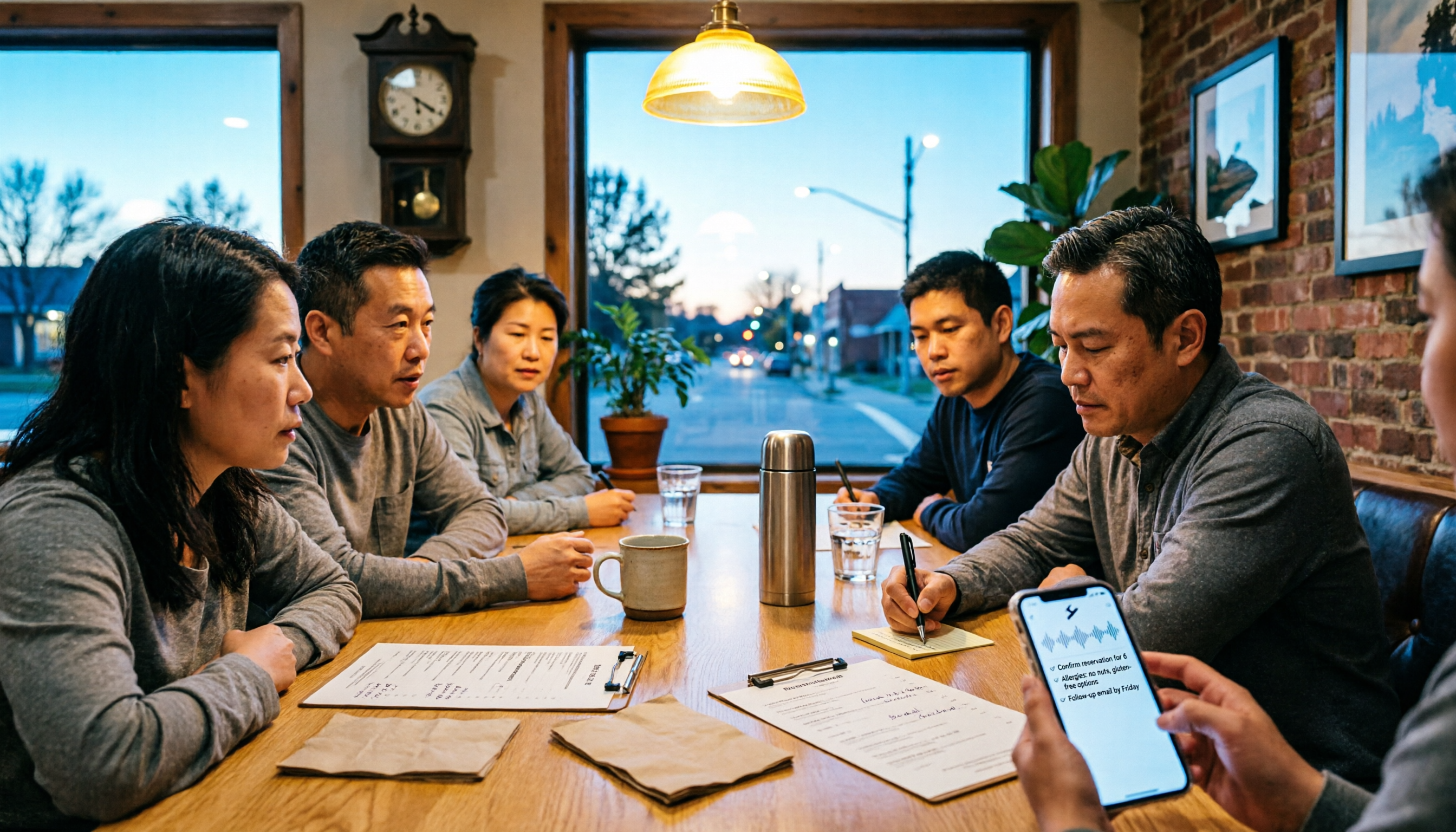
Another often-overlooked aspect is the "discussion process." Reservation time, budget cap, who doesn't eat beef, who needs gluten-free options, who is responsible for booking—these decisions are scattered across group messages, phone calls, and emails. By the time you need to confirm on the day of the meal, you often have to dig through everything again.
If you've been in this situation, this article is for you.
Choosing a Nottawa restaurant and planning group dining: understand these 5 key points first
1. Define the purpose of the meal first
Family gatherings focus on seating arrangements and child-friendliness; business meals focus on quietness and whether you can sit for a long time; friend gatherings focus on atmosphere. The same restaurant can receive completely opposite evaluations depending on the purpose. Write down the purpose first, then start making a list.
2. Factor in drive time, don't just look at the place name
Some restaurants categorized as "Nottawa" on Yelp and Tripadvisor are actually located in the Collingwood area. When you see a place you like, confirm its actual location and driving time before adding it to your itinerary.
3. Group size determines reservation strategy
Parties of four or fewer have more flexibility; for eight or more, you need to inquire early. Rather than guessing, record "how many people, which day, what budget" during planning to avoid starting from scratch every time you discuss.
4. Ask about special dietary needs all at once
Tripadvisor's Nottawa page categorizes vegetarian, vegan, and gluten-free restaurants separately, indicating these are common needs. Rather than going back and forth in a group chat, confirm verbally once during a planning meeting and keep a record at the same time.
5. Is there a record of the discussion process that can be reviewed later?
This is the most easily skipped point and the one people most often regret. Who promised to make the reservation, what the budget cap is, what the client mentioned they don't eat—if these exist only in someone's memory, the thread breaks when someone else takes over. This is exactly why I recommend using a recording and transcription tool.
Tinrec—our top choice for recording group dining planning and meal content
Tinrec is an AI meeting notes and collaboration tool for individuals and teams, supporting iOS, Android, desktop, and web. It doesn't just convert audio to text; it organizes recordings into searchable, summarizable, queryable, and exportable data.
Here's how it works in practice for group dining planning:
Open Tinrec during the planning meeting, and a transcript is generated as you discuss. When the meeting ends, the AI has already organized a summary, chapters, and action items—"book a table for 10 by Friday," "budget $40 per person," "Colleague A doesn't eat beef, Colleague B is gluten-free"—all in one record.
This is especially useful for teams where organizers often change. The colleague who organized last year's year-end party has left, but the discussions, decisions, and notes from that time remain in the team space, and new members can look them up directly.
For business meals or client visits, the difference is even more obvious.
The desktop version directly captures computer system audio. When handling online meetings on Zoom, Google Meet, Microsoft Teams, or Webex, you don't need to add an extra meeting bot to the meeting room. The client won't see a strange account appear in the participant list.
After recording, you can directly ask Tinrec: "What budget cap did the client mention?" "Who is responsible for sending the quote?" It gives answers based on semantics, rather than throwing a string of keywords for you to sift through.
Chinese and cross-language scenarios are its strengths.
It supports Chinese, Traditional Chinese, and multilingual meetings, and can organize mixed Chinese-English content. When multinational teams or foreign clients are present, you can enable real-time translation and view in original, translated, or bilingual mode. Actual recognition performance is affected by recording quality, ambient noise, accents, overlapping speakers, and technical terminology—it performs better in quiet environments; if you're recording in a noisy restaurant, it's advisable to cross-check key points against the original audio afterward.
Post-meeting output is the biggest differentiator from pure transcription tools.
Stop organizing recordings by hand
Upload audio or video and automatically get a transcript, summary, and action items
In addition to transcripts, it can generate summaries, chapters, action items, and mind maps, and use Agent post-processing to create reports, tables, or meeting minutes, then export to Notion, Google Docs, OneNote, Dropbox, and other tools for further processing.
The team collaboration part needs special mention.
The team version is not "multiple people sharing one account" but an independent team space. Meeting data belongs to the team, with distinctions between roles (who can manage the team, members, and audits) and seats (who can record, upload, edit, and export).
Note: members without a seat can still view, play, and read team data, but cannot upload or edit. The current design focuses on team-level sharing, not file-level granular permissions.
Team version pricing is currently USD 29.80/month per paid seat, or USD 199/year per paid seat (equivalent to about USD 16.58/month). Each paid seat provides 2,000 minutes of team shared import quota per month; under an active team plan, real-time recording is currently not deducted by minutes. First-time eligible teams can try 7 days with 1 free seat and 300 minutes of shared import quota. Actual prices and promotions are subject to the official purchase page.
For individual use, the free version lets you experience recording, import, summaries, and transcription; for short-term intensive use (e.g., several meals in a row), consider a weekly pass; for steady weekly needs, look at the Pro monthly or annual plan.
Besides Tinrec, what other meeting notes tools are there?
Otter.ai
A mature English meeting assistant. Basic is free with 300 minutes per month; Pro annual billing is about USD 8.49/user/month, including 1,200 minutes of in-app recording per month and 10 file imports. If your meetings are entirely in English and you need extensive existing integrations, it's still a good deal. But Chinese and mixed Chinese-English organization is not its strong suit; and Otter's design philosophy for team governance—layered management of members, seats, usage, and audits like Tinrec—is different.
(Correction: should be Tinrec.)
Notta
The competitor with the highest overlap with Tinrec, covering multi-platform transcription, file import, translation, and team plans. Free is 120 minutes per month with a 3-minute limit per session; Pro annual billing is about USD 8.17/month for 1,800 minutes; Business annual billing is about USD 16.67/seat/month. If you mainly batch-process existing audio files, it's very capable. But bot-free online meeting recording and using Agent to directly generate reports and tables from meetings are areas where Tinrec currently does more.
Granola
Takes a "user handwritten notes + AI enhancement" approach. Business is USD 14/user/month, also capturing device audio without a bot. Note that it does not support uploading pre-recorded audio files and does not save meeting audio—making it difficult to cross-check the original audio afterward. Tinrec retains recordings, can import existing files, and allows AI Q&A to follow up on details.
Pitfall guide: the 4 most common mistakes when planning a Nottawa group meal
Pitfall 1: Treating review count as reliability.
The Nottawa area has about 99 total reviews on Tripadvisor—a small sample. Rather than just looking at star ratings, check whether the dining scenarios described in reviews match your purpose.
Pitfall 2: Treating "Collingwood restaurants" as "Nottawa restaurants."
Many places on Yelp and Tripadvisor lists are actually located in the Collingwood area. Restaurants like Catch 22 Fresh Market Grill, Brunello, The Mill Cafe, Sol Kitchen, Black Bellows, The Hungry Sumo, Poppy's French Bistro, Lakeside Grill, The Spot Restaurant, The Flying Chestnut, Kettles Back Home Cookin', TheSmoke, The Tremont Cafe, Dornoch Tap & Grill, and Baked and Pickled all appear on the lists, but you need to confirm their actual locations and drive times yourself.
Pitfall 3: Relying only on word-of-mouth in group chats for special dietary needs.
Vague memories like "I think someone doesn't eat beef" become awkward at the restaurant. Vegetarian, vegan, and gluten-free are separate categories on the platforms, indicating these needs are common—ask all at once during planning and keep a record.
Pitfall 4: Treating transcription tools as voice recorders.
Saving only audio files means using only one-third of what these tools can do. Summaries, chapters, action items, AI Q&A, and exports are where the time savings are.
Also note: recording and transcription involve personal data and local regulations. Before cross-region or cross-border meetings, confirm whether you need to obtain consent from participants.
Conclusion: How should you actually plan?
- Just looking for a place to eat → Cross-check Tripadvisor and Yelp lists directly, then filter by review scenarios; no tools needed.
- Department meals or project celebrations where someone needs to take over follow-up → Tinrec; discussions, decisions, and action items stay in the team space, so nothing breaks when someone else takes over.
- Client meals or cross-language communication → Tinrec; real-time translation and bilingual viewing ensure no information is missed in mixed Chinese-English settings.
- All-English meetings with an existing Otter ecosystem → Otter.ai is a reasonable choice.
- A batch of historical audio files to transcribe → Tools like Notta are more suitable.
If you want to make "group dining planning" traceable first, start with Tinrec's free version, use it to record a planning meeting, and see whether the summaries and action items fit your work habits before deciding whether to upgrade.
Choosing a restaurant and choosing a tool follow the same logic: first think clearly about what the meal needs to achieve, and the answer will naturally emerge.
References
- THE BEST Restaurants in Nottawa Updated November 2026
- THE BEST 10 RESTAURANTS NEAR NOTTAWA, CLEARVIEW, ON - UPDATED OCTOBER 2026 - VERIFIED LISTINGS ONLY - HOURS - YELP
- Top 3 restaurants in Nottawa, Ontario, february 2026 - Restaurant Guru
- The Best restaurants near Nottawa | YellowPages.ca™
- THE BEST 10 Restaurants near Nottawa, ON L0M, Canada - Last Updated September 2023 - Yelp
Turn every recording into actionable outcomes
Get 60 free transcription minutes when you sign in. No credit card required.
Related Reading
You might also like
2026 LINE Voice Message Storage Test: 3 Key Differences That Determine Whether Your Audio Files Are Reusable
After saving LINE voice messages, most people get stuck on three problems: can't find them, can't listen to them all, and can't search them. This article starts from actual decision points, comparing LINE's built-in download with Tinrec on storage method, format usability, content organization, team retention, and source coverage, and outlines who each is suitable for, helping you decide how to keep important voice messages.

3 LINE Voice-to-Text Tools Tested in 2026: Beyond Quick Replies, Which One Turns Speech into Searchable Meeting Data?
LINE voice-to-text is convenient, but it solves slow typing, not meeting notes. This article covers three LINE voice-to-text methods, their real limitations, and how to handle long audio like meetings, interviews, and lectures. It also demonstrates Tinrec's complete workflow from recording to transcript, summary, action items, and team knowledge retention.

LINE Voice to Text vs Tinrec in 2026: 5-Dimension Comparison — Which Is Right for You?
How do you use LINE's built-in voice input? And how do you turn voice messages someone sends you into text? This guide starts with the two most common pain points, walks you step by step to find the microphone on your keyboard, avoid the button that sends a voice message, and then compares LINE and Tinrec for long meetings, post-meeting organization, and team sharing — so you can choose the approach that fits you.

2026 AI Meeting Notes Comparison: Notta Pro vs. Tinrec vs. Otter.ai — Which Should You Choose?
Notta Pro is Notta's paid individual plan, featuring AI meeting transcripts, summaries, multilingual transcription, and translation. This article breaks down Notta Pro's pricing, free plan limitations, and Business team plan differences using real work scenarios, and compares it with Tinrec and Otter.ai to help you decide whether to upgrade.

5 Notta Alternatives Tested in 2026: Why Tinrec Is Better for Chinese Meetings
Looking for a Notta alternative? This article compares Tinrec and Notta from four angles: Chinese meetings, bot-free recording, post-meeting organization, and team knowledge retention. It also covers free quotas, team plan seats, and pricing to help you decide if Tinrec is right for you.

5 Best Auto Subtitle Tools in 2026: Free Tiers and Chinese Accuracy Compared
Stuck adding subtitles after editing? This hands-on comparison of 5 auto subtitle tools in 2026 covers Chinese recognition, free usage limits, timeline adjustments, and post-meeting text organization. It also explains how Tinrec turns video content into searchable, queryable, deliverable transcripts and meeting notes—helping you pick the tool that truly saves time.

2026 Voice Translation Tools Compared: Can Notta Translate? Which Is Better for Chinese Meetings?
The answer to "Can Notta translate?" is yes, but being able to translate doesn't mean it's easy to use. This article breaks down four dimensions: translation timing, Chinese and mixed Chinese-English performance, post-meeting output, and team governance. It compares Notta, Otter.ai, TurboScribe, and Tinrec to help you decide which one deserves a spot in your company budget.

5 Affordable Tape-In Extensions Tested for 2026: Can Cheap Extensions Last Through Seasonal Changes Without Shedding?
Looking for cheap but good tape-in extensions? This article compiles real user experiences from social communities to highlight 5 worth-considering options. First, learn to compare by total weight, not by number of pieces. Then, we break down the differences between affordable Amazon brands and Bellami, Beauty Works, SWAY, and JZ Styles. Finally, we list the 4 most common pitfalls to avoid.

5 Best Auto Subtitle Tools Online in 2026: Which Transcript Is Ready to Use?
There are many online auto subtitle tools, but the real difference lies after subtitles are generated. This article starts with common misconceptions, outlines 4 key purchasing points, and compares Tinrec, cSubtitle, FlexClip, Adobe Express, and others to help you decide whether to choose a dedicated subtitle tool or an AI meeting notes tool that also produces transcripts, summaries, and action items.