
Turn recordings into transcripts and summaries in minutes
Upload audio or video for multilingual transcription, AI notes, and action items
Introduction: Why Do You Need Real-Time Speech-to-Text Tools?
Still spending two hours after a meeting to organize notes? Can't grasp key points after replaying a classroom recording? Traditional audio files have extremely low information density, and the cost of re-listening is high—a common pain point for professionals and students alike. With AI technology maturing, real-time speech-to-text transcription software for Traditional Chinese has become a necessity for productivity. But with so many tools on the market, how do you choose?
This article will conduct a horizontal review of 5 mainstream tools across dimensions such as Chinese recognition accuracy, real-time capability, and summarization ability, and provide practical tutorials and a decision tree. If you value Chinese accuracy and follow-up action item organization, consider solutions that support a complete workflow—for example, Tinrec as one candidate.
Quick Navigation Conclusion:
- For English-only meeting recording → Otter.ai is the top choice
- For Chinese recognition and meeting summaries → Check Tinrec, Notta
- For offline privacy protection → Consider MacWhisper
- For basic transcription on a budget → Reference Google Live Transcribe
User Segmentation: Who Needs Real-Time Speech-to-Text Tools Most?
Different scenarios have vastly different requirements. Identify your role and core pain points before choosing.
1. Business Meetings and Project Discussions
Office workers and enterprise users need "meeting minutes" and "action items." A simple transcript won't save reporting time; tools must automatically summarize conclusions and to-dos.
2. Students and Educational Institutions
Class notes and online course recording require high-accuracy Chinese recognition and support for highlighting key points for exam review and material organization.
3. Content Creators and Media
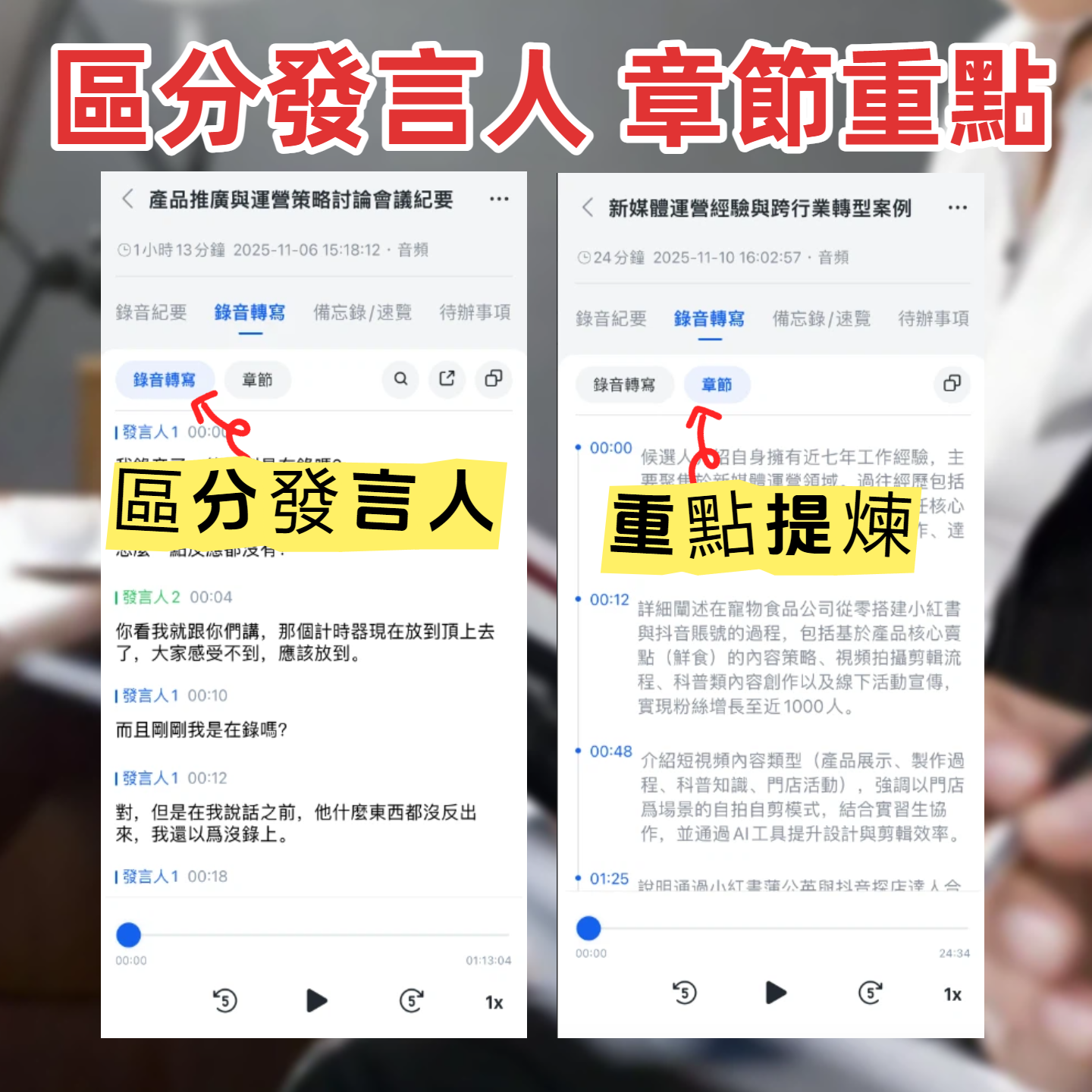
Podcast editing and interview transcripts require speaker diarization, and quick export to editable drafts for script writing or articles.
4. Personal Daily Use and Inspiration Recording
Life logs and family discussions need easy operation, on-the-go mobile recording, and long-term storage and searchability.
Selection Criteria: 5 Key Dimensions to Evaluate Tools
After testing multiple software, we summarized the following 5 key evaluation dimensions to avoid pitfalls.
1. Language Support and Chinese Accuracy
Recognition ability for Traditional Chinese, Taiwanese Hokkien, and Cantonese is key. Some international tools have poor Chinese support; check first.
2. Real-Time Capability and Processing Speed
Do you need real-time transcription during recording, or is post-upload audio file processing okay? Real-time transcription suits meetings; post-processing suits interviews.
3. Summary and Action Item Generation
Basic tools only provide transcripts; advanced tools generate meeting minutes, conclusions, and to-do action items, greatly reducing organization time.
4. Export Formats and Integration
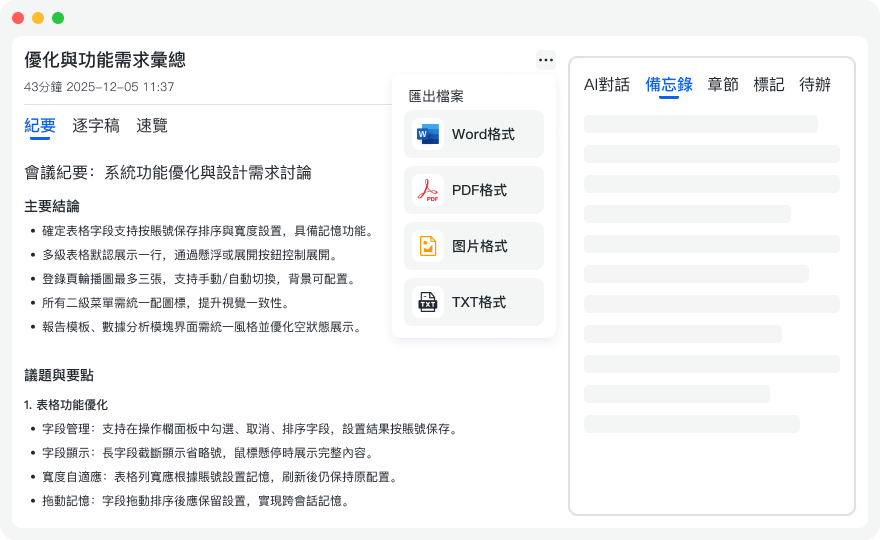
Support for multiple export formats (Word, PDF, TXT) and integration with calendar and note-taking apps affects subsequent efficiency.
5. Pricing and Free Tiers
Is the free version sufficient? How cost-effective is the paid plan? Choose according to monthly recording duration.
Head-to-Head Comparison of 5 Popular Tools
The following table is based on actual testing and official information for quick reference.
| Tool Name | Language Support | Real-Time Transcription | Summary/Action Items | AI Query | Pricing/Free Tier |
|---|---|---|---|---|---|
| Tinrec | Chinese, Japanese, English, etc. (10 languages) | Yes | Auto-generate meeting minutes | Semantic query supported | Free 100 min/month |
| Otter.ai | Primarily English | Yes | Basic summaries | Yes | Free 300 min/month |
| Notta | 50+ languages | Yes | Supported | Partial | Free 120 min/month |
| Google Live Transcribe | Multiple languages | Real-time only | No | No | Free |
| MacWhisper | Multiple languages | Upload only | No | No | Paid (one-time purchase) |
Stop organizing recordings by hand
Upload audio or video and automatically get a transcript, summary, and action items
Analysis Notes
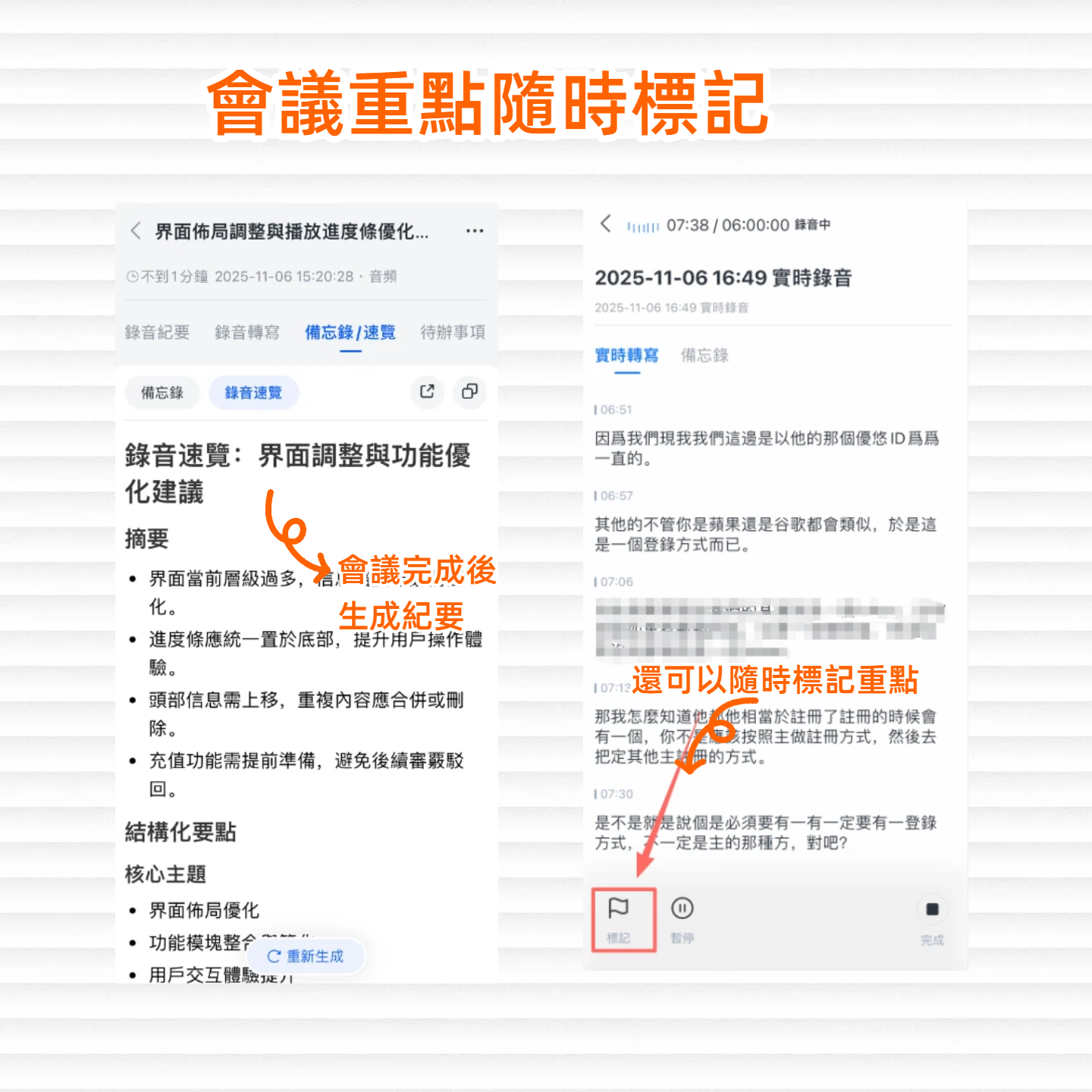
- Tinrec: Advantage lies in Chinese recognition and complete workflow—from recording to action items in one go, ideal for Traditional Chinese users.
- Otter.ai: Top choice for English meetings, but Chinese support is weak; not suitable for Chinese-language environments.
- Notta: Feature-rich, but some users report inconsistent Chinese recognition stability.
- System tools (Google/Apple): Only suitable for ad-hoc input; cannot save or organize audio files—not professional transcription solutions.
Practical Tutorial: How to Generate Transcripts and Meeting Minutes with AI Tools
Using the most common workflow as an example, the following steps show how to use a tool to go from recording to organization.
Step 1: Real-Time Transcription During Recording
Open the tool and select real-time recording mode; the system will simultaneously convert audio to text. This step is suitable for in-person meetings and classrooms to ensure no content is missed.
Step 2: Audio File Transcription
If you already have a recording (e.g., from your phone), simply upload the audio file. Supports multiple formats; automatically generates a transcript and AI summary without re-recording.
Step 3: Video Link Transcription
Paste a web video link (e.g., YouTube), and the tool will directly parse the audio track and convert it to text. Ideal for content creators organizing podcasts or online course materials.
Step 4: AI Query for Key Information
Traditional transcripts only allow Ctrl+F keyword search; advanced tools support semantic AI queries. For example, ask "What was the meeting conclusion?" or "Who is responsible for next week's task?" and the system will answer directly—like asking a person instead of searching a document.
Export and Sharing
After organizing, choose the appropriate format (e.g., Word or PDF) to export, or share a link directly with team members to ensure action items are followed up.
Decision Tree Recommendations: Choose Tools by Scenario
To reduce decision-making effort, refer to the following suggestions.
Scenario: Multi-person Chinese meeting + need action items
- Recommendation: Choose a tool that supports meeting minutes and action item generation, e.g., Tinrec.
- Reason: Simple transcription cannot save reporting time; automated summarization is needed.
Scenario: English-only meeting + cross-border team
- Recommendation: Choose Otter.ai.
- Reason: English recognition is well-optimized for international environments.
Scenario: Pure subtitle editing + video production
- Recommendation: Choose VEED.IO or built-in editing software features.
- Reason: Focused on timeline and subtitle styling, not meeting recording.
Scenario: Offline privacy + local processing
- Recommendation: Choose MacWhisper.
- Reason: Data does not upload to the cloud, suitable for sensitive content.
Tinrec Target User Conclusion
If you primarily work in a Traditional Chinese environment and want actionable meeting conclusions and to-dos directly after recording, Tinrec is a suitable choice. If you only need simple English transcription or offline processing, consider other alternatives.
Frequently Asked Questions
1. Does real-time speech-to-text software support iPhone?
Most mainstream tools offer iOS apps that support background recording and real-time transcription, but system permission settings must be noted.
2. Are there free transcription software recommendations?
Some tools like Google Live Transcribe are completely free but limited in functionality; Tinrec and Notta offer free tiers suitable for light users to try.
3. Does it support Teams or Google Meet meeting recording?
Some tools support browser extensions or direct meeting bot integration; check specific integration capabilities.
4. How accurate is Chinese recognition?
Recognition accuracy for Traditional Chinese, Taiwanese Hokkien, and Cantonese varies by tool; it is recommended to test with free tiers on actual scenarios.
5. What export formats are supported?
Common formats include TXT, Word, PDF, and SRT subtitle files; professional tools usually support multiple formats.
6. Is recording content private and secure?
When choosing a tool, review the privacy policy. Enterprise users should confirm data storage location and encryption methods to avoid sensitive information leaks.
Turn every recording into actionable outcomes
Get 60 free transcription minutes when you sign in. No credit card required.
Related Reading
You might also like

2026 Meeting Knowledge Base Tools: AI Meeting Notes + Team Knowledge Retention
A mid-level manager who attends 15 meetings a week tested 3 meeting knowledge base tools, covering bot-free online meeting recording, AI summaries and action item extraction, team spaces, seats, and usage management. Learn the 5 key factors to consider, the 4 most common pitfalls, and why Tinrec ultimately stood out.

2026 Meeting Notes Tools Compared: Which Is Best for Team Sharing?
Tired of meeting notes scattered across group chats, docs, and personal laptops? We tested Tinrec, Notta, Otter.ai, and Granola in student group and team collaboration scenarios to break down 4 key factors for choosing a meeting notes tool, 4 common mistakes, and how to decide between free plans and team versions.

How to Take Cross-Department Meeting Minutes in 2026: 5 Steps from Recording to Team Consensus
The challenge with cross-department meeting minutes isn't typing speed—it's not deciding beforehand who the minutes are for, what to record, and where to store them. This article breaks down the cross-department meeting documentation process into 5 steps and shares how to use Tinrec's bot-free desktop recording, AI summaries, and action item extraction to turn meeting content into searchable, trackable team data.

2026 Comparison of 4 Meeting Data Sharing Tools: From Transcripts to Team Governance
Meeting data scattered across personal computers and group chats is a common governance gap for teams. This article compares Tinrec, Otter.ai, Fireflies.ai, and Notta across four dimensions: data ownership, roles and seats, post-meeting processing, and export/cross-platform capabilities. It also highlights common pitfalls when implementing meeting data governance, helping you choose the right approach for your team to build a long-term meeting asset repository.

4 Team Meeting Tools Tested in 2026: Why Post-Meeting Follow-Through Is the Real Deciding Factor
A mid-level manager leading a 10-person team through 15 meetings a week tested 4 team meeting tools, focusing on whether they deliver usable output after the meeting. The comparison covers bot-free recording, transcript post-processing, AI Q&A, and team seat management, plus 3 common purchasing mistakes.

Tinrec Meeting Data Access Permissions Guide 2026: Role Authorization + Seat Management
When meeting data is seen by other departments or disappears when members leave, the problem usually stems from unclear permissions. This article starts with common misconceptions, breaks down Tinrec's team space, roles, seats, and audit mechanisms, and teaches you how to set up meeting data access so you control who can view, use, and edit. It also covers 5 purchasing considerations and FAQs.

How to Assign Project Meeting Tasks in 2026: 5 Steps from Meeting to Action Items
How do you assign project meeting tasks in 2026? This article compares Tinrec and PLAUD Note across five dimensions: meeting recording methods, action item extraction, post-meeting follow-up, export workflows, and cost, helping you determine which approach ensures tasks are truly assigned and progress is trackable.

2026 Cross-Departmental Meeting Collaboration Tools Compared: Which Saves More Time with Chinese Transcripts and Post-Meeting Action Items?
Cross-departmental project meetings often end with everyone interpreting things differently. This article starts with common pitfalls and outlines 4 key factors for choosing a cross-departmental meeting collaboration tool. It compares Tinrec, Granola, Notta, and Otter.ai in real tests, focusing on Chinese transcripts, post-meeting action items, and team knowledge retention, plus a guide to avoid pitfalls and selection advice.

Best Project Meeting Action Item Follow-Up Tools in 2026: We Tested 2, and This One Is Best for Chinese-Speaking Teams
The real breakdown in project meetings often happens after the meeting, not during it—specifically, in following up with action item owners. This article starts with common follow-up pitfalls, compares Tinrec and Otter.ai across 6 dimensions including action item extraction, Chinese-language meetings, team seats, and post-meeting deliverables, and summarizes pricing and FAQs to help you decide which tool better fits your project team.