

Turn recordings into transcripts and summaries in minutes
Upload audio or video for multilingual transcription, AI notes, and action items
Introduction: Why You Need a YouTube AI Summary Tool
Faced with hours of online courses, meeting recordings, or tech talk videos, manually taking notes is time-consuming and easy to miss key information. Many users searching for "YouTube AI summary" actually need a tool that quickly converts video content into readable, searchable text—not just a video downloader.
This article reviews 5 mainstream tools on the market in 2026, offering specific selection criteria, a feature comparison table, and hands-on tutorials. It also includes an FAQ section covering free limits, Chinese accuracy, and privacy concerns. If you prioritize Chinese recognition and actionable takeaways, check out solutions with a complete workflow, such as Tinrec.
Quick Navigation Conclusion:
- Want free and simple → Choose a browser extension
- Care about Chinese accuracy and meeting summaries → Choose a multi-language AI recording assistant
- Need to edit video subtitles → Choose an online editing platform with built-in features
- Seek privacy and offline use → Choose a local deployment model (requires technical skills)
5 Key Evaluation Dimensions for Choosing a Tool
Before subscribing or using any tool, check these five dimensions as they directly affect your experience and efficiency.
1. Language Support & Recognition Accuracy
Many international tools like Otter.ai perform well in English but have limited Chinese support. If your content includes traditional Chinese, Taiwanese, or code-switching, prioritize tools with automatic language detection. Accurate transcription is the foundation for high-quality summaries.
2. Input Variety
An ideal tool supports multiple input sources:
- Video link: Directly paste a YouTube URL for parsing.
- Audio file: Upload local recordings (e.g., MP3, WAV).
- Live recording: Record and transcribe directly via web or app.
3. Summary & Action Item Generation Capability
Plain transcripts often have low information density. A good AI tool should automatically generate meeting minutes, conclusion summaries, and to-do lists, transforming content from "saved" to "usable."
4. AI Chat Query Feature
Traditional tools only support Ctrl+F keyword search, while advanced tools allow you to ask questions about the content. For example, "What are the three key points mentioned by the speaker?" The system answers based on semantics, greatly improving retrieval efficiency.
5. Pricing & Free Limits
Most tools use a freemium model. Pay attention to monthly free minutes, single-file length limits, and whether export formats are paid. For frequent users, cost-effectiveness is a key long-term consideration.
2026 Deep Review & Comparison Table of 5 Tools
Below is an objective comparison of five common tools: Tinrec, Otter.ai, VEED.IO, TurboScribe, and GlotDojo.
| Tool Name | Language Support | Input Methods | Summary/Actions | AI Chat Query | Pricing/Free Limit |
|---|---|---|---|---|---|
| Tinrec | Chinese, English, Japanese, etc. 10 languages | Link, file, live recording | Supports meeting minutes & to-do lists | Supports semantic chat query | Free 100 min/month, flexible paid plans |
| Otter.ai | Primarily English, weak Chinese support | Live recording, upload | Basic summary | Supports AI Q&A | Free 300 min/month, advanced features paid |
| VEED.IO | Multi-language subtitles | Video upload/link | Mainly subtitle generation | No dedicated chat query | Free with watermark, advanced watermark removal paid |
| TurboScribe | Multi-language support | Audio/video upload | Basic summary | No | Free 3 files/day, paid unlimited |
| GlotDojo | Mainly multi-language translation | Browser extension | Basic summary | No | Free basic features, advanced paid |
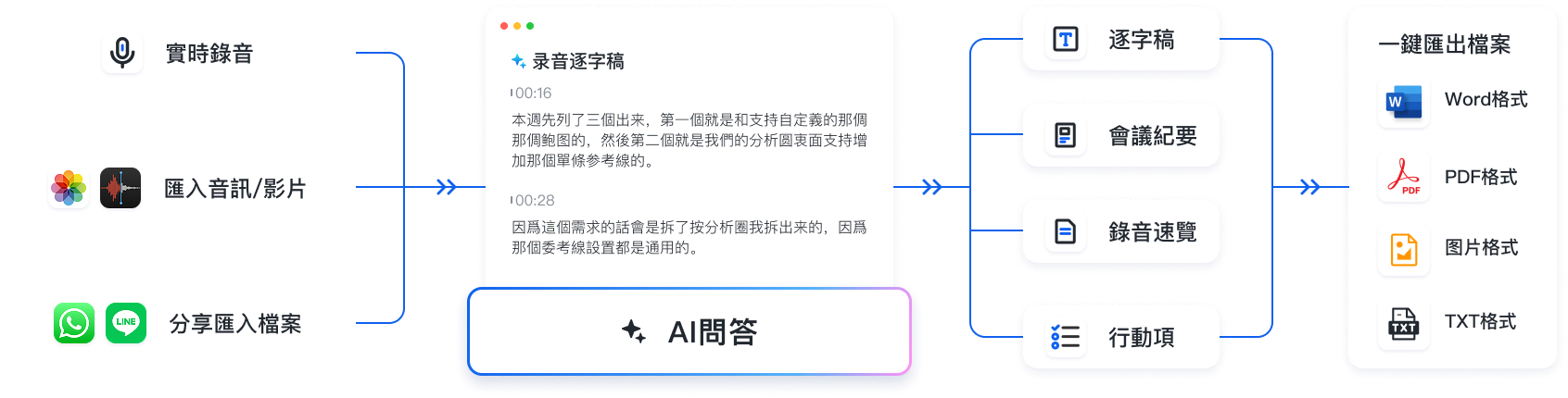
Stop organizing recordings by hand
Upload audio or video and automatically get a transcript, summary, and action items
Review Summary:
- Otter.ai is suitable for pure English meetings; Chinese users should evaluate carefully.
- VEED.IO is good for creators who need to edit videos and generate subtitles, but it's heavy for note-taking.
- Tinrec offers more complete integration of Chinese recognition and workflow (transcription → summary → action), suitable for workplace and learning scenarios where content needs to be turned into specific tasks.
- TurboScribe is for users who simply need high-volume transcription and don't mind manual organization.
Hands-On Tutorial: 4 Steps to Organize Video Key Points
Below is a standard workflow example showing how to turn a YouTube tutorial video into actionable notes. This process works for tools that support link parsing and AI summaries.
Step 1: Get the Video Link or Prepare Audio File
Copy the YouTube video URL you want to summarize. For in-person meetings or live online courses, you can prepare a recording file or enable live recording.
Step 2: Input Content and Select Language
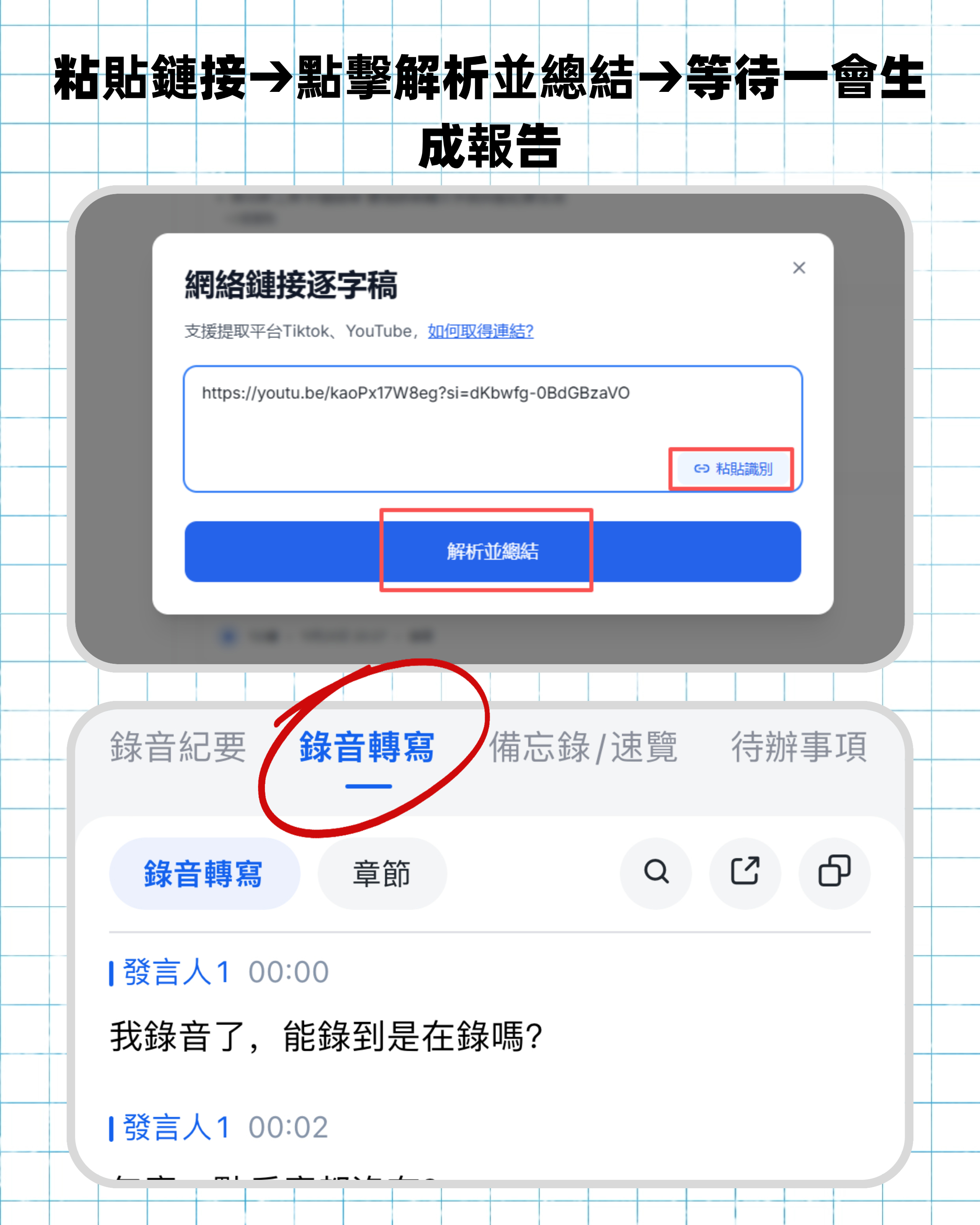
Paste the link into the tool's input box or upload a local audio file. Most modern tools support automatic language detection, but if the content is Traditional Chinese, manually selecting it can improve accuracy.
Step 3: Generate Transcript and AI Summary
Once processed, the tool generates a full transcript. Check the auto-generated summary block for key conclusions and action items. If the summary is too vague, try adjusting the prompt or regenerating.
Step 4: Use AI Chat Query for Details
Don't just read the summary; try asking the tool questions. For example: "What tool names are mentioned in the video?" or "What are the key points of Chapter 3?" This helps you quickly locate details without re-watching the video.
Frequently Asked Questions (FAQ)
1. Is there a free YouTube AI summary tool?
Most tools offer free limits, e.g., monthly minutes or single-file length. Tinrec's free version provides up to 100 minutes per month, suitable for light users; TurboScribe offers daily free transcription. Try the free version first to confirm accuracy before upgrading.
2. Is Chinese recognition accurate?
It depends on the model's training data. International tools like Otter.ai have weak Chinese support and may make errors. Localized tools like Tinrec or Yating typically perform better for Traditional Chinese and terminology.
3. Can I use it directly on iPhone?
Some tools offer iOS apps supporting phone recording and transcription. If a tool only has a web version, you can use it via Safari. Check if iOS background recording is supported to avoid interruption when the screen locks.
4. Can it process long videos (over 1 hour)?
Free versions often have limits, e.g., single file under 30 minutes. Paid plans usually support long videos. If the video is too long, consider splitting it or using tools that support long audio transcription.
5. Can I export transcripts?
Most tools support export to TXT, PDF, or Word formats. Some advanced tools support exporting timestamped subtitle files (SRT), useful for content creators for later editing.
6. Is my privacy safe?
When processing internal meetings or sensitive content, check the tool's privacy policy. Local deployment tools (e.g., MacWhisper) offer the highest privacy; cloud tools need to verify data encryption and storage policies. For enterprise users, choose services with privacy compliance commitments.
Conclusion: Choose the Best Solution for Your Scenario
When selecting a YouTube AI summary tool, there's no absolute best, only the most suitable. For learning and meeting notes, prioritize tools with high Chinese accuracy and action item generation to reduce post-processing time. For video caption creation, choose a platform with integrated editing features.
The ultimate goal is to turn video content into actionable knowledge. Start with free trials to verify transcription accuracy and summary quality before committing to a long-term subscription.
Turn every recording into actionable outcomes
Get 60 free transcription minutes when you sign in. No credit card required.
Related Reading
You might also like

2026 Real-World Comparison of 2 Cantonese Input Method Practice Tools: Which One Makes Learning Jyutping Easier?
Want to learn Jyutping typing but don’t know where to start? This article compares jyutping.io’s interactive practice tool and the Cantonese Reverse-Cut input method, from learning curve and practice efficiency to real typing speed, to help you pick the most suitable Cantonese input method practice solution.

4 Cantonese Input Methods Tested on Windows 11 in 2026: Voice-to-Text Isn't Always Real-Time, but Tinrec Is the Most Practical
Windows 11 offers many ways to type Cantonese, from traditional Jyutping to voice-to-text. Which one is best for Hong Kong office workers? We tested 4 tools, including Tinrec for recording transcription and Windows voice input, to help you choose the most efficient solution.

2026 Comparison of Two Android Cantonese Input Methods: Which One Offers a Better Jyutping Typing Experience?
If you want to type Cantonese on an Android phone, Google's Cantonese input method was delisted years ago, while the Jyutping input method continues to receive updates. This hands-on comparison evaluates both across installation, typing accuracy, flexibility, and compatibility to help you pick the right option.

2026 Tested: 4 Cantonese Subtitle Generators for Video Editing – Can Free Plans Be Fast and Accurate?
After video editing, adding Cantonese subtitles is often time-consuming and laborious. This article tests 4 AI subtitle generator tools, comparing accuracy, speed, price, and export formats to help you find the best solution.

2026 Hands-On Comparison of 2 WhatsApp Voice-to-Text Tools: Which Is Better for Cantonese Recognition and AI Organization?
Too many Cantonese voice messages on WhatsApp to keep up? In this hands-on test, we compare Tinrec and Yating across four key dimensions—recognition accuracy, AI organization, cross-platform support, and pricing—to help you decide which tool truly saves you time.

2026 Review: 6 Recording Summary Tools Compared – Which Saves You the Most Overtime?
We tested 6 AI recording summary tools, including Tinrec, Meeting Ink, ChatGPT voice mode, Yating, MyEdit, and Otter.ai, comparing transcription accuracy, summary features, and free plans to help you find the best time-saving tool for meetings and classes.

2026 Hands-On Comparison of 4 Cantonese Speech-to-Text AI Tools: Which One Goes Beyond Transcription to Help You Organize Key Points?
In our 2026 hands-on tests of 4 AI speech-to-text tools with Cantonese support, we compare transcription fluency, AI organization features, pricing plans, and use cases to determine which one is best for Hong Kong office workers, students, and content creators.

4 Automatic Transcription Tools Compared in 2026: It's Not Just About Speech-to-Text – AI Summaries and Q&A Are the Real Game Changers
This article compares four popular automatic transcription tools, evaluating Chinese speech recognition accuracy, AI summarization capabilities, cross-platform support, and pricing to help you find the best solution for meeting minutes, study notes, and content organization. Tinrec (Seconds Transcription) is highlighted as the top pick due to its multi-source input and AI-powered conversational querying.

4 Meeting Summary Generators for 2026: Beyond Transcription to Actionable To-Do Lists
The worst part after a meeting is organizing the notes. We tested four tools—Tinrec, Otter.ai, Tactiq, and Meeting Ink—evaluating transcription accuracy, AI summary quality, and cross-source integration to help you find a meeting summary solution that actually saves you time.