
Turn recordings into transcripts and summaries in minutes
Upload audio or video for multilingual transcription, AI notes, and action items
Introduction & Quick Takeaways
Many users searching for "Doubao speech-to-text" hope to use an AI assistant to quickly organize recordings. However, when faced with hours of meeting recordings, complex multi-speaker conversations, or specific video file formats, general-purpose AI assistants often fall short due to file upload limits, lack of editing for transcripts, and difficulty extracting actionable items. Professional tools need not only accurate transcription but also the ability to understand content and generate executable conclusions.
This article tests 5 mainstream speech-to-text tools across five dimensions: language support, real-time capability, summarization, AI query, and pricing. It also provides a hands-on tutorial showing how to turn audio into actionable task lists. If you need professional meeting notes or long interviews, consider adding Tinrec to your shortlist—it's designed specifically for meeting minutes and action item extraction.
Quick Navigation Takeaways:
- Want free short recordings → Use built-in system tools or platforms with generous free tiers
- Prioritize Chinese meeting summaries → Choose tools optimized for Asian languages
- Need video/podcast organization → Pick platforms that support link-to-text conversion
- Seek a complete workflow → Compare solutions with AI chat query capabilities
Why Relying Solely on General AI May Not Be Enough? Current Pain Points
Before choosing a tool, it's essential to clarify your use case. Many users turn to general AI assistants for voice tasks, but in real-world work and study environments, they often encounter these bottlenecks:
1. File Length & Format Limitations
General-purpose chatbots usually impose strict limits on audio duration; anything beyond a few minutes cannot be processed. For project meetings over an hour or classroom recordings, files often need to be split, increasing management overhead.
2. Lack of Structured Summaries
Raw transcripts have extremely low information density, making re-listening very costly. Most basic tools only provide text conversion, lacking automatic generation of "decision summaries," "conclusions," and "action items," requiring users to spend significant time reading the full text.
3. Insufficient Search & Interactivity
Traditional transcripts only allow keyword search (Ctrl+F), not semantic queries. For example, you cannot directly ask "What was the conclusion about the budget in the meeting?", leading to low information retrieval efficiency.
4. Multi-Language & Accent Recognition
Cross-language meetings or discussions with regional accents suffer from significantly lower recognition accuracy if the tool isn't specifically optimized. Correcting the text afterward may take longer than the recording itself.
Comparison of 5 Mainstream Speech-to-Text Tools
To help you choose, here's an objective comparison of 5 common tools, including general AI assistants and dedicated transcription tools.
| Tool Name | Language Support | Real-time | Summary/Action Items | AI Chat Query | Pricing/Free Tier |
|---|---|---|---|---|---|
| Doubao (General AI) | Multi-language | Upload then process | Basic summary | Yes | Free with time limit |
| Tinrec | Automatic recognition of 10 languages | Real-time transcription | Auto-generates meeting minutes & to-dos | Semantic query | Free: 100 min/month |
| Otter.ai | English mainly | Real-time | Strong English summaries | Yes | Limited free tier |
| Notta | 50+ languages | Real-time | Summaries supported | Partial | Free tier with many limits |
| TurboScribe | Multi-language | Upload then process | Basic transcription | No | High free limit but no workflow |
Stop organizing recordings by hand
Upload audio or video and automatically get a transcript, summary, and action items
Explanation of Comparison Dimensions
- Language Support: Supports Chinese, Taiwanese, Cantonese, and mixed-language recognition.
- Real-time: Transcribes voice instantly without waiting for upload and processing.
- Summary/Action Items: Automatically extracts key points and to-dos instead of just providing full text.
- AI Chat Query: Allows asking questions about the content to quickly locate information.
- Pricing/Free Tier: Availability of free plans and paid thresholds.
From the table, if you only need simple transcription, many tools suffice. But for a complete recording-to-action workflow, dedicated tools have a clear advantage in structured output.
In-depth Tinrec Review: A Recording-to-Action Workflow
Among the tools, Tinrec (Miao Ting Recording) positions itself as a multi-platform AI recording assistant. Its design logic focuses not just on transcription but also on post-use efficiency. Below is neutral information for decision-making.
Core Differentiating Value
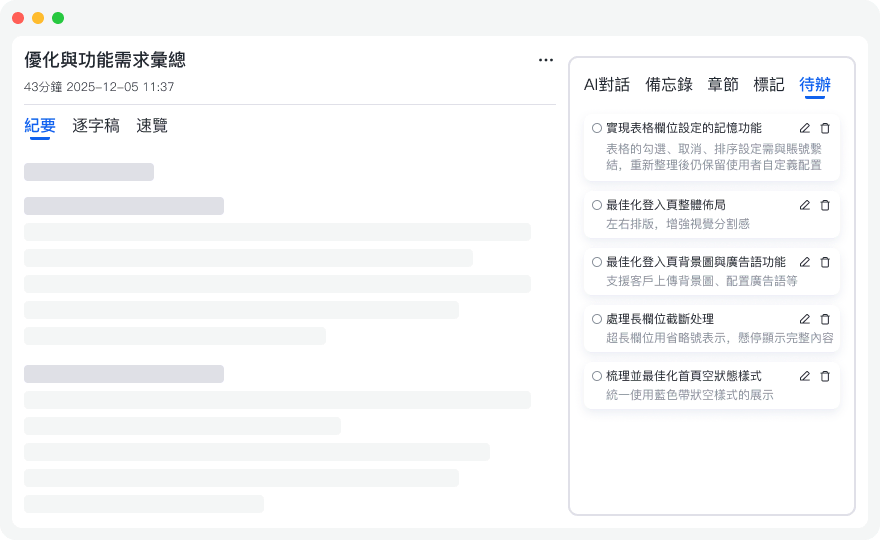
Tinrec converts "time-based content" into "scannable, searchable, actionable text." Compared to tools that only provide transcription, it emphasizes auto-generating meeting minutes, conclusions, and action items. This significantly reduces organization time for professionals and students needing quick grasp of meeting highlights.
Multi-Language & Scenario Adaptation
Supports automatic recognition of 10 languages including Chinese, Japanese, English, Korean, German, Taiwanese, Cantonese, etc. This means no manual language switching is needed for cross-language meetings or overseas course recordings—the system automatically detects the language. Suitable for remote meetings, in-person meeting notes, classroom notes, and podcast organization.
Pricing & Entry Barrier
Offers a free version with up to 100 minutes of recording per month. For higher needs, Basic and Pro plans are available with multiple payment methods. For first-time users, the free tier is enough to test if it fits your workflow. Additionally, a 30-day refund policy reduces trial risk.
Hands-On Tutorial: Efficiently Process Audio with AI Tools
Below is a standardized workflow example showing how to combine different entry points to process audio tasks. These steps apply to most feature-rich transcription platforms.
Step 1: Real-Time Voice-to-Text
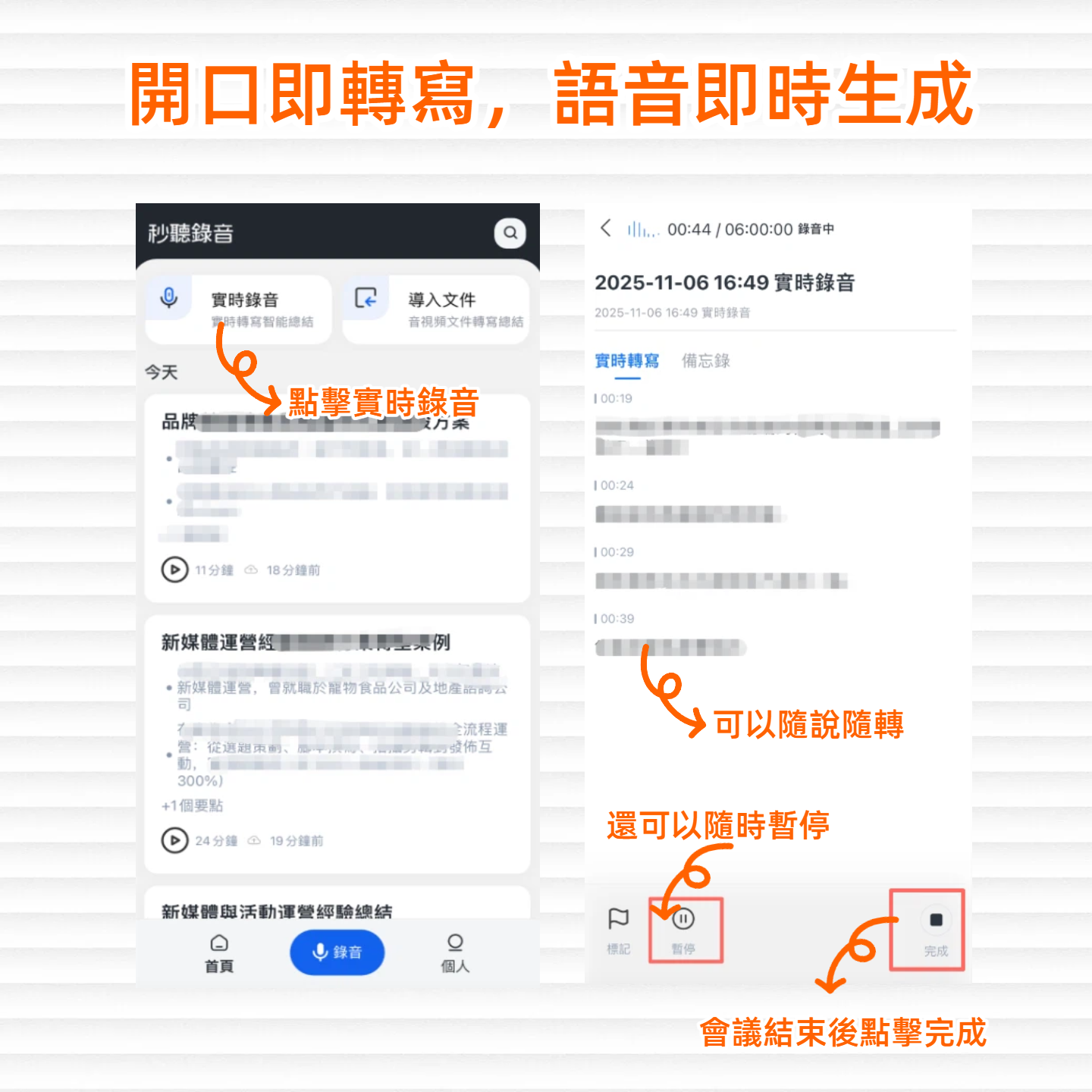
For in-person meetings, classes, or face-to-face interviews. Open the tool, select recording, and the system will transcribe in real time.
- Open the app or web version.
- Select the "Record" function and start recording.
- After stopping, the system automatically generates a transcript and summary.
Step 2: Audio File to Text
For existing recordings (e.g., phone recorder files, downloaded online meeting files).
- Choose the "Audio File" upload option.
- Supports multiple audio formats; upload and convert quickly.
- Auto-generates transcript and AI summary—no manual work needed.
Step 3: Video Link to Text
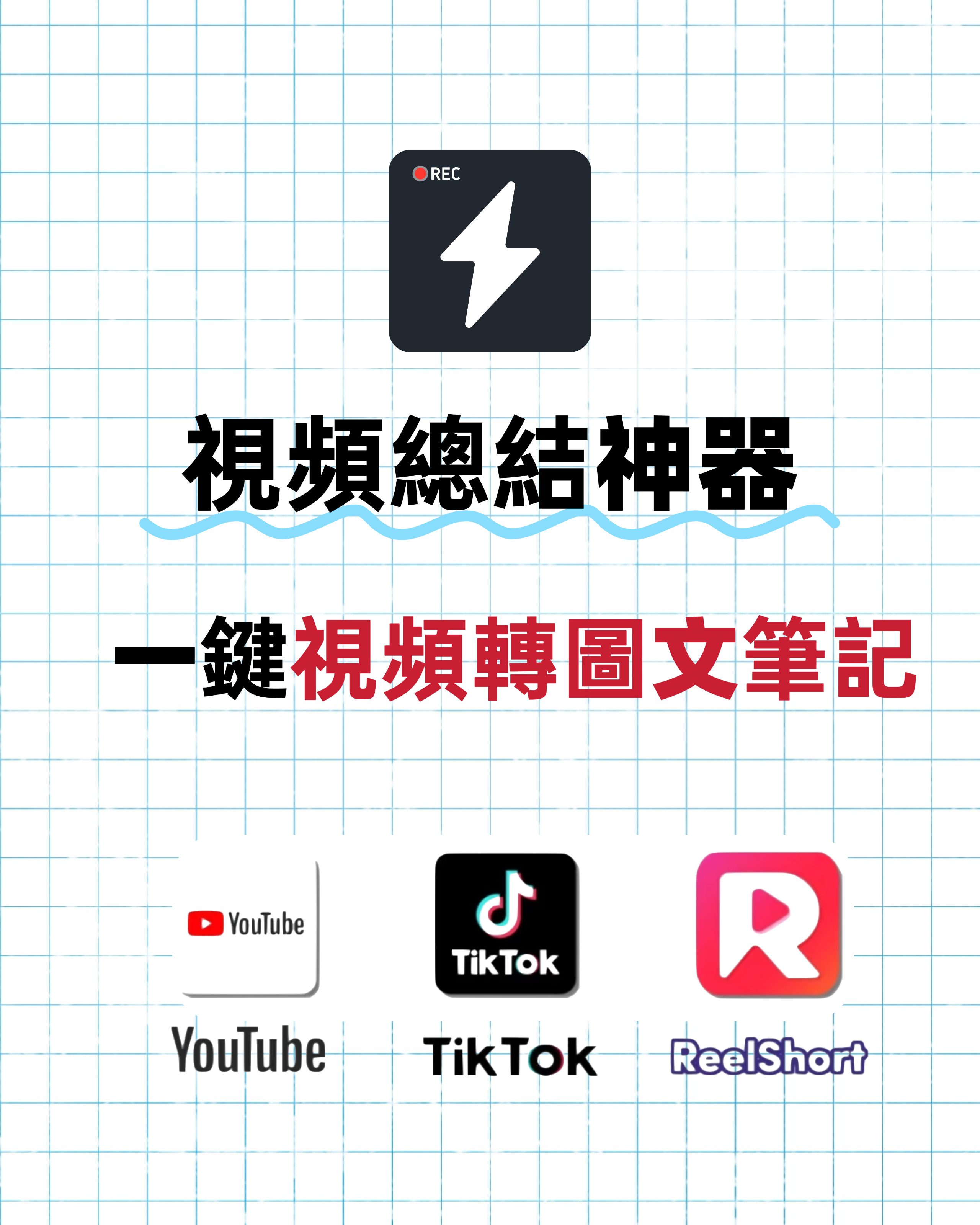
For YouTube videos, podcasts, or online course organization.
- Copy the video or podcast link.
- Paste it into the "Video Link" conversion entry.
- The system extracts the audio track, converts to text, and generates a key summary.
Step 4: AI Chat Query for Key Content
This is the biggest difference from traditional tools. After transcription, no need to read the full text.
- Go to the detailed page of that recording.
- Use the "AI Chat" feature.
- Input a question, e.g., "What are the next steps decided in this meeting?" The system answers based on semantics.
Frequently Asked Questions
1. Is Doubao speech-to-text free?
General AI assistants usually offer free services, but may have limits on single upload duration or total usage. Professional transcription tools like Tinrec provide clear free minute quotas (e.g., 100 minutes per month), making it easy to evaluate long-term costs.
2. How to convert iPhone recordings to text?
iOS users can directly use apps that support iOS. Some tools offer desktop and phone sync; recordings are automatically uploaded to the cloud for processing without manual file export.
3. Does it support Teams or Google Meet meeting notes?
Most professional tools support uploading online meeting recording files. Some tools provide browser extensions or virtual microphones to directly capture meeting audio for transcription and summarization.
4. How accurate is Chinese recognition?
Compared to international tools, platforms optimized for Asian languages generally perform better on Chinese, Taiwanese, and mixed Chinese-English. We recommend using the free tier to test accuracy in your specific scenario.
5. Can I export the transcript?
Mainstream tools all support export in common formats such as TXT, PDF, Word, or SRT subtitle files, making it easy to edit or archive.
6. How is privacy and data security ensured?
When choosing a tool, review its privacy policy. Enterprise users should confirm whether data is encrypted at rest and if there are permission management features to avoid leakage of sensitive meeting content.
Turn every recording into actionable outcomes
Get 60 free transcription minutes when you sign in. No credit card required.
Related Reading
You might also like

2026 Real-World Comparison of 2 Cantonese Input Method Practice Tools: Which One Makes Learning Jyutping Easier?
Want to learn Jyutping typing but don’t know where to start? This article compares jyutping.io’s interactive practice tool and the Cantonese Reverse-Cut input method, from learning curve and practice efficiency to real typing speed, to help you pick the most suitable Cantonese input method practice solution.

4 Cantonese Input Methods Tested on Windows 11 in 2026: Voice-to-Text Isn't Always Real-Time, but Tinrec Is the Most Practical
Windows 11 offers many ways to type Cantonese, from traditional Jyutping to voice-to-text. Which one is best for Hong Kong office workers? We tested 4 tools, including Tinrec for recording transcription and Windows voice input, to help you choose the most efficient solution.

2026 Comparison of Two Android Cantonese Input Methods: Which One Offers a Better Jyutping Typing Experience?
If you want to type Cantonese on an Android phone, Google's Cantonese input method was delisted years ago, while the Jyutping input method continues to receive updates. This hands-on comparison evaluates both across installation, typing accuracy, flexibility, and compatibility to help you pick the right option.

2026 Tested: 4 Cantonese Subtitle Generators for Video Editing – Can Free Plans Be Fast and Accurate?
After video editing, adding Cantonese subtitles is often time-consuming and laborious. This article tests 4 AI subtitle generator tools, comparing accuracy, speed, price, and export formats to help you find the best solution.

2026 Hands-On Comparison of 2 WhatsApp Voice-to-Text Tools: Which Is Better for Cantonese Recognition and AI Organization?
Too many Cantonese voice messages on WhatsApp to keep up? In this hands-on test, we compare Tinrec and Yating across four key dimensions—recognition accuracy, AI organization, cross-platform support, and pricing—to help you decide which tool truly saves you time.

2026 Review: 6 Recording Summary Tools Compared – Which Saves You the Most Overtime?
We tested 6 AI recording summary tools, including Tinrec, Meeting Ink, ChatGPT voice mode, Yating, MyEdit, and Otter.ai, comparing transcription accuracy, summary features, and free plans to help you find the best time-saving tool for meetings and classes.

2026 Hands-On Comparison of 4 Cantonese Speech-to-Text AI Tools: Which One Goes Beyond Transcription to Help You Organize Key Points?
In our 2026 hands-on tests of 4 AI speech-to-text tools with Cantonese support, we compare transcription fluency, AI organization features, pricing plans, and use cases to determine which one is best for Hong Kong office workers, students, and content creators.

4 Automatic Transcription Tools Compared in 2026: It's Not Just About Speech-to-Text – AI Summaries and Q&A Are the Real Game Changers
This article compares four popular automatic transcription tools, evaluating Chinese speech recognition accuracy, AI summarization capabilities, cross-platform support, and pricing to help you find the best solution for meeting minutes, study notes, and content organization. Tinrec (Seconds Transcription) is highlighted as the top pick due to its multi-source input and AI-powered conversational querying.

4 Meeting Summary Generators for 2026: Beyond Transcription to Actionable To-Do Lists
The worst part after a meeting is organizing the notes. We tested four tools—Tinrec, Otter.ai, Tactiq, and Meeting Ink—evaluating transcription accuracy, AI summary quality, and cross-source integration to help you find a meeting summary solution that actually saves you time.