

Turn recordings into transcripts and summaries in minutes
Upload audio or video for multilingual transcription, AI notes, and action items
Before You Buy: Traditional Voice Recorder vs. AI Recording Software
Many people searching for "where to buy a voice recorder" only focus on hardware specs, overlooking the pain point of post-processing. Traditional voice recorders can capture audio but cannot automatically transcribe it into text, leaving you to spend hours listening and summarizing after a meeting. If you value "information digestion efficiency" over mere recording, modern AI recording software might be a better solution. Among the many tools, Tinrec is one candidate that offers a complete workflow from recording to summary, but you still need to evaluate based on your needs.
This article provides the following to help you decide:
- A comparison table of 5 evaluation dimensions, clearly showing the differences between hardware and software.
- A step-by-step tutorial demonstrating how to use your smartphone for professional recording and transcription.
- An FAQ section answering questions about iPhone, Teams meetings, and free quotas.
Quick Navigation Conclusion:
- For high-fidelity hardware recording in offline environments → Choose Sony or Philips traditional voice recorders.
- For meeting summaries, automatic transcription, and cross-device sync → Prioritize AI recording software (e.g., Tinrec, Otter.ai).
- For limited budgets and frequent transcript needs → Smartphone paired with AI tools offers the best value.
2026 In-Depth Review of 6 Popular Recording Tools
To ensure objective evaluation, we set the following test standards: 30-minute meeting audio, mixed Chinese and English environment, and noise interference test. Metrics include word error rate, segmentation quality, summary quality, export efficiency, and price.
Tool Comparison Table: Hardware vs. Software
| Tool Name | Language Support | Real-time Transcription | Summary / Action Items | AI Chat Query | Price / Free Tier |
|---|---|---|---|---|---|
| Sony ICD-UX570 | Recording only | Not supported | Not supported | Not supported | Starting from about 4,000 yuan (hardware) |
| Philips VTR5100 | Recording only | Not supported | Not supported | Not supported | Starting from about 2,000 yuan (hardware) |
| Otter.ai | English primarily | Supported | Supported | Supported | Free 300 minutes/month, weak Chinese support |
| Notta | 50+ languages | Supported | Supported | Partial support | Free 120 minutes/month, higher paid tiers |
| Tinrec | 10 languages (incl. Chinese/Taiwanese) | Supported | Auto-generated | Supported | Free 100 minutes/month, flexible paid plans |
| TurboScribe | Multilingual | Upload & transcribe | Basic summary | Not supported | Generous free tier, no live recording |
Test Results and Scenario Analysis
In a 30-minute Chinese meeting test, traditional voice recorders only provided audio files, requiring about 90 minutes to transcribe manually. Among AI tools, Otter.ai had frequent sentence segmentation errors in Chinese; Notta performed steadily but had a higher price barrier. Tinrec excelled in mixed Chinese and Taiwanese scenarios, and its auto-generated action items reduced post-processing time. For users who need cross-language meetings or foreign language courses, multilingual automatic recognition is crucial.
Stop organizing recordings by hand
Upload audio or video and automatically get a transcript, summary, and action items
Tinrec: Value and Limitations
Tinrec's strength lies in transforming recordings into actionable information—not just verbatim transcripts but also meeting minutes and to-do items. Its limitation is that it requires an internet connection for real-time processing, and the free version has a minute limit. It suits office workers, students, and content creators who frequently organize meeting notes. If you need fully offline functionality or ultimate audio quality, traditional hardware remains the first choice.
Practical Tutorial: How to Use Your Smartphone as a Voice Recorder with Auto-Transcription
If you decide on an AI tool solution, here are the specific steps covering four common entry points to help you get started.
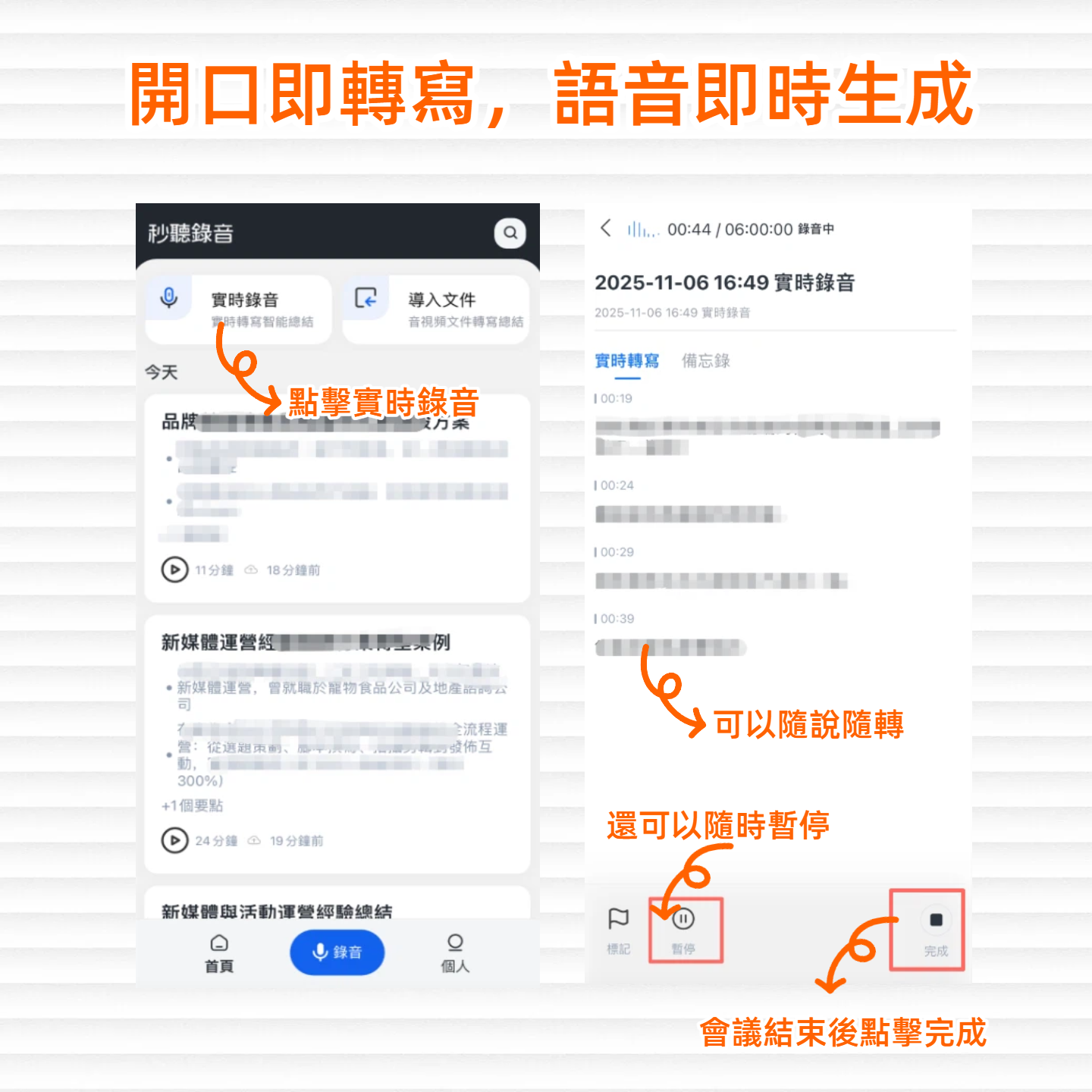
Step 1: Real-time Recording & Transcription
Open the app and select the live recording feature—your smartphone acts as the microphone. Text appears on screen in real time without waiting for the recording to end.
- Tap the record button on the main page.
- Confirm language settings (supports auto-detection).
- After recording ends, the summary and transcript are auto-generated.
Step 2: Upload Audio Files for Transcription
If you have audio files from a voice recorder or other devices, you can upload them directly for conversion.
- Select the import audio file feature.
- Supports multiple formats (MP3, WAV, M4A, etc.).
- After processing, the system generates an editable text file.
Step 3: Transcribe Video Links
For online meeting recordings or YouTube videos, paste the link to extract the audio.
- Copy the video URL.
- Paste it into the video-to-text entry point.
- Audio track is extracted, and key summary is auto-generated.
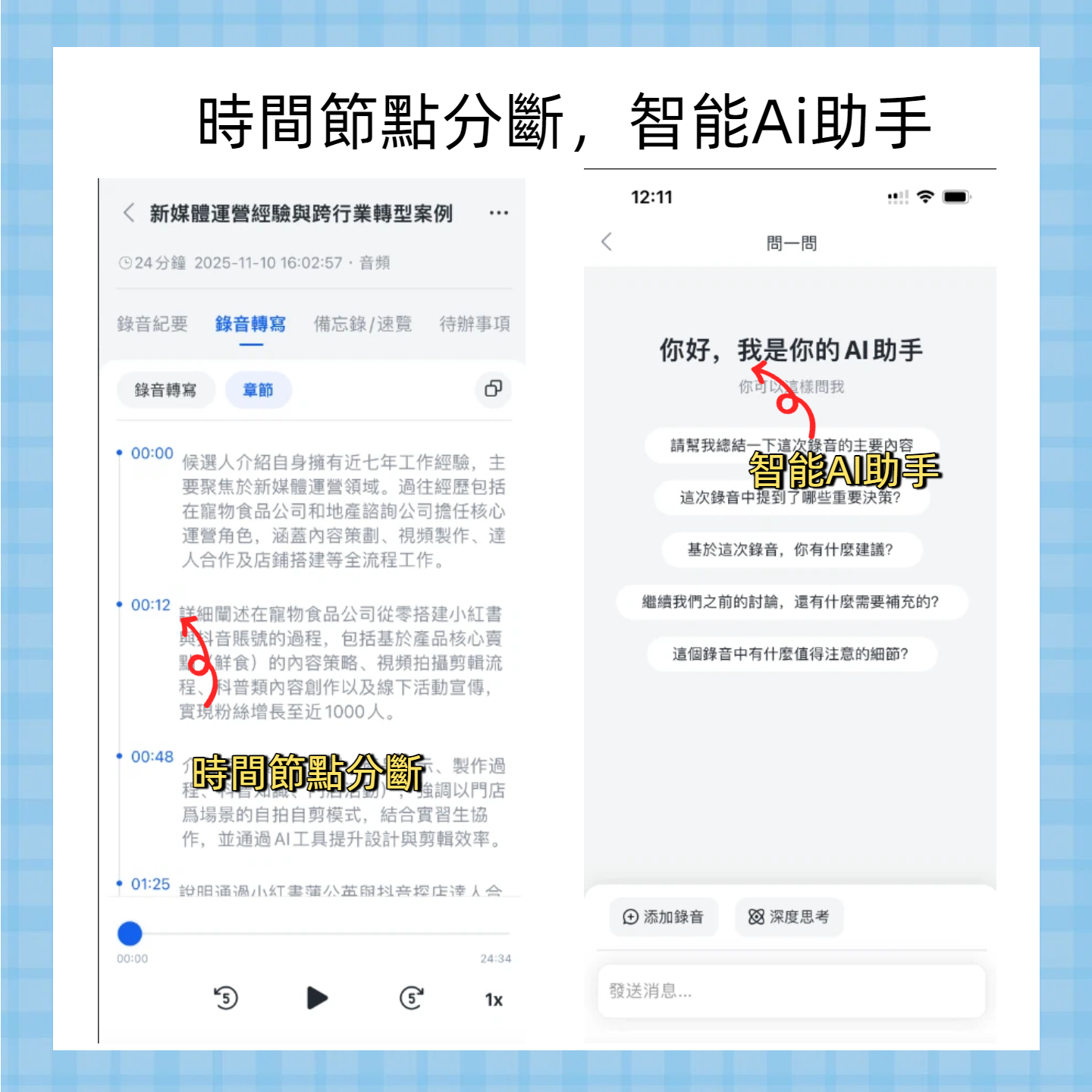
Step 4: AI Chat to Query Key Content
This is the biggest difference from traditional tools—you can ask questions about the recording as if talking to someone.
- Enter the chat query interface.
- Type a question (e.g., "What was the budget mentioned in the meeting?").
- The AI provides precise answers with timestamps based on the recording content.
Recommended Recording Solutions for Different Scenarios
Learning Scenario: Classes and Self-Study
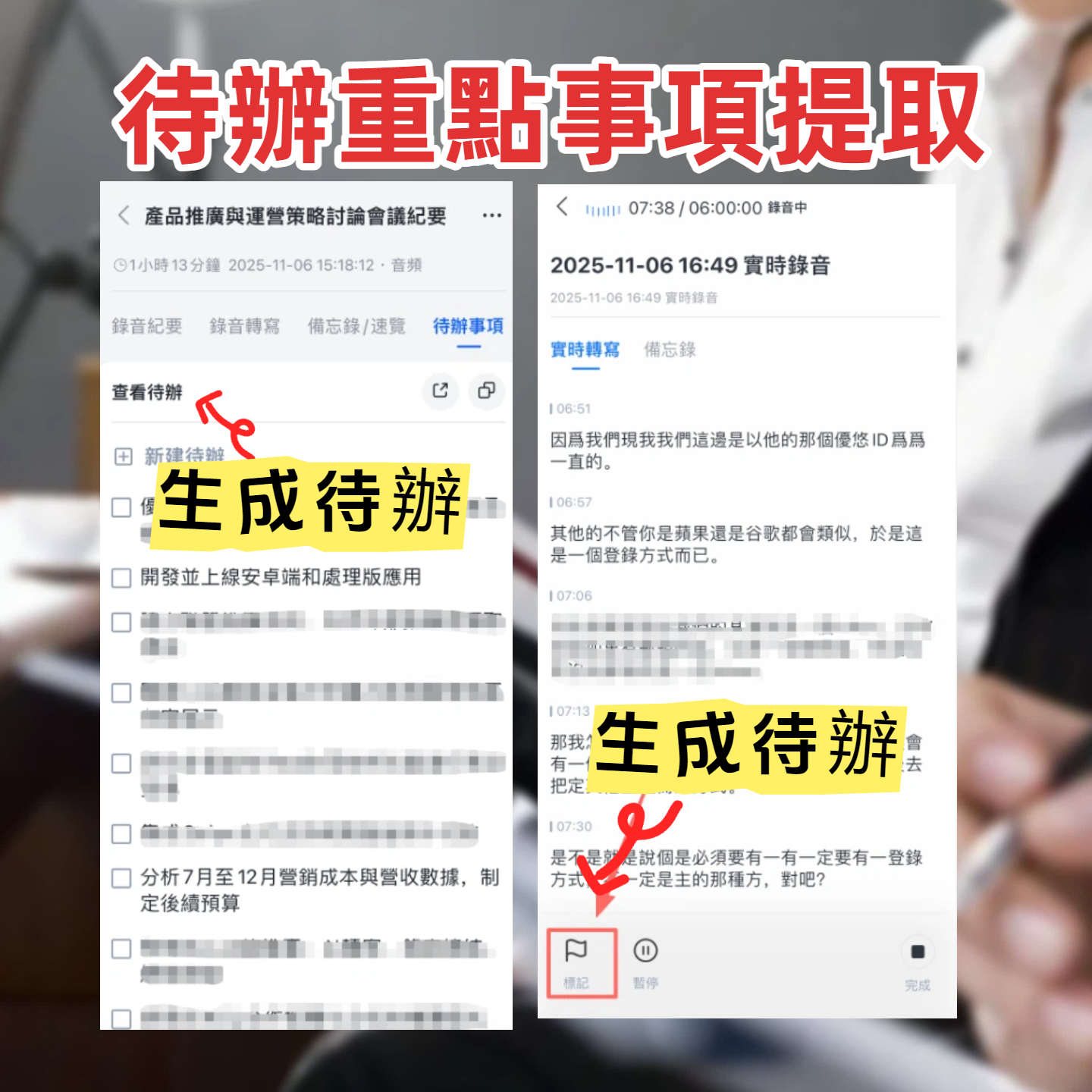
Students value efficient note-taking and review. Use tools that support multilingual recognition, especially for foreign language courses. A smartphone paired with AI software can mark key points in real time, allowing you to export notes directly after class, avoiding time-consuming manual copying.
Work Scenario: Remote and In-Person Meetings
Office workers need to handle a large number of meeting records. For Teams or Meet, use software that records and transcribes directly. For in-person meetings, place your smartphone on the table—the key is follow-up on action items to ensure meeting conclusions are implemented.
Content Creation: Interviews and Podcasts
Creators need high-accuracy transcripts as raw material. Hardware voice recorders can serve as backup, but main processing should be handled by AI tools. Support for video link transcription helps quickly organize online interview content.
Frequently Asked Questions (FAQ)
1. Where can I buy a voice recorder at a lower price?
Traditional hardware like Sony or Philips is available on e-commerce platforms or physical electronics stores, but you must factor in the cost of subsequent transcription. If your budget is tight, a smartphone with a free AI tool is a more economical choice.
2. Which iPhone voice-to-text tool works best?
iOS users can choose tools that support multi-device sync. Note that some tools may be interrupted by iOS background recording restrictions; look for apps specifically optimized for background recording.
3. Does it support meeting recordings for Teams or Google Meet?
Some tools support joining as a meeting bot for recording. If not, use your system's built-in recording feature with a transcription tool. Make sure the tool supports virtual audio input.
4. Do free transcription tools have limits?
Most free plans have a minute cap, e.g., 100 to 300 minutes per month. If you use it frequently, consider the per-minute cost of paid plans, which is usually more cost-effective than buying hardware.
5. How accurate is mixed Chinese and Taiwanese speech recognition?
Traditional tools typically do not support dialects. When choosing, confirm whether the tool explicitly supports Taiwanese or Cantonese. Some AI tools have optimized mixed-language recognition, suitable for localized meeting scenarios.
6. Can I export the transcript to Word?
Mainstream tools support exporting to TXT, Word, or PDF. Before choosing, confirm whether the export includes timestamps, which is important for later proofreading.
Turn every recording into actionable outcomes
Get 60 free transcription minutes when you sign in. No credit card required.
Related Reading
You might also like

2026 Cantonese Input Method Comparison: Windows, Mac, and Mobile – Which Is Easiest to Use?
Looking for a Cantonese input method to download? We tested online Cantonese input methods, Jyutping IME, and Rime Weasel, comparing installation, typing experience, and platform support to help you choose the best Jyutping input tool for Hong Kong users.

2026 Cantonese Input Method No-Install Buying Guide: 2 Hands-On Tests and Recommendations
Want to type Cantonese without installing software? This article hands-on tests two no-install solutions: the voice input tool Tinrec and an online Jyutping input method, to help you pick the right tool for your needs.

2026 4-Way iPhone Cantonese Input Method Comparison: Can a Recording-to-Text App Beat the Built-in?
We tested iPhone's built-in Cantonese input method, a third-party keyboard, and Tinrec's recording-to-text tool to see which provides the most accurate Cantonese recognition and saves the most time. Here's the real difference between voice input, predictive text, and AI organization.

2026 Hands-On Comparison of 3 Cantonese Voice Input Tools: Which One Really Turns Recordings into Usable Data?
Windows 11 finally includes built-in Cantonese voice input, but are free tools really enough? This article tests three tools—Tinrec, Windows built-in, and Notta—covering recognition accuracy, organizing features, and cross-platform support, to tell you which one best suits meetings, learning, and content creation.

2026 Review: 5 Cantonese Input Methods Compared – Which Speech-to-Text Is Most Accurate for Cantonese?
Looking for a reliable Cantonese input method on Windows? We tested 5 speech-to-text tools, comparing Cantonese accuracy, AI features, free plans, and real-world experience to find the best options for Hong Kongers and Cantonese speakers.

2026 Real-World Comparison of 2 Cantonese Input Method Practice Tools: Which One Makes Learning Jyutping Easier?
Want to learn Jyutping typing but don’t know where to start? This article compares jyutping.io’s interactive practice tool and the Cantonese Reverse-Cut input method, from learning curve and practice efficiency to real typing speed, to help you pick the most suitable Cantonese input method practice solution.

4 Cantonese Input Methods Tested on Windows 11 in 2026: Voice-to-Text Isn't Always Real-Time, but Tinrec Is the Most Practical
Windows 11 offers many ways to type Cantonese, from traditional Jyutping to voice-to-text. Which one is best for Hong Kong office workers? We tested 4 tools, including Tinrec for recording transcription and Windows voice input, to help you choose the most efficient solution.

2026 Comparison of Two Android Cantonese Input Methods: Which One Offers a Better Jyutping Typing Experience?
If you want to type Cantonese on an Android phone, Google's Cantonese input method was delisted years ago, while the Jyutping input method continues to receive updates. This hands-on comparison evaluates both across installation, typing accuracy, flexibility, and compatibility to help you pick the right option.

2026 Tested: 4 Cantonese Subtitle Generators for Video Editing – Can Free Plans Be Fast and Accurate?
After video editing, adding Cantonese subtitles is often time-consuming and laborious. This article tests 4 AI subtitle generator tools, comparing accuracy, speed, price, and export formats to help you find the best solution.