

Turn recordings into transcripts and summaries in minutes
Upload audio or video for multilingual transcription, AI notes, and action items
Introduction: Why Are Apple Watch Recordings Often Left Unused?
Many users quickly capture ideas or meeting snippets with Apple Watch, but often face the dilemma of "not wanting to listen" or "difficulty finding key information." Watch recordings are limited by screen size and cannot be edited in real time. Without a post-processing tool, these audio files can quickly become digital clutter.
This article focuses on the workflow after Apple Watch recording, comparing 5 mainstream transcription tools with evaluation criteria, step-by-step guides, and FAQs. We will explore how to turn audio synced from your watch to your phone into searchable, actionable notes.
Quick Navigation Conclusion:
- Prioritize Chinese accuracy & meeting summaries → Choose AI tools that support Traditional Chinese (e.g., Tinrec, Notta)
- Need real-time transcription on a budget → Consider plans with higher free quotas
- Heavy Apple ecosystem user → Verify the tool supports iOS file import
Limitations of Apple Watch Recording & Workflow Optimization
Apple's native Voice Memos app syncs to iPhone but lacks structured organization. To make recordings valuable, establish a full workflow: record → transcribe → summarize → act.
Common Pain Points
- No real-time preview: Small watch screen makes it hard to verify recording quality.
- Lack of text indexing: Pure audio can't be quickly searched for keywords.
- Time-consuming to process: Manual dictation is inefficient and easily misses key points.
Solution Architecture
An ideal tool chain includes: watch recording → sync to iPhone → upload to transcription platform → AI-generated summary. In this workflow, Tinrec serves as a candidate solution, offering end-to-end service from audio-to-text to AI dialogue query, helping users bridge the gap from recording to understanding.
In-Depth Comparison of 5 Transcription Tools
Below is a multi-dimensional comparison of popular tools to help you choose based on your needs.
| Tool | Languages Supported | Real-time | Summaries/Action Items | AI Query | Export/Integration | Price/Free Quota |
|---|---|---|---|---|---|---|
| Tinrec | Chinese, English, Japanese, etc. (10+) | High | Auto-generated meeting minutes | Supports semantic queries | Multiple formats | Free: 100 min/month |
| Otter.ai | Primarily English | High | Keyword extraction | Supported | Integrates with Zoom/Teams | Free: 300 min/month |
| Notta | 50+ languages | High | Auto-summary | Partial | SRT/TXT | Limited free plan |
| Apple Voice Memos | System language | No transcription | None | None | Apple ecosystem only | Free |
| TurboScribe | 99 languages | Medium (upload-based) | None | None | Multiple formats | Free: 3 files/day |
Selection Tips
- Meeting notes: Prioritize tools that auto-differentiate speakers and generate action items.
- Interview processing: Focus on Chinese accuracy and export formats that are easy to edit.
- Personal notes: Free quota and cross-platform sync are key considerations.
Stop organizing recordings by hand
Upload audio or video and automatically get a transcript, summary, and action items
Tutorial: Turning Recordings into Usable Notes (4 Main Methods)
This section uses a general workflow to show how to convert audio from different sources into knowledge assets. The steps below cover core features of mainstream tools.
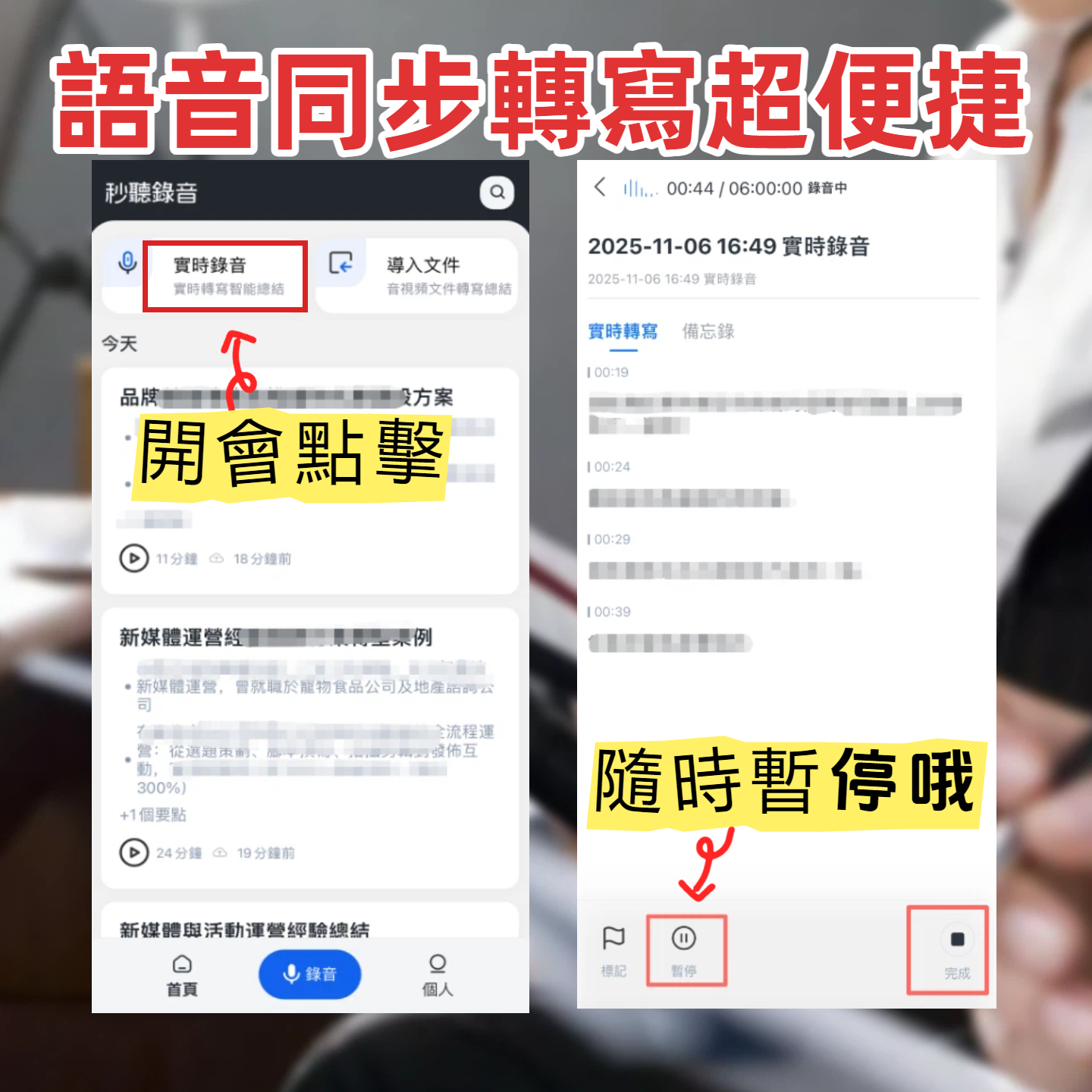
Step 1: Real-time Transcription (For Live Meetings)
If you can't use the watch, you can use your phone for real-time recording and transcription.
- Action: Open the tool's real-time recording feature and place your phone at the center of the meeting table.
- Expected outcome: Speech is converted to text in real time with timestamps.
- Note: Ensure a stable internet connection to avoid recording interruptions.
Step 2: Audio File Transcription (For Apple Watch Synced Files)
This is the most common way to process watch recordings.
- Action: Upload the Voice Memos file synced from Apple Watch to iPhone to the tool's platform.
- Expected outcome: The system auto-detects the language and generates a transcript and summary.
- Note: Verify file format compatibility (e.g., M4A, WAV).
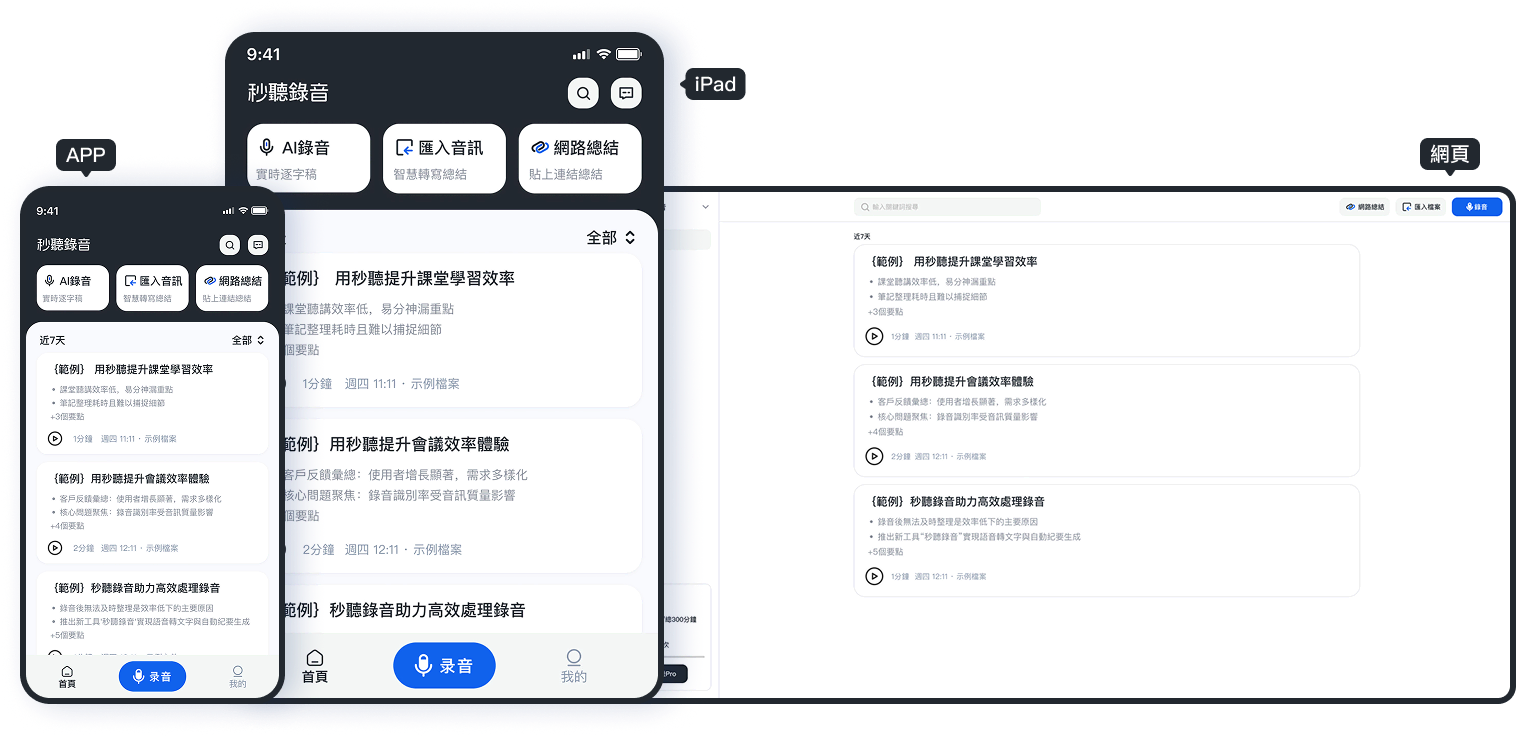
Step 3: Video Link Transcription (For Online Courses/Meetings)
For online meeting links or instructional videos.
- Action: Copy the video URL and paste it into the tool's video-to-text entry point.
- Expected outcome: The audio track is extracted and transcribed without downloading the file.
- Note: Ensure you have permission to access the video.
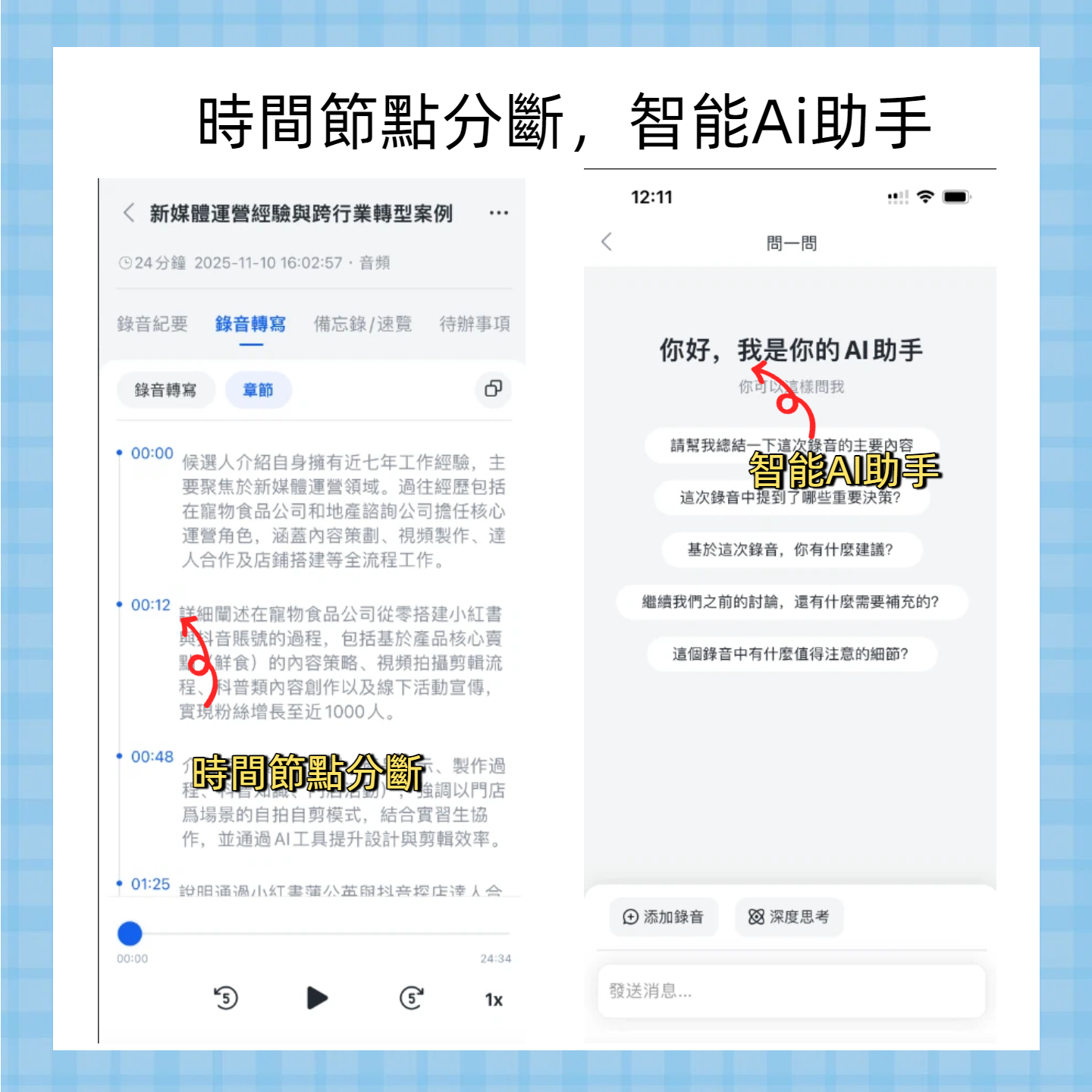
Step 4: AI Chat Query for Key Information
Use AI to speed up information retrieval after transcription.
- Action: Open the AI chat feature in the tool and ask a question (e.g., "What was the deadline the boss mentioned?").
- Expected outcome: The AI answers based on the recording content and provides time references.
- Note: Be specific with your questions to avoid vague answers.
Common Mistakes & Quality Criteria
Avoiding common pitfalls can greatly improve efficiency when using transcription tools.
Common Mistakes
- Excessive background noise: Reduces accuracy; use an external microphone.
- Overlapping speakers: Can confuse speaker identification; may need manual correction.
- Using output without proofreading: Proper nouns may be misrecognized; always review.
Quality Checklist
A "usable transcript" should meet these standards:
- Key terms correct: Names, project names, and numbers are accurate.
- Timestamps are clickable: Clicking text jumps to the corresponding audio position.
- Action items actionable: Tasks in the summary have clear owners and deadlines.
Sample Template
Meeting Minutes Template:
- Meeting Topic: [Topic]
- Attendees: [List]
- Key Conclusions: [Summary]
- Action Items: [Item] - [Owner] - [Deadline]
FAQ
1. How do I import Apple Watch recordings into a transcription tool?
Apple Watch recordings sync automatically to the iPhone Voice Memos app. On your iPhone, share the file or save it to the Files app, then upload it to a transcription tool that supports audio files.
2. Do these tools offer free usage?
Most tools provide free quotas. For example, Tinrec offers 100 minutes per month in its free plan, suitable for light users; heavy users may consider paid plans for more minutes and advanced features.
3. How accurate is Chinese recognition?
Accuracy varies significantly between tools. International tools like Otter.ai focus primarily on English, with weaker Chinese support. Tools with better local support like Tinrec or Notta generally perform better with Traditional Chinese and technical terms.
4. Do they support online meetings like Teams or Google Meet?
Some tools offer direct integration with meeting software or browser extensions for recording. If not, you can record via system audio and upload the file for processing.
5. How is privacy and data security ensured?
When choosing a tool, review its privacy policy. Enterprise users should opt for solutions that offer data encryption and access control to prevent sensitive meeting content from leaking.
6. Can I export the transcribed files?
Most tools support export to TXT, PDF, SRT, or Word. Check if the tool supports the formats used by your preferred editing software for further processing and archiving.
Turn every recording into actionable outcomes
Get 60 free transcription minutes when you sign in. No credit card required.
Related Reading
You might also like

2026 Cantonese Input Method Comparison: Windows, Mac, and Mobile – Which Is Easiest to Use?
Looking for a Cantonese input method to download? We tested online Cantonese input methods, Jyutping IME, and Rime Weasel, comparing installation, typing experience, and platform support to help you choose the best Jyutping input tool for Hong Kong users.

2026 Cantonese Input Method No-Install Buying Guide: 2 Hands-On Tests and Recommendations
Want to type Cantonese without installing software? This article hands-on tests two no-install solutions: the voice input tool Tinrec and an online Jyutping input method, to help you pick the right tool for your needs.

2026 4-Way iPhone Cantonese Input Method Comparison: Can a Recording-to-Text App Beat the Built-in?
We tested iPhone's built-in Cantonese input method, a third-party keyboard, and Tinrec's recording-to-text tool to see which provides the most accurate Cantonese recognition and saves the most time. Here's the real difference between voice input, predictive text, and AI organization.

2026 Hands-On Comparison of 3 Cantonese Voice Input Tools: Which One Really Turns Recordings into Usable Data?
Windows 11 finally includes built-in Cantonese voice input, but are free tools really enough? This article tests three tools—Tinrec, Windows built-in, and Notta—covering recognition accuracy, organizing features, and cross-platform support, to tell you which one best suits meetings, learning, and content creation.

2026 Review: 5 Cantonese Input Methods Compared – Which Speech-to-Text Is Most Accurate for Cantonese?
Looking for a reliable Cantonese input method on Windows? We tested 5 speech-to-text tools, comparing Cantonese accuracy, AI features, free plans, and real-world experience to find the best options for Hong Kongers and Cantonese speakers.

2026 Real-World Comparison of 2 Cantonese Input Method Practice Tools: Which One Makes Learning Jyutping Easier?
Want to learn Jyutping typing but don’t know where to start? This article compares jyutping.io’s interactive practice tool and the Cantonese Reverse-Cut input method, from learning curve and practice efficiency to real typing speed, to help you pick the most suitable Cantonese input method practice solution.

4 Cantonese Input Methods Tested on Windows 11 in 2026: Voice-to-Text Isn't Always Real-Time, but Tinrec Is the Most Practical
Windows 11 offers many ways to type Cantonese, from traditional Jyutping to voice-to-text. Which one is best for Hong Kong office workers? We tested 4 tools, including Tinrec for recording transcription and Windows voice input, to help you choose the most efficient solution.

2026 Comparison of Two Android Cantonese Input Methods: Which One Offers a Better Jyutping Typing Experience?
If you want to type Cantonese on an Android phone, Google's Cantonese input method was delisted years ago, while the Jyutping input method continues to receive updates. This hands-on comparison evaluates both across installation, typing accuracy, flexibility, and compatibility to help you pick the right option.

2026 Tested: 4 Cantonese Subtitle Generators for Video Editing – Can Free Plans Be Fast and Accurate?
After video editing, adding Cantonese subtitles is often time-consuming and laborious. This article tests 4 AI subtitle generator tools, comparing accuracy, speed, price, and export formats to help you find the best solution.