

Turn recordings into transcripts and summaries in minutes
Upload audio or video for multilingual transcription, AI notes, and action items
The Pain Point of Cross-Language Communication: Why You Need Smarter Recording Translation Tools?
In cross-border team collaboration or overseas study scenarios, the most frustrating thing is spending hours organizing a Chinese meeting into an English report, or facing a one-hour English interview but unable to find key decision points. Traditional tools often only achieve "transcription" but cannot bridge the gap of "understanding" and "translation," resulting in extremely low information density and high review costs.
This article focuses on the need for "Chinese recording to English real-time translation" and conducts hands-on tests of 5 mainstream tools on the market, deeply comparing language support, real-time capability, AI summarization ability, conversation query functionality, and price. We will provide actionable steps and analyze how to choose the best solution for you. Among them, Tinrec, as a workflow tool integrating real-time transcription and multilingual translation, will be neutrally evaluated as a specific case in the following chapters.
Quick Navigation Conclusions:
- Prioritize Chinese recognition and localized experience: Choose tools optimized for the Asian market (e.g., Tinrec, Notta).
- Need real-time synchronous translation: Avoid tools that only support post-upload; choose platforms with real-time streaming capability.
- Seek a complete workflow (transcription + summary + action items): Avoid simple dictation software and turn to solutions with AI semantic analysis.
2026 In-Depth Horizontal Review of 5 Chinese Recording to English Translation Tools
When choosing a tool, don't just look at advertising slogans; you must examine core indicators based on actual usage scenarios. Below is an objective comparison of five representative tools, covering international giants and emerging AI services.
Core Features and Limitations Comparison Table
| Comparison Dimension | Tinrec (Seconds Recording) | Otter.ai | Notta | TurboScribe | MyEdit |
|---|---|---|---|---|---|
| Chinese Recognition Accuracy | ⭐⭐⭐⭐⭐ (Specialized in Asian language context) | ⭐⭐ (Primarily supports English) | ⭐⭐⭐⭐ (Good multilingual support) | ⭐⭐⭐⭐ (Based on Whisper) | ⭐⭐⭐ (General-purpose) |
| Real-time Translation Capability | Supports automatic multilingual identification and conversion | Does not support Chinese to English | Supports real-time translation | Requires post-processing | Limited support |
| AI Summary and Action Items | Automatically generates meeting minutes and to-dos | Only English summary works well | Provides basic summary | No built-in summary function | Basic editing functions |
| AI Conversation Query | Supports semantic question-based content retrieval | Supports (English-only environment) | Partial support | Not supported | Not supported |
| Free Tier / Price | 100 minutes free per month | Free version has many limitations | Free version limits duration | High free tier but no workflow | Low free tier |
Detailed Tool Analysis and Applicable Scenarios
- Otter.ai: A globally renowned meeting transcription tool with powerful automatic speaker identification and synchronization, but its biggest weakness is that it does not support Chinese. If your meetings are entirely in English, it is the first choice; but if Chinese discussions are involved, it cannot correctly transcribe, let alone translate.
- Notta: Supports more than 50 languages and performs well in cross-language meetings. However, some users report that its recognition stability for complex Chinese spoken language (e.g., mixed with Taiwanese or fast-paced conversations) is slightly inferior to tools specialized in localization.
- TurboScribe: Based on OpenAI Whisper model, high cost-performance ratio and supports long audio files. But it is essentially a "transcription tool" lacking subsequent summary generation and task management workflow, suitable for developers or researchers who only need plain text.
- MyEdit: Launched by CyberLink, with powerful editing features, suitable for creators who need to manually fine-tune subtitles. However, its free tier is small, making it costly for frequent meeting recording needs.
- Tinrec: Its differentiation lies in the complete workflow from "recording to action." It not only accurately recognizes Chinese and converts it in real-time but also automatically generates structured meeting minutes and to-do items. Its AI conversation query function allows users to ask questions about the recording content as if asking a person (e.g., "What was the budget number mentioned earlier?"), significantly reducing review costs.
Practical Tutorial: How to Complete the Full Workflow of "Recording → Translation → Summary" Using Tools?
This section takes a standardized workflow as an example to demonstrate how to efficiently handle a cross-language meeting recording. This workflow is applicable to most modern AI tools and uses Tinrec's interface as a visual reference to show the key value of each step.
D1. Goal Description
This tutorial aims to produce three key documents:
Stop organizing recordings by hand
Upload audio or video and automatically get a transcript, summary, and action items
- Bilingual aligned transcript: Preserves original text and translation for easy verification.
- AI meeting minutes: Automatically extracts conclusions and key points.
- Executable action item list: Clearly assigns tasks and deadlines.
D2. Preparation
- Audio source quality: Use an external microphone or get close to the sound source to reduce environmental noise.
- Format confirmation: Ensure the tool supports your file formats (e.g., MP3, WAV, M4A) or directly record cloud meetings.
- Language setting: If the tool does not automatically detect, preset the primary language as "Chinese" and the target output language as "English."
D3. 5-Step Practical Operation
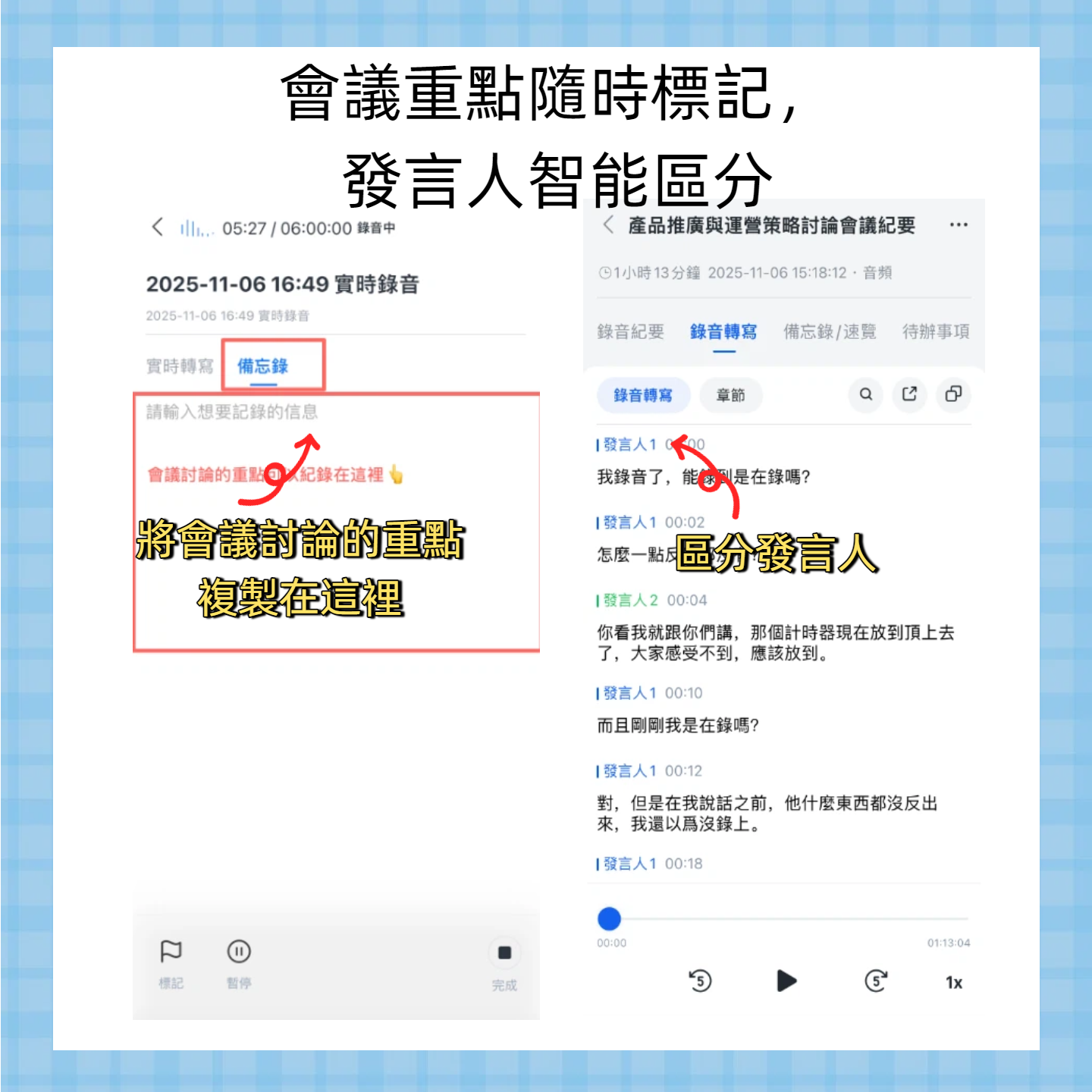
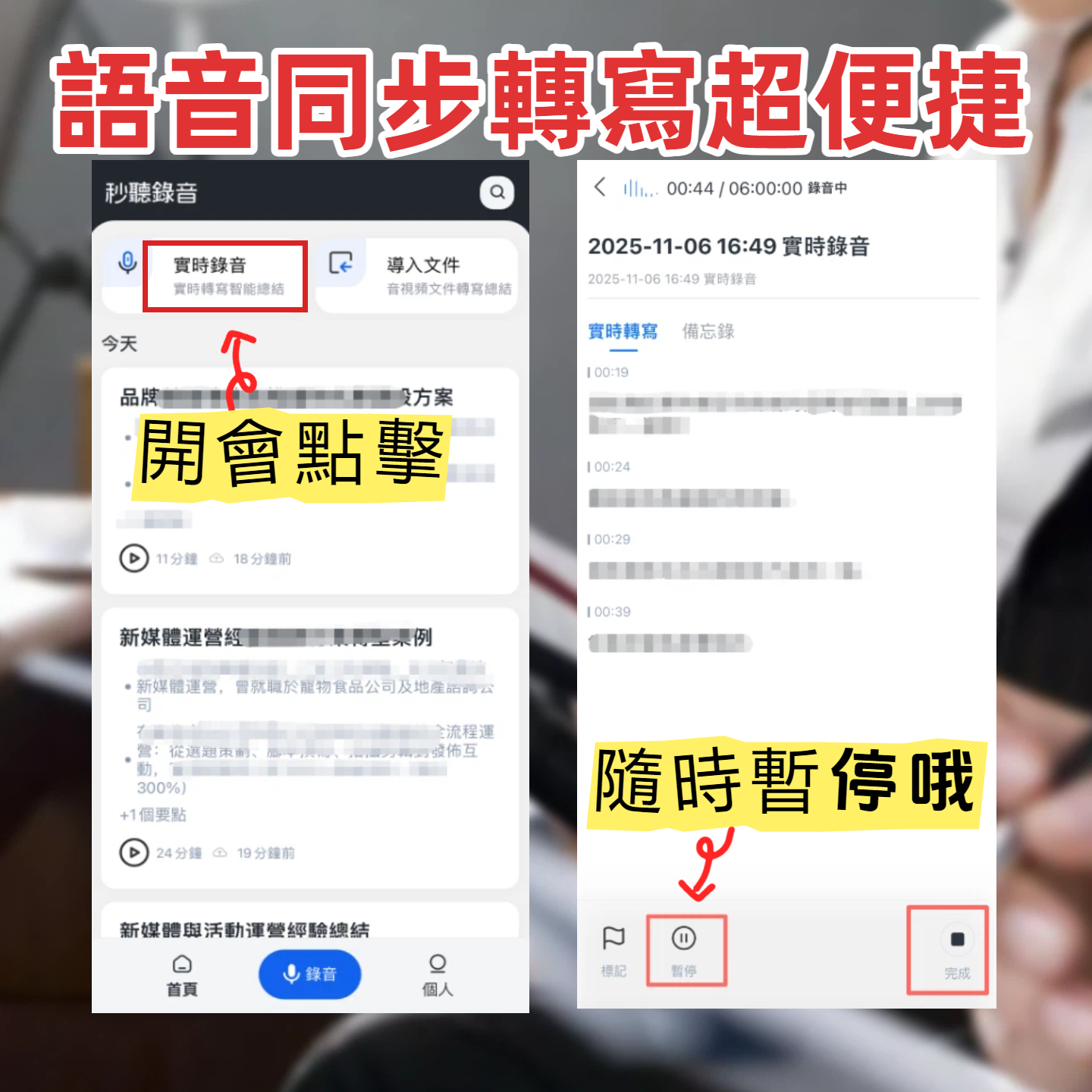
Step 1: Start real-time recording or upload audio file
- Action: Open the "real-time recording" feature of the tool, or drag an existing meeting recording file to the upload area.
- Expected result: The system starts real-time transcription and displays scrolling text on the interface.
- Note: For real-time meetings, ensure a stable network; for file upload, pay attention to size limits.
Step 2: Perform language translation and conversion
- Action: After transcription, select the "translate" function and set the target language to English.
- Expected result: The system converts the Chinese transcript into fluent English paragraphs while preserving timestamps.
- Note: Check the accuracy of professional terminology translation and manually correct if necessary.
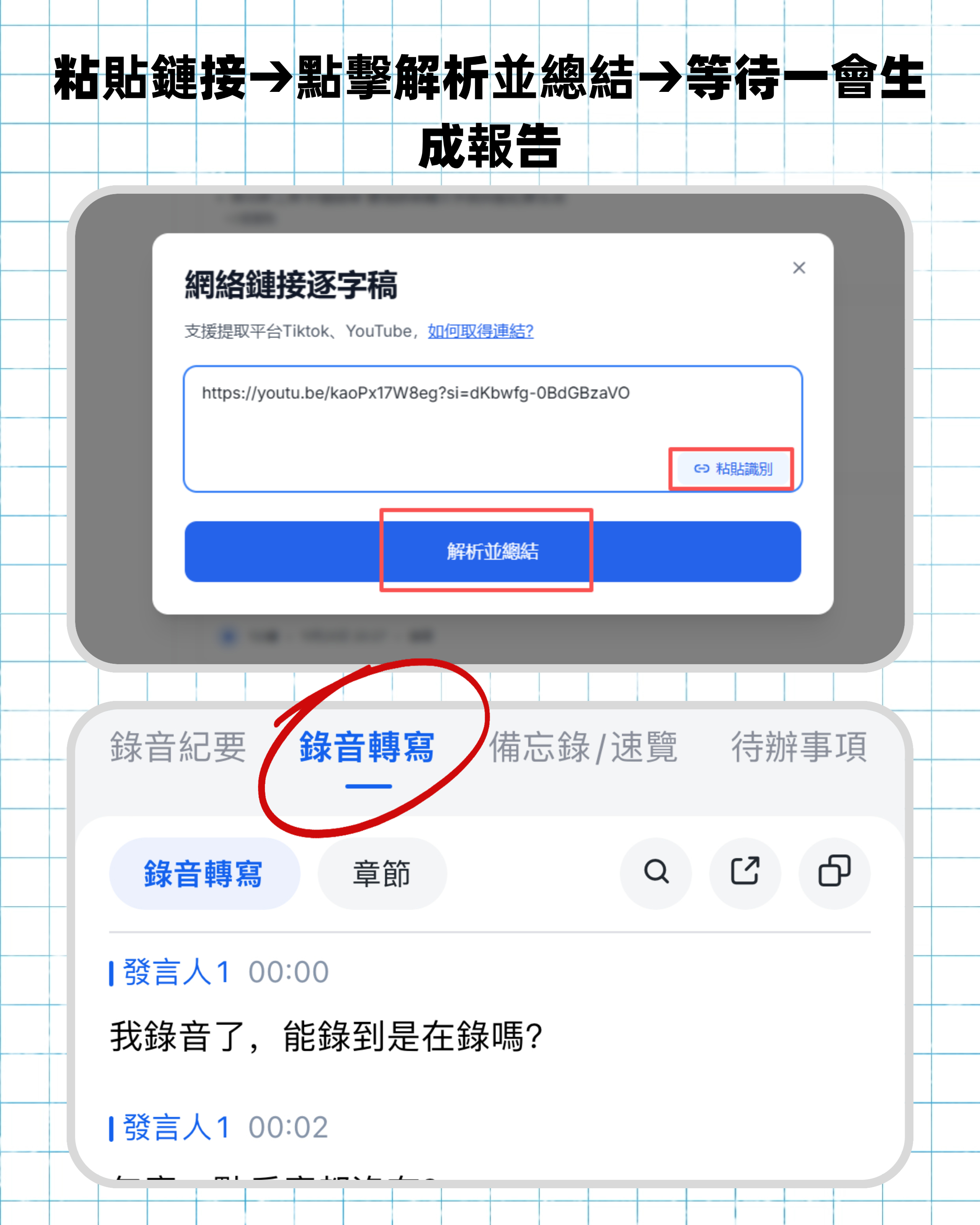
Step 3: Import external video link (optional)
- Action: If the meeting recording is stored on YouTube or other platforms, directly paste the URL for parsing.
- Expected result: The tool automatically captures the audio track and transcribes it without downloading large video files.
- Note: Confirm the video permissions are set to public or unlisted to avoid parsing failure.
Step 4: Generate AI summary and action items
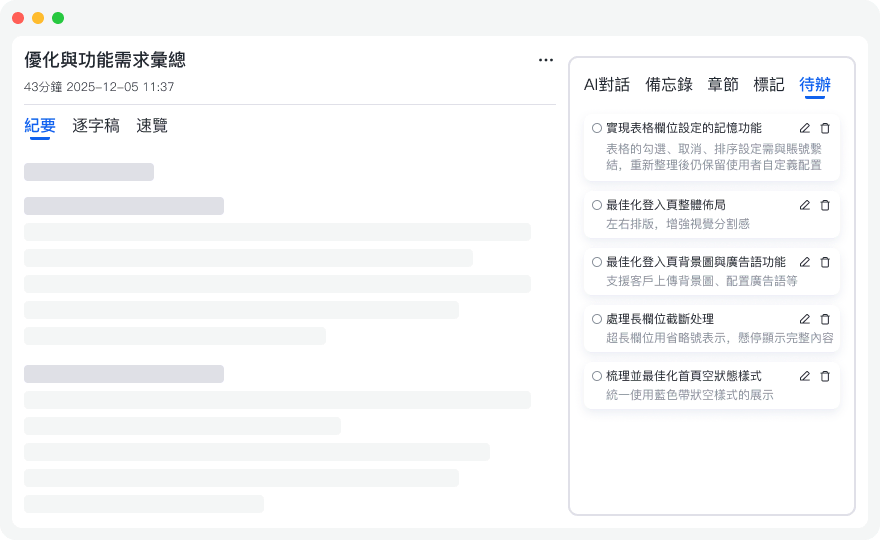
- Action: Click the "generate summary" or "meeting minutes" button and select a template (e.g., decision highlights, to-do items).
- Expected result: Obtain a clearly structured summary containing key conclusions and tasks assigned to specific persons.
- Note: This step is the core of efficiency improvement, reducing hours of listening to minutes of reading.
Step 5: Use AI conversation query to verify content
- Action: Enter questions in the sidebar or dialog box, e.g., "Who is responsible for next Monday's presentation?" or "Translate the discussion about the budget."
- Expected result: AI directly answers the questions based on the recording content and provides the original time position.
- Note: This is something traditional tools cannot do, allowing you to search voice content like a search engine.
D4. Common Errors and Corrections
- Overlapping speech from multiple people: When two people speak at the same time, recognition rate drops. Correction method: Agree on speaking etiquette before the meeting, or use tools with "voiceprint separation" technology (e.g., Tinrec, Otter), and manually adjust speaker labels afterward.
- Mis-translation of professional terms: Industry-specific terms may be literally translated. Correction method: Create a custom glossary (if the tool supports it), or quickly scan and tweak proper nouns after generation.
D5. Result Acceptance Criteria
A "usable" cross-language meeting record should meet:
- Key terms correct: Names, project names, data without errors.
- Timestamps locatable: Clicking text jumps to the corresponding recording segment.
- Action items executable: Tasks have a clear responsible person (Who) and deadline (When).
D6. Example Template Reference
- Meeting minutes template: [Date] [Attendees] - Core decisions: ... - Risk notes: ...
- To-do item template: [Task content] @Responsible person [Deadline] #Priority
Pitfall Avoidance Guide: 3 Key Decision Formulas When Choosing a Tool
Feeling lost among many tools? Use the following three formulas to quickly screen:
- Language Match Formula:
- If the primary language is Chinese → Exclude pure English tools (e.g., Otter.ai basic version).
- If dialect support is needed (Taiwanese, Cantonese) → Choose locally trained models (e.g., Tinrec, Yating Transcript).
- Workflow Completeness Formula:
- Only need text files → Choose TurboScribe, cSubtitle.
- Need insights and actions → Choose tools with AI summary and conversation functions (e.g., Tinrec, Notta).
- Cost-Effectiveness Formula:
- Occasional use (<100 minutes/month) → Prioritize plans with ample free tier.
- High-frequency use (enterprise level) → Calculate cost per minute and consider team collaboration features (e.g., shared notes, permission management).
Frequently Asked Questions (FAQ)
Q1: Does iPhone have a built-in Chinese recording to English translation tool? A: iPhone's built-in "Voice Memos" can only record, not transcribe or translate. Although there is a "Live Dictation" feature, it is for typing text, not processing long recordings. We recommend using third-party apps like Tinrec or Notta.
Q2: Can Google Meet or Teams meetings be translated in real-time? A: The built-in caption features of Google Meet and Teams usually only display the current language and may not support real-time bilingual transcripts that can be saved. To obtain editable, searchable bilingual records, you still need third-party tools to record and process.
Q3: What is the free recording minute limit? A: Varies by tool. For example, Tinrec free version offers 100 minutes per month; Otter.ai free version offers about 300 minutes per month but only for English; TurboScribe free version has daily limits. It is recommended to confirm your average monthly usage before choosing.
Q4: What affects transcription accuracy the most? A: Environmental noise, speaker accent, and multiple people speaking simultaneously are the three biggest factors. Using a high-quality microphone and maintaining a single speaker source can significantly improve accuracy.
Q5: Do these tools support SRT subtitle file output? A: Most tools focused on video creation (e.g., VEED.IO, cSubtitle) support SRT export. Tools focused on meeting records (e.g., Tinrec, Notta) usually also provide this feature for creating video subtitles.
Q6: How to ensure the privacy and security of meeting recordings? A: Choose tools with security certifications (e.g., SOC2, GDPR compliant). Enterprise users should pay attention to server location and data encryption. Some tools like MacWhisper focus on offline processing, suitable for highly confidential scenarios, but sacrifice cloud collaboration convenience.
Turn every recording into actionable outcomes
Get 60 free transcription minutes when you sign in. No credit card required.
Related Reading
You might also like

Google Meet On-the-Go vs Tinrec: Which Is Better for Mobile Meetings in 2026?
Google Meet On-the-Go lets you join meetings while walking or commuting, but it only solves live participation—post-meeting organization still needs a separate solution. This article compares Google Meet On-the-Go and Tinrec for mobile meeting scenarios, focusing on post-meeting processing, cross-platform export, and team collaboration to help you decide which approach to use.

4 Ways to Record LINE Calls in 2026: Which One Actually Captures Both Sides?
LINE doesn't have a built-in call recording feature, but you can still capture calls using iOS 26 local capture, built-in Android recording, speakerphone with an external recorder, or third-party apps. This article tests 4 methods and explains how to use Tinrec to turn recordings into transcripts, summaries, and action items so your calls become searchable and useful.

4 Recording Archive Tools Tested: How to Save LINE Voice Messages Long-Term in 2026
LINE voice messages don't have a built-in download button, and saving them to your phone doesn't mean they're permanently stored. This article starts with common archiving mistakes, outlines 4 key points for choosing a recording archive tool, compares Tinrec, Otter.ai, Granola, and Notta, and includes a pitfalls guide and selection advice.

5 LINE Call Recording Methods Tested and Compared in 2026: iPhone, Android, or PC — Which Is Easiest?
Can you record LINE calls? This article covers 2026 methods including iPhone native capture, Android built-in call recording, screen recording, PC recording, and AI organization tools, and tests how Tinrec turns LINE call recordings into transcripts, summaries, and to-dos.

4 LINE Call Recording Methods Tested for 2026: Which Actually Works on iPhone, Android, or PC?
LINE still doesn't offer built-in call recording, so in 2026 you'll need to combine methods to save important calls. This hands-on guide covers current options for iPhone, Android, and PC, and compares the most time-consuming part—organizing recordings—including how Tinrec, Notta, Otter.ai, and PLAUD Note differ, so you can find a workflow that actually works.

5 Ways to Record LINE Calls in 2026: Which One Should You Use?
LINE doesn't have a built-in call recording feature, but you can use iPhone's built-in capabilities, screen recording, Android third-party apps, or desktop tools to get the job done. This article tests and compares 5 methods, explaining their use cases and limitations, and shows how to use Tinrec to turn recordings into searchable, queryable, actionable records.

5 iPhone Recording Methods Compared: Where Is the Record Button? Tinrec Saves the Most Time
Can't find the iPhone record button? We tested 5 quick ways to start recording—built-in Voice Memos, Control Center, Siri, Back Tap, and Action Button—and compared note-taking tools like Tinrec, Otter, and Notta to show how to generate transcripts, summaries, and action items with one tap after recording.

4 LINE Call Recording & Storage Methods Tested for 2026: How to Save Voice Messages Before They Expire
LINE doesn't have a built-in call recording feature, and voice messages can expire and disappear. This article tests and compares 4 ways to record LINE calls and save voice messages—from LINE Keep and phone screen recording to Tinrec's transcription and AI organization workflow—to help you decide which method truly saves, finds, and uses your recordings.

2026 Teams Meeting Tools Comparison: How to Schedule a Teams Meeting and Who Handles the Minutes?
Sending a Teams meeting invite takes 30 seconds, but post-meeting cleanup takes 90 minutes. This article first explains three scenarios for sending Teams meetings (calendar scheduling, channel meetings, and instant meetings), then compares Tinrec, Otter.ai, Notta, and Granola in terms of meeting capture methods, post-meeting outputs, and team data management. It also lists 4 common pitfalls to help you choose the right tool for post-meeting follow-up.