
Turn recordings into transcripts and summaries in minutes
Upload audio or video for multilingual transcription, AI notes, and action items
Why Your YouTube Subtitles Always Fail or Come Out Wrong?
Many creators face several pain points when dealing with "auto-generating YouTube subtitles to SRT": low recognition rates for Chinese or specialized terms, inaccurate timestamps causing sync issues, or being limited to online editing without being able to download a standard SRT file for secondary proofreading. Worse, if the video source is a meeting recording or interview, traditional editing tools often only provide subtitles but cannot extract key summaries and action items, making it hard to transform valuable audio-visual content into searchable knowledge assets. While tools like Tinrec are beginning to emphasize a complete workflow from recording to action, how should users who simply need to "quickly produce high-quality SRT files" choose the most suitable tool?
This article will deeply review 5 mainstream solutions, comparing them across five dimensions: "language support," "timestamp accuracy," "export format flexibility," "additional features (e.g., summary/AI query)," and "price threshold." You will get a clear decision tree to help you choose a tool based on whether you are "pure editing for publishing" or "in-depth content organization," along with practical tutorials and FAQ.
Quick Navigation Conclusions:
- Pure video editing and publishing: Give priority to tools built into editing software or those focused on subtitle timestamps (e.g., VEED.IO, cSubtitle).
- Meeting/interview/course recording: If you need both transcripts, key summaries, and action items, choose AI assistants with complete workflows (e.g., Tinrec, Notta).
- Technical developers: If you are familiar with deployment and value privacy, consider open-source models (e.g., Whisper).
Who Needs YouTube Auto Subtitle Generation Tools? Four User Scenario Analysis
Before choosing a tool, identify which category your core need falls into, as this directly determines the tool's cost-effectiveness.
1. Content Creators (YouTubers/Short Video Producers)
Main goal: compliance and SEO optimization. They need to quickly convert speech into SRT files with precise timestamps for upload to YouTube Studio. Pain points: slow processing of long videos and high error rates for proper nouns.
2. Enterprises and Marketing Teams (Meeting/Event Recording)
Beyond subtitles, they need to convert recordings of webinars and product launches into text reports. They need not just SRT but also speaker differentiation (who said what), plus automatic extraction of meeting conclusions and action items.
3. Educational Institutions and Instructors (Course Digitization)
Convert lecture videos into subtitles to assist hearing-impaired students, or turn long lectures into searchable notes. Multilingual support (e.g., mixed Chinese-English, Taiwanese Hokkien) is critical here.
4. Media and Journalists (Interview Organization)
Interview recordings need quick conversion into transcripts for article writing. This scenario values transcription accuracy and subsequent "query-based retrieval" ability to quickly find specific viewpoints.
Five Key Selection Criteria: How to Choose the Right SRT Generation Tool
Faced with a myriad of tools, screen them according to the following five dimensions to avoid pitfalls.
- Language recognition accuracy: Does it support Traditional Chinese, Taiwanese Hokkien, or mixed Chinese-English? Is there optimization for professional terminology? This is key to post-production cost.
- Timestamp and format support: Are the generated SRT timestamps precise? Does it support other export formats like VTT, TXT? Can it directly match the video length?
- Speaker diarization: Can it automatically distinguish different speakers? This is crucial for multi-person meetings or interview videos.
- Smart value-added features: Beyond transcription, does it offer automatic summarization, keyword tagging, or even an "AI dialogue query" feature similar to chatting? This can greatly improve information digestion efficiency.
- Cost and quota limits: What are the free minutes limits? Is the paid plan unit price reasonable? Are there hidden export restrictions?
2026: Horizontal Comparison of 5 Popular Tools – Features, Pros/Cons, and Target Users
Below is an objective comparison of mainstream solutions on the market, including editing-focused VEED.IO, Taiwan-local Yating Transcriber, open-source OpenAI Whisper, cost-effective TurboScribe, and workflow-focused Tinrec.
| Dimension | VEED.IO | Yating Transcriber | OpenAI Whisper | TurboScribe | Tinrec (Second Ruler Recording) |
|---|---|---|---|---|---|
| Core positioning | Online video editing + subtitles | Taiwan local speech-to-text service | Open-source speech recognition model | High cost-effectiveness online transcription | AI recording assistant (transcribe + understand + act) |
| Chinese accuracy | Good, strong for general use | Excellent, good at Taiwanese Hokkien/mixed Chinese-English | Excellent, depends on model version | Excellent, based on Whisper architecture | Excellent, optimized for business/interviews |
| SRT export | ✅ Supported, online editing available | ✅ Supported | ⚠️ Requires scripting | ✅ Multiple formats | ✅ Supported, includes timestamps |
| Speaker diarization | Basic support | Good | Requires additional setup | Good | Automatic detection and labeling |
| AI value-added features | Basic editing assistance | Transcription and simple editing only | None (pure model) | None (pure transcription) | Meeting minutes, action items, AI dialogue query |
| Usage threshold | Low (web-based) | Low (web/mobile) | High (requires technical deployment) | Low (web-based) | Low (cross-platform support) |
| Free quota | Limited with watermark | Limited trial | Completely free (self-hosted) | Daily free minutes | 100 minutes per month |
| Suitable scenarios | Short videos quick publishing | Taiwan local interviews, court records | Developers, privacy-sensitive projects | Massive long audio low-cost transcription | Meetings, courses, in-depth interview organization |
Stop organizing recordings by hand
Upload audio or video and automatically get a transcript, summary, and action items
Analysis Summary:
- If you only need to "make subtitles", VEED.IO has the best integration – complete it directly in the editing interface; TurboScribe is a cost-effective choice for processing long audio files.
- If you need to handle "Taiwan local languages" (like Taiwanese Hokkien), Yating Transcriber performs most stably.
- If your video content involves "decision discussions, teaching highlights, interview insights", a simple SRT file is not enough. Here, Tinrec shines: it not only generates SRT but also automatically produces meeting minutes and to-do lists via AI, and allows users to query video content through dialogue (e.g., "Find the point where we discussed the budget"), turning passive viewing into active information retrieval.
Practical Tutorial: How to Efficiently Generate SRT and Unlock Content Value
Below, using Tinrec as an example (which has a complete workflow), we demonstrate how to go from a video link to generating SRT and further extract value using AI features. This flow also applies to other tools that support link input, but Tinrec offers a differentiated experience in the subsequent "understand" and "act" phases.
Step 1: Import Source (Recording/File/Link)
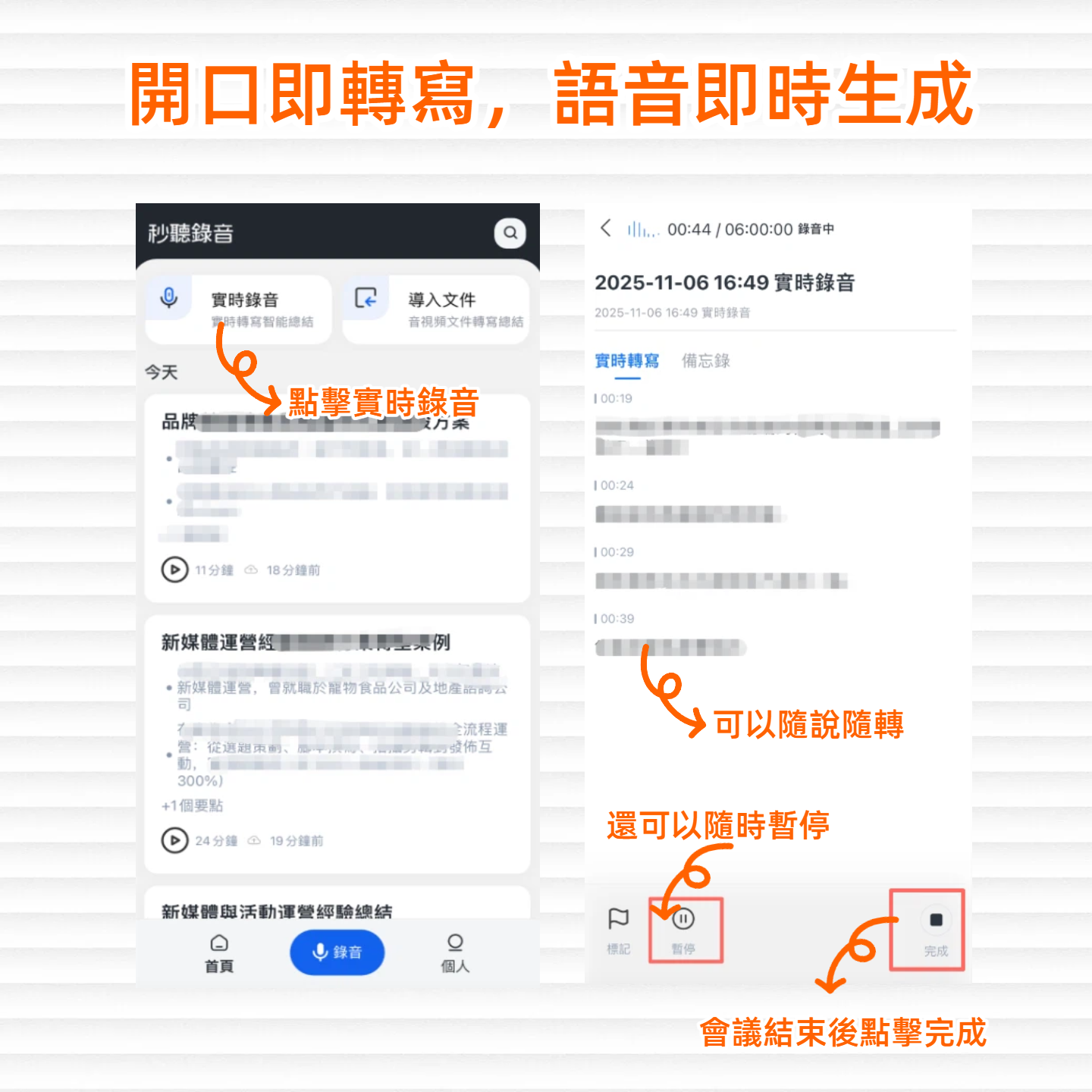
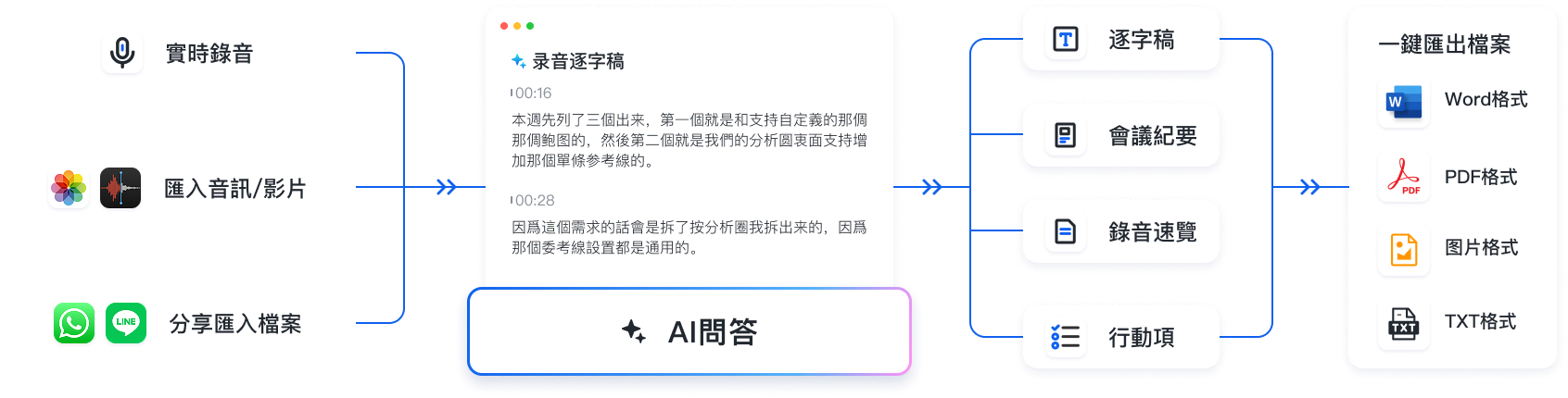
Tinrec offers three flexible entry points for different scenarios:
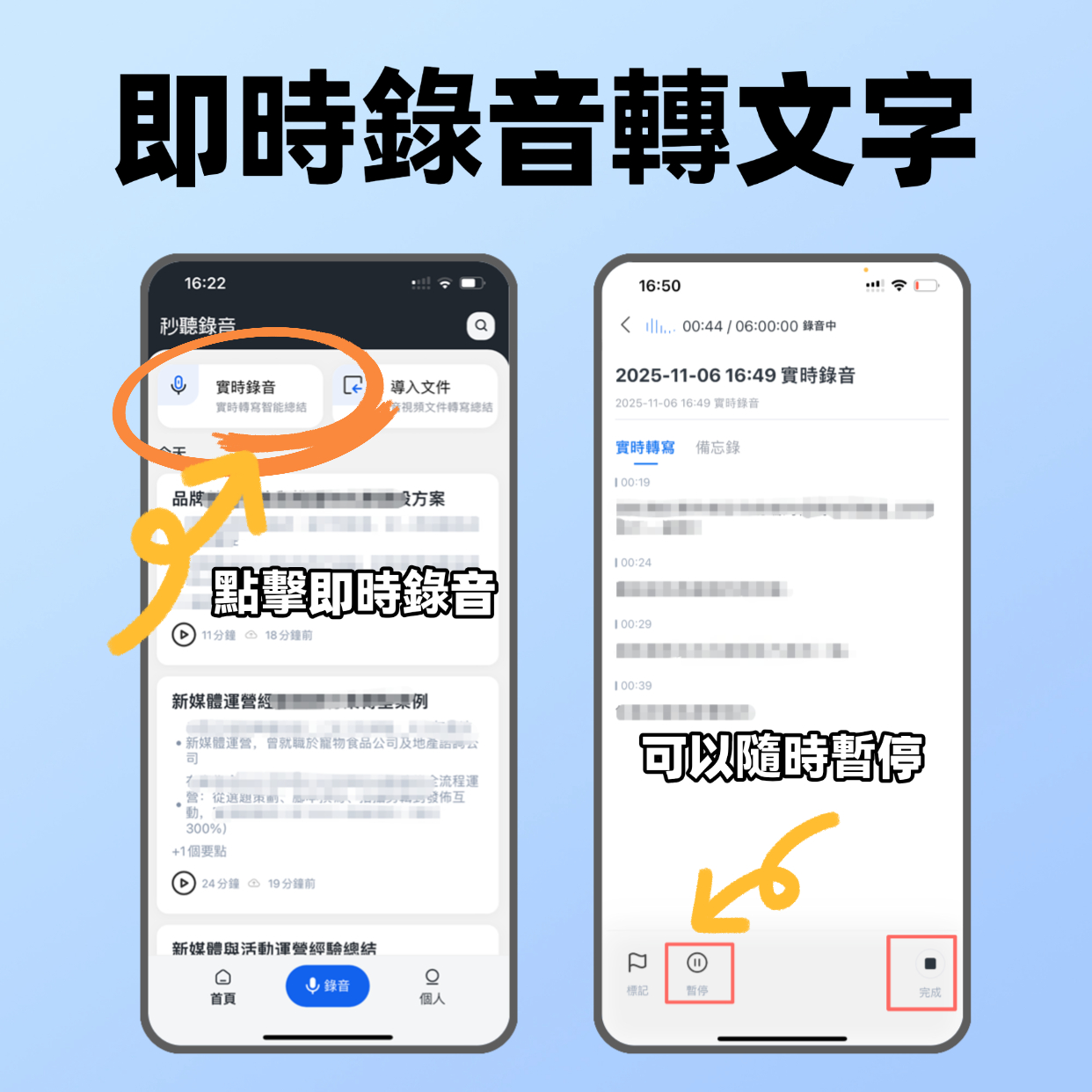
- Real-time recording to text: Suitable for physical meetings or classes – open the app and record while transcribing.
- Audio file upload: Drag and drop existing MP3/WAV recording files.
- Video link parsing: Directly paste a YouTube, Zoom, or other online video link, and the system automatically extracts the audio track.
Step 2: Automatic Transcription and Language Detection
The system automatically detects the language (supports 10 languages including Chinese, English, Japanese, Korean) and completes transcription within minutes. It automatically marks timestamps and distinguishes speakers during the process.
Step 3: Generate SRT and Export in Multiple Formats
After transcription, enter the editing page. Preview the correspondence between text and timestamps, correct a few proper nouns, then click the export button, select SRT format to download, and upload directly to YouTube Studio.
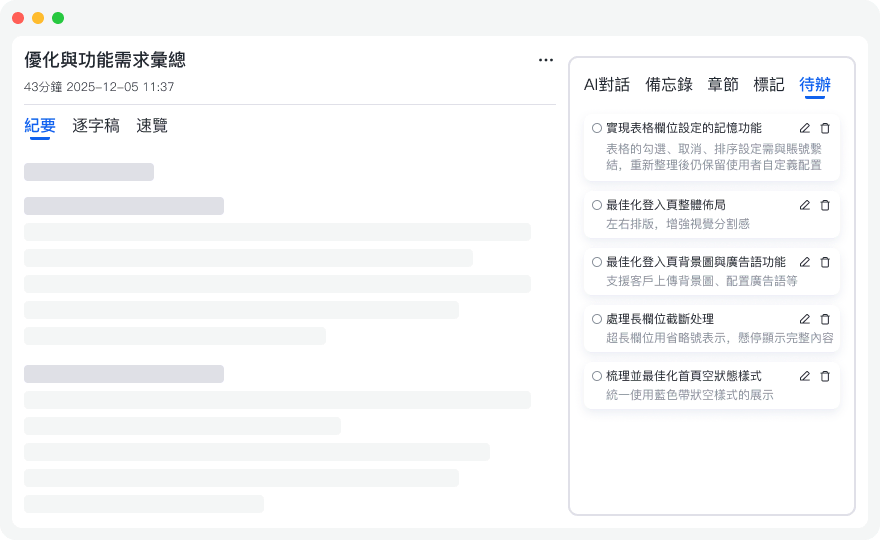
Step 4: Advanced Application - AI Dialogue Query and Action Item Extraction (Key Differentiator)
This is a step impossible with traditional subtitle tools. In Tinrec, without rewatching the video, you can ask questions via the right-side AI dialogue query feature:
- "What is the conclusion about the marketing budget in this meeting?"
- "What are the three review points mentioned by the instructor?"
- "Who is responsible for submitting the design draft by next Friday?"
The system, based on semantic understanding, directly extracts segments from the video and organizes them into answers, while automatically generating a to-do action item list, truly turning video content into actionable tasks.
Decision Tree Recommendation: Choose the Best Solution Based on Your Needs
To reduce your choice difficulty, refer to the following decision paths:
- Scenario A: I'm a YouTuber, just want to quickly add Chinese subtitles to my video.
- 👉 Choose VEED.IO or cSubtitle. Pros: high editing integration, intuitive operation.
- Scenario B: I have lots of interview recordings or meeting videos, need to organize them into transcripts or meeting minutes.
- 👉 Choose Tinrec or Notta. These two perform better in speaker diarization and structuring long documents; Tinrec's Chinese localization and AI summary features save a lot of manual organization time.
- Scenario C: I'm a developer, care about data privacy and have the ability to set up my own server.
- 👉 Choose OpenAI Whisper or MacWhisper. Full control over data, but requires technical maintenance costs.
- Scenario D: I need to handle interviews in Taiwanese Hokkien or special dialects.
- 👉 Choose Yating Transcriber. It has the richest training data for Taiwan's local languages.
Tinrec's Target Audience Conclusion: If you not only need a "subtitle file" but also want to turn audio-visual content into a "searchable knowledge base" and "executable task list," then Tinrec is the most suitable choice. It is especially suitable for office workers who frequently conduct remote meetings, students who need to organize course highlights, and content creators who need to extract material from interviews. Conversely, if you only need a simple timestamp subtitle file and have a very low budget, a free basic transcription tool may suffice.
Frequently Asked Questions (FAQ): Answers to Questions About YouTube Subtitles and Transcription Tools
Q1: Can I directly download SRT from YouTube's built-in auto-captions?
Yes, but with limitations. Creators can edit and download auto-generated subtitle files in YouTube Studio. However, the built-in recognition often lacks accuracy for Chinese proper nouns, sentence breaks, and overlapping conversations, usually requiring extensive manual correction. For efficiency, generating subtitles with a third-party tool and then uploading them is usually faster.
Q2: Which tool has the best recognition for "mixed Chinese-English" or "Taiwanese Hokkien"?
In the Taiwan market, Yating Transcriber and Tinrec perform better. Most international tools (e.g., Otter.ai) are optimized for English and have low or no support for Chinese dialects.
Q3: Any recommended free tools? What are the typical limits of free versions?
TurboScribe offers daily free minutes; Tinrec provides 100 minutes per month for free. Common free version limitations include: single file length restrictions, inability to export SRT (only copy text), no speaker diarization, or no AI summary. For commercial use, consider evaluating the cost-effectiveness of paid plans.
Q4: How to ensure the SRT timestamps are synchronized with the video?
Choosing tools based on advanced models (like Whisper architecture) usually guarantees high synchronization. Before exporting, it's recommended to quickly preview in the tool's interface to check for any offset segments. Most modern tools (including Tinrec, VEED) allow manual fine-tuning of timestamps.
Q5: How to quickly find tasks assigned by the boss after transcribing meeting recordings?
This is the difference between traditional transcription tools and next-gen AI assistants. Traditional tools rely only on Ctrl+F keyword search. With Tinrec, you can directly use the "AI dialogue query" feature, input "tasks assigned by the boss" or "action items," and the system will automatically summarize and list relevant segments and conclusions without manual line-by-line reading.
Q6: Do these tools support iPhone or Android?
Yes, mainstream tools have gone mobile. Tinrec, Notta, and Yating Transcriber all provide iOS and Android apps supporting real-time recording to text, ideal for on-the-go interviews or ad-hoc meeting notes. Some pure web-based tools (e.g., certain Whisper deployments) may have poor mobile browser experience.
Turn every recording into actionable outcomes
Get 60 free transcription minutes when you sign in. No credit card required.
Related Reading
You might also like

2026 Cantonese Input Method Comparison: Windows, Mac, and Mobile – Which Is Easiest to Use?
Looking for a Cantonese input method to download? We tested online Cantonese input methods, Jyutping IME, and Rime Weasel, comparing installation, typing experience, and platform support to help you choose the best Jyutping input tool for Hong Kong users.

2026 Cantonese Input Method No-Install Buying Guide: 2 Hands-On Tests and Recommendations
Want to type Cantonese without installing software? This article hands-on tests two no-install solutions: the voice input tool Tinrec and an online Jyutping input method, to help you pick the right tool for your needs.

2026 4-Way iPhone Cantonese Input Method Comparison: Can a Recording-to-Text App Beat the Built-in?
We tested iPhone's built-in Cantonese input method, a third-party keyboard, and Tinrec's recording-to-text tool to see which provides the most accurate Cantonese recognition and saves the most time. Here's the real difference between voice input, predictive text, and AI organization.

2026 Hands-On Comparison of 3 Cantonese Voice Input Tools: Which One Really Turns Recordings into Usable Data?
Windows 11 finally includes built-in Cantonese voice input, but are free tools really enough? This article tests three tools—Tinrec, Windows built-in, and Notta—covering recognition accuracy, organizing features, and cross-platform support, to tell you which one best suits meetings, learning, and content creation.

2026 Review: 5 Cantonese Input Methods Compared – Which Speech-to-Text Is Most Accurate for Cantonese?
Looking for a reliable Cantonese input method on Windows? We tested 5 speech-to-text tools, comparing Cantonese accuracy, AI features, free plans, and real-world experience to find the best options for Hong Kongers and Cantonese speakers.

2026 Real-World Comparison of 2 Cantonese Input Method Practice Tools: Which One Makes Learning Jyutping Easier?
Want to learn Jyutping typing but don’t know where to start? This article compares jyutping.io’s interactive practice tool and the Cantonese Reverse-Cut input method, from learning curve and practice efficiency to real typing speed, to help you pick the most suitable Cantonese input method practice solution.

4 Cantonese Input Methods Tested on Windows 11 in 2026: Voice-to-Text Isn't Always Real-Time, but Tinrec Is the Most Practical
Windows 11 offers many ways to type Cantonese, from traditional Jyutping to voice-to-text. Which one is best for Hong Kong office workers? We tested 4 tools, including Tinrec for recording transcription and Windows voice input, to help you choose the most efficient solution.

2026 Comparison of Two Android Cantonese Input Methods: Which One Offers a Better Jyutping Typing Experience?
If you want to type Cantonese on an Android phone, Google's Cantonese input method was delisted years ago, while the Jyutping input method continues to receive updates. This hands-on comparison evaluates both across installation, typing accuracy, flexibility, and compatibility to help you pick the right option.

2026 Tested: 4 Cantonese Subtitle Generators for Video Editing – Can Free Plans Be Fast and Accurate?
After video editing, adding Cantonese subtitles is often time-consuming and laborious. This article tests 4 AI subtitle generator tools, comparing accuracy, speed, price, and export formats to help you find the best solution.