
Turn recordings into transcripts and summaries in minutes
Upload audio or video for multilingual transcription, AI notes, and action items
Why Searching for "Open-Source Speech-to-Text" Often Fails to Deliver?
Many users searching for "open-source speech-to-text" solutions hope to get a free, privacy-focused, and customizable tool. However, the reality is that while mainstream open-source models like Whisper are powerful, they require programming skills to deploy. For typical professionals, students, or content creators, the time cost of setting up the environment, handling dependencies, and optimizing recognition rates often far exceeds the cost of buying a service. Worse, open-source models usually only provide transcription, lacking downstream features like meeting summarization, action item extraction, and semantic querying, making the raw transcript hard to convert into productivity.
This article provides an in-depth review of 5 popular tools (including open-source models and commercial alternatives), comparing them across four dimensions: Chinese accuracy, deployment difficulty, feature completeness, and cost. We offer a concrete decision tree to help you decide whether to invest time in studying open-source code or choose a complete tool like Tinrec that integrates recording, transcription, and AI analysis.
Quick Navigation Conclusion:
- Engineers/Developers: Need local offline operation, willing to write Python scripts → Choose OpenAI Whisper or Faster Whisper.
- Mac Single Users: Value privacy, need standalone offline transcription → Choose MacWhisper.
- Professionals/Students/Creators: Need real-time meeting notes, automatic summaries and to-dos, multi-device sync → Prioritize Tinrec or Notta.
- Video Subtitle Creation: Only need SRT file generation, no meeting logic involved → Choose cSubtitle or VEED.IO.
User Segmentation and Selection Criteria: Who Should Use Open Source? Who Should Use Finished Products?
Before diving into tool details, we first categorize the audience into four groups based on usage scenarios and define the core evaluation dimensions.
Four Target User Groups
- Technical Developers: Have server resources, familiar with Docker/Python, seek complete data privatization, need to embed speech recognition into their own products.
- Enterprise Compliance Departments: Sensitive about data leaving the country, require on-premises deployment, but need stable Chinese recognition and speaker diarization.
- Professionals and Administrative Staff: Frequently attend meetings (Teams/Zoom/in-person), pain point is "need to organize minutes after listening", need automated summaries and action items.
- Students and Content Creators: Need classroom notes or interview transcripts, limited budget, value ease of use and multilingual support (e.g., Chinese-English mixed).
Five Key Evaluation Metrics
- Chinese Recognition Accuracy: Especially ability to handle Traditional Chinese, proper nouns, and mixed Chinese-English.
- Deployment and Usage Barrier: Is coding required? Is there a GUI? Is a web version supported?
- Intelligent Analysis Capability: Besides transcription, can it auto-generate summaries and extract action items?
- Multi-Device Collaboration: Does it support mobile recording, computer editing, and cloud sync?
- Total Cost: Includes hardware cost (GPU), time cost (debugging), and financial cost (subscription fees).
5 Speech-to-Text Tools In-Depth Review: Open-Source Models vs. Commercial Powerhouses
Below is an objective comparison of the five most representative tools on the market, covering pure open-source solutions, open-source-based wrappers, and mature commercial platforms.
| Comparison Dimension | OpenAI Whisper (Open Source) | Faster Whisper (Open Source Optimized) | MacWhisper (Local App) | Notta (Commercial Cloud) | Tinrec (AI Workflow) |
|---|---|---|---|---|---|
| Core Positioning | Basic speech recognition model | High-speed inference version | Mac local offline tool | Multilingual meeting notes | Complete chain: recording → understanding → action |
| Chinese Accuracy | Very high (depends on model size) | Very high (comparable to Whisper) | High (depends on underlying model) | Medium (occasional sentence segmentation issues) | Very high (optimized for Traditional Chinese/terminology) |
| Deployment Barrier | Very high (requires coding/server) | High (requires coding/environment setup) | Low (one-click install) | None (web/app) | None (web/app/multi-device sync) |
| Summarization & Action Items | ❌ None (transcription only) | ❌ None (transcription only) | ❌ None (requires external LLM) | ⭕ Basic summarization | ✅ Auto-generates minutes, conclusions, to-dos |
| AI Conversation Query | ❌ Not supported | ❌ Not supported | ❌ Not supported | ⭕ Partial support | ✅ Supports semantic Q&A (like asking a person) |
| Use Cases | Secondary development, private deployment | High-concurrency processing, local service | Personal single-machine private transcription | Cross-border meetings, simple recording | Efficient meetings, interviews, lecture notes |
| Cost Structure | Free (but requires computing cost) | Free (but requires computing cost) | One-time purchase/free version limitations | Monthly subscription (expensive quotas) | Free version sufficient, paid version offers high value |
Stop organizing recordings by hand
Upload audio or video and automatically get a transcript, summary, and action items
Open-Source Camp Analysis: Powerful but Distant?
OpenAI Whisper is undoubtedly the strongest open-source speech recognition model currently, supporting 99 languages, with impressive performance on Chinese. However, it is essentially a model weight, not a "product." Users need to set up a Python environment, handle GPU drivers, and even write code to split audio files and merge results. For non-technical users, this is nearly unusable.
Faster Whisper, as its accelerated version, improves inference speed several times, suitable for developers processing large amounts of audio, but faces the same "model without application" dilemma, lacking a ready-made interface for managing meeting notes or extracting action items.
Commercial and Wrapper Camp: Efficiency First
MacWhisper solves the local deployment problem for Mac users, making the Whisper model easily accessible, suitable for single users who value privacy and don't want to upload data. However, its functionality is limited to "transcription," lacking downstream analysis.
Notta is a well-established cloud transcription tool, with strengths in multilingual support and real-time sync, but sometimes appears mechanical in deep understanding of Chinese context and precise extraction of "action items."
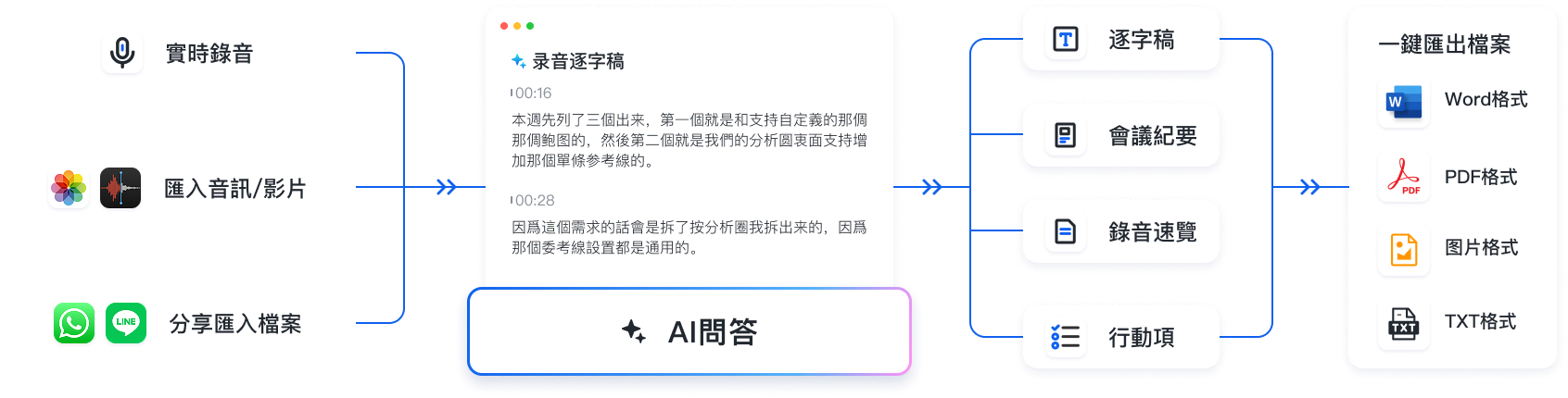
In contrast, Tinrec takes a different approach. It doesn't just call open-source models for transcription; it builds a complete workflow of "recording → understanding → action." In tests, Tinrec not only accurately recognizes Traditional Chinese and professional terminology but also automatically distinguishes speakers and extracts concrete "to-do lists" and "meeting conclusions" from messy conversations—key value that open-source models lack.
Practical Tutorial: How to Complete the Conversion from Recording to Action Items in Three Steps?
No matter which tool you choose, an efficient workflow is crucial. Using Tinrec as an example, we show how to use a modern tool to complete in 3 minutes what traditionally takes 1 hour of meeting organization. (Note: Open-source tools would require writing similar workflows; here we demonstrate standard operation logic of a mature product.)
Step 1: Multi-Source Audio Import and Real-Time Transcription
No need to manually upload large files; modern tools should support multiple input methods:
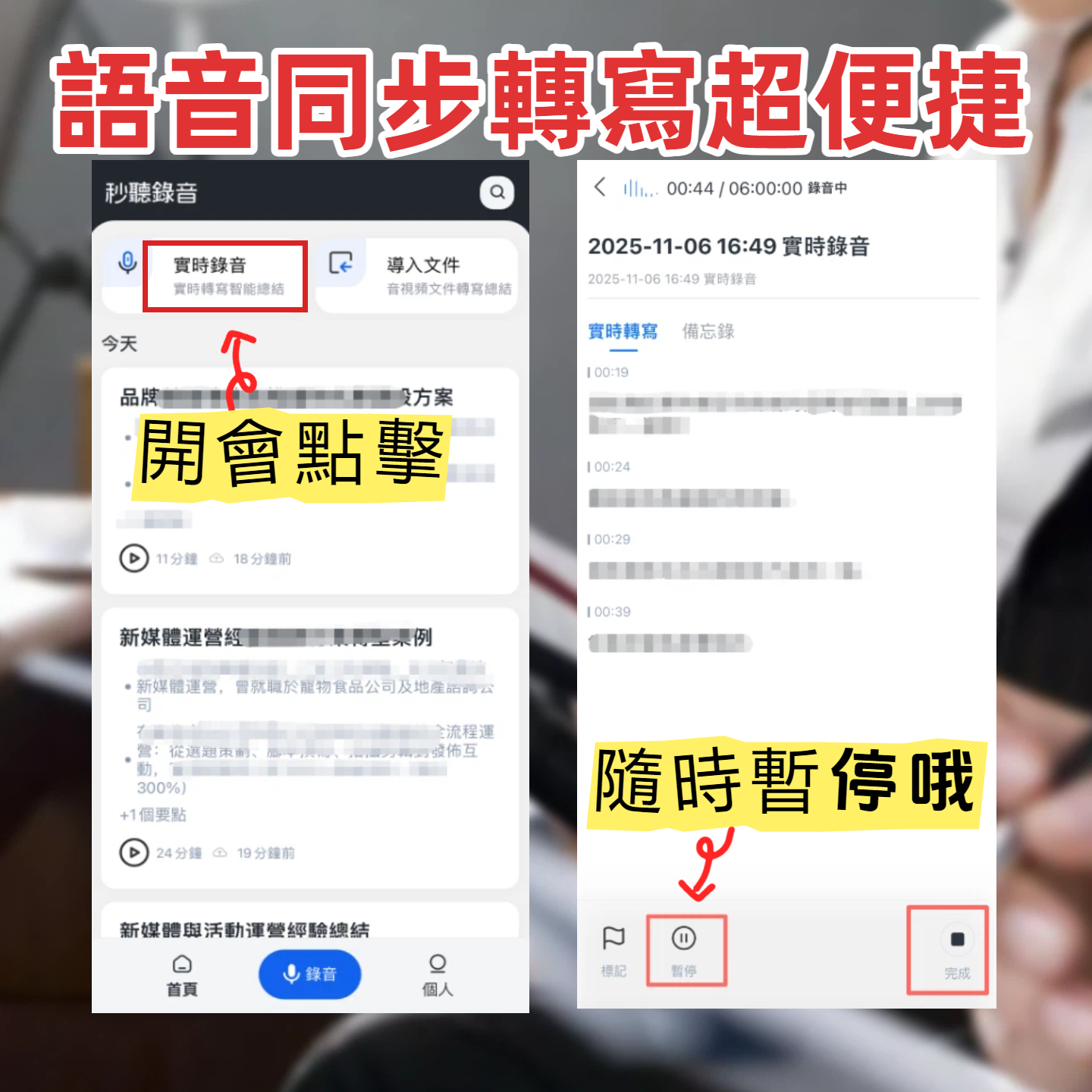
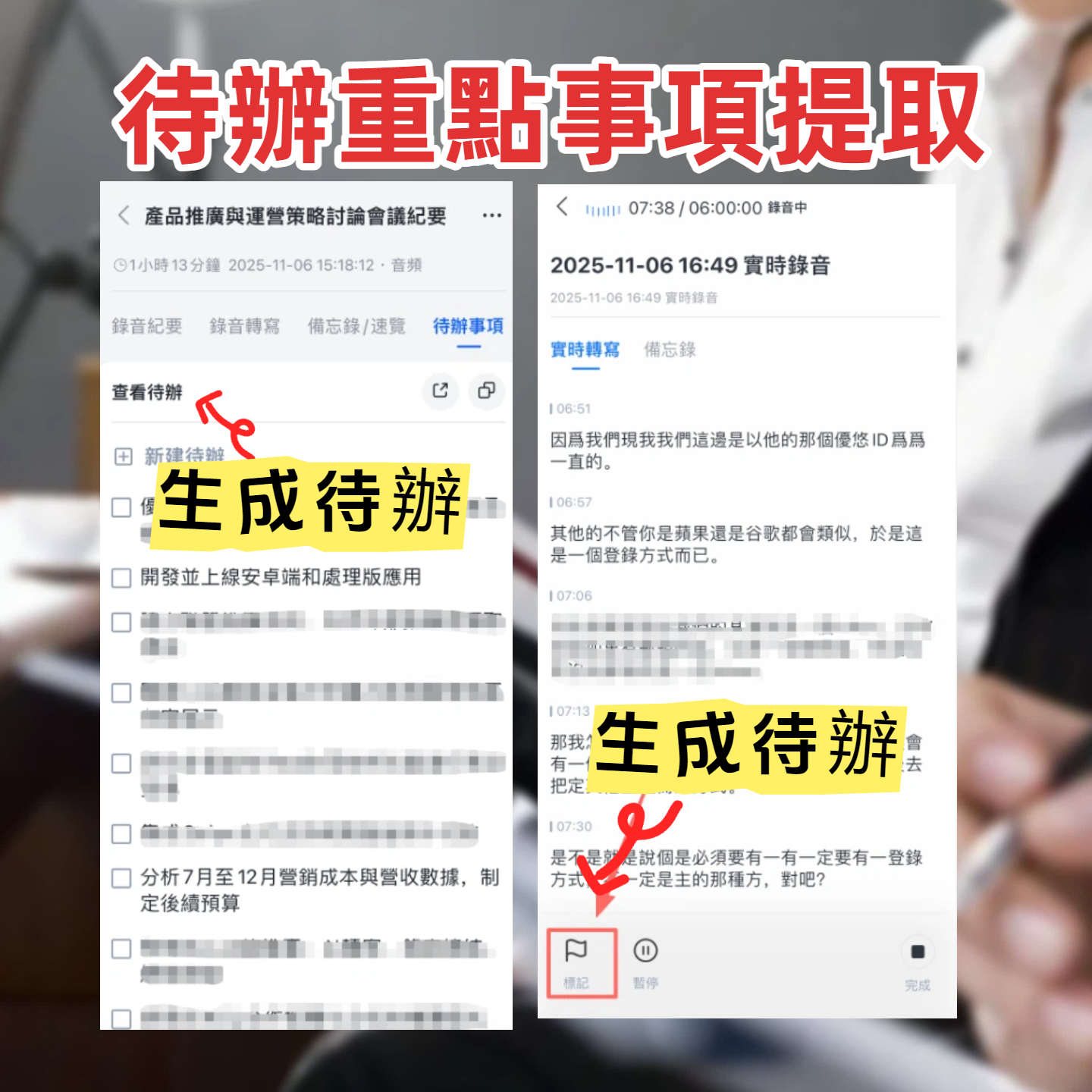
- Real-time Recording: Open the mobile or web app, tap the record button, and the system will transcribe speech to text in real time with timestamps.
- Audio File Upload: Drag and drop existing audio files (e.g., .m4a, .mp3, .wav) into the interface for automatic queued transcription.
- Video Link Parsing: Paste a YouTube or podcast link directly, and the system automatically fetches the audio track and transcribes it.
Step 2: AI Smart Summarization and Action Item Extraction
After transcription, don't rush to read the full text. Use the built-in AI engine:
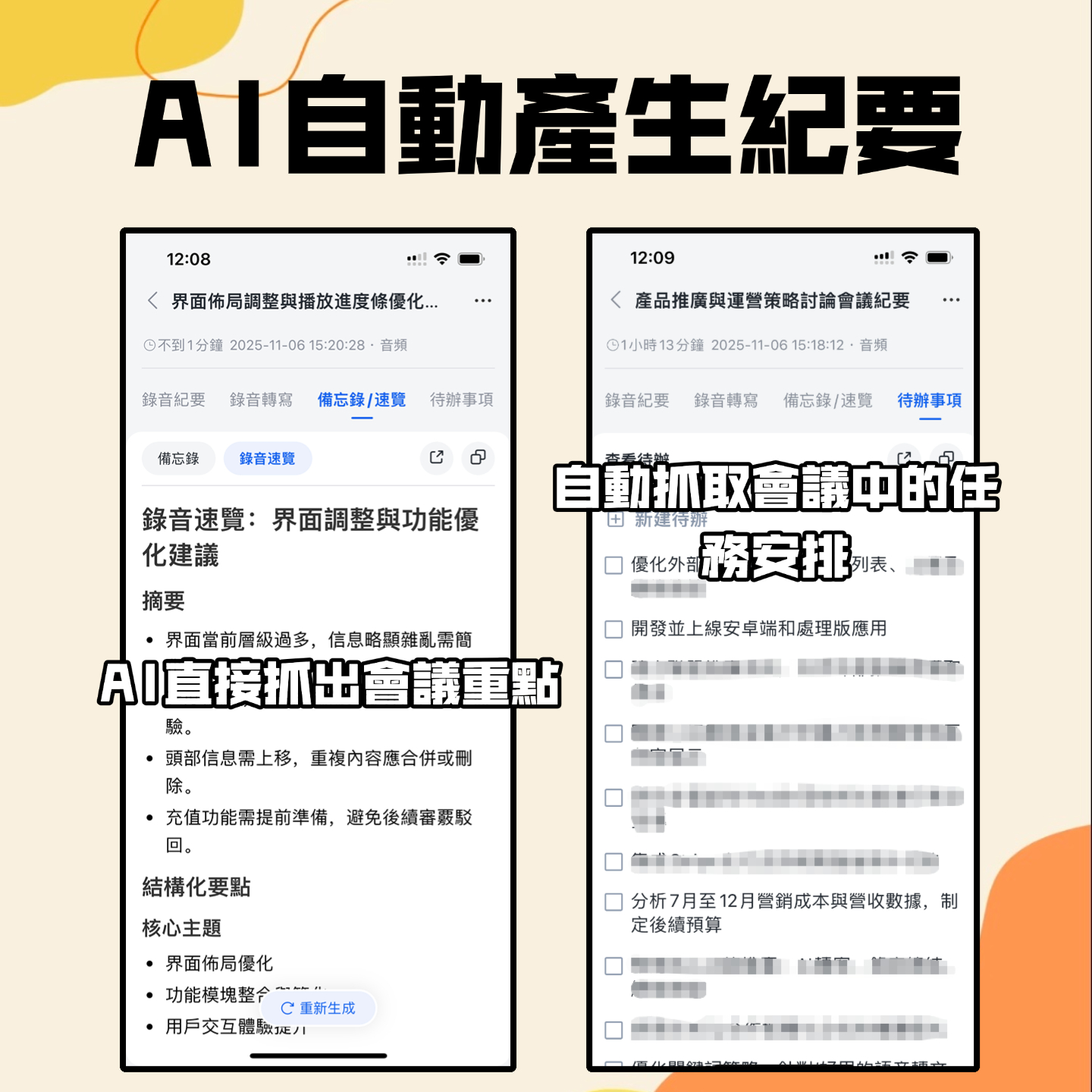
- Click "Generate Summary" and the system will automatically summarize the meeting key points.
- Check the "To-Do" section; the system will identify sentences like "Please submit the report by next Friday" and automatically list them as tasks.
- Review "Decisions & Conclusions" to quickly grasp the meeting output.
Step 3: Query Key Information via AI Conversation
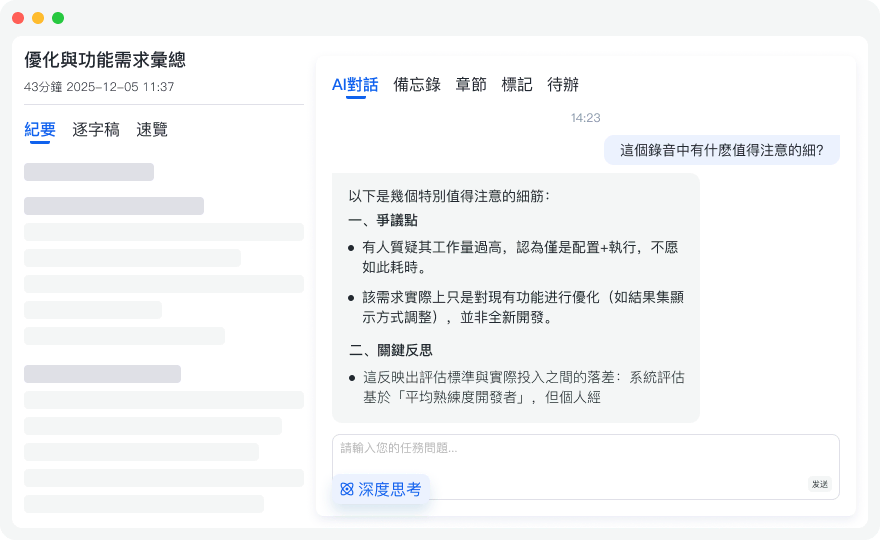
This is the biggest differentiator between traditional open-source models and modern tools. Instead of using Ctrl+F to painfully search for keywords, you can directly "ask" the recording content:
- Input question: "What was the boss's final decision on the budget adjustment?"
- System responds: directly provides the answer paragraph with a link to the original recording timeline.
- This "semantic search" capability allows you to quickly uncover hidden information in recordings as if talking to a real person.
Decision Tree Recommendation: Open Source or Commercial Tool?
To reduce your decision difficulty, follow the logic below:
Do you need to embed speech recognition into your own software product?
- Yes → Choose OpenAI Whisper or Faster Whisper (requires development team).
- No → Go to the next question.
Must your data never leave the local device (e.g., classified meetings)?
- Yes, and using Mac → Choose MacWhisper.
- Yes, but using Windows/Android → Need to set up a local Whisper service (high barrier).
- No (can accept cloud encryption processing) → Go to the next question.
Do you need automatic generation of "meeting minutes," "to-do lists," and support for "semantic Q&A"?
- Yes, and want out-of-the-box → Strongly recommend Tinrec. Its understanding of Chinese context and workflow integration saves significant manual organization time.
- Yes, but with ample budget and prefer international interface → Consider Notta or Otter.ai (note Chinese support level).
- No, only need plain text transcript → Consider TurboScribe or free-tier MyEdit.
Tinrec's Target Audience and Limitations
- Best for: Professionals, students, and media workers who frequently process Chinese meetings, interviews, and lectures. Especially those tired of "replaying recordings" and "manually writing to-dos."
- Not suitable for: Users who need to work completely offline (due to cloud AI computation), or algorithm engineers who need deep customization of model parameters.
Frequently Asked Questions (FAQ)
1. Does the open-source Whisper model support Traditional Chinese? How is the accuracy?
Yes, OpenAI Whisper natively supports Traditional Chinese and has very high accuracy on general corpus. However, in specific domains (e.g., medical, legal) or with heavy accents, fine-tuning may be needed for best results, which is difficult for general users.
2. What are the main differences between Tinrec and directly using open-source models?
Open-source models (like Whisper) only provide the basic "speech-to-text" capability, outputting a large block of text without punctuation or speaker distinction. Tinrec adds speaker diarization, automatic paragraphing, keyword extraction, meeting summarization, and AI conversation querying, packaging these into an easy-to-use interface requiring no programming knowledge.
3. Is there a completely free and unlimited speech-to-text tool?
Pure open-source models (like Whisper) are free as software, but running them requires expensive hardware (GPU) or cloud server costs. Most online tools use a "free quota + paid subscription" model. For example, Tinrec offers a monthly free quota for basic use, with upgrades available for more—this is a necessary business model to maintain service stability and computing power.
4. My meetings are on Teams or Google Meet. How do I transcribe them?
You can use the system's "internal audio recording" feature, or download the recording after the meeting and upload it to the tool. Some tools (like Tinrec) also support recording with your phone nearby and transcribing in real time. For open-source solutions, you need to capture system audio yourself and write scripts for batch processing.
5. Are there any good speech-to-text apps for iPhone?
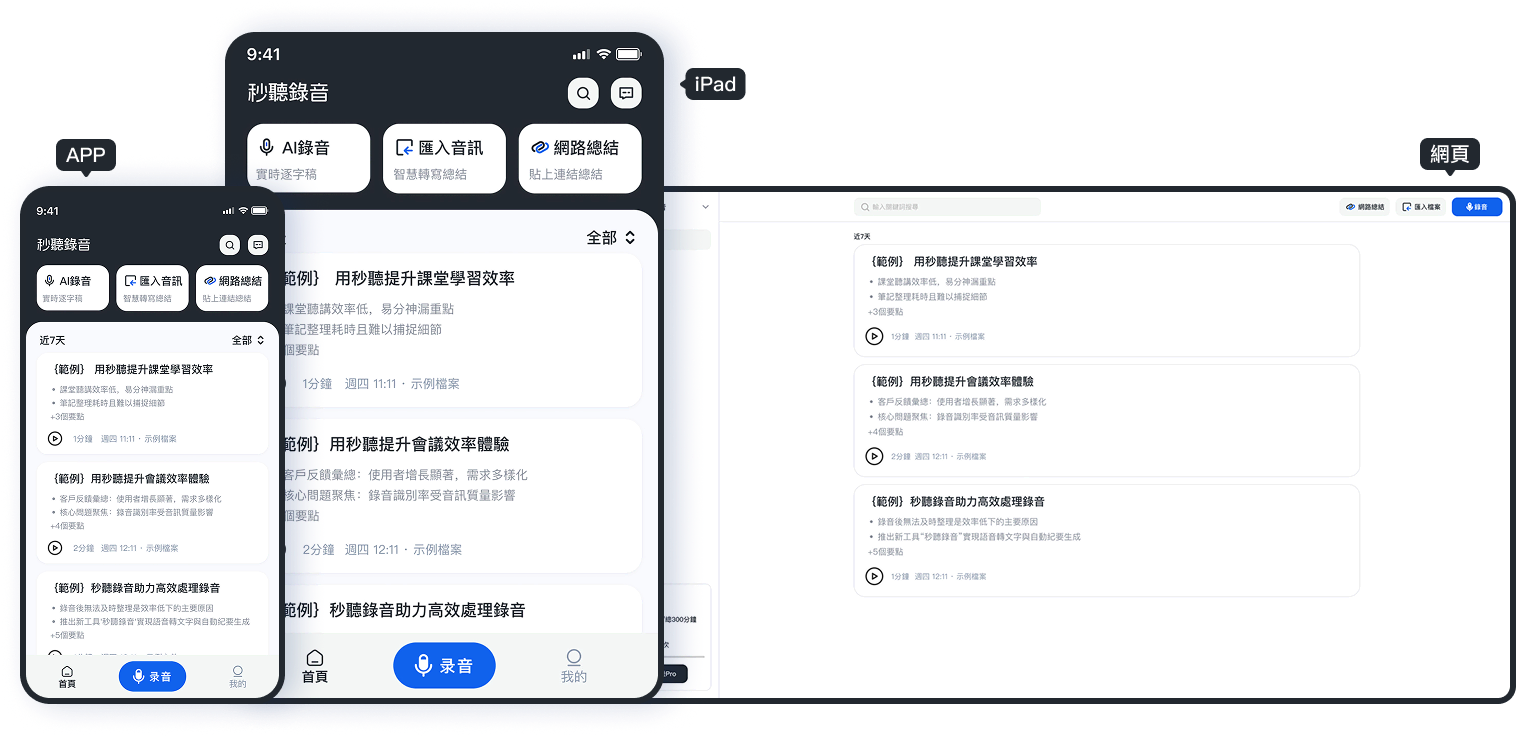
There are many options, but many are limited to Simplified Chinese or English. Tinrec offers a full iOS app that perfectly supports Traditional Chinese, Taiwanese Hokkien, and Cantonese recognition, and syncs data with the web version, making it ideal for mobile work and classroom note-taking.
6. If I don't know programming, can I use Faster Whisper?
It's difficult. Faster Whisper is primarily a backend library designed to improve inference speed and usually requires command-line or Python code to call. Unless you can find a third-party GUI tool built on it (like some locally deployed GUI tools), it's recommended to choose a mature commercial product to save time.
Turn every recording into actionable outcomes
Get 60 free transcription minutes when you sign in. No credit card required.
Related Reading
You might also like
2026 Mac Recording-to-Text App Comparison: Which AI Meeting Notes Really Save Time?
Apple's built-in Voice Memos makes recording easy, but it can't transcribe audio. This article hands-on tests Tinrec, Otter.ai, and Notta, covering accuracy, AI summaries, cross-platform support, and free plans, to help you find the best fit for meetings, classes, and interview notes.
iPhone Voice-to-Text Test in 2026: Built-in Dictation vs. Apps Compared, This AI Q&A App Made Note-Taking 3x Faster
A college senior tested iPhone voice-to-text methods, from built-in dictation to third-party apps. See how Tinrec’s free plan saved 3 hours of note-taking time per week, plus a pitfall guide and student-focused buying advice.

iPhone 17 Screen Recording Free Options in 2026: 5 Tools Reviewed
How to screen record on iPhone 17? This article covers built-in screen recording, Dual Capture tips, and recommends tools like Tinrec to transcribe audio from recordings, from free to paid options.
Best AI Meeting Recorder Tools in 2026: Automatic Summaries, Action Items, and Multi-Source Organization
Looking for an AI meeting note tool but not sure where to start? This article reviews 6 top solutions—from automatic summaries and action items to cross-platform collaboration—and shows you how to save up to 80% of your meeting note time with the right tool.
2026 Free AI Meeting Notes Tools Buyer's Guide: 2 Hands-On Reviews and Practical Tips
Don't want to spend money on hardware but still want to use AI to organize meeting recordings? I actually compared Tinrec, a pure software tool that provides instant recording, with Plaud Note, which integrates hardware. From free plans, recording sources, post-processing capabilities, to cross-platform flexibility, this guide helps you find the best free AI meeting notes solution for your needs.
iPhone Call Recording in 2026: Do You Still Need Tinrec? 3 Reasons to Convince You
iPhone's built-in call recording in iOS 18.1 is handy, but organizing recordings still takes time. This article shows how Tinrec turns call recordings into searchable notes, summaries, and to-dos to boost learning and work efficiency.

2026 Hands-On Comparison of 4 Computer Recording Tools: More Than Just Recording, They Help You Organize Key Points
Struggling to organize your computer recordings after capturing them? This test of 4 computer recording tools — from free options to AI-powered organization — helps you find the most suitable solution.

2026 Complete Guide to AI Meeting Minutes: Auto-Generated Transcripts and Action Items to Double Meeting Efficiency
Still wasting time on meeting minutes? This article shows how to use AI recording tools to auto-generate transcripts, summaries, and action items, with hands-on comparisons of Tinrec, Notta, Otter.ai and more to help you pick the best solution.

2026 iPhone Screen Recording with Audio: 2 Methods Compared — Is the Built-in Feature Good Enough?
Can iPhone screen recording capture audio? This hands-on comparison tests the built-in screen recorder against two third-party apps, showing how to record system sounds and ambient sound, and explains the common causes of no-audio issues and how to fix them.