
Turn recordings into transcripts and summaries in minutes
Upload audio or video for multilingual transcription, AI notes, and action items
Speech-to-Text GitHub Projects Too Hard to Use? Check Out These 6 Alternatives
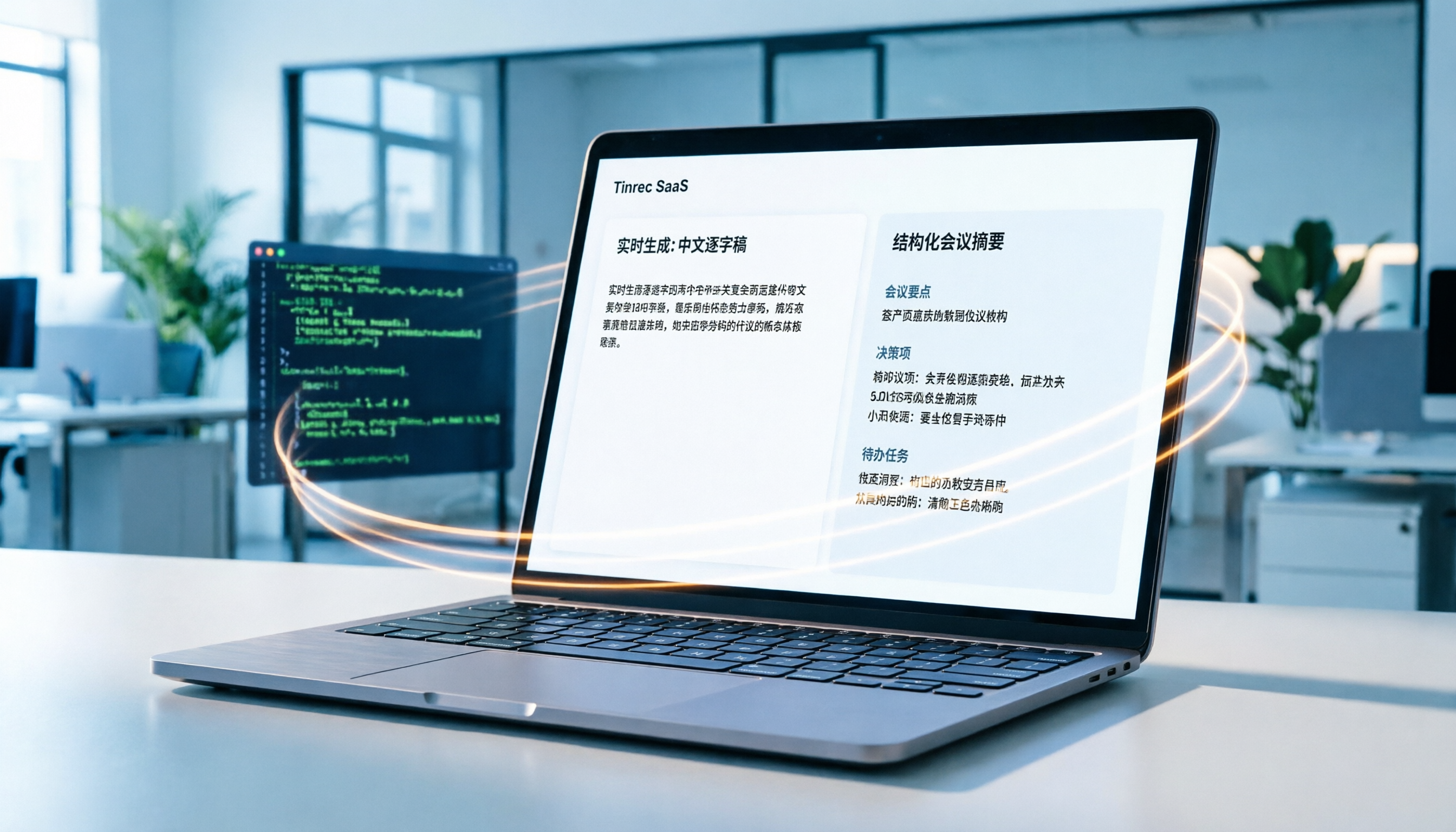
Many developers and tech enthusiasts searching for speech-to-text solutions often start with speech-to-text GitHub, hoping to find powerful open-source models like OpenAI Whisper. However, the reality is: while open-source models are free and powerful, they require setting up the Python environment, GPU acceleration, and downloading model weights. For non-technical users or professionals seeking an out-of-the-box solution, the time cost is extremely high.
If you don't want to deal with code but still need high-precision Chinese transcription and meeting summaries, Tinrec (Second Listen Recorder) is a modern option worth considering. It is based on advanced speech recognition technology but packages the complex underlying logic into a simple interface. Especially in Chinese contexts, its recognition rate and subsequent AI organization capabilities outperform many tools that only provide raw transcripts.
This article covers:
- Why do most people eventually abandon open-source GitHub solutions? (Pain point analysis)
- Comparison of 6 mainstream speech-to-text tools (including Tinrec, Whisper, Otter.ai, etc.)
- Tinrec hands-on tutorial: How to go from recording to generating action items in just a few steps
- FAQ: Address common concerns about iPhone recordings, Teams meetings, etc.
Quick Navigation Conclusion:
- Privacy-conscious and tech-savvy → Choose OpenAI Whisper or Faster Whisper (requires self-deployment).
- Mac users preferring local operation → Choose MacWhisper.
- High Chinese accuracy, meeting summaries, and cross-platform sync → Prioritize Tinrec.
- Primarily English meetings → Consider Otter.ai.
Why Open-Source Speech-to-Text GitHub Projects Aren't for Everyone?
Searching GitHub for speech-to-text or whisper yields thousands of projects. While most boast "free" and "high accuracy," practical use often hits three major pain points:
1. High environment setup barrier
Most quality projects (e.g., Faster-Whisper) require installing Python, PyTorch, or CUDA. For non-programmers like marketers, administrative assistants, or students, resolving dependency conflicts can take hours and even crash the system.
2. Lack of "post-processing" capabilities
Open-source models typically output only "raw text transcripts." However, the workplace needs not just text but "structured information." For example: who said what? What are the meeting conclusions? What are the action items? Basic GitHub models don't automatically summarize, requiring manual organization.
3. High hardware resource consumption
Running high-precision Whisper Large models locally usually requires a dedicated NVIDIA GPU. While MacBooks with M-series chips can run it, they consume significant memory and battery, affecting other tasks.
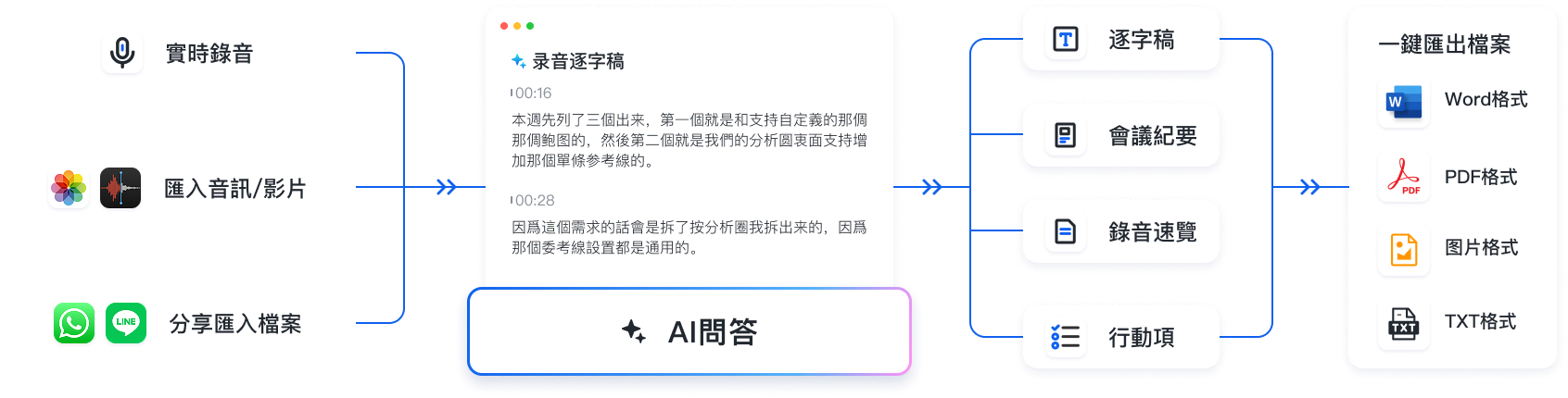
In contrast, cloud-based SaaS tools like Tinrec offload computing to servers, letting users focus on content, enabling a complete workflow from "recording" to "understanding" to "action," greatly lowering the barrier.
In-Depth Comparison of 6 Speech-to-Text Tools: Tinrec vs. Whisper vs. Others
To help you choose, we compare the most representative 6 tools on the market, covering open-source models, local apps, and cloud services.
| Dimension | Tinrec (Second Listen Recorder) | OpenAI Whisper (GitHub) | MacWhisper | Otter.ai | Notta | TurboScribe |
|---|---|---|---|---|---|---|
| Core Positioning | AI recording assistant & meeting minutes | Open-source speech recognition model base | Mac local Whisper client | Real-time English meeting transcription | Multi-language online transcription | Cost-effective online transcription |
| Chinese Accuracy | ⭐⭐⭐⭐⭐ (Optimized well) | ⭐⭐⭐⭐ (Depends on model) | ⭐⭐⭐⭐ (Depends on model) | ⭐ (No Chinese support) | ⭐⭐⭐ (Stability average) | ⭐⭐⭐⭐ |
| Deployment Difficulty | None, register and use | High (requires coding environment) | Low (Mac App) | None | None | None |
| AI Summary/Action Items | ✅ Auto-generates minutes & To-Do | ❌ Requires extra LLM integration | ❌ Text only | ✅ Supports English summaries | ✅ Supports summaries | ❌ Text only |
| AI Chat Query | ✅ Supports semantic Q&A | ❌ Not supported | ❌ Not supported | ✅ Supports English Q&A | ❌ Not supported | ❌ Not supported |
| Cross-Platform Support | iOS, Android, Web | All platforms (requires compilation) | macOS only | Web, iOS, Android | Web, iOS, Android | Web |
| Pricing/Free Tier | Free: 100 min/month | Fully free (hardware cost) | Paid license/subscription | Limited free tier | Limited free tier | Free trial then paid |
Stop organizing recordings by hand
Upload audio or video and automatically get a transcript, summary, and action items
Key Difference Analysis
- Tinrec vs. OpenAI Whisper: Whisper is an underlying engine, while Tinrec builds on similar technology with application-level optimizations. Tinrec adds "speaker separation," "AI summarization," "multi-language auto-detection," and "AI chat query," solving the "what to do after transcription" problem.
- Tinrec vs. Otter.ai: Otter.ai dominates the English market but has poor Chinese support. If your meetings include Chinese, Taiwanese, or Cantonese, Tinrec is a better choice.
- Tinrec vs. MacWhisper: MacWhisper suits Mac users who insist on "data staying local," but lacks seamless sync on iPhone or Windows. Tinrec offers multi-device sync, ideal for hybrid scenarios like recording on phone and editing on computer.
Tinrec Hands-On Tutorial: From Recording to AI Query
If you decide to try a more efficient workflow, here are four core scenarios for using Tinrec to process voice content. Whether it's live meetings, old recordings, or online video learning, it's easy.
Scenario 1: Live Meeting/Classroom Recording to Text
Suitable for: In-person meetings, class notes, interview recordings.
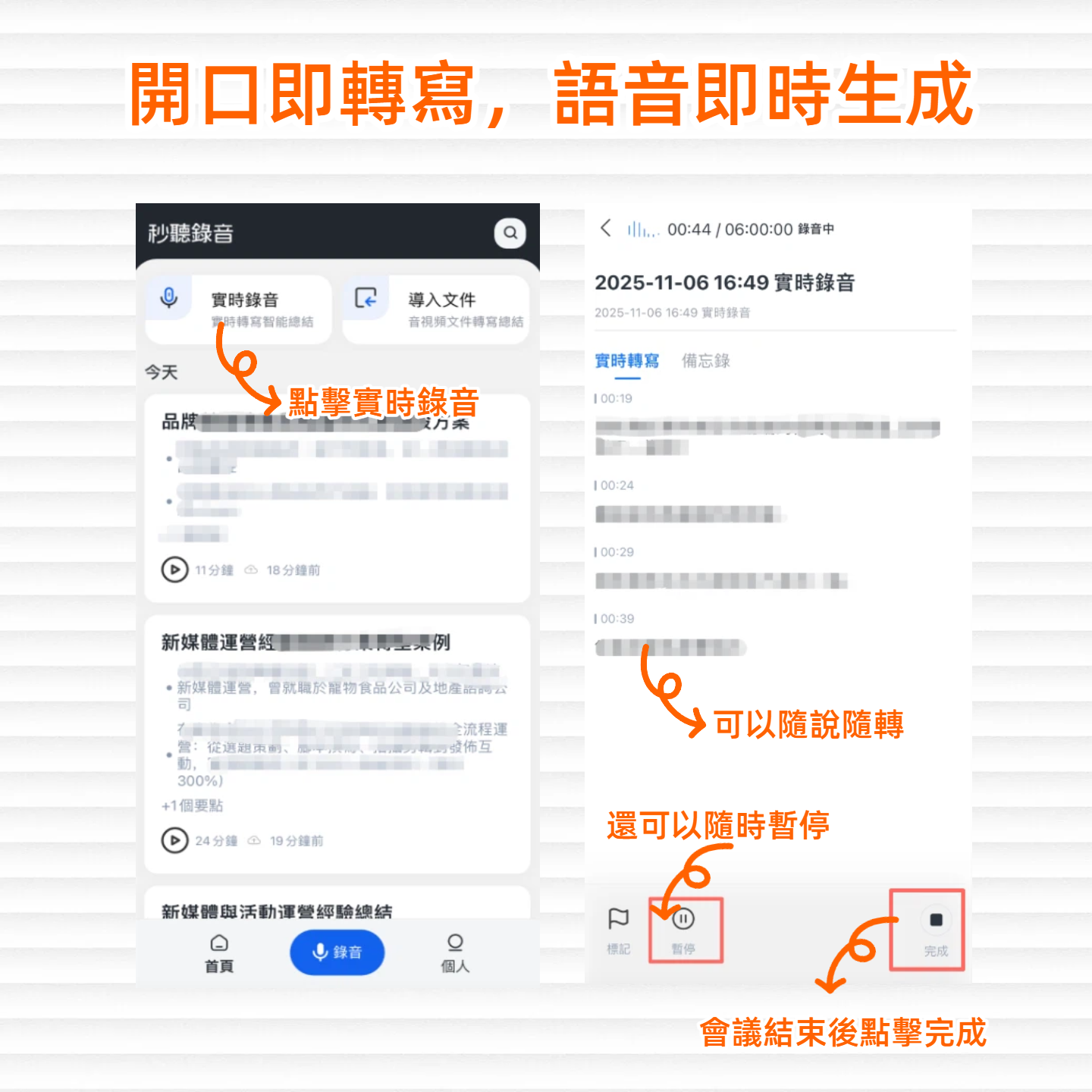
- Start live recording: Open the Tinrec app or web version, tap "Record & Transcribe Live."
- Begin recording: Tap to start; the system transcribes speech to text in real-time. You can mark important moments.
- Auto-generate minutes: After recording ends, AI processes the audio to generate a transcript, meeting minutes, and action items.
- View results: In the details page, you see a structured meeting summary instead of a wall of text.
Scenario 2: Upload Existing Audio Files
Suitable for: Organizing past voice recordings, Line voice message backups.
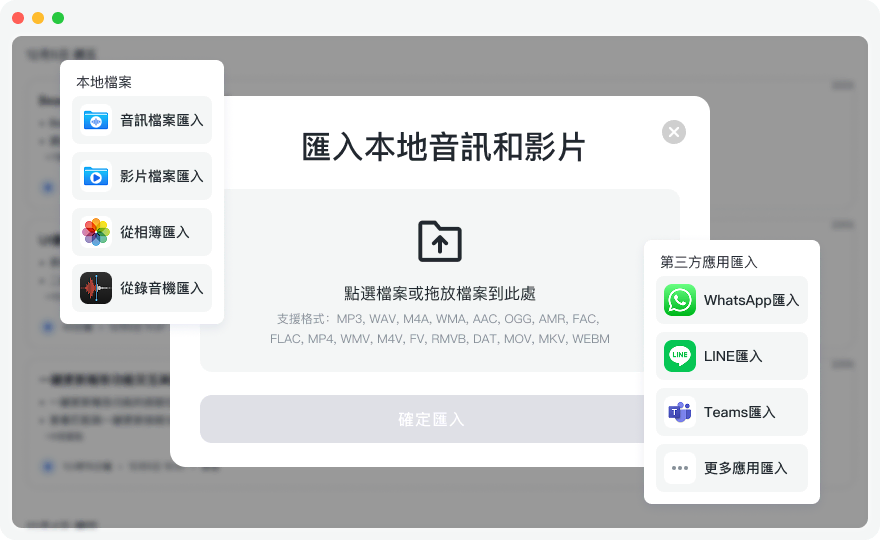
- Upload entry: Choose "Audio File to Text."
- Import file: Supports MP3, WAV, M4A, etc., upload from phone or computer.
- Wait for processing: The system transcribes in the cloud; you can close the page and get notified when done.
- Edit and export: Check transcript accuracy, correct proper nouns, then export as Word or TXT.
Scenario 3: YouTube/Podcast Video to Text
Suitable for: Content creators organizing material, students learning online courses.
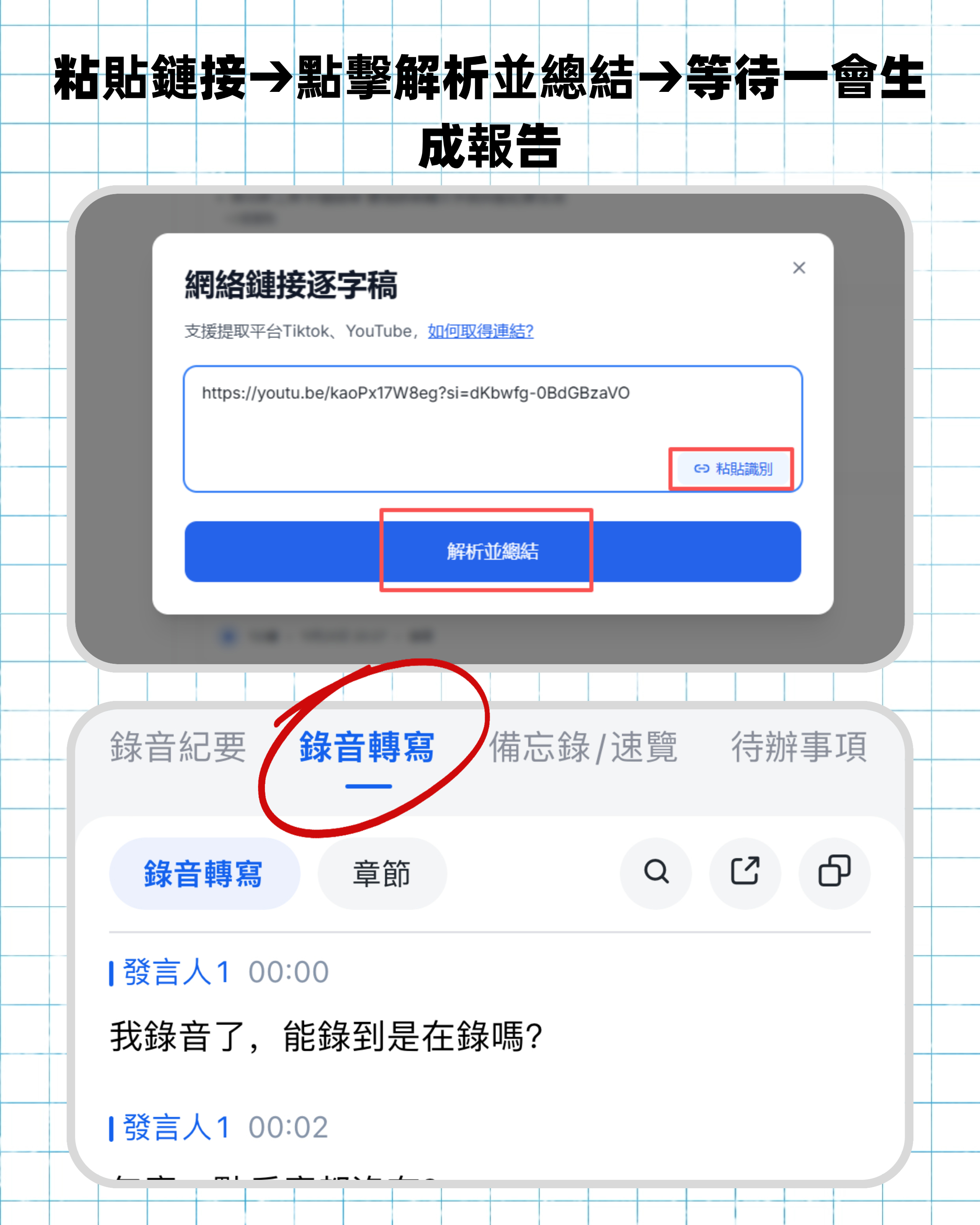
- Copy link: Copy the video URL from YouTube or a podcast platform.
- Paste to parse: In Tinrec, select "Podcast/Online Video to Text" and paste the link.
- Get transcript: The system auto-extracts the audio track and transcribes, also generating a video content summary.
- Use material: Directly copy key passages for article writing or note-taking.
Scenario 4: Use AI Chat Query for Key Content
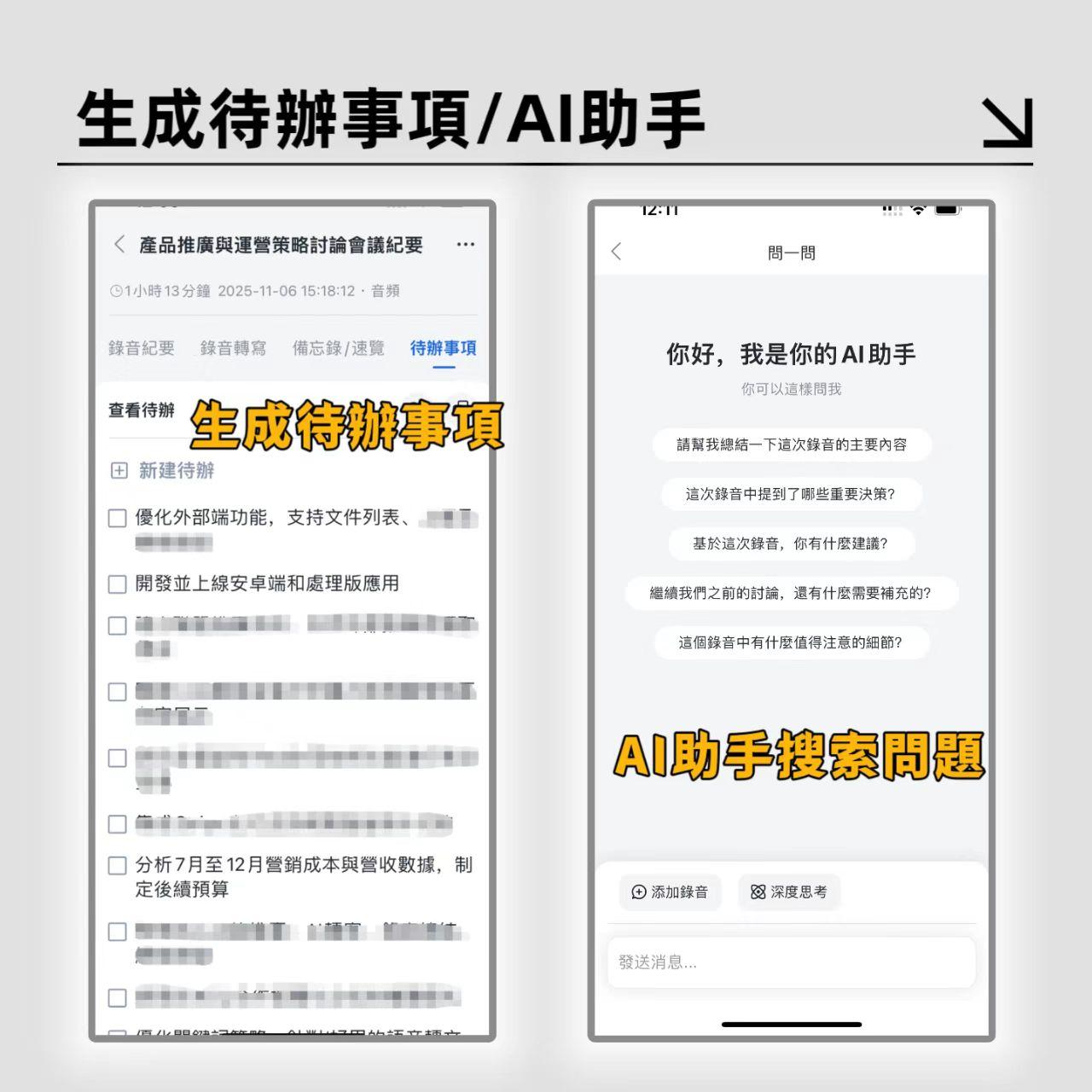
This is the biggest differentiator between Tinrec and traditional tools. No more Ctrl+F searching for keywords.
- Open AI chat: In a transcribed record, tap "AI Chat Query."
- Ask in natural language: For example, "What was the conclusion about the budget in this meeting?" or "What are the main pain points the customer mentioned?"
- Get precise answer: AI synthesizes the answer from the recording content and marks the timestamp source.
- Verify and cite: Tap the citation marker next to the answer to jump to the corresponding audio segment for verification.
FAQ: About Speech-to-Text and Tinrec
Q1: What languages does Tinrec support? Is Chinese recognition accurate?
Tinrec supports automatic recognition of 10 languages including Mandarin Chinese, English, Japanese, Korean, German, Taiwanese Hokkien, Cantonese, and more. It is specifically optimized for Chinese contexts, offering better accuracy than many international tools for meetings with technical jargon or Chinese-English mixing.
Q2: Compared to OpenAI Whisper on GitHub, what advantages does Tinrec have?
Whisper is a model requiring users to build the service, handle audio preprocessing, and text organization. Tinrec provides a complete product experience including multi-device sync, speaker separation, AI auto-summarization, action item extraction, and AI Q&A, saving time on technical maintenance and post-processing.
Q3: Can I record directly on iPhone or Android and transcribe?
Yes. Tinrec offers iOS and Android apps that support real-time recording and transcription. This is more powerful than the built-in dictation feature because it handles long recordings and generates structured summaries afterward, not just real-time text input.
Q4: Can it handle online meeting recordings from Teams or Google Meet?
Yes. You can use Tinrec's live recording feature to capture audio while playing the meeting on your computer (recommend using a virtual audio cable or external microphone), or upload the downloaded meeting recording file for transcription and summarization.
Q5: Does Tinrec have a free plan? What are the limits?
Tinrec offers a free version with up to 100 minutes of transcription per month. For light users or those wanting to test the tool, this is enough to experience core features. For heavier use, upgrade to Basic or Pro plans.
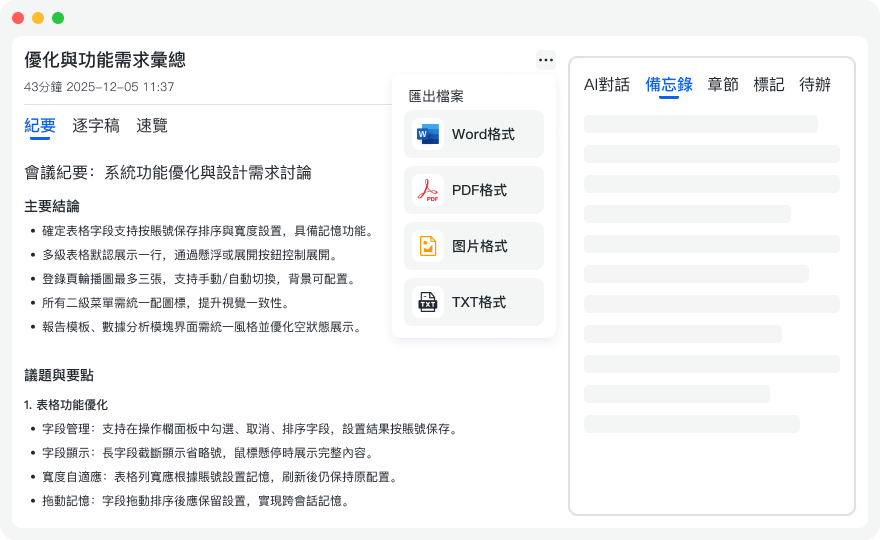
Q6: Can I export the generated transcript? What formats are supported?
Yes. You can export transcripts and meeting minutes as TXT, Word, or PDF files, making it easy to integrate into your workflow or archive.
Summary: The Key to Choosing a Tool Lies in "Post-Transcription Value"
Users searching for "speech-to-text GitHub" essentially want high-quality, low-cost transcription. However, as AI applications mature, "accurate transcription" is now table stakes. The real competitive edge lies in what happens after transcription.
- If you're a developer who enjoys tinkering with code, OpenAI Whisper remains a powerful foundation.
- If you're a professional, student, or creator needing results, Tinrec's "Record → Understand → Act" workflow compresses what used to take hours of manual work into just a few minutes of review.
We suggest using Tinrec's free tier to upload a 10-minute meeting recording or course video, experience the efficiency gains from AI summaries and chat queries, and then decide if it earns a spot in your long-term toolkit.
Turn every recording into actionable outcomes
Get 60 free transcription minutes when you sign in. No credit card required.
Related Reading
You might also like

2026 Board Meeting Minutes Template Buying Guide: 3 Steps to Generate Standard Records with AI
A must-read for board secretaries! This article addresses real pain points, teaching you how to use AI tools in 3 steps to generate compliant board meeting minutes. Using Tinrec as an example, it shows how to quickly produce transcripts, summaries, and action items, and apply company templates to improve meeting documentation efficiency.

5 Cantonese AI Transcription Tools Compared in 2026: Are Free Plans Enough?
Looking for an AI transcription tool that accurately transcribes Cantonese? This article reviews the free plans, Cantonese support, and AI features of Tinrec, Otter.ai, Notta, TurboScribe, and Google Docs to help you choose the best option.

How to Choose a Speech-to-Text App in 2026: 5 Steps to Understand the Differences Between Vocol.ai and Tinrec
Looking for a speech-to-text tool? This article walks you through 5 steps to compare Vocol.ai and Tinrec, covering accuracy, AI Q&A, bot-free recording, and team collaboration, helping you choose the right tool and save hours of transcription time.

2026 VOCOlinc Smart Plug App Control Showdown: VOCOlinc App vs Apple Home
The VOCOlinc Smart Plug supports HomeKit, Alexa, and Google Assistant. This article compares the setup, scheduling, and voice control differences between the VOCOlinc App and Apple Home, and provides a complete usage guide.

Best Online Transcription Tools in 2026: We Tested 5, and Tinrec Wins for Chinese Meetings
Still manually transcribing meeting recordings? This article tests 5 online transcription tools, including Tinrec, Vocol.ai, Otter.ai, and Notta, comparing Chinese meeting support, free tiers, AI summaries, and team collaboration to help you choose the best fit for your workflow.

2026 Review of 3 AI Meeting Note Tools: How Tinrec Saves You Time on Meeting Notes?
Starting from common recording pitfalls, this hands-on review of Tinrec, an AI meeting notes tool, covers bot-free recording, summaries, action items, AI Q&A, and team collaboration, along with buying tips and FAQs.

2026 Free AI Voice Tools Compared: Which One Has the Most Complete Meeting Notes Feature?
This article addresses common misconceptions about free AI voice tools, using Tinrec as an example to break down 5 pitfalls when choosing a meeting notes tool and explain which features actually save you time.

2026 Hands-On Comparison of 3 Speech-to-Text Tools: Beyond Vocol's Free Plan, Tinrec Is Worth a Try
This article walks you through the real-world experience of Vocol's free plan and introduces how Tinrec fills the gaps in post-transcription organization, Q&A, and team collaboration.

Which Country Is Vocol From? Which One Is Better? 2026 Hands-On Test of 2 Tools: This Taiwan-Made Option Suits You Better
Vocol.ai is an AI voice collaboration platform developed by Taiwan's Aiello. This article compares Vocol and Tinrec in meeting transcription, post-meeting organization, and team collaboration to help you decide which one fits your needs.