
Turn recordings into transcripts and summaries in minutes
Upload audio or video for multilingual transcription, AI notes, and action items
The Pain of Cross-Language Meetings: Why You Need Smarter Real-Time Translation Tools?
In today's era of remote work, online meetings often come with multilingual communication challenges. Have you ever encountered the following: fatigue from listening to English technical terms, having to re-listen to a one-hour recording just to confirm one decision detail, or missing key action items due to language barriers? The traditional "record + manual notes" model is inefficient and error-prone in high-intensity, multilingual business scenarios.
This article will deeply review 5 mainstream online meeting real-time translation and transcription tools and provide specific selection criteria. We will demonstrate step-by-step how to use new-generation AI tools like Tinrec (Second Listening) to transform lengthy meeting recordings into searchable, actionable structured text, shifting information processing from "passive recording" to "active understanding."
Quick Navigation Summary:
- Prioritize Chinese/Taiwanese recognition accuracy → Choose tools optimized for Asian languages (e.g., Tinrec, Yating Transcript).
- Need full English environment and ecosystem integration → Consider Otter.ai (but note its Chinese support limitations).
- Seek high cost-effectiveness and complete workflow → Recommend evaluating platforms with free tiers and AI summary features (e.g., Tinrec).
- Only need simple subtitles, not meeting analysis → VEED.IO or cSubtitle may be more suitable for video creators.
5 Key Dimensions for Choosing an Online Meeting Translation Tool
Before subscribing, evaluate based on these five core dimensions to avoid buying a tool that is powerful but not suitable.
1. Language Support and Mixed Speech Recognition Capability
Not all tools handle code-switching (mixed Chinese and English) or accented speech well. For teams in Taiwan or Asia-Pacific, it's crucial that the tool supports Chinese (Traditional/Simplified), Taiwanese, Cantonese, and automatic language detection. If a tool only excels in pure English, it may produce many mistranslations in localized meetings.
2. Real-Time Performance and Latency
The core value of real-time translation is reducing communication barriers in the moment. Good tools should display text within seconds of speech, allowing participants to immediately confirm intentions. If latency is too long, it can only be used for post-meeting review, not real-time assistance.
3. AI Summarization and Action Item Extraction
Plain transcripts have very low information density. Modern AI tools should automatically separate speakers and extract meeting conclusions, to-do items, and key decisions from messy conversations. This is key to saving re-listening time.
4. AI Conversational Query (Semantic Search)
Traditional tools only support keyword search (Ctrl+F), but if you forget the exact term, you can't find it. Advanced tools like Tinrec support AI conversational queries based on semantics. You can ask, "What was said about the budget earlier?" and the AI will summarize from context, not just list sentences containing "budget."
5. Export Formats and Integration Flexibility
Check if the tool supports export to Word, PDF, SRT subtitle files, or integration with collaboration platforms like Notion, Slack. Also, the monthly minute limit of free or entry-level plans is a cost consideration for long-term use.
In-Depth Comparison of Popular Meeting Translation Tools in 2026
The following table compares five representative tools on the market, ranging from international giants to localized solutions.
| Dimension | Tinrec (Second Listening) | Otter.ai | Notta | Yating Transcript | MyEdit |
|---|---|---|---|---|---|
| Key Strengths | Great Chinese/multilingual recognition, AI query, high cost-effectiveness | Strong English ecosystem, stable real-time streaming | Supports many languages, intuitive interface | Excellent Taiwanese/local terminology recognition | Rich audio editing features |
| Chinese Support | ⭐⭐⭐⭐⭐ (auto-detect, Traditional/Simplified, Taiwanese) | ⭐ (mainly English) | ⭐⭐⭐ (okay, occasional errors) | ⭐⭐⭐⭐⭐ (excellent) | ⭐⭐⭐ (average) |
| Real-Time Transcription | Yes (real-time recording to text) | Yes (real-time streaming) | Yes | Weak (primarily post-upload processing) | Weak (mainly file processing) |
| AI Features | Meeting minutes, action items, AI query | Meeting summaries, keyword search | Meeting summaries, highlight markers | Basic transcript, paragraph markers | Basic transcription and editing |
| Free Tier | 100 min/month (full features) | Limited minutes (restricted features) | Limited minutes | Few trial minutes | Very limited free minutes |
| Best For | Cross-language meetings, interviews, lecture notes | English-only meetings, Salesforce users | Multinational team meetings | Taiwan local meetings, interviews | Podcast post-production |
Stop organizing recordings by hand
Upload audio or video and automatically get a transcript, summary, and action items
Analysis:
- Although Otter.ai is an international benchmark, its lack of Chinese support greatly reduces its practicality in the Asian market.
- Notta has an advantage in language quantity, but its stability in recognizing Chinese technical terms is sometimes inferior to tools focused on Asian languages.
- Tinrec's differentiation lies in its AI conversational query feature and generous free tier strategy, allowing users to experience the entire process from recording to understanding at a low threshold, especially suitable for professionals who frequently handle Chinese or multilingual content.
- System built-in tools (like Google Live Transcribe, Apple Dictation) can only serve as simple input methods; they cannot save, edit, or generate summaries, and are not recommended as formal meeting recording solutions.
Hands-On Tutorial: How to Efficiently Process Meeting Recordings with Tinrec
This section uses Tinrec as an example to demonstrate how to transform a chaotic online meeting into a clear action list. This workflow applies to in-person meeting recordings, online meeting recordings, or video links.
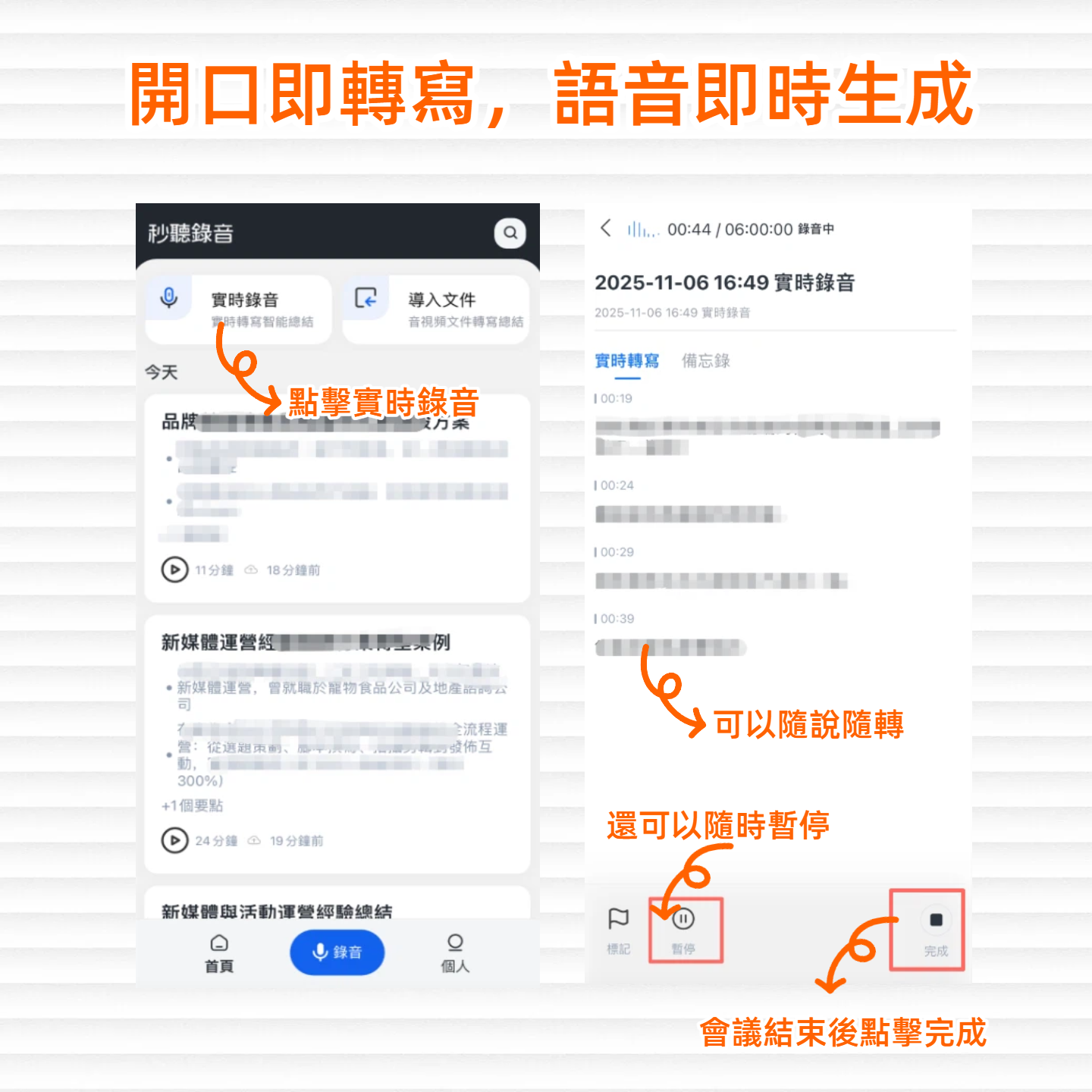
Step 1: Real-Time Recording to Text (For Ongoing Meetings)
If you are in a meeting or about to start a call, use the real-time recording feature.
- Action: Open the Tinrec App or web version, click the "Real-Time Recording" button. Ensure microphone permission is enabled and place the device near the sound source or use internal system recording (if supported).
- Result: The screen will display the transcribed text in real time with automatic timestamps. After the meeting, click stop, and the system will automatically process and generate a summary.
- Note: If ambient noise is high, use an external microphone to improve accuracy. Real-time transcription allows you to quickly scan key points during the meeting to confirm if you missed any information.
Step 2: Audio File to Text (For Post-Meeting Upload)
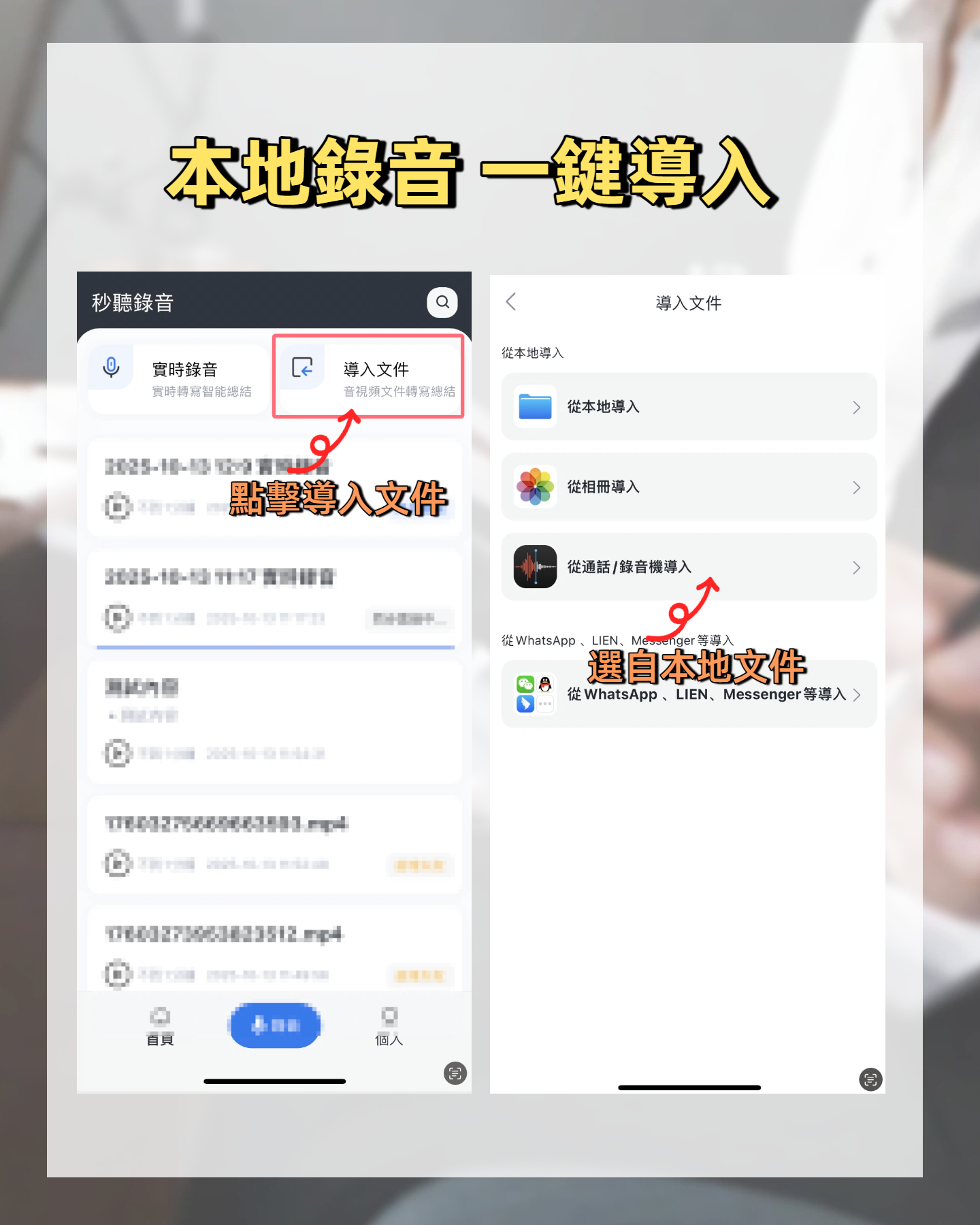
If you already have a meeting recording (e.g., MP3, M4A, WAV), you can upload it directly.
- Action: Go to the "Audio File to Text" page, click upload, select a local file. Supports various common audio formats.
- Result: The system will complete transcription within minutes (depending on file length) and automatically perform speaker diarization.
- Note: Preview the file clarity before uploading. For multi-person meetings, ensure the recording device captures sound evenly from all directions to help AI accurately identify speakers.
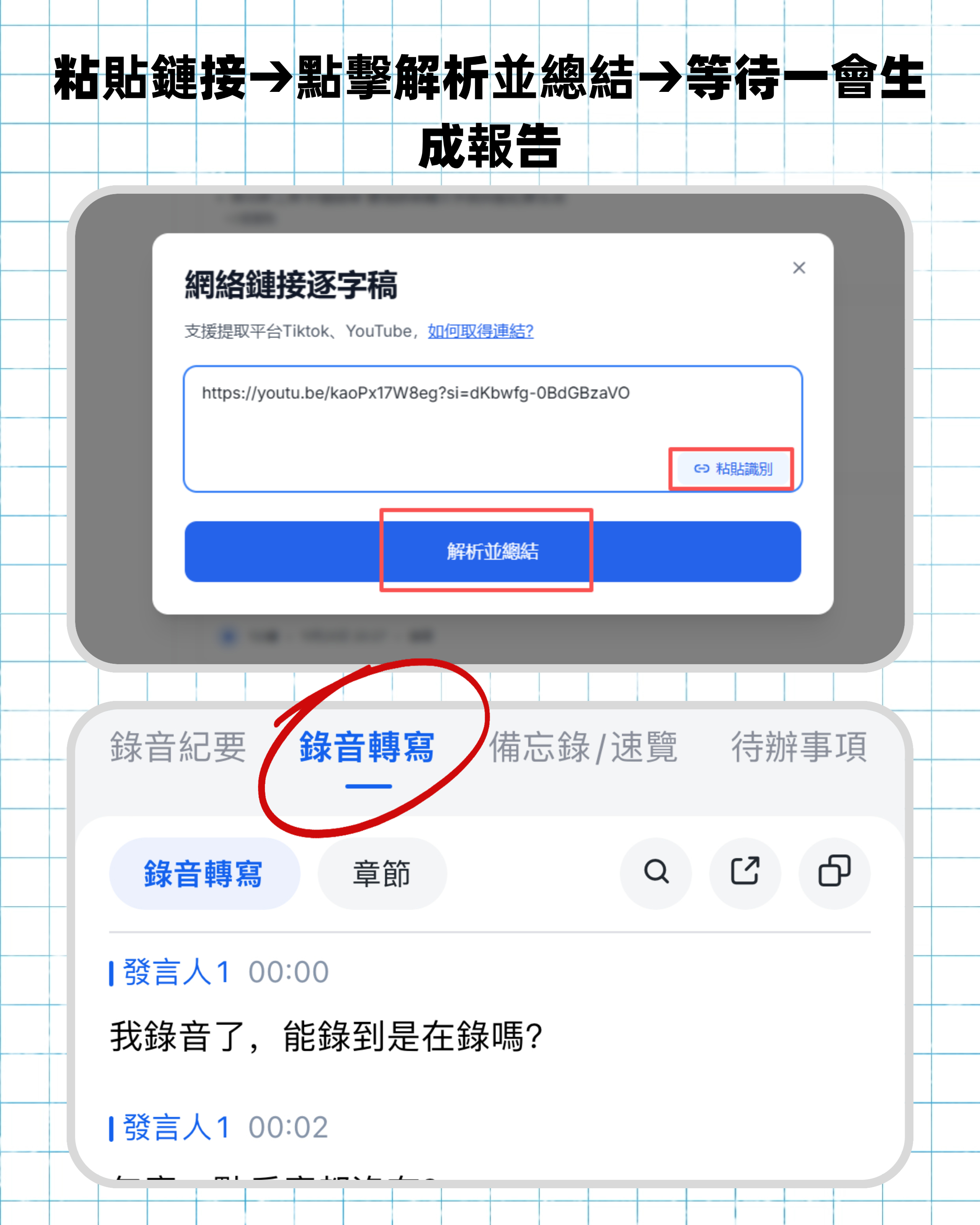
Step 3: Video Link to Text (For YouTube/Podcast Learning)
For online courses or public industry sharing videos, you can extract content without downloading.
- Action: Select the "Video to Text" feature, paste a YouTube or other supported platform video link.
- Result: The system directly extracts the audio track for transcription and generates structured notes for the video.
- Note: This feature is great for self-study and competitor analysis, quickly converting long video content into readable text material.
Step 4: AI Conversational Query and Key Point Extraction
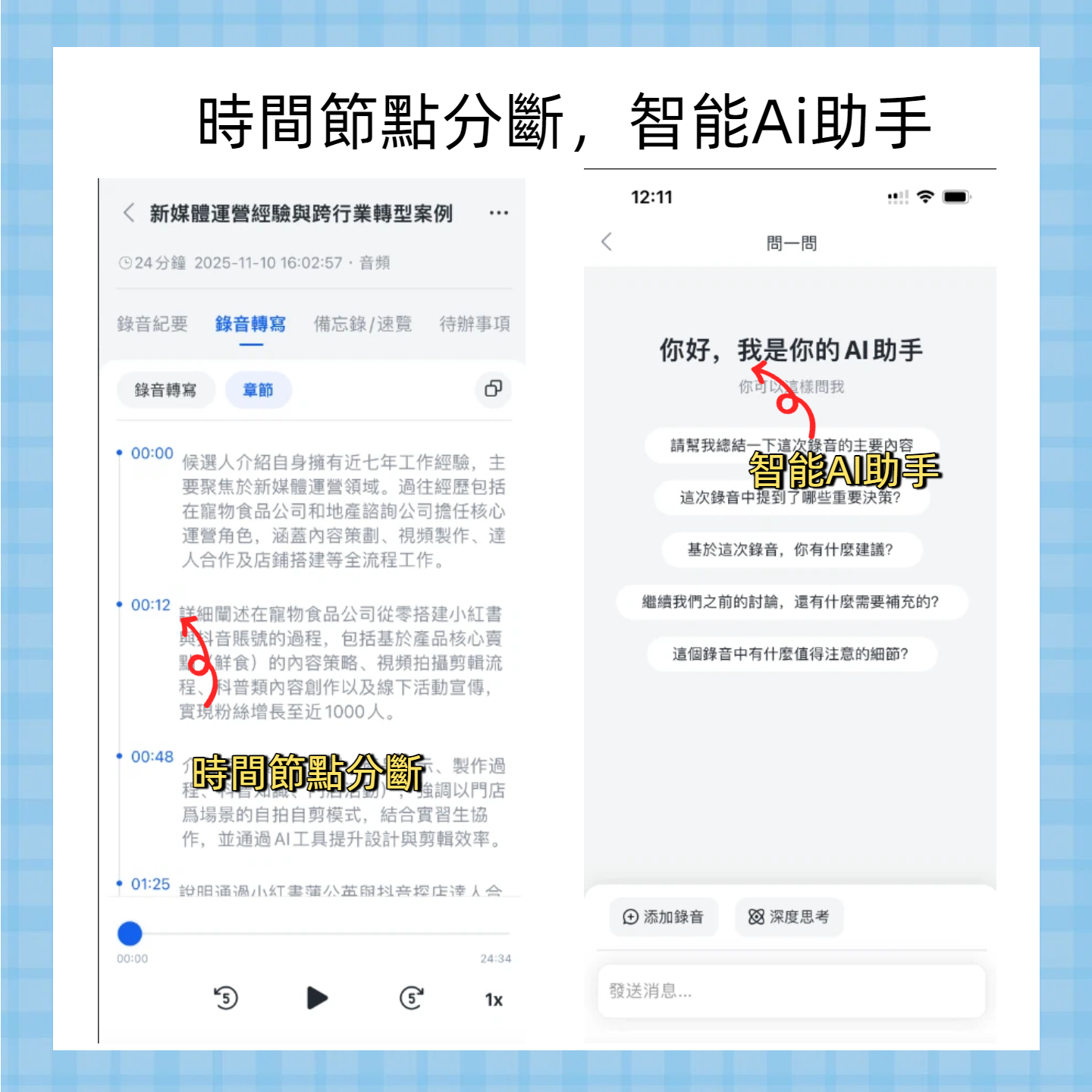
This is the most critical step for efficiency, turning passive reading into active questioning.
- Action: On the transcribed page, find the "AI Conversational Query" or Chat entry. Ask questions like: "Summarize the decisions about marketing budget in this meeting." or "List all tasks that need to be completed by next Friday."
- Result: The AI will accurately extract relevant paragraphs and generate concise answers with time-stamped references.
- Note: Use this feature to quickly verify details without re-listening to the entire recording. You can also ask the AI to organize content into specific formats like tables or bullet-point email drafts.
Common Mistakes and Result Acceptance Criteria
Common Pitfalls to Avoid
- Overlapping speech not handled: If multiple people speak simultaneously, AI recognition accuracy drops. Suggestion: The meeting host should encourage one speaker at a time, or manually correct severely misaligned sections during post-editing.
- Proper nouns not corrected: Although AI is getting smarter, very niche internal codes or names may still be misrecognized. Suggestion: Use the tool's custom vocabulary feature (if available) or quickly scan and correct key terms after processing.
- Over-reliance on real-time translation: Real-time translation is for reference only; official documents should rely on the final full transcript and AI summary to avoid misunderstanding due to latency or errors.
Result Acceptance Criteria: What Makes a 'Usable' Meeting Record?
A high-quality AI-assisted meeting record should meet the following standards:
- Key terms correct: Project names, data, dates are accurate.
- Timestamps are clickable: Clicking text jumps to the corresponding recording position for verification.
- Action items actionable: Clearly state who (Who) needs to do what (What) by when (When).
- Semantically coherent: Remove verbal fillers (e.g., 'um', 'like') while preserving complete sentence meaning.
Frequently Asked Questions (FAQ)
Q1: Does Tinrec support real-time recording on iPhone or Android? Yes, Tinrec offers iOS and Android apps for real-time recording to text, convenient for in-person meetings or interviews.
Q2: Online meeting tools (like Teams, Meet) have built-in translation, why need extra tools? Built-in translation usually only provides live captions, and often cannot save complete structured records after the meeting, or lack deep AI summarization and query features. Extra tools offer more lasting knowledge management value.
Q3: Is the free version sufficient? What is Tinrec's free tier? Tinrec free version provides 100 minutes of recording per month, including core AI features. For occasional meetings or short interviews, it's usually enough.
Q4: For meetings with mixed Chinese and English, which tool performs better? For Asian language environments, Tinrec and Yating Transcript perform better in mixed Chinese/English and Taiwanese recognition. Tools like Otter.ai designed primarily for English have limited effectiveness with Chinese.
Q5: Can I upload pre-recorded audio files? Yes. Tinrec, Notta, MyEdit, etc. all support uploading local audio files (MP3, WAV, M4A, etc.) for transcription and analysis.
Q6: Are AI-generated summaries accurate? Do I need manual review? AI summaries capture 80-90% of key points, greatly saving time. However, users are advised to quickly scan the original text, especially for numbers, regulations, or highly specialized decisions, to ensure 100% accuracy.
Turn every recording into actionable outcomes
Get 60 free transcription minutes when you sign in. No credit card required.
Related Reading
You might also like

How to Choose a Meeting Notes App in 2026? 5 Steps to Pick the Right Tool and Save Time
Still scrambling to take meeting notes? This hands-on guide walks you through 5 steps—from identifying pain points and understanding what to look for, to an in-depth look at our top pick, Tinrec (秒聽錄音), and comparing popular alternatives like Otter.ai, Notta, and PLAUD Note—so you can find the best meeting notes assistant and never miss key decisions again.

2026 Free AI Meeting Minutes from Recording: 5 Tools Compared
A mid-level manager’s real-world test! We compare 5 types of AI recording-to-meeting-minutes tools, from meeting bots to all-in-one workspaces, break down free plans and buying tips, and use Tinrec as an example to show you how to auto-generate meeting minutes from recordings and save 50% of your organizing time.

2026 5 AI Meeting Note Tools Compared: Which Free Version Is Enough?
This article recommends 5 practical AI meeting note tools, including Tinrec Instant Recording, AI Meeting Notes App, Otter.ai, Notta, and PLAUD Note. It compares free plans, features, and use cases to help you find the best meeting notes assistant.
2026 iPhone LINE Call Recording Tools Guide: Hands-On Tests of 3 Options and Recommendations
Can you record LINE calls on iPhone? This article introduces the iOS 26 on-device capture feature and tests 3 post-recording processing tools to help you choose the best LINE call recording and organization solution.
2026 iPhone Voice Recorder App Comparison: Which One Can Take Notes for You While Recording?
How do you choose an iPhone voice recorder app? This hands-on comparison of the built-in Voice Memos, Voice Recorder Pro, Notta, and Tinrec covers recording quality, transcription accuracy, AI summaries, cross-platform support, and pricing to help you find the most time-saving option.

Tinrec vs Otter.ai 2026: 5-Dimension Comparison — Which Is Better for International Students' Lecture Recording & Note-Taking?
How should international students choose a lecture recording tool? I tested Tinrec and Otter.ai for two weeks, comparing Chinese recognition, input sources, AI organization, pricing flexibility, and cross-platform experience — and I'll tell you exactly which one is better for post-class review and note-taking.

How to Choose AI Meeting Recording Tools in 2026: 5 Steps to Find the Best Transcription Tool
Still typing meeting notes manually? This article tests 5 AI voice-to-text tools, including Tinrec, Otter.ai, Notta, SeaMeet, Notion AI, and Google's free options. We compare features, pricing, and use cases to help you pick the right meeting assistant.
How to Turn Recordings into Meeting Notes in 2026? 2 Steps from Audio to AI Summary
Tired of struggling with meeting notes? We tested two AI tools, Tinrec and Otter.ai, comparing input sources, Chinese transcription quality, AI features, and pricing plans. Use these 4 key dimensions to choose the right tool and turn recordings into structured meeting summaries with one click.
2026 AI Recording Tool Buying Guide: 6 Tools Tested and Recommended
Drowning in back-to-back meetings and still listening to recordings to write meeting minutes? We tested 6 AI recording tools—including Tinrec, Otter.ai, and Notta—to find the most time-saving solution. Say goodbye to overtime.