
Turn recordings into transcripts and summaries in minutes
Upload audio or video for multilingual transcription, AI notes, and action items
Why Is Your iPad Still Just a Netflix Machine? The Key to Choosing the Right Learning Apps
Many students and new professionals who buy an iPad face a common dilemma: the hardware is powerful, but the software ecosystem is so vast that the device ends up being an entertainment tool rather than a productivity powerhouse. Especially when dealing with hours-long recorded lectures, all-English online seminars, or fast-paced team meetings, traditional handwritten notes often fail to capture key points, and re-listening to recordings afterward is time-consuming.
This article focuses on the core need of "iPad learning and work efficiency" and reviews 8 mainstream apps. We'll compare them across dimensions like "note integration," "audio-to-text accuracy," and "AI summarization capabilities," and provide practical tutorials. If you're looking for a tool that turns recordings directly into searchable notes, solutions like Tinrec that combine AI semantic understanding will be one of the standout candidates in this review.
Quick Navigation:
- Prioritize handwriting experience and textbook annotation → Check out GoodNotes 6, Notability
- Need to process lots of recordings/meetings/course videos → Check out Tinrec, Notta
- Knowledge base building and bidirectional links → Check out Obsidian, Notion
- Plain text minimalists → Check out Apple Notes, Bear
Who Needs to Upgrade Their iPad Learning Workflow? (User Segmentation)
Before choosing an app, identify your use case—this will determine which type of tool brings the highest marginal benefit.
1. Current Students and Exam Prep Candidates
- Pain point: Professors talk fast, PPT slides are dense, handwriting notes can't keep up; during review, it's hard to match notes with the lecturer's verbal explanations.
- Need: Support for mixed handwriting and typing, ability to import PDF textbooks, and recording sync playback.
2. Online Course Self-Learners (Udemy/Coursera/YouTube)
- Pain point: Videos are long, key information is scattered; can't flip through like a physical book to find specific parts.
- Need: Ability to transcribe video audio to text, auto-generate chapter summaries, and support keyword search.
3. New Professionals and Project Managers
- Pain point: Multiple meetings per week, post-meeting minutes take time; cross-department communication often misses action items.
- Need: Real-time voice-to-text, automatic speaker differentiation, AI extraction of to-dos.
4 Golden Criteria for Choosing iPad Study Apps
With countless apps on the market, filter using these four dimensions to avoid downloading and abandoning them.
- Multimedia integration: Does it support "audio-text" sync? When you tap a text in your note, can you jump directly to the corresponding recording progress? This is key for review efficiency.
- AI depth: Transcription alone isn't enough. Great tools should understand semantics and offer "summary," "Q&A query," or "action item extraction."
- Cross-platform and export flexibility: Your study materials shouldn't be locked in one device. Does it support web viewing? Can you export to Word, PDF, or Markdown for further editing?
- Language support accuracy: For Chinese users, the ability to recognize mixed Chinese-English, technical terms, or Taiwanese/Cantonese is a dividing line between general international tools and locally optimized ones.
Head-to-Head Review of 8 Popular iPad Learning Apps
Below is an objective comparison of 8 mainstream apps. We've included Tinrec as a representative AI voice processing tool alongside traditional note apps and competitors.
| App Name | Primary Focus | Language Support (Chinese) | AI Summary/Q&A | Voice-to-Text | Best For |
|---|---|---|---|---|---|
| Tinrec | AI Recording Assistant | ⭐⭐⭐⭐⭐ (Excellent) | ✅ Conversational Q&A | ✅ Real-time/File/Video | Meeting minutes, lecture recording organization, video key point extraction |
| Notability | Handwriting Notes | ⭐⭐⭐ (Average) | ❌ No | ✅ Recording sync playback | Classroom handwriting notes, lecture recording |
| GoodNotes 6 | Digital Planner/Notes | ⭐⭐⭐ (Average) | ❌ No | ❌ Requires third-party | PDF annotation, hand-drawn diagrams, error notebook |
| Notta | Voice-to-Text | ⭐⭐⭐⭐ (Good) | ✅ Basic summaries | ✅ Real-time/Upload | Cross-language meetings, interview transcripts |
| Otter.ai | Meeting Minutes | ❌ No Chinese support | ✅ Strong | ✅ Real-time | English-only meetings, studying abroad |
| Notion | Knowledge Base Management | ⭐⭐⭐⭐ (Good) | ✅ Notion AI | ❌ No native feature | Project management, database creation, note architecture |
| Obsidian | Bidirectional Linking Notes | ⭐⭐⭐⭐ (Good) | ✅ Plugin support | ❌ No native feature | Academic research, long-term knowledge accumulation |
| Apple Notes | Built-in Notes | ⭐⭐⭐⭐⭐ (Excellent) | ❌ No | ❌ No | Quick memos, simple lists, Apple ecosystem integration |
Stop organizing recordings by hand
Upload audio or video and automatically get a transcript, summary, and action items
Key App Insights
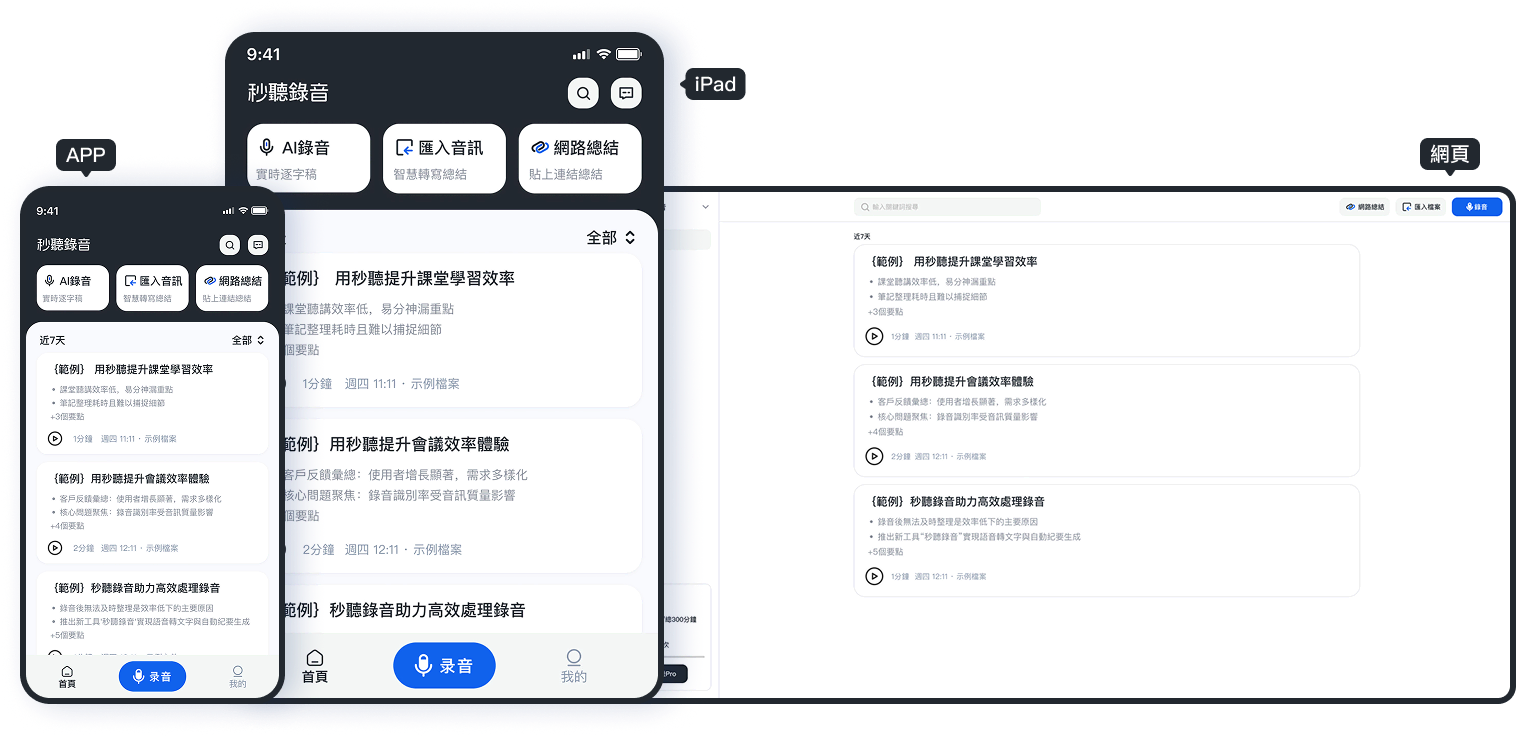
- Tinrec: Its differentiator is the "complete workflow." It handles not only live recordings but also uploaded audio files and even YouTube video links. Its AI conversational Q&A allows users to ask questions to get specifics from the recording, not just keyword search.
- Notability: The classic "recording sync" feature keeps it popular among students. Best for those who prefer handwriting but need audio as a memory aid.
- Otter.ai: Industry benchmark for English recognition, but for Chinese users, the language barrier makes it a choice for specific scenarios (e.g., all-English environments).
Hands-On Tutorial: How to Efficiently Organize Study and Meeting Content with Tinrec
The traditional note-taking workflow is usually "record → re-listen at home → manually type up notes," which is extremely inefficient. Here's a demonstration of how to use Tinrec on iPad to achieve an efficient "record now, notes now" workflow.
Step 1: Real-Time Classroom/Meeting Voice-to-Text
During online courses or in-person meetings, no need to frantically write every word.
- Open the Tinrec app and tap the "Record" button on the main screen.
- Start the lecture or meeting. Tinrec transcribes the audio to text in real-time in the background.
- You can mark key moments on the fly (Mark) for later review.
- When finished, the system automatically generates a transcript and initially differentiates between speakers.
Step 2: Process Existing Audio or Video Resources
For recorded instructional videos or podcasts, use file import or link parsing.
- Audio Files: Tap "Import Audio," choose MP3/M4A files from your iPad library. The system will auto-transcribe and generate a summary.
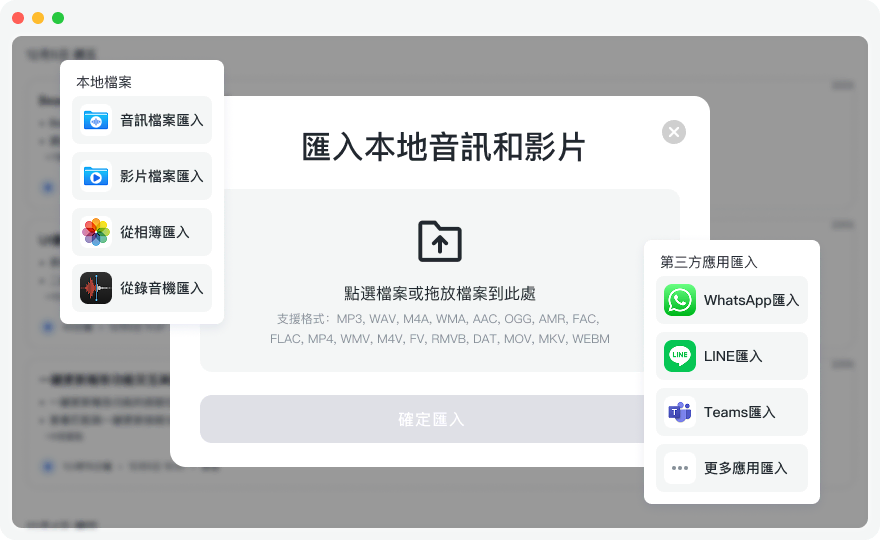
- Video Links: If the learning source is from YouTube or a podcast platform, simply copy the URL and paste it into Tinrec. The system extracts the audio track, converts it to text, and retains the timeline.

Step 3: Quick Review with AI Conversational Q&A
This is the biggest difference from traditional tools. You don't need to read the entire transcript.
- Enter the "AI Dialogue" interface for that recording.
- Directly ask questions like "What are the three exam key points the teacher mentioned?" or "What was the conclusion on the budget decision in the meeting?"
- The AI will give precise answers based on the recording content, along with reference timestamps.
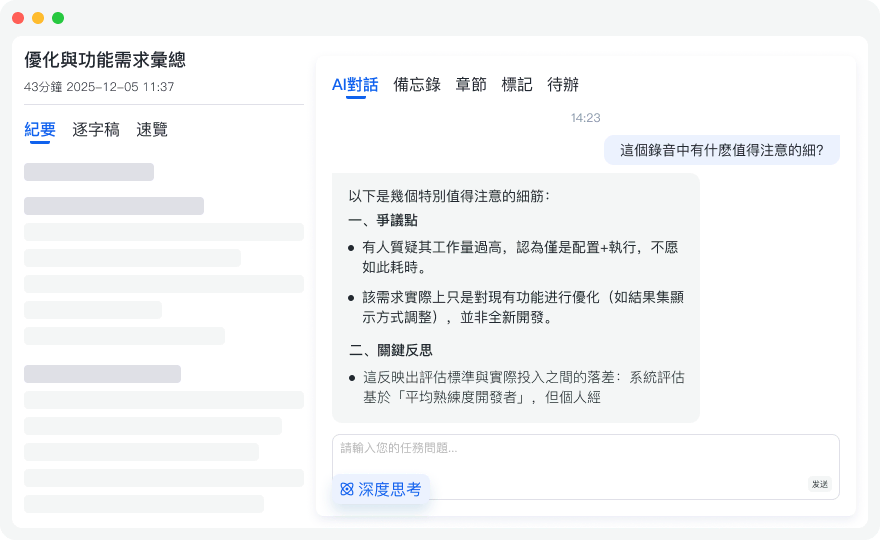
With these three steps, you can turn hours of audio into structured study notes or meeting minutes in just a few minutes.
Decision Tree: Which iPad Study App Should You Choose?
To reduce choice paralysis, follow this decision logic:
Is your primary input method handwriting?
- Yes → Choose GoodNotes 6 or Notability. If you need recording assistance, Notability is better.
- No → Proceed to the next question.
Do you deal with a lot of audio/video content?
- Yes, mostly Chinese or mixed Chinese-English → Choose Tinrec. It has an edge in Chinese semantic understanding and action item extraction.
- Yes, but mostly pure English → Choose Otter.ai.
- No → Proceed to the next question.
Do you need to build a large knowledge base or manage projects?
- Yes → Choose Notion or Obsidian.
- No, just simple notes → Choose Apple Notes.
Tinrec's Fit Summary: If you're a professional who frequently attends meetings or a student taking many online courses, and you hate the process of "re-listening to recordings," Tinrec is the tool that best solves your "time anxiety." Conversely, if you lean toward artistic creation, hand-drawn notes, or only need a simple to-do list, traditional note apps are more suitable.
Frequently Asked Questions (FAQ)
Q1: Does Tinrec offer a free tier?
Yes, Tinrec offers a free version with up to 100 minutes of recording/transcription per month. For light users or those wanting to try the features, this is enough for a few important meetings or courses each week.
Q2: Which is better for class, Notability or GoodNotes on iPad?
Both are top choices. Notability's strength is "recording and notes sync"—tap a note to play back the audio at that point. GoodNotes 6 excels in PDF annotation, handwriting feel, and file management structure. Choose based on whether you rely on "audio playback."
Q3: What languages does Tinrec support? How accurate is Chinese recognition?
Tinrec supports 10 languages including Chinese, English, Japanese, Korean, German, Taiwanese, and Cantonese. For Chinese users, its recognition of mixed Chinese-English and technical terms is optimized better than most general international tools, and it can automatically differentiate between speakers.
Q4: Can I turn a YouTube video directly into notes?
Yes. Use Tinrec's "video link to text" feature—just paste a YouTube or other supported platform URL, and the system automatically extracts the audio and generates a transcript and summary. Great for reviewing online courses.
Q5: Are exported file formats compatible?
Most tools support mainstream formats. Tinrec supports export to TXT, DOCX, PDF, etc., for easy secondary editing and archiving in Word or Notion. Notability and GoodNotes mainly export to PDF or their own formats.
Q6: Does background noise affect transcription accuracy?
Modern AI tools (e.g., Tinrec, Notta) have noise reduction capabilities. However, in extremely noisy environments, using an external microphone or recording with headphones is recommended for best results. Tinrec's AI model is trained to filter background noise and correct sentences to some degree.
Turn every recording into actionable outcomes
Get 60 free transcription minutes when you sign in. No credit card required.
Related Reading
You might also like

2026 Free Cantonese Recording-to-Text Solutions: 2 Tools Compared
Compare two free Cantonese recording-to-text tools: Tinrec and Google Voice Typing, analyzing accuracy, mixed Chinese-English handling, file upload, AI features, and free quotas to help you find the time-saving solution.

2026 Free Cantonese Audio-to-Text Solutions: 4 Tools Compared
Cantonese audio-to-text tools are growing in number, but are the free plans sufficient? This article compares four tools—Tinrec, Otter.ai, Notta, and PLAUD Note—covering Cantonese recognition, free quotas, and AI features to help you find the best fit.

2026 Hands-On Comparison of 4 Cantonese Voice-to-Text Apps: Which One Saves You the Most Time on Meeting Notes?
We tested Tinrec, Plaud Note, Otter.ai, and Notta for Cantonese voice-to-text transcription, comparing accuracy, AI summarization, cross-platform support, and free tiers. Here's our practical review from a mid-level manager's perspective.

2026 Tested: 4 Cantonese Voice-to-Text Tools Compared – Which Has the Best Accuracy?
People on Dcard often ask how to convert Cantonese recordings to text. This article tests 4 tools, focusing on Cantonese accuracy, AI summaries, cross-platform support, and free tiers, to help you pick the best app for transcribing Cantonese meetings, classes, and interviews.

2026 Cantonese Voice-to-Text Tools Compared: Which Free Version Is Best for Professionals?
After testing multiple Cantonese voice-to-text tools, a mid-level manager found that the most critical factor in free versions isn't the number of minutes but the post-transcription organization. Using Tinrec as an example, this article shares practical uses for meetings, courses, and interviews, plus 4 key points to consider when choosing a tool.

2026 Review: 5 Cantonese Speech-to-Text Tools Compared — Free and Paid Options
Looking for a Cantonese speech-to-text tool? This article compares 5 voice-to-text services that support Cantonese, including Tinrec, cSubtitle, Subanana, SoundType AI, and Google Docs, analyzing accuracy, features, and pricing to help you quickly find the best option for your needs.

Tinrec vs iPhone Voice Memos in 2026: A 5-Dimension Comparison for Cantonese Voice-to-Text
A complete guide to Cantonese voice-to-text tools in 2026, testing Tinrec, iPhone Voice Memos, SoundType AI, cSubtitle, Subanana, and Good Tape. From free plans to paid features, learn how to quickly convert Cantonese recordings into transcripts.

2026 Comparison of 3 Cantonese Voice-to-Text Tools: Which Offers the Most Practical Cantonese Transcription and AI Organization?
We tested 3 Cantonese voice-to-text tools in 2026, comparing Cantonese transcription accuracy, AI organization features, and pricing to help you choose the best option for meeting notes and interview transcription.

5 Cantonese Voice-to-Text Tools Compared in 2026: From Free to Paid, All You Need to Know
This article compares 5 voice-to-text tools that support Cantonese in 2026, including Tinrec, Callinter Lite, UniScribe, Google Docs, and Notta. It covers features, pricing, and use cases to help you find the best Cantonese transcription solution.