
Turn recordings into transcripts and summaries in minutes
Upload audio or video for multilingual transcription, AI notes, and action items
The "Black Hole" of Audio Files: Why You Need a Better AI Transcription Tool
In today's era of remote work and online courses, "record it first, worry later" has become a habit for many students and office workers. However, the real pain point most people face isn't "how to record"—it's the aftermath of recording:
- Extremely low information density: A one-hour meeting recording takes the same amount of time to re-listen, making it highly inefficient.
- Time-consuming to organize: Traditional transcribing requires constant pausing and rewinding, making the process of converting speech to text tedious and painful.
- Lack of actionability: Audio files are often buried deep in folders, with no clear key takeaways or action items afterward, making meetings a mere formality.
While tools like Notta pioneered automatic AI transcription, Traditional Chinese users may wonder if there are more cost-effective alternatives that better suit decision-making needs.
This article highlights the most noteworthy AI speech-to-text tools in 2026, focusing on Traditional Chinese recognition accuracy, AI summarization capabilities, and pricing flexibility.
Comparison of Mainstream Tools: Notta, Google, and Tinrec
When looking for alternatives, we consider not just "transcription accuracy" but also whether the tool helps us "understand" the content. Below is a comparison of three representative tools:
| Dimension | Tinrec | Notta | Google Docs Voice Typing |
|---|---|---|---|
| Positioning | End-to-end AI meeting assistant (record + understand + act) | Professional transcription tool | Basic dictation tool |
| Traditional Chinese / Taiwanese Hokkien Support | 🟢 Excellent (supports Chinese, English, Japanese, Korean, Taiwanese Hokkien, and 10+ languages) | 🟢 Excellent | 🟡 Moderate (no Taiwanese Hokkien, weak punctuation) |
| Real-time Recording & Transcription | Supported (Web/App synced) | Supported | Supported (browser only) |
| External File/Video Transcription | 🟢 Supports audio files, YouTube/Podcast links | 🟢 Supports audio files | 🔴 Not supported (requires extension) |
| AI-Powered Features | AI Dialogue Query (Ask AI), meeting minutes, action item extraction | AI summaries, chapter segmentation | 🔴 None |
| Affordability | ⭐ High value (free 100 min/month, Basic $4.9/month) | ⭐ Market standard (higher price) | ⭐ Free |
| Best For | Professionals who need quick "conclusions" and "to-dos" | Media professionals needing detailed transcripts | Ad-hoc, short personal notes |
Analysis Conclusion: If you just need free dictation, Google Docs works in a pinch. If you like Notta's interface but find subscription costs high, or if you want to search recorded content via AI dialogue (instead of digging through long transcripts), Tinrec is a highly competitive alternative.
In-Depth Review: How Tinrec Solves the "Recorded but Never Revisited" Problem
Tinrec stands out because it's more than just a transcription tool—it emphasizes a complete workflow from recording to action. Here's a hands-on analysis of its core features:
1. Multiple Input Sources: From Meetings to Podcasts
Beyond basic microphone recording, Tinrec's most convenient feature for content creators and students is URL parsing. No need to download YouTube videos or podcast audio—just paste the link, and the system automatically fetches and transcribes the content.
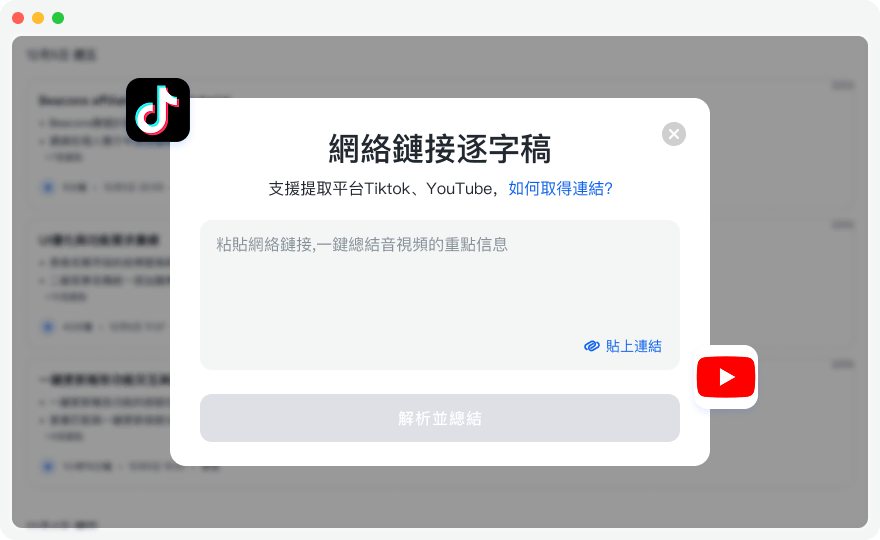
For existing audio files, Tinrec supports multiple formats, solving compatibility issues between different recorders or phone models.
Stop organizing recordings by hand
Upload audio or video and automatically get a transcript, summary, and action items
- Feature links: Audio to Text | Podcast/Video to Text
2. AI Smart Summaries & Action Item Extraction
This is the biggest differentiator from traditional tools. While conventional transcription gives you a 10,000-word transcript, Tinrec uses AI to automatically generate:
- Meeting minutes: A one-sentence summary of key points.
- Structured summary: Bullet points of the discussion.
- Action items: Automatically identify who should do what by when.
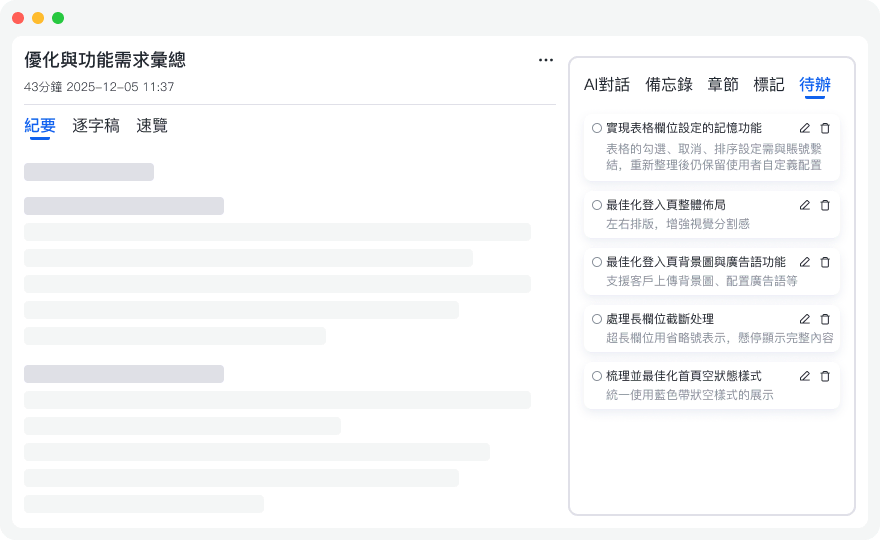
For project managers or administrative staff who need to write meeting notes, this saves about 80% of organization time.
3. AI Dialogue Query: Ask Your Recording Like a Person
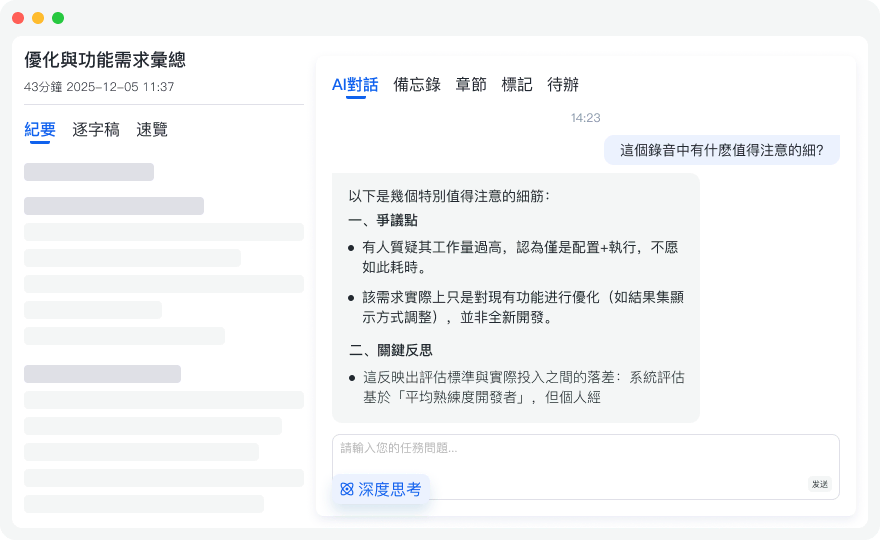
This is Tinrec's most differentiating feature. Facing a 3-hour interview recording, even with a transcript, Ctrl+F to search keywords is still tedious. Tinrec's AI Dialogue Query lets you ask direct questions, such as:
"What was the conclusion about Q3 budget in the meeting?" "What pros and cons did the speaker mention about remote work?"
The AI answers based on the recording content, making "reviewing recordings" as simple as talking to an assistant who just listened to the meeting.
Practical Tutorial: How to Quickly Generate Meeting Notes with Tinrec
Here's a 4-step guide to turn a chaotic meeting into a clear action list:
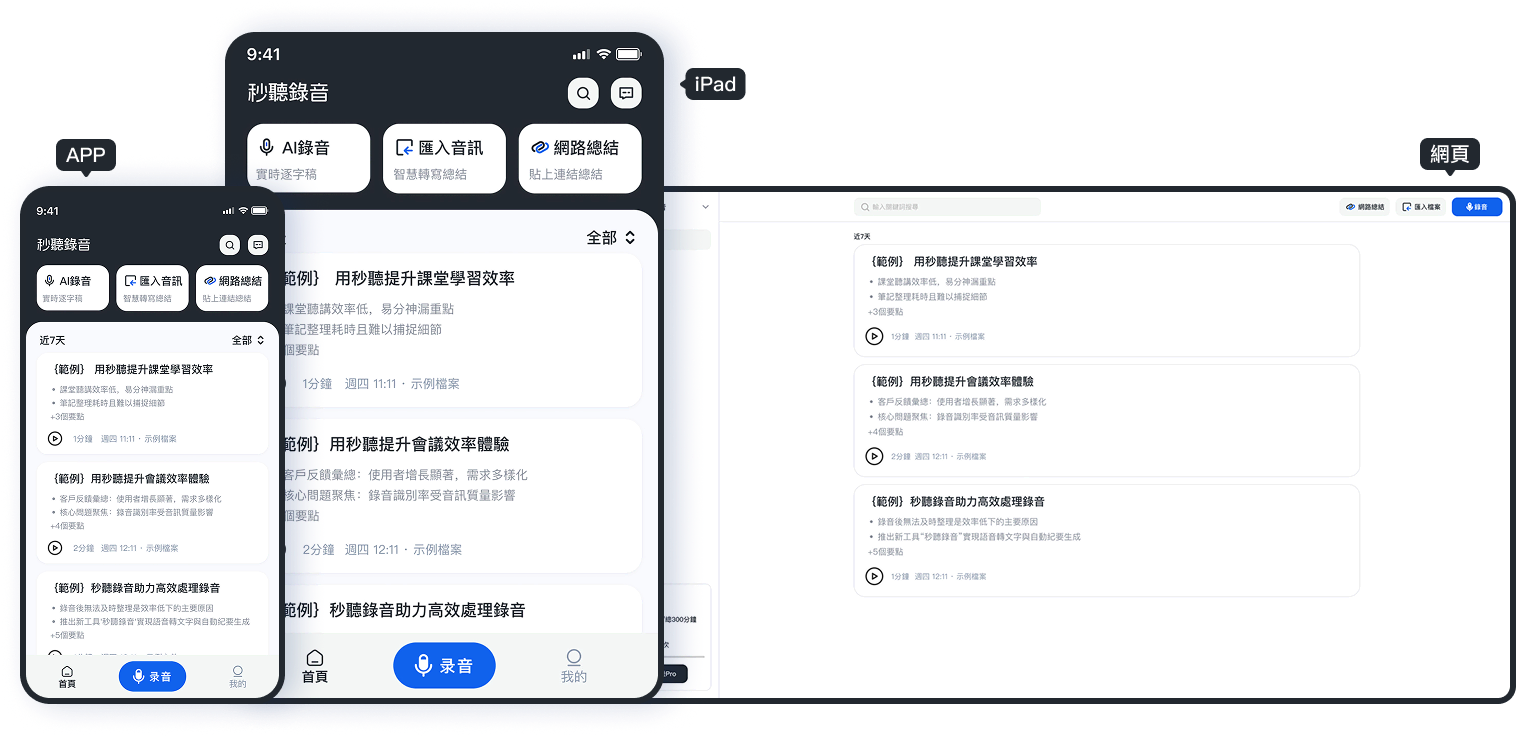
Step 1: Start Recording or Import
- Live meetings: Open the Tinrec mobile app or web version, click Record & Transcribe in Real Time. The system shows voice waveform and transcribed text in real time, supporting mixed recognition of Chinese, English, Japanese, Korean, and even Taiwanese Hokkien.
- External files: If you used a voice recorder, upload the audio file via the web version later.
Step 2: Real-time Marking & Monitoring
During recording, if you hear something important, click to highlight. This helps the AI capture key information more accurately when generating summaries later.

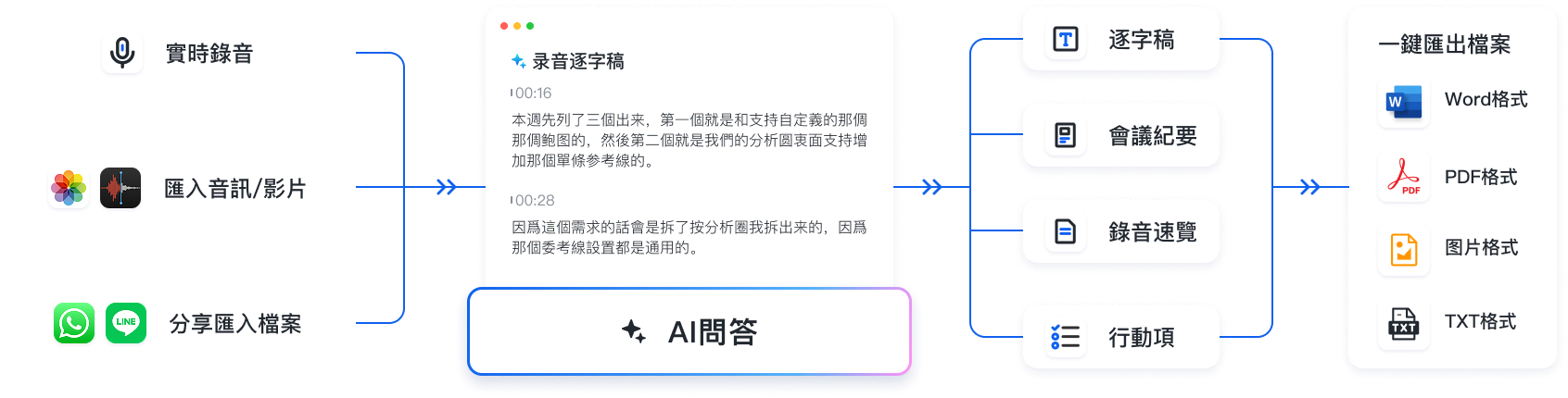
Step 3: Generate AI Analysis
After recording ends, click "AI Analysis." The system processes within minutes, producing a complete report including summary, keywords, and full transcript. We recommend reading the "Summary" first for the big picture, then "Action Items" to confirm task assignments.
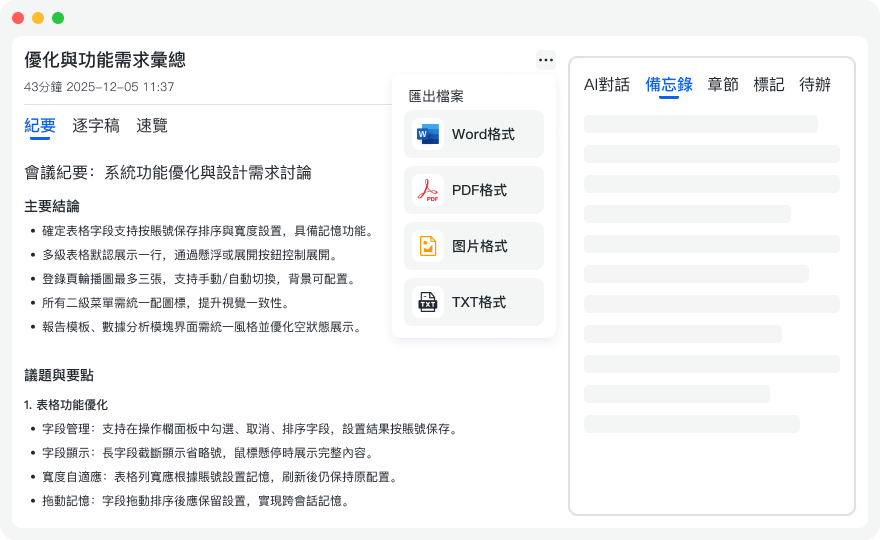
Step 4: Export & Share
Finally, export the organized content as Word, PDF, or TXT, and paste it into your company's Notion or email to send to the team.
FAQ
Q1: Is Tinrec free? How does it compare to Notta in price? Tinrec offers a free plan with 100 minutes of transcription per month, which is generous for students or light users. For more minutes, the Basic plan is only $4.9/month, compared to Notta and other competitors typically ranging from $10-15, making Tinrec extremely cost-effective.
Q2: Does it support Taiwanese terminology or Taiwanese Hokkien? Yes, Tinrec supports automatic recognition of 10 languages including Taiwanese Hokkien. For Traditional Chinese contexts, its AI model is optimized to accurately recognize common Taiwanese business terms.
Q3: Can I use it to transcribe iPhone call recordings? Due to iOS system privacy restrictions, no app can directly record calls in the background. The recommended approach is: during a call, enable speakerphone and record with another device (or the Tinrec web version); or import the call recording file (if available) into Tinrec for transcription.
Q4: How accurate is the transcription? Do I need manual proofreading? Current top-tier AI transcription tools achieve over 95% accuracy (in clear environments). Tinrec is no exception, but for proper nouns, names, or noisy multi-person conversations, quick manual proofreading is still recommended. Tinrec's editing interface lets you listen and edit simultaneously, which is intuitive.
Q5: Are there limitations on the AI Dialogue Query feature? AI Dialogue Query answers based on the specific recording's content. As long as the audio quality is clear and transcription is successful, the AI can accurately answer relevant questions, which is very helpful for quick retrieval from long videos or meetings.
Q6: Does it support recording from Zoom, Google Meet, or Teams? Tinrec can record system audio via its web version, or use the mobile app to record external sound. For online meetings, this provides a universal solution without complex plugins.
Summary
In 2026, choosing an AI transcription tool is no longer just about "who hears better" but "who saves me more organization time." If you're looking for a high-value alternative to Notta with strong Traditional Chinese support and post-meeting actionability, Tinrec with its AI summaries and dialogue query is definitely worth adding to your productivity toolkit.
Turn every recording into actionable outcomes
Get 60 free transcription minutes when you sign in. No credit card required.
Related Reading
You might also like

2026 Smart Meeting Collaboration Tools Compared: Which One Handles Post-Meeting Work Without a Meeting Bot?
Many people think meeting tools only need transcription, but the real trouble is finding key points after the meeting, tracking action items, and keeping team data from walking out the door with individuals. This article compares Tinrec, Otter.ai, Notta, and Granola using the same meeting workflow, and covers selection criteria, common pitfalls, and team seat concepts to help you choose a smart meeting collaboration tool that fits your team.

Tinrec vs Zoom in 2026: 5-Dimension Comparison — How to Choose an AI Meeting Collaboration Platform
Meetings scattered across Teams, Meet, and Webex mean records get scattered too — a real pain point for many teams. This article compares Tinrec and Zoom across five dimensions from the perspective of consolidating cross-platform meetings, explaining what problems bot-free recording, post-meeting summaries and action items, AI Q&A, team spaces, and seat governance each solve, and outlines five key considerations when choosing an AI meeting collaboration platform.

2026 Smart Meeting Collaboration Tools: 4 Top Picks Tested and Compared
Tired of working overtime on meeting notes? We tested four smart meeting collaboration tools in real meeting scenarios for 2026, comparing bot-free recording, mixed Chinese-English transcription, AI Q&A, and team seat management. We also highlight key buying factors and common pitfalls to help you choose the right one.

2026 Smart Meeting Assistant Comparison: Tinrec vs Fireflies.ai — How They Work and Where They Differ
A side-by-side comparison of two smart meeting assistants, breaking down meeting capture, Chinese-language experience, post-meeting output, team governance, and pricing, plus a practical workflow from meeting to deliverable to help you decide which fits your budget and use case.

2026 Comparison of 4 AI Meeting Collaboration Tools: Evaluation Criteria and Key Selection Tips
We break down 5 evaluation criteria for AI meeting collaboration tools—from meeting capture methods, post-meeting organization, Chinese language experience, team governance, to quota and cost—and compare Tinrec, Otter.ai, Granola, and Notta through hands-on testing to help you determine which tool suits your meeting style and team size.

Best AI Meeting Notes Tools in 2026: Testing 3 Options — Tinrec Shines for Chinese Meetings and Team Knowledge
Tired of spending after-hours organizing meeting notes? Based on real meeting scenarios, this article outlines 4 key buying criteria and compares NotebookLM, Otter.ai, and Tinrec. NotebookLM is free but requires pre-recorded audio; Tinrec supports bot-free online meeting recording, real-time transcription, AI Q&A, and team spaces — ideal for Chinese meetings and team knowledge retention. The article honestly lists each tool's limitations and pricing to help you choose the best fit.

2026 Comparison of 3 AI Meeting Note Tools: How Cantonese Meetings Turn Transcripts into Actionable Records
2026 comparison of 3 AI meeting note tools, focusing on Cantonese and mixed Chinese-English meetings. Analyzes transcripts, summaries, action items, AI Q&A, bot-free recording, and team collaboration to determine who Tinrec, Subanana, and Plaud Note are each best for, plus buying criteria and pitfalls to avoid.

2026 Meeting Minutes Tools Showdown: Tinrec vs Otter.ai – Which Wins on 5 Key Dimensions?
Starting from the difference between meeting minutes and meeting records, this article outlines 5 key points for choosing a meeting minutes tool and compares Tinrec, Otter.ai, Notta, and Granola in scenarios involving Chinese meetings, post-meeting organization, and team collaboration.

Tinrec vs Notta 2026: 5-Dimension Comparison — Which Is Better for Chinese Meeting Notes?
How to choose a meeting notes AI? This article starts with common pitfalls, compares Tinrec and Notta across 5 dimensions, and adds use cases for Granola and PLAUD. It covers bot-free recording, Chinese transcripts, AI summaries, action items, Q&A, team spaces, roles and seats, pricing, and a guide to avoiding pitfalls — helping you find the right tool with one of your own meetings.