

Turn recordings into transcripts and summaries in minutes
Upload audio or video for multilingual transcription, AI notes, and action items
The Pain Point for Xiaomi Users: Is the Built-in Recorder Enough?
Many Xiaomi (Xiaomi/Redmi/POCO) users rely on the system's built-in "Recorder" for meeting or class notes, depending on its built-in transcription feature. However, in real-world work and study scenarios, users often face challenges: high cost of replaying long meetings, lack of structured summaries from built-in transcription, difficulty in cross-device syncing, and inconsistent recognition of multiple languages or technical terms.
If you're searching for the best solution for "Xiaomi voice to text," this article will clarify the limitations of system tools and show how to combine professional AI tools to boost efficiency. We'll compare mainstream tools across key evaluation dimensions and provide a practical 5-step workflow, covering everything from live recording to AI-powered smart query.
Quick Navigation Conclusion:
- Just need simple notes → Use Xiaomi's built-in Recorder (free, offline).
- Need meeting minutes & action items → Use an AI summary tool like Tinrec.
- Handling cross-platform files (iPhone/computer) → Choose a cloud service with Web and multi-device sync.
Why You Need to Go Beyond the "Xiaomi Built-in Recorder"
Xiaomi's built-in Recorder does offer basic voice-to-text, especially decent for Chinese recognition. But for professionals who need to turn "audio information" into "actionable knowledge," transcripts alone aren't enough.
Three Limitations of System Tools
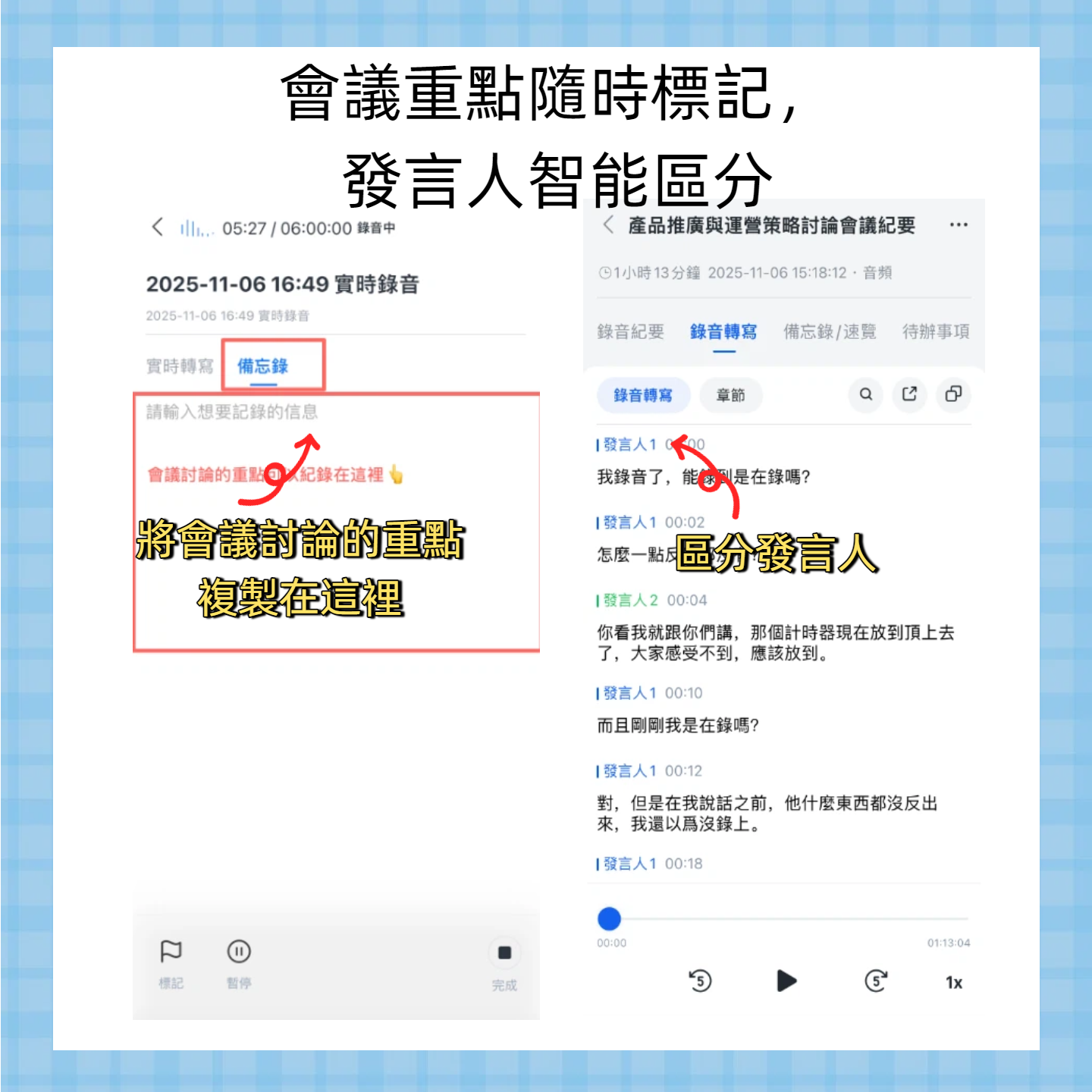
- Lack of semantic understanding: Built-in tools usually just output dense blocks of text without automatically identifying speakers, extracting key conclusions, or generating to-do lists.
- Scattered file management: Audio files are stored locally, making it hard to seamlessly integrate with computer note-taking apps like Notion or Evernote.
- No interactive querying: You can't just ask the tool "What was the conclusion about the budget in that meeting?"—you have to manually Ctrl+F for keywords, risking missing context.
In contrast, AI recording assistants like Tinrec not only deliver high-accuracy voice-to-text but also emphasize a "from recording to action" workflow. They automatically generate meeting minutes, identify speakers, and allow users to quickly locate key points via AI chat queries—this is the core value traditional system tools lack.
2024 Voice-to-Text Tool Deep Comparison: Which One Fits You Best?
To help you make an informed choice, we selected several popular tools—Xiaomi built-in Recorder, Notta, Yating Transcript, and Tinrec—and compared them across five key dimensions.
Tool Comparison Table
| Dimension | Xiaomi Built-in Recorder | Notta | Yating Transcript | Tinrec |
|---|---|---|---|---|
| Language Support | Mainly Chinese, English | 50+ languages | Chinese, Taiwanese, English | Chinese, English, Japanese, Korean, German, Taiwanese, Cantonese, and more (10 languages) |
| Real-time Processing | Real-time transcription (offline/online) | Real-time transcription | Primarily post-upload processing | Real-time transcription, no waiting |
| Summary/Action Items | ❌ No | ✅ Basic summary | ❌ Transcript only | ✅ Auto-generates meeting minutes, conclusions, to-do items |
| AI Chat Query | ❌ Not supported | ❌ Not supported | ❌ Not supported | ✅ Supports semantic query—ask your recording like a person |
| Export/Integration | Local file sharing | Multiple format export | TXT/DOC export | Multiple format export, cross-platform sync (iOS/Android/Web) |
| Price/Free Tier | Free | Limited free minutes | Paid primarily | Free tier: 100 minutes/month, upgradeable plans |
Stop organizing recordings by hand
Upload audio or video and automatically get a transcript, summary, and action items
Selection Recommendations
- Prioritize Chinese & local expressions: If your meetings are full of Taiwanese or mixed Chinese/English, Yating Transcript is a traditional strength, but the experience is more old-school.
- Prioritize internationalization & multilingual: Notta supports many languages, but recognition stability in pure Chinese environments can sometimes lag behind tools specialized in Asian languages.
- Prioritize efficiency & follow-up actions: Tinrec's advantage is that it's not just a "transcriber"—it helps you organize "what to do next." For busy project managers or students, auto-generated to-do lists can significantly reduce post-meeting organization time.
Practical Tutorial: 5 Steps to High-Quality Voice-to-Text & Summaries
Whether you use a Xiaomi phone, iPhone, or computer, the following steps will show you how to leverage modern AI tools (using Tinrec as an example, since it covers the most complete workflow) to maximize recording value.
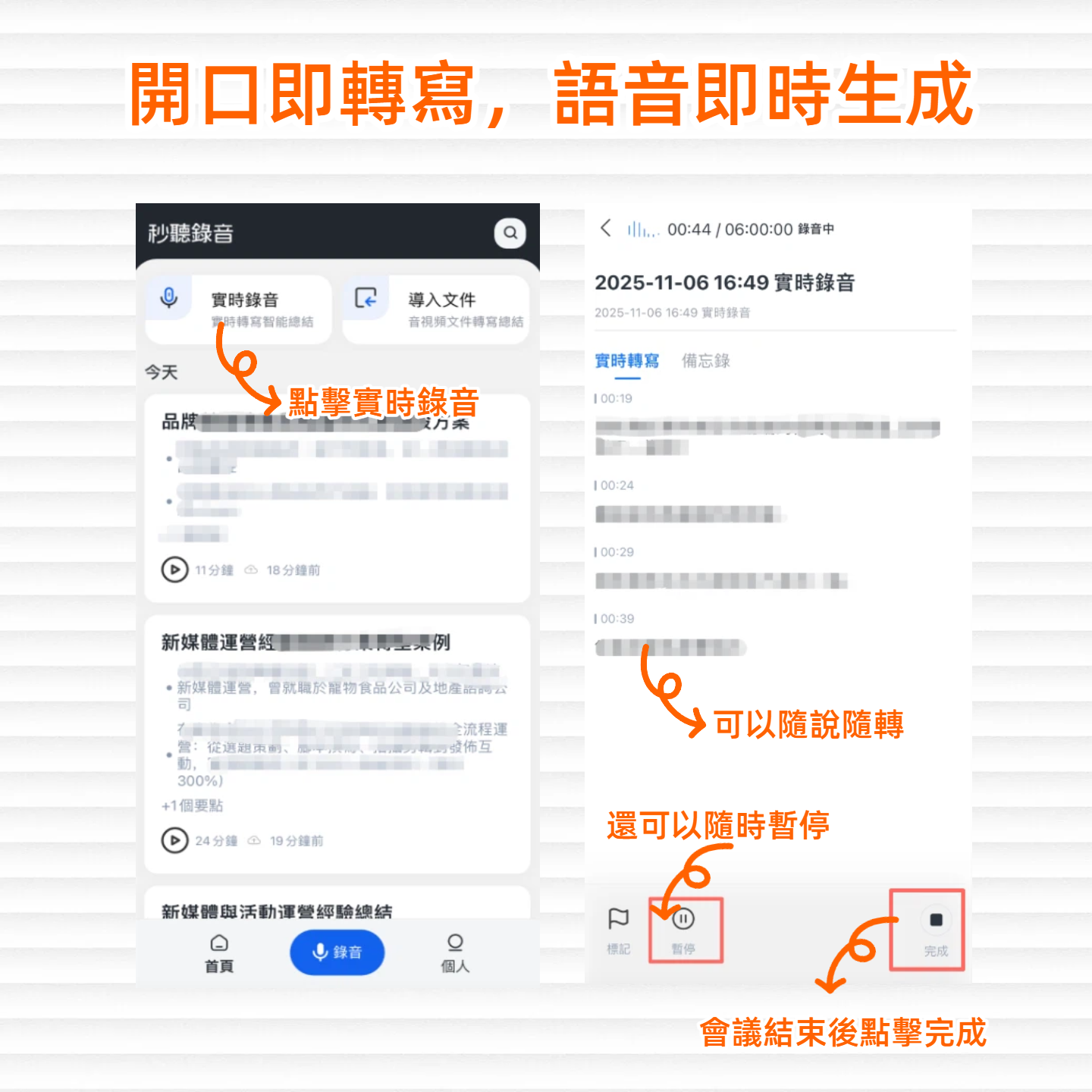
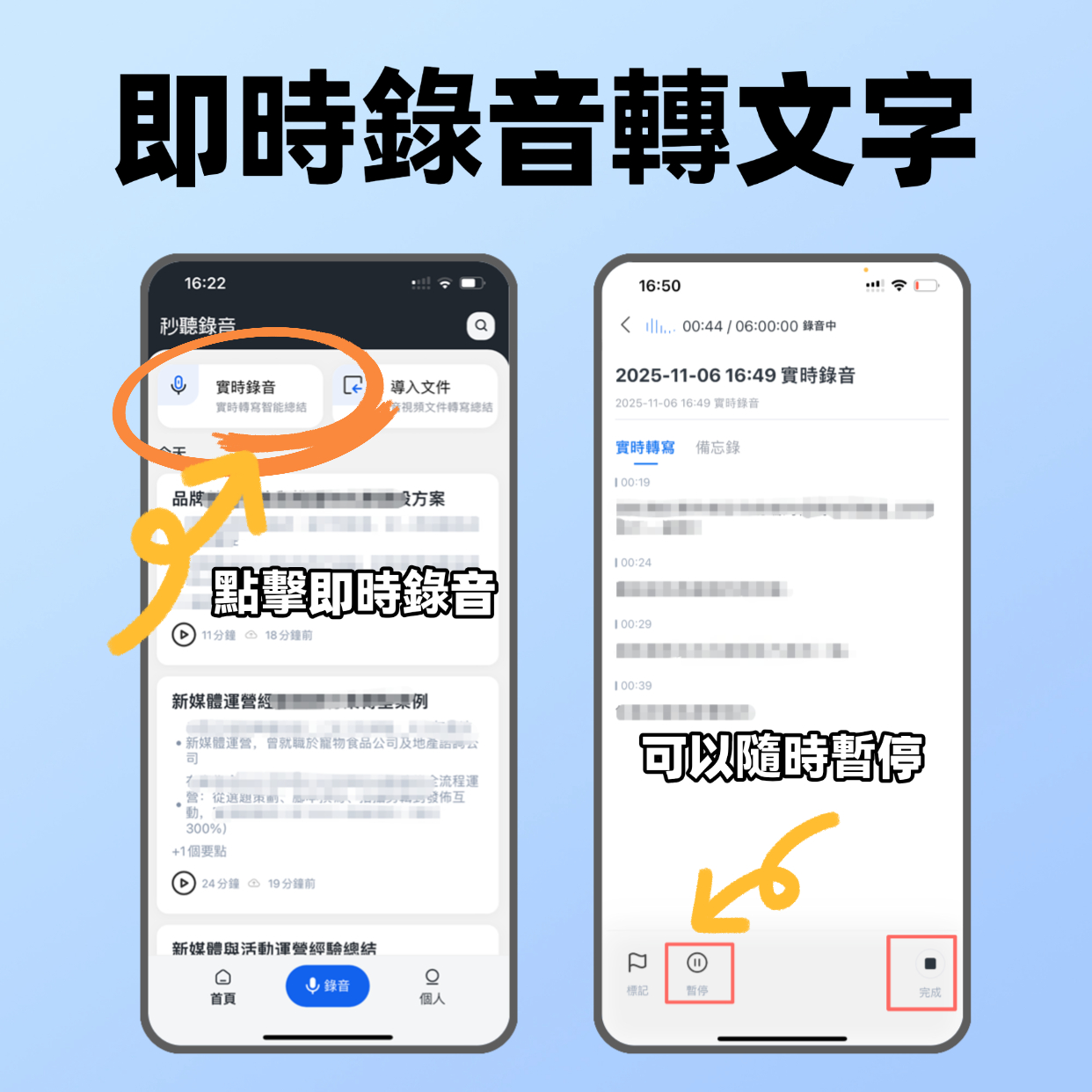
Step 1: Start Live Recording to Text
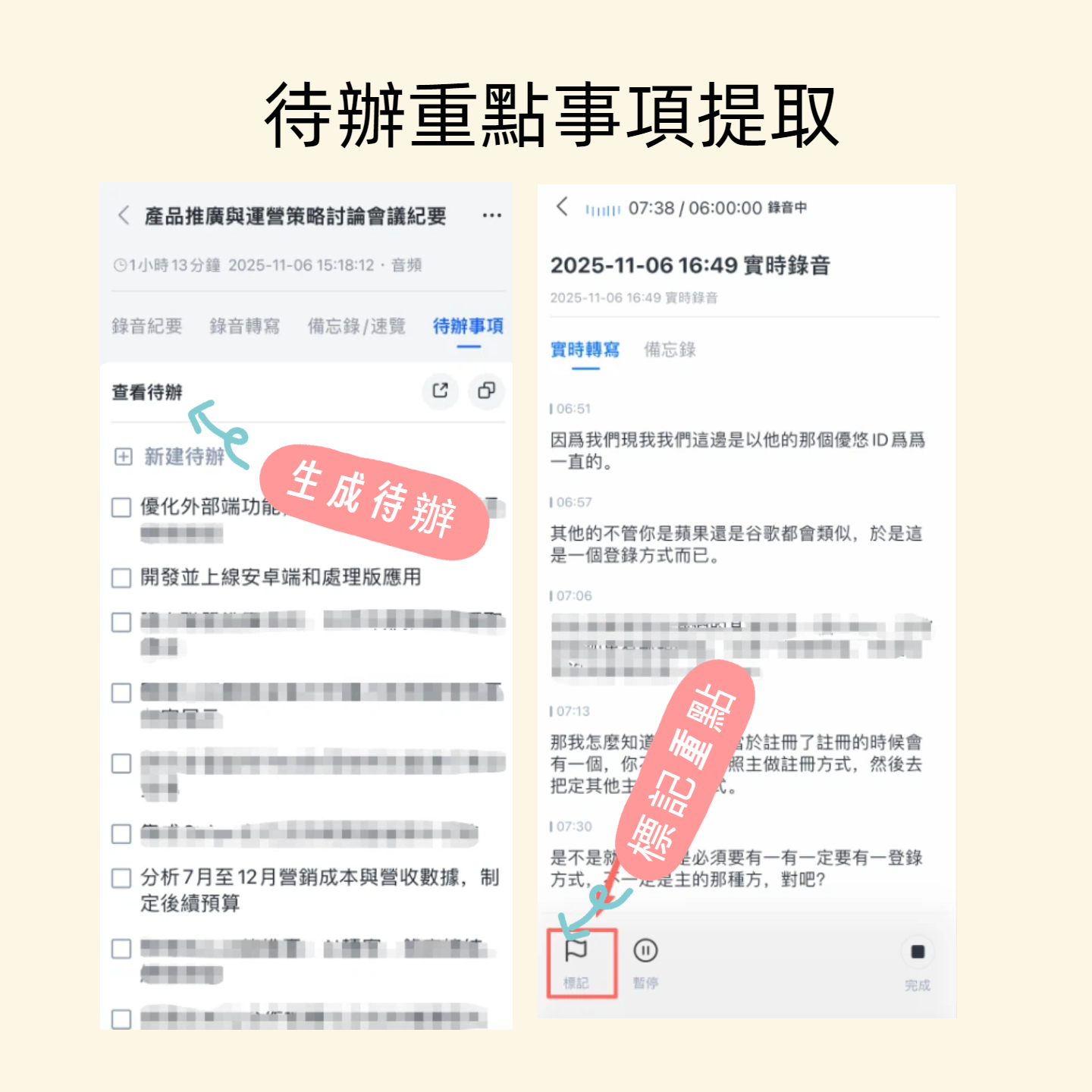
Before a meeting or class, open the tool's "Live Recording" feature. Unlike traditional recording that transcribes later, live transcription lets you confirm content is captured correctly in real time. If you spot an error, you can correct or mark key points immediately.
- Key operation: Ensure microphone permissions are granted, and position the device close to the speaker.
Step 2: Upload Existing Audio Files (If Any)
If you have .mp3 or .m4a files saved from Xiaomi Recorder, use the "Audio File to Text" feature to upload. The system automatically handles background noise and converts to text.
- Use case: Recover meetings where live transcription wasn't started, or organize old interview recordings.
Step 3: Process Online Videos or Podcasts
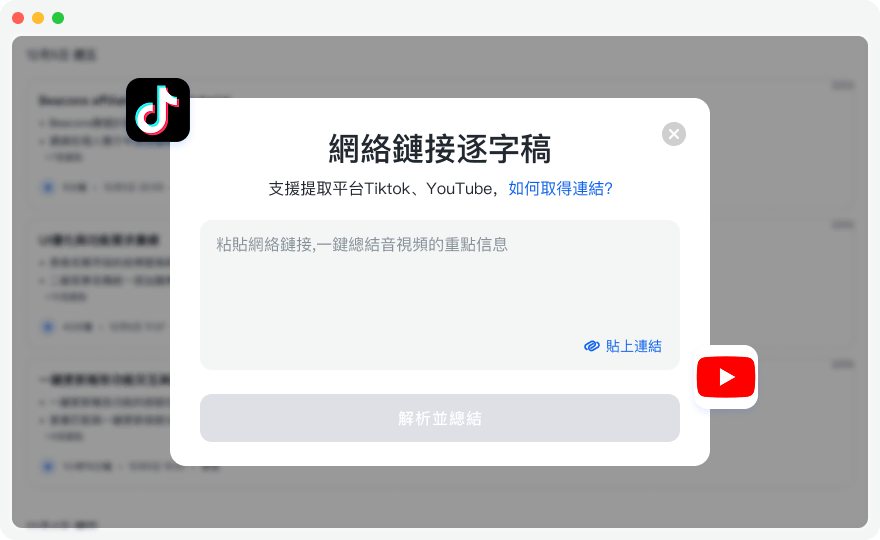
If your source is a YouTube tutorial or online podcast, no download needed. Copy the video link and use the "Podcast/Online Video to Text" feature. Paste the URL to quickly get transcripts and summaries.
- Advantage: Save download and conversion time—extract knowledge directly from the link.
Step 4: Review AI-Generated Meeting Minutes
After recording ends, the AI automatically analyzes the content and generates structured meeting minutes. You'll see clear "Discussion Topics," "Key Conclusions," and "To-Do Items."
- Check key points: Confirm that assignees and deadlines in to-do items are accurate.
Step 5: Use AI Chat Query to Dive into Details
This is the biggest difference from traditional tools. You don't have to read through thousands of words of transcript. Just type a question in the AI chat box, such as: "What was the marketing budget cap mentioned earlier?" or "List all risk points about product development." The AI gives precise answers based on the recording, with source timestamps.
- Application tip: Use this feature to quickly prepare presentation materials or review exam key points.
FAQ: Common Questions About Xiaomi Voice to Text
Q1: Is the transcription feature of Xiaomi's built-in Recorder free?
Yes, the transcription function of Xiaomi's built-in Recorder is usually free, but its capabilities are limited to basic speech recognition—no AI summaries, speaker diarization, or cloud sync. For long-term storage and cross-device management, you may need to rely on your Xiaomi account's cloud space (which may have capacity limits).
Q2: What languages does Tinrec support? Is it suitable for international meetings?
Tinrec supports automatic recognition of 10 languages including Chinese, English, Japanese, Korean, German, Taiwanese, and Cantonese. For multinational meetings or mixed-language conversations, it can effectively lower comprehension barriers and provide corresponding transcription support.
Q3: How to improve voice-to-text accuracy?
Regardless of the tool, the key to accuracy is "audio quality." Recommendations:
- Stay close to the speaker or use an external microphone.
- Reduce background noise.
- If multiple speakers, try to have them speak one at a time to avoid overlap.
- Use the AI chat query feature after the meeting to proofread fuzzy sections.
Q4: Can I export recording files from Xiaomi phone to other tools?
Yes. Xiaomi Recorder files are usually saved in the Recorder folder in File Manager. You can upload those .mp3 or .aac files to any cloud transcription tool that supports file import (like Tinrec, Notta, etc.) for deeper AI processing.
Q5: Is Tinrec's free version enough? What are the pricing tiers?
Tinrec's free version offers up to 100 minutes of recording per month, usually sufficient for light users (e.g., a few short meetings or class notes per week). For higher needs, the Basic plan at $4.9/month offers 600 minutes, and the Pro plan at $8.25/month offers 1200 minutes, including all AI features. Supports credit card, PayPal, and other payment methods.
Q6: Do these tools support iPhone or web version?
Yes, modern AI recording tools like Tinrec adopt a multi-device approach, offering iOS, Android apps, and a web version. This means you can record on your Xiaomi phone, then edit, query, and export on the computer web version, enabling seamless workflow switching—solving the single-device limitation of built-in tools.
Conclusion: Turn Your Recordings into a Second Brain
"Xiaomi voice to text" isn't just a technical action—it's a shift in information management mindset. Moving from relying on simple built-in transcription to using professional tools with AI summaries and chat queries can significantly unleash your productivity.
When the tool automatically identifies speakers, generates to-do lists, and lets you quickly retrieve content through conversation, recordings are no longer digital junk taking up storage space—they become truly scannable, searchable, actionable knowledge assets. Based on your actual scenarios (meeting frequency, language complexity, budget), choose the best tool combination for you and start optimizing your audio workflow.
Turn every recording into actionable outcomes
Get 60 free transcription minutes when you sign in. No credit card required.
Related Reading
You might also like

2026 Comparison of 4 Audio-to-Text Tools: Is iPhone's Built-in Feature Enough?
Since iOS 18.4, iPhone's Voice Memos supports Chinese transcription, leading many to think they no longer need other tools. But a transcript isn't a meeting summary—post-meeting organization, AI follow-up, and team collaboration are key. From a mid-level manager's perspective, this article tests four tools: iPhone built-in, Tinrec, Otter.ai, and Notta, comparing summary to-dos, AI Q&A, online meeting recording, and team data management to help you find the most time-saving choice.

2026 Meeting Software Comparison: 4 Top Tools From Free to Paid
A complete 2026 comparison of four popular meeting software options: Tinrec, Otter.ai, Granola, and Notta. From how meeting audio is captured and what you can do after transcription, to Chinese and mixed Chinese-English recognition, team roles and seat management, see the differences between free and paid plans at a glance and find the meeting notes tool that truly fits your needs.

2026 AI PPT Summarizer Free Options: 5 Tools Reviewed
Got a long deck and no time to read it? Here are 5 AI tools that summarize PowerPoint key points—from reading .pptx files directly and turning slides into clickable mind maps to capturing meeting audio and video. We cover each tool's best use case and free-plan caveats.

How to Transcribe Phone Recordings in 2026: 3 Methods + AI Auto-Summarization
Tired of re-listening to phone recordings? This student-focused guide covers 3 ways to transcribe phone audio in 2026: iPhone Voice Memos, third-party transcription apps, and Tinrec, which auto-generates summaries and to-dos. Includes 4 key factors for choosing a tool, common pitfalls students face, and practical advice on whether free tiers are enough.

6 English Video-to-Text Tools Tested and Compared in 2026: Which Free Plan Is Actually Enough?
A 2026 roundup of 6 English video-to-text tools, including Tinrec, Transcribe, cSubtitle, VEED.IO, Vidnoz, and TurboScribe. We compare free vs. paid plans and explain what to watch for before you start, such as audio quality, privacy permissions, and usage limits.

4 Best English Audio-to-Text Tools in 2026: Free Tiers, AI Summaries, and Team Collaboration Compared
The most time-consuming part of English meetings, classes, and interviews isn't recording—it's turning recordings into usable text. This article tests four English audio-to-text tools: Tinrec, Otter.ai, Notta, and TurboScribe. We break down accuracy, post-meeting organization, input sources, free tiers, and team licensing, with a guide to avoiding pitfalls and selection advice to help you find the most time-saving option.

4 Real-Time Meeting Transcription Apps Tested for 2026: Only One Turns Meetings into Searchable Team Knowledge
Starting from the real pain point of 'no one ever reads the transcript after the meeting,' we break down the four key factors for choosing a real-time meeting transcription app and put Tinrec, Notta, Otter.ai, and PLAUD Note to the test, comparing their differences and ideal use cases. Includes a copy-paste follow-up question template and a quick-start checklist.

4 Free Transcription Tools Tested in 2026: Which Free Tier Gives You the Most?
How do you choose a free transcription tool without getting burned? This hands-on comparison of Tinrec, cSubtitle, Yating Transcription, and TurboScribe covers free quotas, Chinese recognition, post-meeting organization, and cross-platform export, plus 4 common pitfalls and selection advice.

2026 Comparison of 2 Audio-to-Text Tools: Which Saves More Time for Meeting Transcripts and AI Summaries?
How to choose an audio-to-text tool in 2026? This article compares Tinrec and PLAUD Note across input sources, Chinese transcription, post-meeting organization, cross-platform collaboration, and cost structure using the same set of Chinese meeting recordings, so you can pick the right tool for your meeting style.