
Turn recordings into transcripts and summaries in minutes
Upload audio or video for multilingual transcription, AI notes, and action items
Why You Need an "AI Transcription Tool"? From Pain Points to Solutions
In this era of information overload, transcription services have evolved from tools for professionals to an indispensable productivity booster across industries. However, many still face huge time and cost challenges when dealing with hours-long audio recordings.
Pain Point 1: Crushing Time Cost
Traditional manual transcription of a one-hour recording typically takes 3-5 hours to complete. That means if you have a 2-hour meeting recording to transcribe, it could take an entire workday. With AI transcription services, the same recording may only need 10-30 minutes—a tenfold efficiency boost.
Pain Point 2: High Financial Cost
Based on U.S. market rates, manual transcription costs about $15-45 per 30 minutes. If you have 10 hours of recordings to process each month, the transcription bill alone could reach $300-900. In comparison, AI transcription services typically cost just a few dollars per month, and many emerging platforms like Tinrec or LexiTranscript offer generous free tiers or low-cost subscriptions.
Pain Point 3: "No Actionable Output" After Transcription
Most traditional tools or outsourcing services only deliver a "wall of text." Users still have to spend a lot of time rereading, marking key points, and extracting to-dos. Modern tools should go beyond transcription—they should "understand" and "extract action items."
2025 Mainstream Transcription Service Review: In-Depth Comparison of Tinrec and Competitors
We comprehensively evaluated popular transcription services based on "accuracy," "Chinese support," "features," and "value for money." Below is a comparison of five representative tools, including rising star Tinrec.
1. Tinrec: From Recording to Action—A Complete Workflow
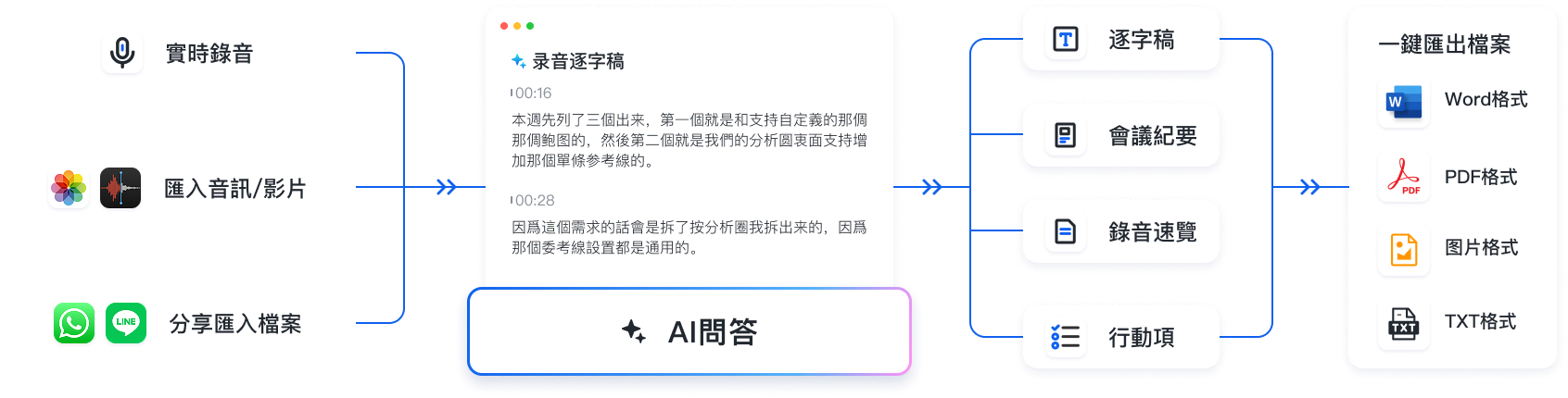
Tinrec is a multi-platform AI recording assistant that has gained attention recently. Its standout feature is that it's "not just transcription, but understanding." It solves the pain point of "having to organize after transcription" by automatically generating meeting minutes and action items via AI.
- Core Advantage: Supports real-time transcription while recording, and features an exclusive "AI Chat Query" function that lets you search recording content by asking questions.
- Chinese Support: Excellent—supports Traditional Chinese, Taiwanese Hokkien, Cantonese, and 10 other languages.
- Use Cases: Meeting minutes, lecture notes, interview collation, cross-language communication.
2. LexiTranscript: A Cost-Effective Choice
LexiTranscript is popular among students thanks to its daily reset free tier.
- Core Advantage: Affordable; unlimited usage plans available during promotions.
- Chinese Support: Optimized for Traditional Chinese with high accuracy.
- Drawback: Relatively simple features—mainly transcription and basic summaries.
3. Otter.ai: Top Choice for Western Meetings, but Weak in Chinese
Otter.ai has a very high market share in the U.S. and Europe, with strong Zoom/Google Meet integration.
- Core Advantage: Real-time transcription and strong meeting software integration.
- Fatal Flaw: Only supports English. For users needing Chinese or mixed-language transcription, it's almost unusable.
4. Yating Transcription: The King of Taiwanese Accents
Developed by Taiwan AI Labs, Yating is designed specifically for Taiwanese accents.
- Core Advantage: Extremely high recognition for "Taiwanese Mandarin" and Taiwanese Hokkien.
- Drawback: Processing speed is relatively slow (1 minute of audio takes about 10 minutes to transcribe), and the interface leans toward traditional transcription, lacking advanced AI interactive features.
5. Rev: Pursue Ultimate Accuracy with Human Service
Rev offers both AI and human options and is an internationally known service provider.
- Core Advantage: Human transcription accuracy can reach 99%+.
- Drawback: Expensive (human service about $1.5 per minute), and the AI transcription's Chinese accuracy lags behind platforms optimized for Chinese.
Stop organizing recordings by hand
Upload audio or video and automatically get a transcript, summary, and action items
Comparison Table
| Feature/Service | Tinrec | LexiTranscript | Otter.ai | Yating | Rev (AI) |
|---|---|---|---|---|---|
| Chinese Accuracy | ⭐⭐⭐⭐⭐ (Excellent) | ⭐⭐⭐⭐☆ (Great) | ⭐ (Not supported) | ⭐⭐⭐⭐⭐ (Excellent) | ⭐⭐⭐ (Average) |
| Processing Speed | Very Fast (real-time) | Fast (cloud processing) | Real-time | Slow (requires waiting) | Fast |
| AI Smart Summary | Yes (with action items) | Yes | Yes | No | No |
| AI Chat Query | Yes (Exclusive) | No | No | No | No |
| Multilingual Support | CN/EN/JP/KR/TW, etc. (10) | CN/EN mainly | English only | CN/TW/EN | 38+ languages |
| Pricing Model | Free / monthly subscription | Subscription / promo buyout | Monthly subscription | Top-up / subscription | Per-minute billing |
Why Tinrec Is Worth Trying: Deep Feature Analysis
During our review, Tinrec demonstrated a different product logic compared to traditional transcription tools. It's not just about converting speech to text—it aims to solve the core problem of "how to quickly extract information from recordings."
1. Real-Time Transcription: WYSIWYG
Unlike many platforms that require "upload and wait," Tinrec supports displaying text on screen in real time as you record. This is very useful for journalists or meeting recorders who need to confirm content accuracy on the spot.
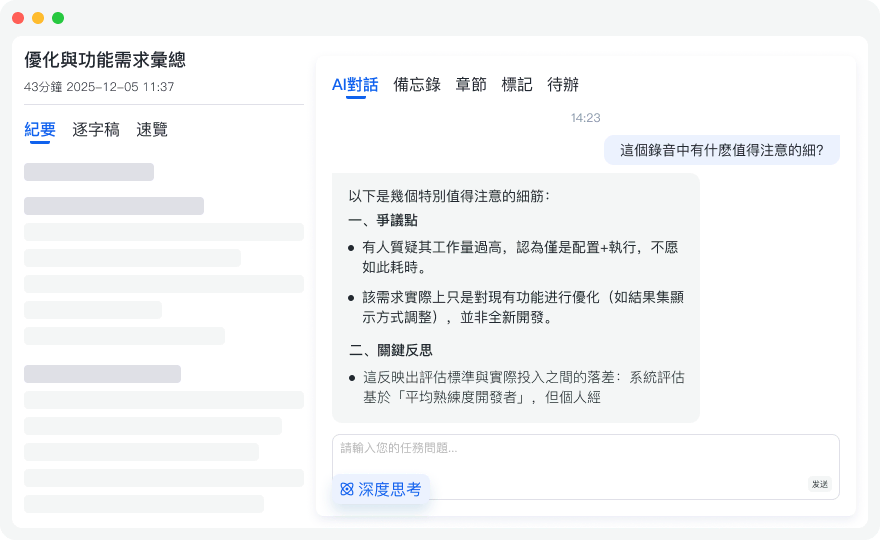
2. AI Chat Query: Find Key Points by Asking
This is Tinrec's most differentiating feature. For a 3-hour lecture recording, you don't need to Ctrl+F to search keywords; you can directly ask AI: "What are the key points for the final exam?" or "What was the decision on the marketing budget during the meeting?" AI will answer based on the recording content, saving a huge amount of time re-listening.
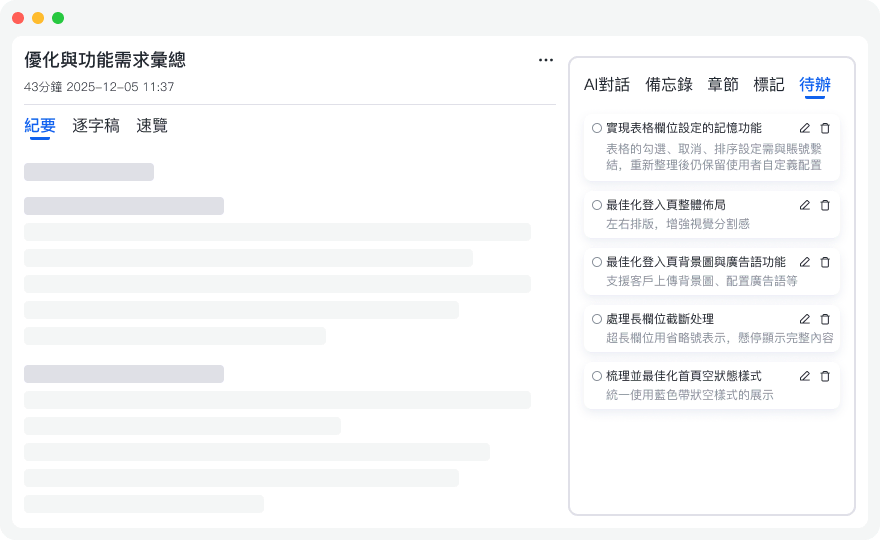
3. Auto-Generate Meeting Minutes and Action Items
Traditional transcripts are dense walls of text. Tinrec automatically analyzes the content and extracts a "summary," "conclusions," and most importantly, "to-dos." This turns recordings directly into actionable task lists.
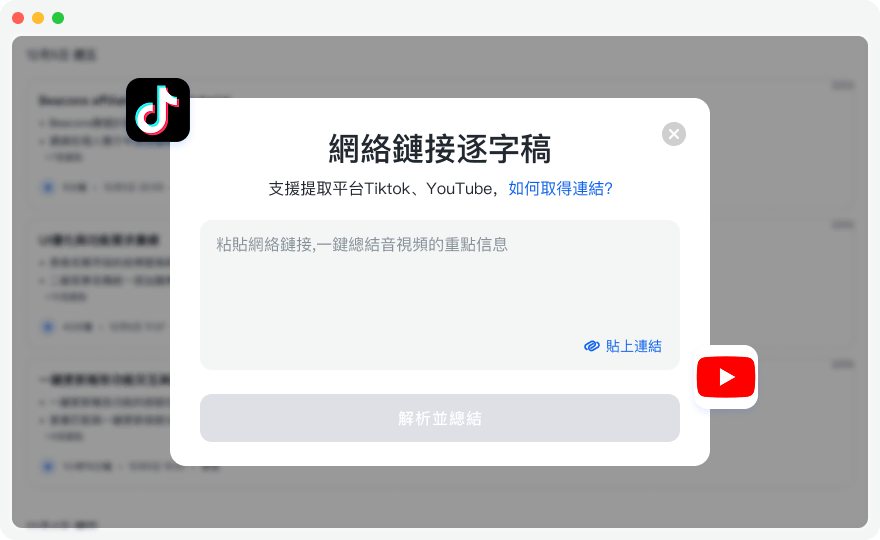
4. All-in-One Import: Even Videos Can Be Transcribed
In addition to audio files, Tinrec also supports pasting YouTube or Podcast links to transcribe directly. This is a huge time-saver for content creators organizing video scripts or students organizing online course materials.
Tutorial: How to Use Tinrec for Efficient Recording Processing
Below are steps for four common scenarios to help you get started quickly.
Scenario 1: Live Meeting/Lecture Recording
- Open Tinrec App (iOS/Android) or web version.
- Click the "Real-time Transcription" button on the home page.
- Place your phone or computer near the speaker (recommended distance 6-12 inches).
- During recording, text appears in real time. Tap stop when done, and AI will auto-generate a summary.
Scenario 2: Transcribe Past Interview Recordings
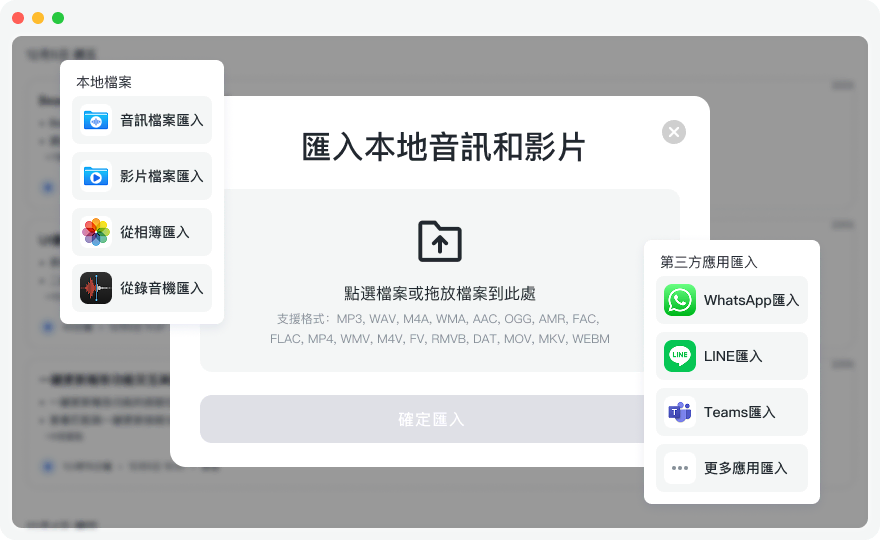
- Log in to Tinrec web version and select "Audio File to Text."
- Drag and drop mp3/m4a/wav files into the upload area.
- Select the main language used in the recording (e.g., Traditional Chinese).
- Wait a few minutes (depending on file length) to get a full transcript with speaker differentiation.
Scenario 3: Summarize YouTube Videos/Podcasts
- Copy the URL of a YouTube video or podcast.
- In Tinrec, select "Podcast/Online Video to Text."
- Paste the link; the system will automatically extract the audio track and convert it to text.
Scenario 4: Quickly Review Long Recordings
- Open a completed transcription file.
- Click the "AI Chat" icon on the right.
- Type your question, e.g., "Please summarize Speaker A's viewpoints."
Frequently Asked Questions
Q1: Which app do you recommend for phone recording transcription?
If you need cross-platform sync (record on phone, edit on computer), Tinrec is a great choice—it supports iOS and Android, and data syncs to the web version. For simple needs, the built-in Voice Memos app (iOS 18+) has basic transcription, but accuracy and summary capabilities are weaker.
Q2: Do these tools support Zoom or Google Meet recording?
Otter.ai supports joining meetings directly, but only in English. For Chinese meetings, we recommend using Tinrec's web or app to record alongside (with speaker output), or use system internal recording to capture audio, then upload to Tinrec for "Audio File to Text" processing.
Q3: Can transcription accuracy reach 100%?
No AI tool currently achieves 100% accuracy. Top-tier AI services (like Tinrec, Rev AI, OpenAI Whisper) can reach about 95%-98% in clear environments. Background noise, overlapping speech, and special accents affect accuracy. We recommend an "AI draft + manual review" approach for maximum efficiency.
Q4: Is Tinrec free?
Tinrec offers a free plan with 100 minutes of transcription per month—enough for occasional meetings or short interviews. For heavy use, choose Basic ($4.9/month) or Pro ($8.25/month) plans.
Q5: Is it safe to upload recordings to the cloud?
Always check privacy policies when choosing a service. Professional paid services usually prioritize security over free tools. Platforms like Tinrec use encrypted transmission and serve corporate and professional users, so they have strict data privacy standards.
Q6: Do I need to convert videos to mp3 before transcription?
Not with Tinrec. It supports direct import of video files (mp4, mov) or pasting YouTube links—the system automatically extracts the audio track for transcription, saving the manual conversion step.
Conclusion
Transcription tools in 2025 are no longer just "dictation machines"—they are your "second brain."
- If you need to handle pure English meetings, Otter.ai remains a powerhouse.
- If you care deeply about Taiwanese Hokkien recognition, Yating is the top choice.
- If you're after high efficiency, cross-language support, and want AI to help summarize key points and action items, then Tinrec is currently the most feature-complete and cost-effective all-around solution on the market.
Use these tools to free up the repetitive, tedious transcription time and invest it in more valuable thinking and decision-making!
Turn every recording into actionable outcomes
Get 60 free transcription minutes when you sign in. No credit card required.
Related Reading
You might also like

2026 Smart Meeting Collaboration Apps Compared: Stop Just Recording—How to Choose AI Minutes and Team Knowledge Retention
Many people treat smart meeting apps as recording-to-text tools, only to manually organize everything afterward. This article starts with common misconceptions, outlines 4 key purchasing criteria, compares Tinrec, Otter.ai, Granola, and Notta for different use cases, and provides step-by-step guidance on connecting recording, summaries, action items, AI Q&A, and team spaces into an executable workflow.

2026 Comparison of 4 Sales Meeting Note Tools: Which Best Organizes Customer Needs and Action Items?
Sales meeting notes are not verbatim transcripts. This article provides field templates and practical writing tips you can apply directly, and compares Tinrec, Otter.ai, Notta, and Granola on Chinese meeting support, post-meeting organization, and team handoff to help you choose the right tool.

2026 Sales Meeting Notes Tools Compared: Which One Turns Client Promises into Action Items?
Sales meeting notes aren't verbatim transcripts—they capture client needs, budget, decision process, concerns, and our commitments in a trackable record. This article explains what sales meeting notes are and the five key points to record, then compares Tinrec, Otter.ai, Notta, and Granola from four angles: no-bot recording, Chinese recognition, post-meeting AI Q&A, and team data ownership. Includes pitfalls to avoid and selection advice.

2026 Smart Meeting Collaboration Free Plans: 4 Tools Compared
Meetings take time, but post-meeting organization is where the real hours go. This guide reviews the free plans of four smart meeting collaboration tools in 2026, breaking down how audio gets into the tool, what you get after transcription, performance with mixed Chinese-English speech, and team management. It also hands-on tests Tinrec's bot-free recording, AI Q&A, and team spaces to help you decide which one is truly sufficient.

2025 Smart Meeting Collaboration Tools Compared: Which Handles Chinese Meeting Notes and Team Knowledge Best?
How to choose a smart meeting collaboration tool in 2025? This article examines four key criteria: how meetings are recorded, whether audio is retained, whether you can query meetings afterward, and team seats and data ownership. It compares Tinrec, Otter.ai, Granola, and PLAUD in terms of positioning, limitations, and pricing to help you pick the right one for Chinese-speaking teams.

2026 AI Meeting Notes Tools Tested: How to Write Sales Meeting Notes Without Missing Deal Signals
The hard part of sales meeting notes isn't typing speed—it's deciding what will still matter three months later. Starting from 'who will read these notes,' this article covers 4 key judgments for sales meeting notes, 4 common mistakes, and compares Tinrec, Otter.ai, Notta, and Granola on Chinese meetings, bot-free recording, and post-meeting organization to help you choose the right approach for your team.

2026 Sales Meeting Notes Tools Compared: Which One Turns Customer Words into Action Items?
How do you write sales meeting notes without them turning into a transcript? Starting from the real pain points salespeople face after customer meetings, this article covers 4 key selection criteria, compares Tinrec with Otter.ai, Notta, and Granola, and highlights the 4 most common note-taking mistakes.

2026 Smart Meeting Collaboration Tools Comparison: Tinrec vs Otter.ai Across 5 Dimensions — Which Handles Chinese Meetings Better?
Meeting tools aren't just about transcription speed. This article starts with common purchasing pitfalls and compares Tinrec and Otter.ai across 5 dimensions: meeting capture methods, Chinese and mixed Chinese-English recognition, post-meeting organization and AI follow-up, team governance, and quota and pricing. It includes a comparison table and FAQ to help you decide which tool better fits your meeting scenarios.

2026 Smart Meeting Collaboration Platform Buying Guide: 4 Hands-On Tests and Selection Advice
Can't find conclusions after a meeting? The problem often isn't transcription accuracy—it's choosing the wrong approach from the start. This guide focuses on three decision points: how meetings are recorded, what you get afterward, and who ultimately holds the data. We hands-on test Tinrec and compare it with Otter.ai, Notta, and Granola, including quota calculations and tips to avoid pitfalls with roles and seats, helping you choose the platform that truly works for you.