
Turn recordings into transcripts and summaries in minutes
Upload audio or video for multilingual transcription, AI notes, and action items
Why "Manual Transcription" Is the Biggest Time Killer for Content Creation and Work?
In 2026, whether you're a content creator needing to produce SRT subtitles for YouTube videos or a professional needing to organize hours of meeting recordings, the unstructured nature of "audio content" remains a major pain point. According to market research, organizing 1 hour of interview or video material often requires 3 to 4 hours of repeated listening and proofreading. This is not only a waste of time but also a huge drain on focus.
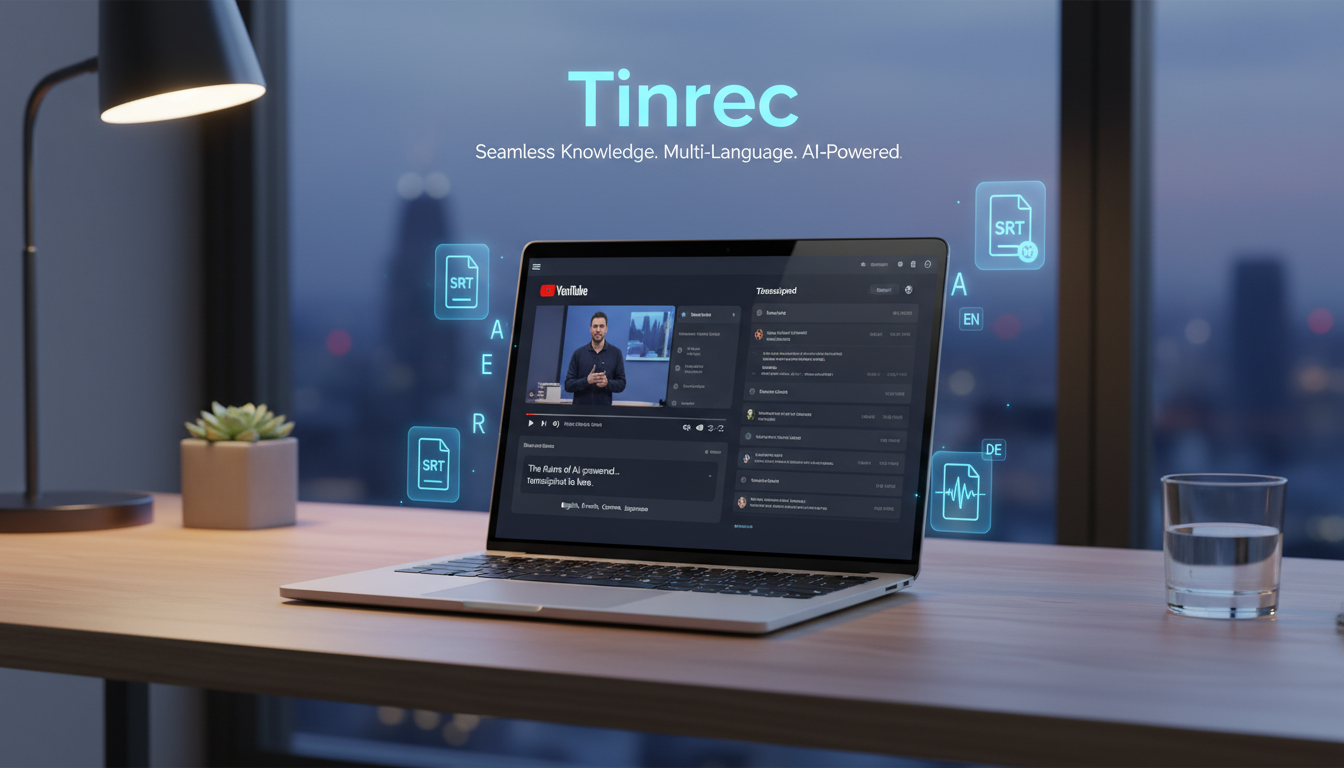
Current Pain Point Analysis
Most people face three major challenges when converting audio/video to text:
- Low Information Density, High Cost of Re-listening: Traditional audio recordings or videos are like a "black box." To find a specific sentence (e.g., "What's the budget number?"), you have to constantly drag the progress bar, which is extremely inefficient.
- Lack of Structured Summaries: Even if you have a transcript, facing tens of thousands of words of verbatim text makes it hard to quickly extract key points or decisions.
- Multi-language and Format Barriers: When dealing with content mixing Chinese and English, or even Taiwanese Hokkien or Cantonese, traditional voice input methods have terrible recognition rates and can't easily export to YouTube-specific SRT subtitle formats.
Comparison of Popular AI Transcription and Subtitle Tools in 2026
There are many tools on the market trying to solve this problem, from project management-focused ClickUp to speech recognition-focused Tinrec, each with its strengths. We selected representative tools for a dimensional comparison to help you find the best solution.
Tool Feature Comparison Table
| Dimension | Tinrec (Instant Recording) | Traditional YouTube Studio | General Note App (e.g., ClickUp) | General Voice Input |
|---|---|---|---|---|
| Core Positioning | Audio/Video to Text + AI Knowledge Base | Video Subtitle Editing in Dashboard | Project Management + Meeting Notes | Pure Speech to Text |
| YouTube Link Parsing | ✅ Supported (paste URL to transcribe) | ❌ (creator dashboard only) | ❌ (usually requires plugin) | ❌ |
| Real-time Transcription | ✅ Supported (transcribe while recording) | ❌ | Partial | ✅ |
| Language Support | 10 languages (including Chinese, English, Japanese, Taiwanese Hokkien, Cantonese) | Multiple languages (inconsistent quality) | Depends on integrated plugins | Primarily single language |
| AI Query | ✅ (ask questions about content) | ❌ | ❌ | ❌ |
| Action Items/Summary Generation | ✅ Auto-generates | ❌ | ✅ (needs manual AI trigger) | ❌ |
| Output Formats | TXT, SRT, PDF, Word | SRT, SBV | Doc, PDF | Plain text |
From the table, while YouTube Studio has built-in subtitle features, for scenarios like "non-creators wanting to transcribe others' videos" or needing "AI summaries" and "cross-language recognition," professional AI transcription tools like Tinrec offer a more complete workflow advantage.
In-depth Tinrec Review: From "Recording" to "Action" — A Complete Workflow
After reviewing multiple tools, we found that Tinrec (Instant Recording) provides a unique integrated experience of "real-time transcription" and "understanding" for both "YouTube automatic subtitle SRT generation" and "meeting transcription." It doesn't just turn speech into text; it makes that text "usable."
Stop organizing recordings by hand
Upload audio or video and automatically get a transcript, summary, and action items
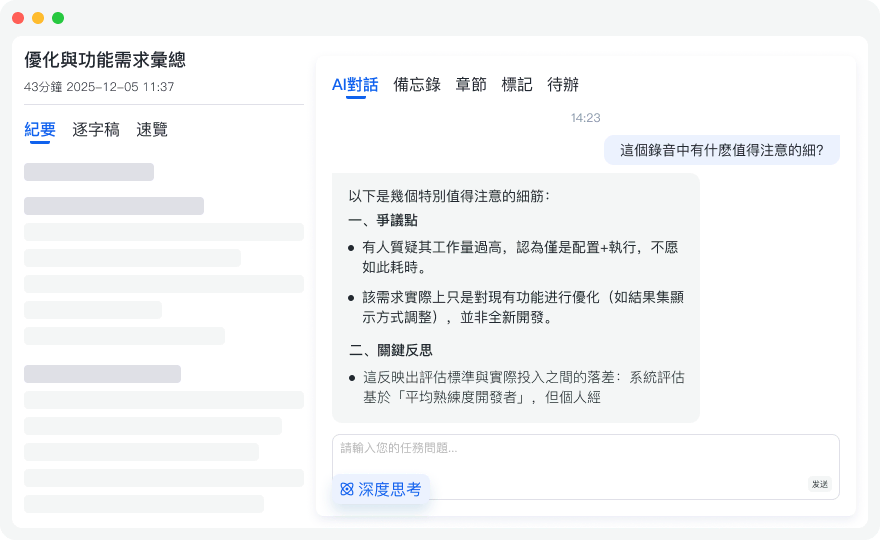
1. Groundbreaking "AI Chat Query"
This is the biggest difference between Tinrec and traditional transcription tools. Traditional tools give you a 50-page transcript that you can only search with Ctrl+F. But with Tinrec, you can directly ask the recording content like you would ask ChatGPT.
- Use Case Example: You import a 2-hour YouTube finance video. You can ask the AI, "What is the speaker's prediction for the semiconductor industry in 2026?" The AI will summarize the answer based on the recording and mark the time points. This is dozens of times faster than re-watching the video.
2. Optimized for YouTube and Podcasts
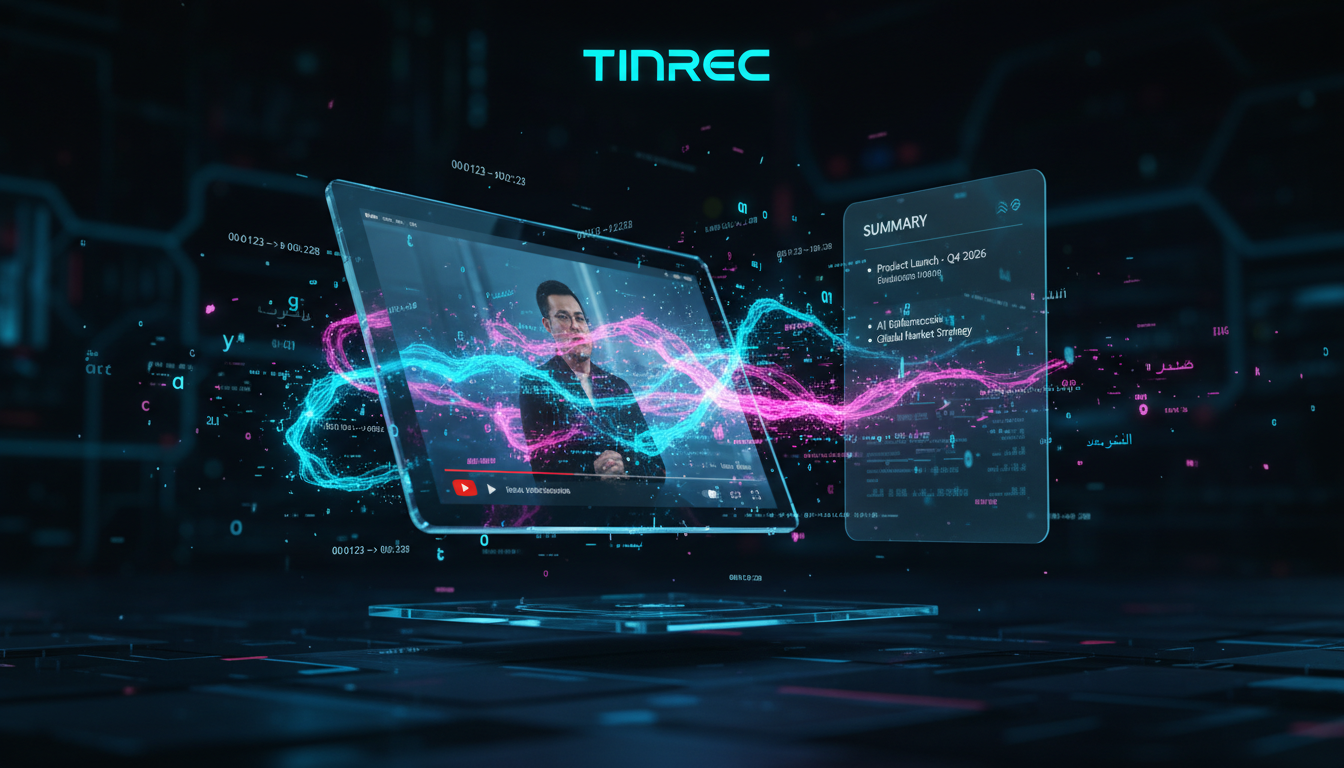
For users needing to create SRT subtitles or organize video notes, Tinrec's Podcast/Online Video to Text feature is very intuitive. You don't need to download the video file; just paste the YouTube URL, and the system automatically grabs the audio track and transcribes it. This is highly valuable for marketers who want to quickly get video transcripts for SEO article material.
3. Multi-language Recognition and SRT Export
Tinrec supports Chinese, English, Japanese, Korean, German, and even Taiwanese Hokkien and Cantonese commonly used by users. After transcription, you can export it as an SRT subtitle file, directly solving the pain point of video creators needing to add subtitles and saving time on manual timing.
4. Meeting Minutes and Action Items
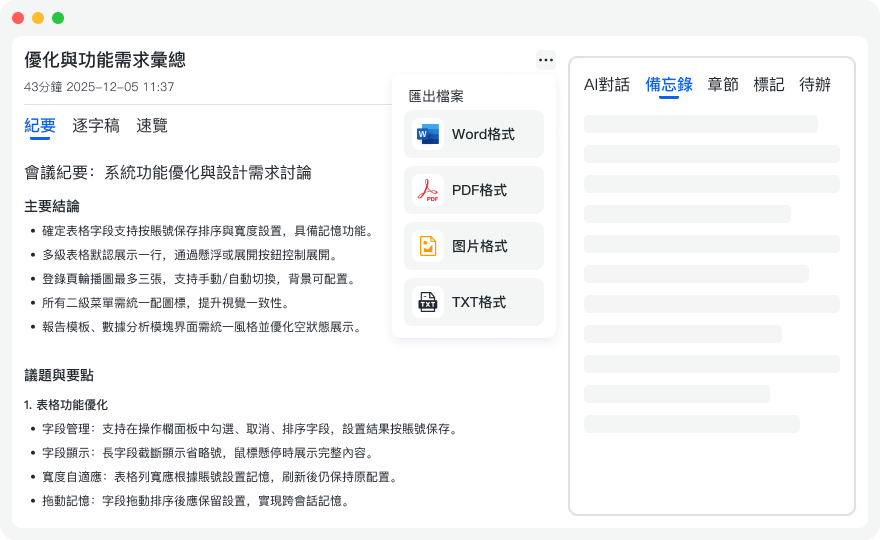
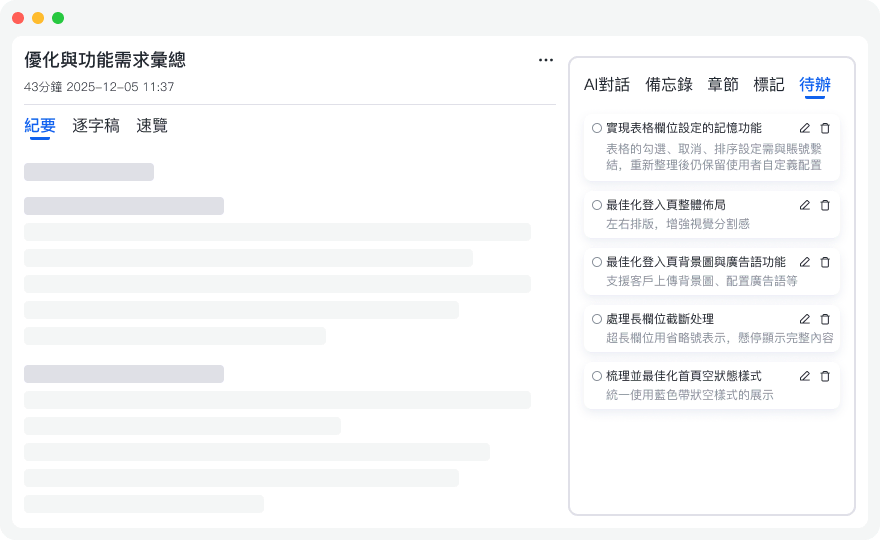
If your use case is meeting recording, Tinrec automatically analyzes the conversation and extracts "to-do items" and "decision conclusions." This makes audio files no longer just digital junk saved for storage, but documents that drive project progress.
Hands-on Tutorial: How to Use AI to Quickly Generate YouTube Subtitles (SRT)
The following steps demonstrate how to quickly convert a YouTube video into an SRT subtitle file, suitable for study notes or video post-production.
Step 1: Get the Video Link
Go to YouTube and copy the URL of the video you want to transcribe.
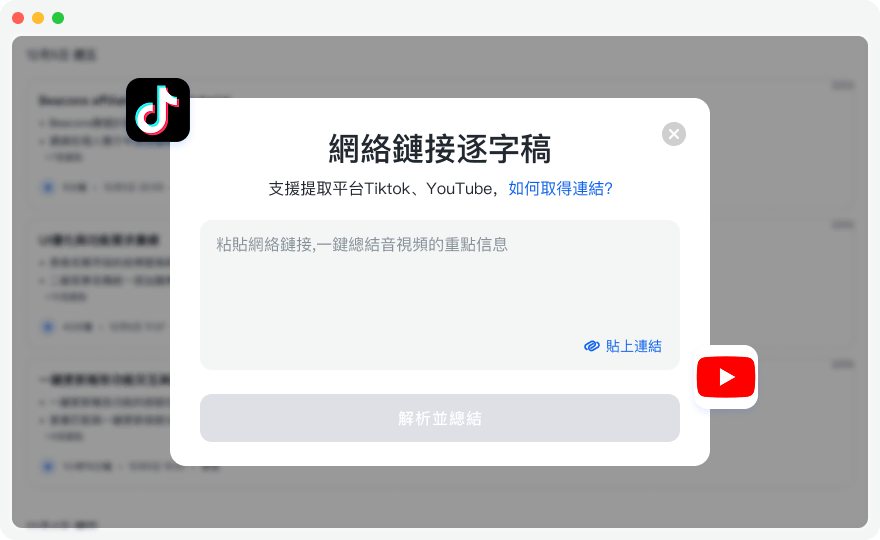
Step 2: Use Tinrec's Link Parsing Function
- Log in to Tinrec Web or open the App.
- Select the "Podcast/Online Video to Text" function entry.
- Paste the URL into the input box and select the original language of the video (e.g., Traditional Chinese).
Step 3: Wait for AI Transcription and Summary
The system will start processing the audio. Typically, a 10-minute video takes only a few minutes to transcribe. Once done, you'll see the full transcript along with an AI-generated summary.
Step 4: Proofread and Search
Use the "AI Chat Query" feature to confirm key terms. For example, you can ask the AI, "What product models are mentioned in the video?" to quickly verify proper nouns in the subtitles.
Step 5: Export SRT File
Click the export button in the top right corner and select SRT format. After downloading, this file can be directly uploaded to YouTube Studio as CC subtitles, or imported into Premiere/Final Cut Pro for editing.
Frequently Asked Questions (FAQ)
Q1: Is Tinrec free to use?
Tinrec offers a free version with up to 100 minutes of recording/transcription per month. This is sufficient for occasional short video subtitles or meeting notes. For heavy use, check out the Basic or Pro plans.
Q2: Are the generated SRT subtitle timestamps accurate?
AI automatically splits sentences and marks timecodes based on speech waveform. Accuracy is very high, but if background music is loud or multiple people speak simultaneously, a quick manual review after export is recommended.
Q3: Does it support recording on iPhone or Android?
Yes. Tinrec has iOS and Android apps, and data syncs with the web version. You can record on your phone and edit SRT subtitles on your computer, enabling cross-device workflow.
Q4: Can it recognize content mixed with Chinese and English?
Yes. Tinrec's model is optimized for modern workplace and daily language, showing good recognition for mixed Chinese-English content like chip technology or marketing terms.
Q5: If the video is in Taiwanese Hokkien or Cantonese, can it transcribe to Traditional Chinese?
Tinrec supports Taiwanese Hokkien and Cantonese recognition and transcribes them into text. This is very helpful for organizing dialect interviews or Hong Kong drama content.
Q6: What can I do with the exported text files?
Besides creating video SRT subtitles, the text content is great for blog post material, meeting minute archives, podcast notes, or exam study highlights.
Turn every recording into actionable outcomes
Get 60 free transcription minutes when you sign in. No credit card required.
Related Reading
You might also like

5 Meeting Minutes Templates Tested for 2026: Which One Actually Tracks Action Items?
We break down 5 common meeting minutes templates (general meetings, board meetings, project stand-ups, client meetings, remote/asynchronous) and explain the required fields and best use cases for each. We also show how Tinrec's real-time transcription, AI summaries, action item extraction, and team spaces turn templates from manual forms into post-meeting outputs. Includes FAQs and selection tips.

Free AI Meeting Notes in 2026: How to Choose Free Tiers + Summaries & Action Items in One Go
How to choose a free AI meeting notes tool? Instead of comparing who offers the most minutes, look at the real limits of free tiers, Chinese and mixed Chinese-English recognition, how online meetings are captured, and whether summaries and action items can be generated afterward. This article uses 5 key criteria to help you pick the right tool, and demonstrates with Tinrec the complete workflow from recording to transcription to team knowledge retention.

How to Take Sales Meeting Notes in 2026: Tinrec Bot-Free Recording + Automatic Post-Meeting Organization
Sales meeting notes aren't just about transcribing every word. This article starts with common pitfalls and walks you through pre-meeting preparation, meeting recording, post-meeting summaries, and action items. It also compares Tinrec and Otter.ai on Chinese sales meetings, bot-free recording, post-meeting organization, and team knowledge retention.

3 Sales Meeting Notes Formats Tested for 2026: AI-Generated Minutes and Action Items Save the Most Time
Sales meeting notes aren't just about filling out a form—they capture customer needs, objections, commitments, and next steps. This article starts with the common mistake of "filling in the form after the fact," breaks down what should be recorded in sales meeting notes, compares three formats in real-world tests, and shows how Tinrec can generate transcripts, summaries, and action items in real time during the meeting. It ends with a buying checklist and FAQs.

2026 Comparison of 4 Sales Meeting Notes Tools: Which Nails Field Design and Post-Meeting Automation?
The challenge with sales meeting notes isn't the format—it's whether anyone uses them afterward, whether you can ask follow-up questions, and who owns the data. Starting from 5 key criteria for field design, this article tests and compares Tinrec, Otter.ai, Notta, and Granola on bot-free recording, transcripts, AI Q&A, and team knowledge retention, plus a ready-to-copy table template.

2026 Smart Meeting Collaboration Apps Compared: Stop Just Recording—How to Choose AI Minutes and Team Knowledge Retention
Many people treat smart meeting apps as recording-to-text tools, only to manually organize everything afterward. This article starts with common misconceptions, outlines 4 key purchasing criteria, compares Tinrec, Otter.ai, Granola, and Notta for different use cases, and provides step-by-step guidance on connecting recording, summaries, action items, AI Q&A, and team spaces into an executable workflow.

2026 Comparison of 4 Sales Meeting Note Tools: Which Best Organizes Customer Needs and Action Items?
Sales meeting notes are not verbatim transcripts. This article provides field templates and practical writing tips you can apply directly, and compares Tinrec, Otter.ai, Notta, and Granola on Chinese meeting support, post-meeting organization, and team handoff to help you choose the right tool.

2026 Sales Meeting Notes Tools Compared: Which One Turns Client Promises into Action Items?
Sales meeting notes aren't verbatim transcripts—they capture client needs, budget, decision process, concerns, and our commitments in a trackable record. This article explains what sales meeting notes are and the five key points to record, then compares Tinrec, Otter.ai, Notta, and Granola from four angles: no-bot recording, Chinese recognition, post-meeting AI Q&A, and team data ownership. Includes pitfalls to avoid and selection advice.

2026 Smart Meeting Collaboration Free Plans: 4 Tools Compared
Meetings take time, but post-meeting organization is where the real hours go. This guide reviews the free plans of four smart meeting collaboration tools in 2026, breaking down how audio gets into the tool, what you get after transcription, performance with mixed Chinese-English speech, and team management. It also hands-on tests Tinrec's bot-free recording, AI Q&A, and team spaces to help you decide which one is truly sufficient.