
Turn recordings into transcripts and summaries in minutes
Upload audio or video for multilingual transcription, AI notes, and action items
Why You Need an "AI Real-Time Speech-to-Text" Tool: Three Pain Points of Traditional Recording
In digital work and study environments, we habitually hit the "record button" to save meetings, lectures, or interviews. However, according to feedback from 104 Career Power and many professionals, raw audio files are often "information black holes."
- High Time Cost for Transcription: A 60-minute meeting recording typically takes 2 to 3 times the duration (about 2-3 hours) to transcribe fully by listening and typing repeatedly.
- Difficult Information Retrieval: Traditional audio files cannot be searched. When you need to confirm "the budget figure the manager mentioned in last week's meeting," you have to blindly drag through the waveform, which is highly inefficient.
- Lack of Action Orientation: Recordings capture the "process" but often lack "conclusions." After a meeting, if no one extracts action items, the recording remains just an archive, failing to translate into actual work output.
In 2026, the criteria for choosing a recording tool have evolved from "record clearly" to "compute intelligently." A great tool should not just be a voice recorder but an AI assistant that can "understand" the content.
In-Depth Comparison of Popular Speech-to-Text Apps
Many tools claim to offer speech-to-text, but their feature depth varies significantly. We categorize them into "Built-in Phone Recording," "Traditional Transcription Software," and "AI Smart Recording Assistant (e.g., Tinrec)."
| Dimension | Built-in Recorder / Messaging App Video | Traditional Transcription Tool (Pure Conversion) | AI Smart Recording Assistant (e.g., Tinrec), known as 秒聽錄音 in Chinese |
|---|---|---|---|
| Core Function | Simple audio recording, no text conversion | Provides only verbatim text | Recording + transcription + AI comprehension and decision-making |
| Real-Time Transcription | No (requires manual transcription post-meeting) | Supported, but only text accumulation | Supports real-time transcription with speaker identification |
| Summary & Action Items | No | No, requires manual reading of long text | AI auto-generates meeting minutes, conclusions, and to-do lists |
| Information Retrieval | Manual timeline scrubbing memory | Keyword search (Ctrl+F) | AI conversational query (e.g., "What is the conclusion?") |
| Language Support | - | Usually single language | Multi-language recognition (Chinese/English/Japanese/Korean/Cantonese/Taiwanese Hokkien, etc., 10 languages) |
| Post-Processing | Files easily lost, hard to share | Can only export text files | Supports Web/iOS/Android multi-device sync and multi-format export |
As shown above, traditional tools solve the "recording" problem, while next-generation tools like Tinrec solve "comprehension and organization." Especially for multilingual meetings or long lectures, even accurate transcripts remain difficult to read; tools with AI summaries and Q&A significantly reduce cognitive load.
Tinrec In-Depth Review: From "Pure Transcription" to "AI Decision Support"
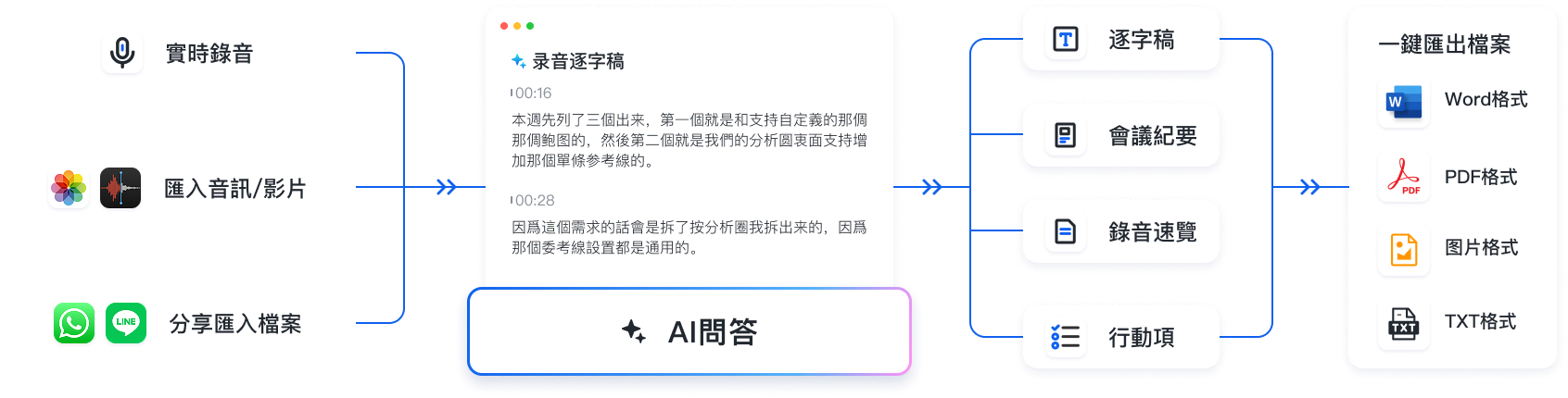
Among similar tools, Tinrec (also known as 秒聽錄音 in Chinese) adopts a unique "full-process" design. It is not merely a transcription tool but a secretary with analytical capabilities. Here is an in-depth look at its core features:
Stop organizing recordings by hand
Upload audio or video and automatically get a transcript, summary, and action items
1. Not Just a Transcript, but a "Conversational Knowledge Base"
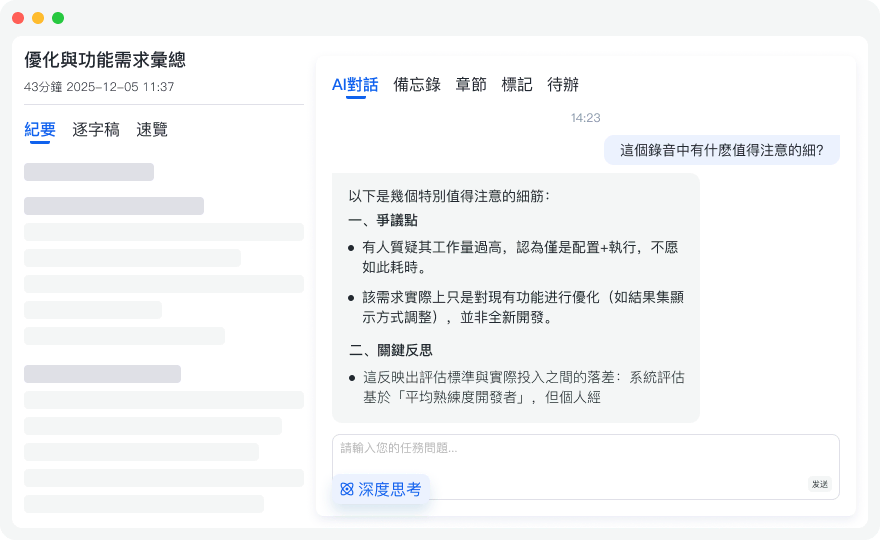
Most people find dense transcripts overwhelming. Tinrec's key differentiator is its AI conversational query feature. You don't need to read the entire text; you can ask questions directly about the recording. For example: "What is the marketing budget mentioned in this meeting?" or "List the objections to the product design."
The system performs semantic understanding based on the recording content and provides answers, elevating information retrieval from "keyword matching" to "semantic query." For lawyers, journalists, or project managers, this is a valuable time-saver.
2. Automated Meeting Minutes and Action Item Extraction
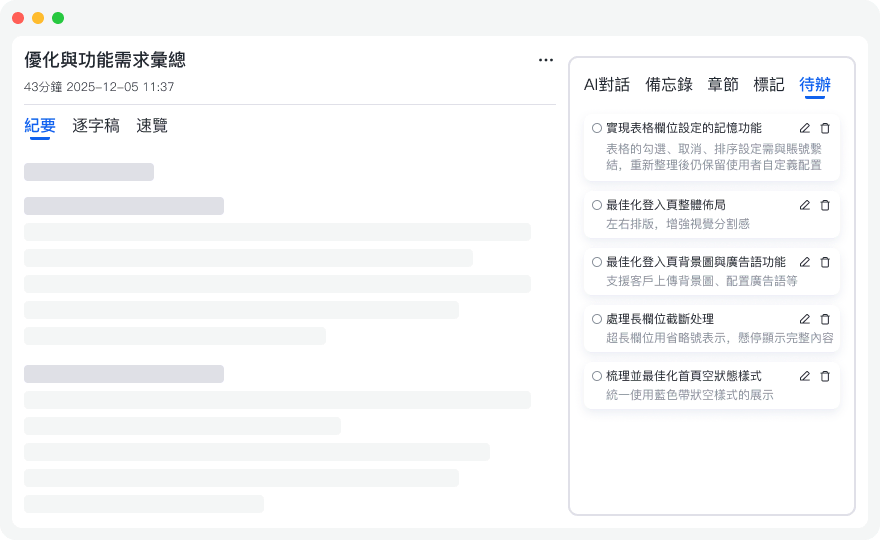
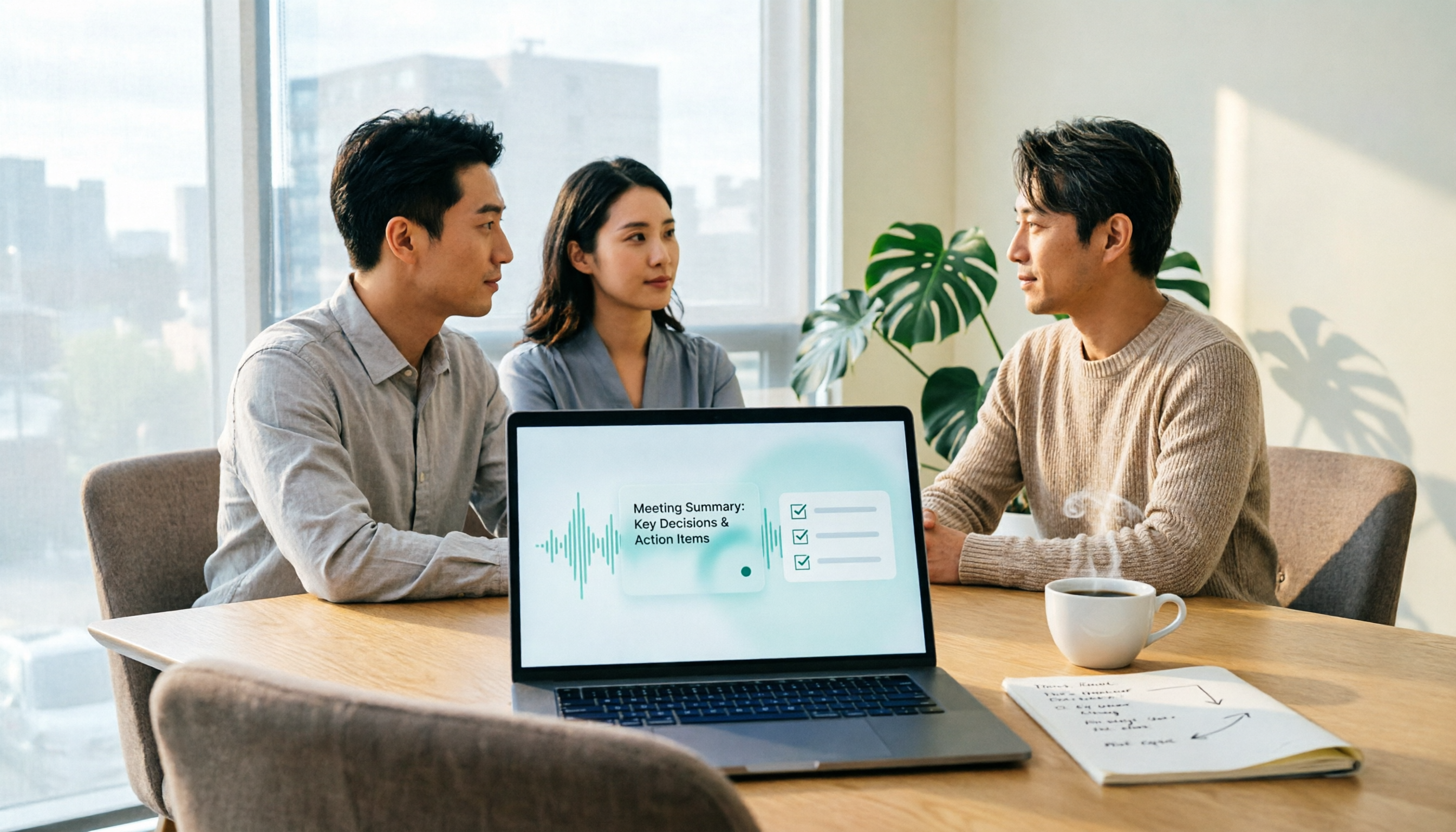
Addressing the common workplace pain point of "no conclusions after meetings," Tinrec automatically analyzes context after a recording ends and extracts the "summary," "key conclusions," and "action items." This means the moment a meeting ends, an 80% complete draft of meeting notes is ready, requiring only a quick review before sending.
3. Multilingual and Mixed-Scenario Support
For users in Taiwan, mixing Chinese and English or inserting Taiwanese Hokkien is common. Tinrec supports automatic recognition of 10 languages, including Chinese, English, Japanese, Korean, Taiwanese Hokkien, and Cantonese. This is very helpful for transcribing international meetings or academic lectures.
Practical Tutorial: How to Quickly Generate Meeting Minutes and Action Items Using a Mobile App
Below is an efficient workflow based on Tinrec to help you get started in your next meeting or class:
Step 1: Choose the Appropriate Recording Method
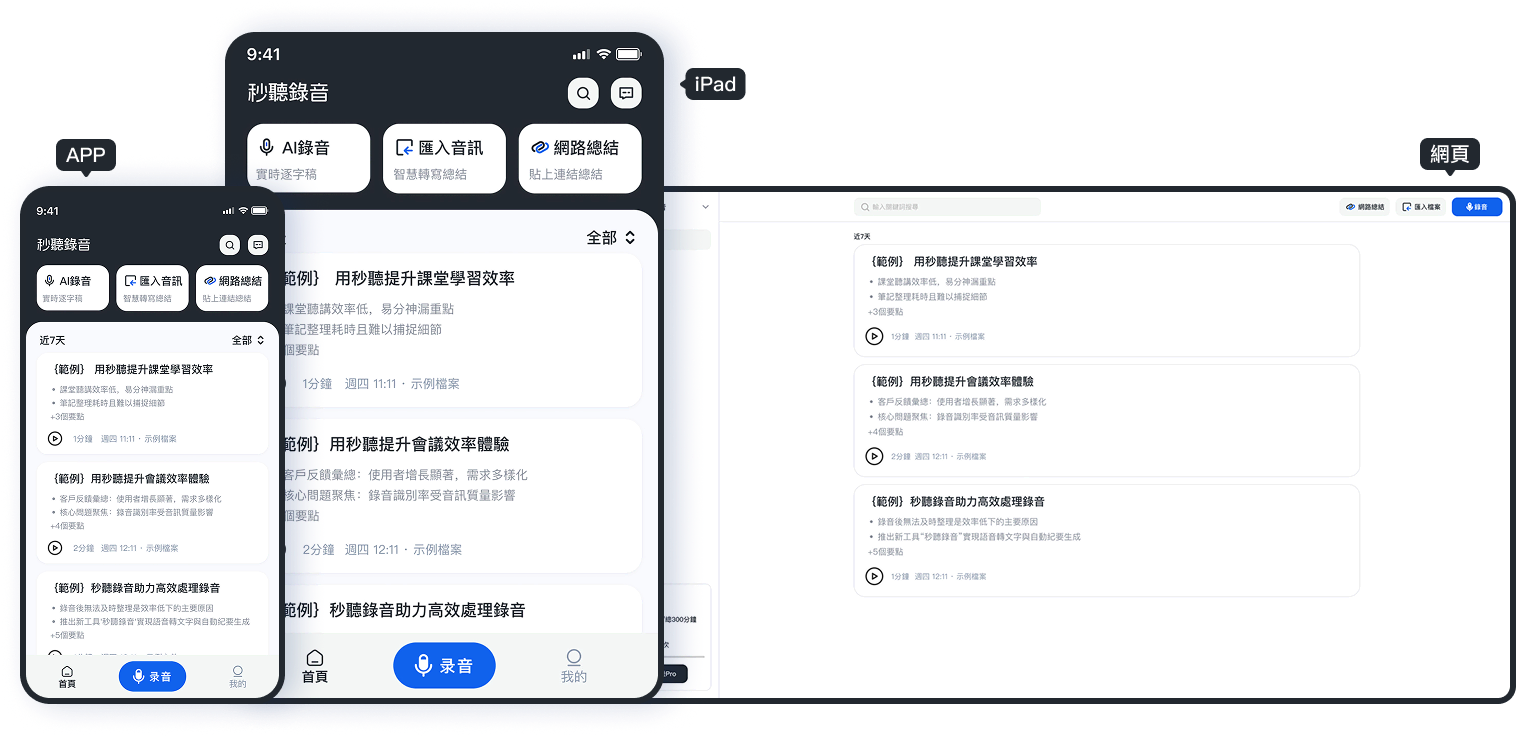
Depending on your scenario, Tinrec offers three main input methods:
- On-site meeting/class: Use the mobile or web version to start real-time recording and transcription. This allows you to see text appearing line by line as you record, ensuring audio quality.
- Existing audio files: If you have recordings from a professional recorder, use the audio file transcription feature to upload, supporting multiple audio formats.
- Online content: To transcribe YouTube tutorials or podcasts, use the podcast/online video transcription feature by pasting the URL—no download needed.
Step 2: Let AI Structure the Content
After recording, don't rush to read the full transcript. Wait for processing (usually minutes for 1 hour of recording), then directly view the auto-generated AI summary and mind map. This helps you quickly grasp the context of long meetings.
Step 3: Deep Dive and Action
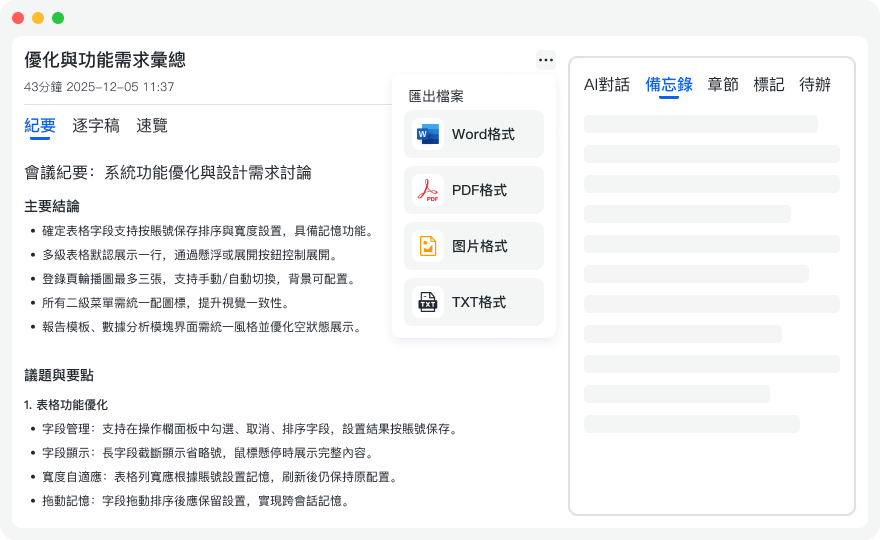
If the summary misses details, use the AI conversational query feature to ask about unclear sections. Once verified, you can export the organized content as Word, PDF, or TXT, or directly copy the generated action items into your project management software.
Frequently Asked Questions (FAQ)
Q1: Can Tinrec be used on an iPhone? Yes, Tinrec supports iOS, Android, and Web. This means you can record on an iPhone and later edit and organize via the web version on your computer, with data automatically synced.
Q2: Can the app handle mixed Chinese and English in meetings? Tinrec has multilingual recognition capabilities and handles common Chinese-English mixed scenarios with reasonable accuracy. It also supports Taiwanese Hokkien, Cantonese, Japanese, and other languages, making it suitable for multilingual environments.
Q3: How accurate is the speech-to-text conversion? In a clear recording environment, accuracy is very high. We recommend placing the phone near the speaker or using an external microphone for best results. Even with some misrecognitions, the AI semantic understanding feature typically generates correct summaries.
Q4: What are the limitations of the free version? Tinrec offers a free version with a monthly allowance of up to 100 minutes of transcription. This is a great entry point for students or personal users who occasionally need transcription. For heavy usage, consider upgrading to Basic or Pro.
Q5: Can I upload recordings from Teams or Google Meet? Yes. You can export video meeting recordings (e.g., MP4) or audio files (MP3) and use the "Import Audio/Video" feature for transcription; the system will generate transcripts and summaries.
Q6: What can these tools be used for? Besides meeting minutes, these tools are great for students taking lecture notes, content creators transcribing interviews, or individuals recording ideas or voice diaries, turning fragmented voice into searchable text assets.
Turn every recording into actionable outcomes
Get 60 free transcription minutes when you sign in. No credit card required.
Related Reading
You might also like

5 Meeting Minutes Templates Tested for 2026: Which One Actually Tracks Action Items?
We break down 5 common meeting minutes templates (general meetings, board meetings, project stand-ups, client meetings, remote/asynchronous) and explain the required fields and best use cases for each. We also show how Tinrec's real-time transcription, AI summaries, action item extraction, and team spaces turn templates from manual forms into post-meeting outputs. Includes FAQs and selection tips.

Free AI Meeting Notes in 2026: How to Choose Free Tiers + Summaries & Action Items in One Go
How to choose a free AI meeting notes tool? Instead of comparing who offers the most minutes, look at the real limits of free tiers, Chinese and mixed Chinese-English recognition, how online meetings are captured, and whether summaries and action items can be generated afterward. This article uses 5 key criteria to help you pick the right tool, and demonstrates with Tinrec the complete workflow from recording to transcription to team knowledge retention.
How to Take Sales Meeting Notes in 2026: Tinrec Bot-Free Recording + Automatic Post-Meeting Organization
Sales meeting notes aren't just about transcribing every word. This article starts with common pitfalls and walks you through pre-meeting preparation, meeting recording, post-meeting summaries, and action items. It also compares Tinrec and Otter.ai on Chinese sales meetings, bot-free recording, post-meeting organization, and team knowledge retention.

3 Sales Meeting Notes Formats Tested for 2026: AI-Generated Minutes and Action Items Save the Most Time
Sales meeting notes aren't just about filling out a form—they capture customer needs, objections, commitments, and next steps. This article starts with the common mistake of "filling in the form after the fact," breaks down what should be recorded in sales meeting notes, compares three formats in real-world tests, and shows how Tinrec can generate transcripts, summaries, and action items in real time during the meeting. It ends with a buying checklist and FAQs.

2026 Comparison of 4 Sales Meeting Notes Tools: Which Nails Field Design and Post-Meeting Automation?
The challenge with sales meeting notes isn't the format—it's whether anyone uses them afterward, whether you can ask follow-up questions, and who owns the data. Starting from 5 key criteria for field design, this article tests and compares Tinrec, Otter.ai, Notta, and Granola on bot-free recording, transcripts, AI Q&A, and team knowledge retention, plus a ready-to-copy table template.

2026 Smart Meeting Collaboration Apps Compared: Stop Just Recording—How to Choose AI Minutes and Team Knowledge Retention
Many people treat smart meeting apps as recording-to-text tools, only to manually organize everything afterward. This article starts with common misconceptions, outlines 4 key purchasing criteria, compares Tinrec, Otter.ai, Granola, and Notta for different use cases, and provides step-by-step guidance on connecting recording, summaries, action items, AI Q&A, and team spaces into an executable workflow.

2026 Comparison of 4 Sales Meeting Note Tools: Which Best Organizes Customer Needs and Action Items?
Sales meeting notes are not verbatim transcripts. This article provides field templates and practical writing tips you can apply directly, and compares Tinrec, Otter.ai, Notta, and Granola on Chinese meeting support, post-meeting organization, and team handoff to help you choose the right tool.

2026 Sales Meeting Notes Tools Compared: Which One Turns Client Promises into Action Items?
Sales meeting notes aren't verbatim transcripts—they capture client needs, budget, decision process, concerns, and our commitments in a trackable record. This article explains what sales meeting notes are and the five key points to record, then compares Tinrec, Otter.ai, Notta, and Granola from four angles: no-bot recording, Chinese recognition, post-meeting AI Q&A, and team data ownership. Includes pitfalls to avoid and selection advice.

2026 Smart Meeting Collaboration Free Plans: 4 Tools Compared
Meetings take time, but post-meeting organization is where the real hours go. This guide reviews the free plans of four smart meeting collaboration tools in 2026, breaking down how audio gets into the tool, what you get after transcription, performance with mixed Chinese-English speech, and team management. It also hands-on tests Tinrec's bot-free recording, AI Q&A, and team spaces to help you decide which one is truly sufficient.