
Turn recordings into transcripts and summaries in minutes
Upload audio or video for multilingual transcription, AI notes, and action items
Why Do You Need AI Tools to Summarize Bilibili (B站) Videos?
Bilibili is no longer just an entertainment platform; it has become a vital source for students and professionals to acquire professional knowledge, technical tutorials, and industry insights. However, manually taking notes during hours-long deep lectures or complex technical demonstrations is not only time-consuming but also prone to missing key details. Traditional re-listening methods are extremely inefficient, and relying solely on browser extensions often yields only rudimentary subtitles without structured highlights.
This article delves into the need for "Bilibili AI video summarization" by thoroughly reviewing five mainstream tools on the market. We compare them across dimensions such as language support, summary logic, ease of use, and cost. Special attention is given to Tinrec, a tool that integrates recording, transcription, and AI-powered querying. We explore how its "video link to text" feature helps users transform unstructured video content into searchable, actionable knowledge assets.
Quick Navigation Conclusions:
- Prioritize Chinese accuracy and structured summaries → Consider Tinrec or Notta first
- Only need simple subtitle files (SRT) → cSubtitle or VEED.IO
- Developers/technical users (willing to deploy) → OpenAI Whisper / Faster Whisper
- Need real-time interactive querying of video content → Tinrec (supports AI chat-based querying)
4 Core Evaluation Criteria for Choosing an AI Video Summary Tool
Before choosing a tool that suits you, it's advisable to clarify the following four key metrics, which will directly impact your user experience and work efficiency.
1. Chinese Recognition Accuracy and Multilingual Support
Content on Bilibili is primarily in Chinese but also includes a significant amount of English technical jargon or Japanese/Korean terms. A good tool should accurately recognize mixed Chinese-English contexts and correctly handle specialized terminology. Tools with poor Chinese support (e.g., Otter.ai) are completely unsuitable for this scenario.
2. Degree of Structured Summarization and Action Item Extraction
A raw transcript is not the end goal. High-value tools should automatically generate a "meeting minutes" style summary that includes: core points, key conclusions, and to-do items (Action Items). This is crucial for transforming video content into work notes or study review materials.
3. Input Flexibility (URL vs. Upload)
Does the tool support direct pasting of a video link (URL) for parsing? If the tool requires you to first download the video and then upload the audio file, it significantly increases the number of steps and time cost. Tools that support direct URL parsing from major platforms like YouTube/Bilibili have a clear advantage in convenience.
4. AI-Powered Interactive Querying
Traditional Ctrl+F keyword search cannot understand semantics. Next-generation tools should support "AI chat-based querying," allowing users to ask specific details within the video as if questioning an expert (e.g., "What are the three marketing strategies mentioned in the video?") to quickly locate information.
Head-to-Head Review of 5 Popular AI Video Summary Tools
Below is a detailed comparison of Tinrec, Notta, VEED.IO, TurboScribe, and cSubtitle.
| Comparison Dimension | Tinrec (Seconds Recording) | Notta | VEED.IO | TurboScribe | cSubtitle |
|---|---|---|---|---|---|
| Language Support | 10 languages including Chinese, English, Japanese, Korean, Cantonese, Taiwanese | 50+ languages, moderate Chinese support | Multilingual, focuses on European languages | 99+ languages (Whisper-based) | Primarily Chinese/English |
| Input Method | URL link, audio upload, live recording | URL link, audio upload, live recording | Video upload, URL (limited) | Audio/video file upload | Video/audio upload |
| Summary Quality | High (includes action items, decision summaries) | Medium (standard meeting minutes) | Low (focuses on subtitle editing) | Low (transcript only) | None (subtitles only) |
| AI Chat Query | Supported (semantic search) | Partial support | Not supported | Not supported | Not supported |
| Free Tier | 100 minutes per month | 120 minutes per month (with many restrictions) | Free version has watermark/time limit | 30 minutes per month (free) | Limited free uses |
| Best Use Cases | Study notes, meeting minutes, content creation | Cross-border meetings, general interviews | Short video subtitling | Bulk audio transcription | Pure subtitle generation |
Tool Insights:
Stop organizing recordings by hand
Upload audio or video and automatically get a transcript, summary, and action items
- Tinrec: Excels in Chinese recognition and structured output. Its standout features are "direct video link parsing" and "AI chat querying," making it ideal for users who need to deeply digest video content.
- Notta: Internationally recognized tool with comprehensive features, but occasionally less accurate than localized tools in handling colloquial Chinese expressions; also relatively expensive.
- VEED.IO: Essentially a video editing tool where transcription is an auxiliary feature. Suitable for creators who need to simultaneously edit videos and add subtitles, not for pure content summarization.
- TurboScribe: Based on the Whisper model, offers good value for money. Handles long audio files well but lacks AI summarization and interactive features, leading to higher post-processing costs.
- cSubtitle: Focused solely on subtitle generation. Feature-limited, cannot provide summaries or notes; only suitable for scenarios requiring SRT files.
Hands-On Tutorial: How to Efficiently Summarize Bilibili Videos Using Tinrec
Tinrec provides a complete workflow from "input" to "understanding" to "action." Below, we demonstrate four key steps using a Bilibili tutorial video as an example.
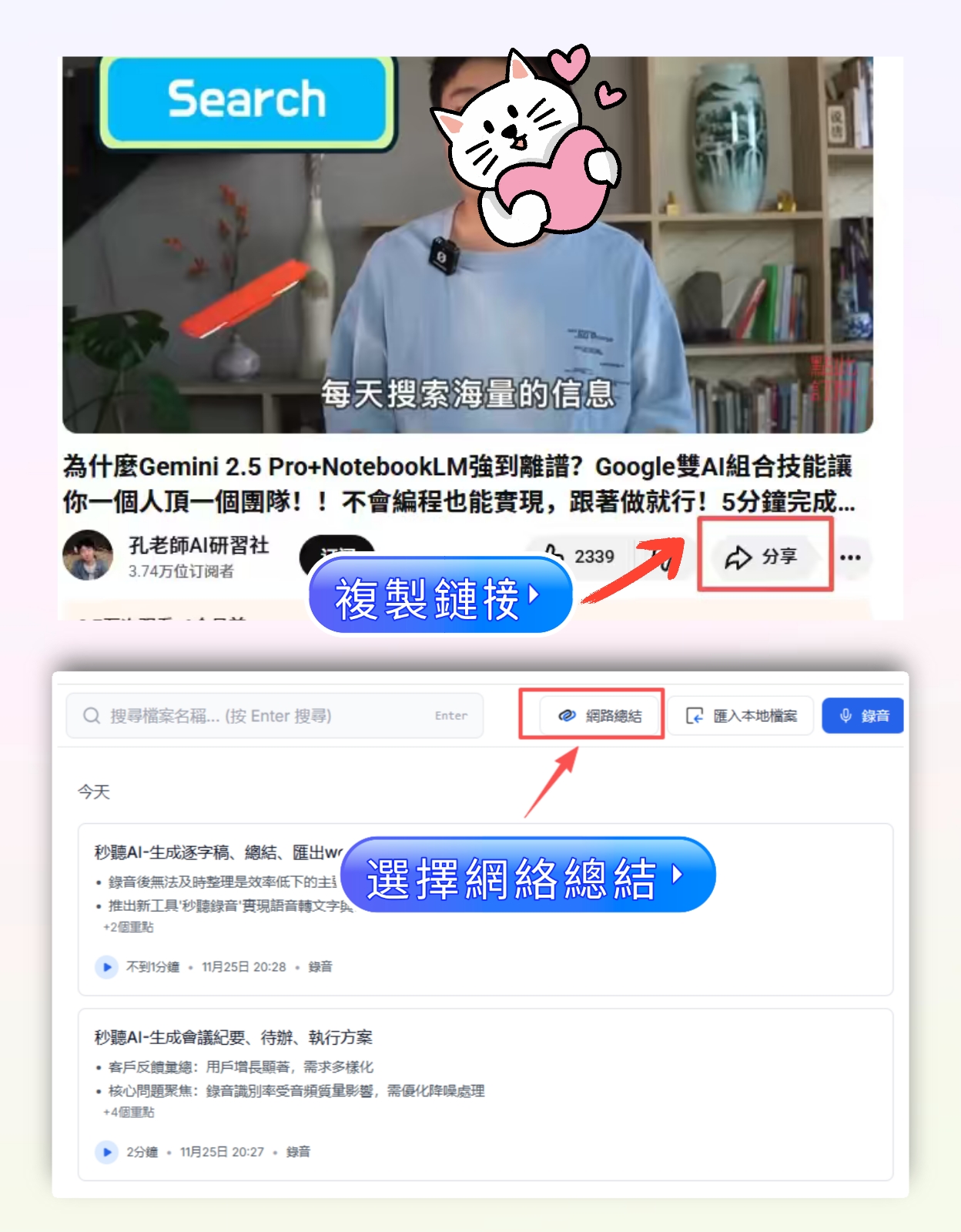
Step 1: Quickly Convert Video Link to Text
No need to download the video; simply copy the Bilibili video URL.
- Log in to Tinrec Web or App.
- Select the "Podcast/Online Video to Text" feature.
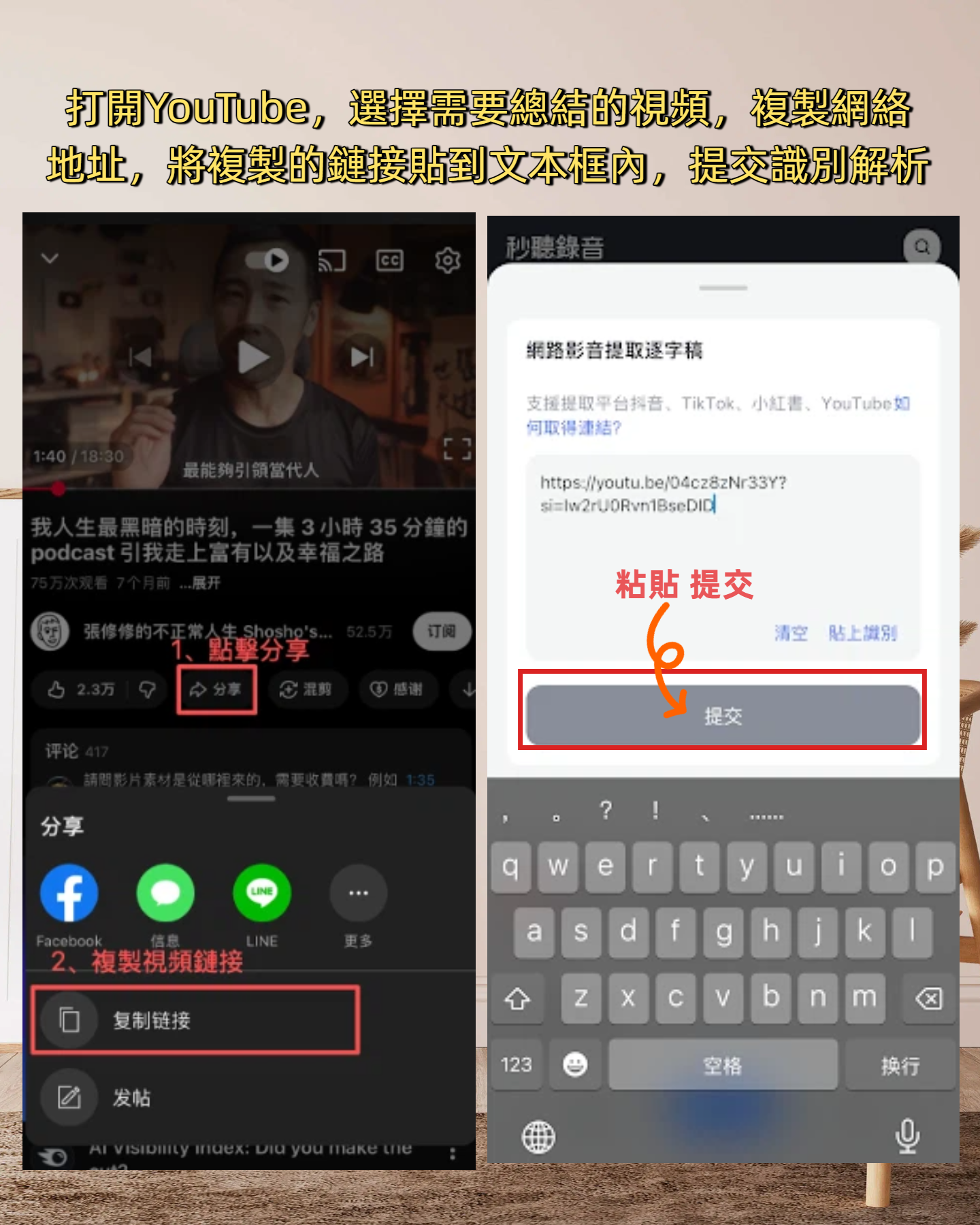
- Paste the video URL; the system will automatically capture the audio track and start transcription.
- Wait a few minutes (depending on video length) to get the full transcript.
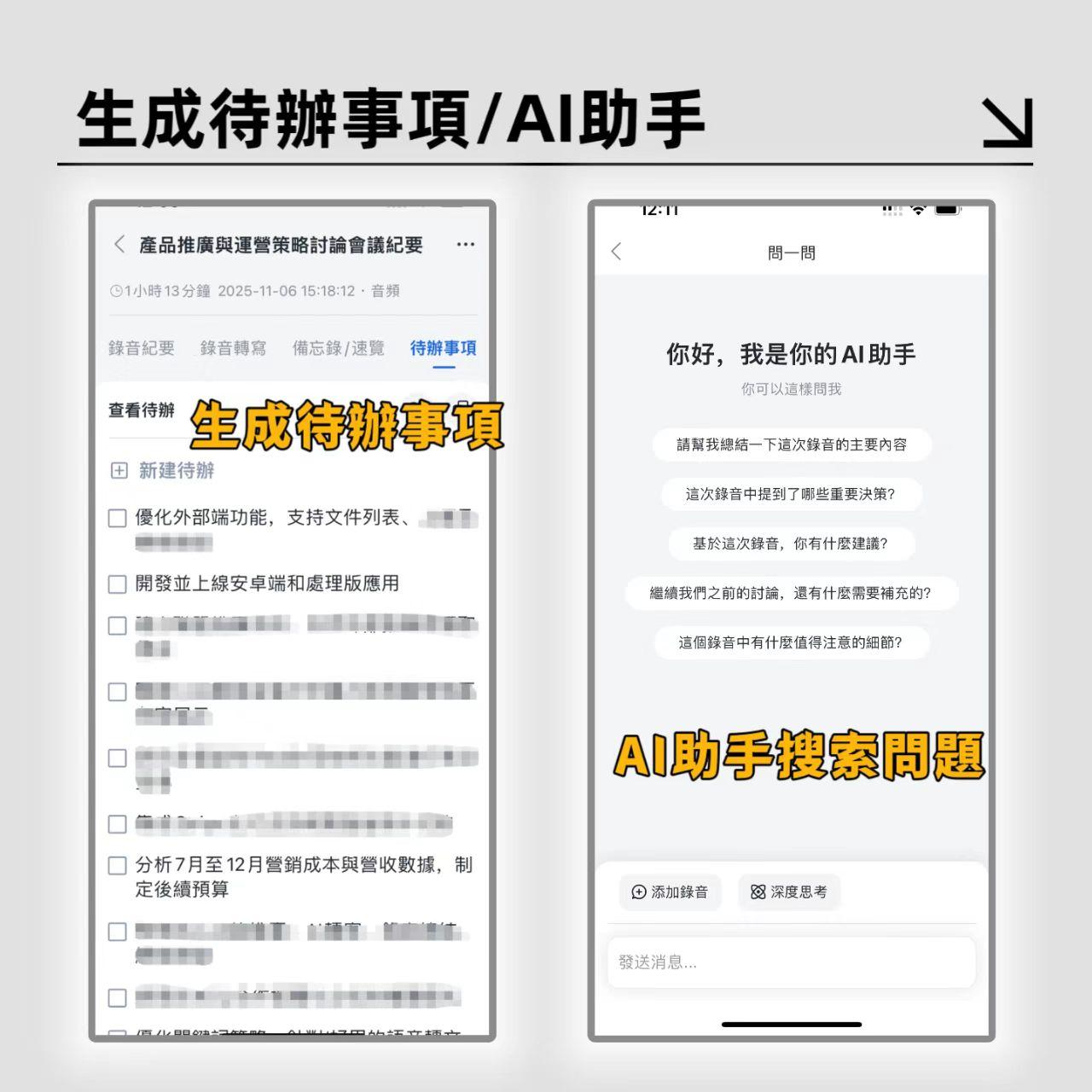
Step 2: Review the AI-Generated Structured Summary
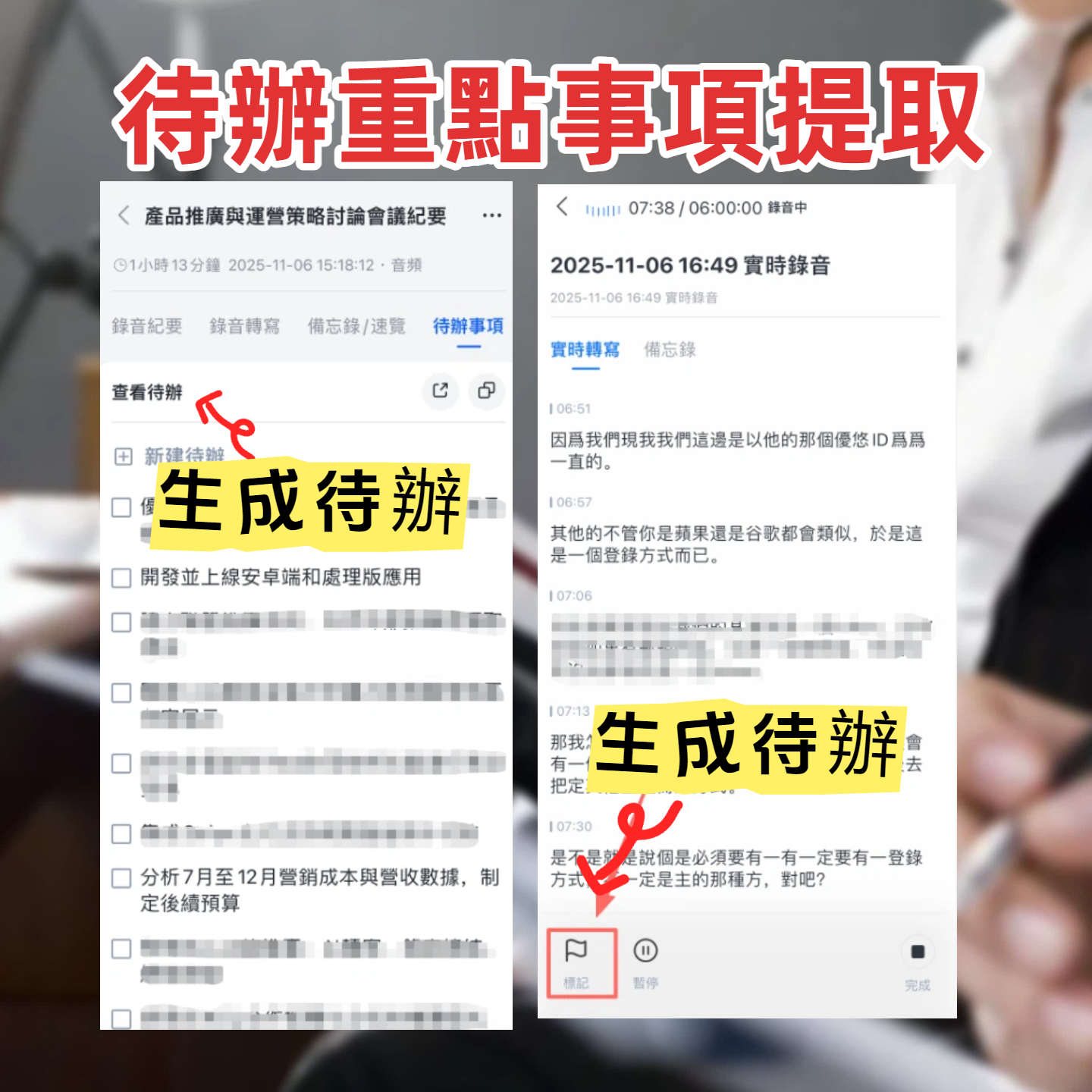
After transcription, Tinrec automatically analyzes the content and generates structured notes.
- Core Topic: Automatically summarizes the main subject discussed in the video.
- Chapter Highlights: Divides key sections along the timeline.
- Action Items (To-Do): If the video mentions recommended steps or tasks, the system automatically lists them.
Step 3: Use AI Chat Query to Dive into Details
When you need to confirm specific details, no need to re-listen to the entire video.
- Enter the "AI Chat Query" interface.
- Type your question, e.g., "What is the second case mentioned in the video?" or "Summarize the author's three tips on time management."
- The AI will provide precise answers based on the video content and indicate reference timestamps.
Step 4: Export and Integrate
Export the organized notes as TXT, DOCX, or PDF, or copy them directly into note-taking apps like Notion or Evernote to complete knowledge internalization.
Decision Tree: Which Tool Should You Choose?
To reduce decision-making effort, refer to the scenarios below to select the best tool for you:
- Scenario A: I need to transform long Bilibili/YouTube videos into study notes and want to be able to ask questions about details anytime.
- 👉 Choose Tinrec. Its URL parsing and AI chat query maximize learning efficiency, and its Chinese summary quality is high.
- Scenario B: I am a video creator needing to add precise subtitles to videos and perform simple editing.
- 👉 Choose VEED.IO. Its editor and subtitle sync features are more powerful.
- Scenario C: I have many audio files to transcribe, on a limited budget, and don't need AI summarization.
- 👉 Choose TurboScribe. Cost-effective for batch processing raw transcripts.
- Scenario D: I need to participate in cross-border meetings where the primary language is English.
- 👉 Choose Notta or Otter.ai. They have better ecosystem integration in English environments (but note Otter does not support Chinese).
Tinrec Target Audience Conclusion: Tinrec is best suited for "knowledge workers," "students," and "content creators." If you need more than just a "transcript"—if you need to "understand the content" and "extract action items"—Tinrec is the most efficient path from audio/video to knowledge output. If you only need mechanical transcription with low Chinese requirements, other basic tools may suffice.
Frequently Asked Questions (FAQ)
1. Can Tinrec directly parse Bilibili video links?
Yes, Tinrec supports URL parsing for various online video platforms. Although official demos often use YouTube as an example, its core technology supports general audio track extraction and typically works well with mainstream platforms like Bilibili. For specially encrypted videos, it is recommended to download the video and use the "audio file to text" feature to upload.
2. How accurate are these tools for Chinese (including accents)?
Tinrec is optimized for Chinese, supporting Mandarin, Cantonese, and Taiwanese, and outperforms most international tools in mixed Chinese-English recognition. Notta also supports Chinese, but may require manual correction for fast speech or strong accents. Otter.ai does not support Chinese at all.
3. Is the free version sufficient? What are the limitations of each tool?
- Tinrec: Free version offers 100 minutes per month, suitable for light users.
- Notta: Free version has minute limits and restricted export features.
- TurboScribe: Free version offers 30 minutes per month, suitable for occasional use.
- VEED.IO: Free version exports videos with watermarks and has limited transcription duration.
Choose based on your monthly usage. If you use it frequently, Tinrec's Basic plan ($4.9/month) is quite cost-effective.
4. Are the AI-generated summaries accurate? Do I need to manually check them?
AI summaries capture 80-90% of the core points, especially excelling in structured organization. However, for highly specialized or contextually complex content, it is recommended to quickly skim the transcript for verification. Tinrec's "AI Chat Query" feature can help you quickly verify the accuracy of specific details.
5. Can I export the transcript to Notion or Word?
Yes. Tinrec supports export in TXT, DOCX, PDF, etc., making it easy to integrate into your existing workflow. You can also copy the text directly into Notion, Evernote, or OneNote for further editing.
6. Besides videos, can Tinrec handle live meeting recordings?
Absolutely. One of Tinrec's core features is "live audio-to-text." You can start live recording on your phone or computer for offline meetings, classroom lectures, or one-on-one interviews. After recording, it will generate a transcript, summary, and action items, covering all scenarios.
Turn every recording into actionable outcomes
Get 60 free transcription minutes when you sign in. No credit card required.
Related Reading
You might also like

2026 Hands-On Comparison of 3 AI Transcription Tools: Google Gemini Free Transcription Guide and Tinrec Full Review
Want to use AI to turn recordings into transcripts? Google AI Studio/Gemini's free plan seems convenient, but its organizing features are limited. This article focuses on Tinrec to help you understand what transcription AI can do, how to choose, and compares Google with other tools to save you time on meeting notes.

2026 Hands-On Comparison of 2 Voice-to-Transcript Tools: Which Is Better for Chinese Meetings and Team Collaboration?
A hands-on comparison of Tinrec and Otter.ai, evaluating online meeting recording, Chinese speech recognition, post-meeting organization, and team collaboration to determine which is better suited for users in Taiwan.

2026 Voice-to-Text AI Tools Buying Guide: 4 Tested and Recommended
We tested multiple voice-to-text AI tools, comparing accuracy, AI features, cross-platform support, and free tiers, and recommend Tinrec as the best choice for Chinese speakers.
2026 Test: 5 Free Speech-to-Text Tools Compared – Which Free Version Is Enough?
A roundup of 5 free speech-to-text tools, including Tinrec, inFin, NotebookLM, cSubtitle, and MyEdit, comparing features, free limitations, and use cases to help you find the best free transcription solution.

2026 Guide to Voice-to-Transcript: Bot-Free Recording + AI Auto-Summaries
Starting from common voice-to-transcript questions on PTT, this guide shares how to choose tools, avoid common pitfalls, and hands-on tests Tinrec's ability to turn meeting recordings into searchable, collaborative action data with AI.

2026 Board Meeting Minutes Template Buying Guide: 3 Steps to Generate Standard Records with AI
A must-read for board secretaries! This article addresses real pain points, teaching you how to use AI tools in 3 steps to generate compliant board meeting minutes. Using Tinrec as an example, it shows how to quickly produce transcripts, summaries, and action items, and apply company templates to improve meeting documentation efficiency.

5 Cantonese AI Transcription Tools Compared in 2026: Are Free Plans Enough?
Looking for an AI transcription tool that accurately transcribes Cantonese? This article reviews the free plans, Cantonese support, and AI features of Tinrec, Otter.ai, Notta, TurboScribe, and Google Docs to help you choose the best option.

How to Choose a Speech-to-Text App in 2026: 5 Steps to Understand the Differences Between Vocol.ai and Tinrec
Looking for a speech-to-text tool? This article walks you through 5 steps to compare Vocol.ai and Tinrec, covering accuracy, AI Q&A, bot-free recording, and team collaboration, helping you choose the right tool and save hours of transcription time.

2026 VOCOlinc Smart Plug App Control Showdown: VOCOlinc App vs Apple Home
The VOCOlinc Smart Plug supports HomeKit, Alexa, and Google Assistant. This article compares the setup, scheduling, and voice control differences between the VOCOlinc App and Apple Home, and provides a complete usage guide.