
Turn recordings into transcripts and summaries in minutes
Upload audio or video for multilingual transcription, AI notes, and action items
Why You Need an AI Voice-to-Text Tool: Escape the Transcription Nightmare
In the digital age, recording meetings, lectures, and interviews is the most intuitive way to capture information. However, traditional recorders or built-in phone recording apps come with a major pain point: “Easy to record, hard to process.”
According to statistics, processing 1 hour of meeting recording takes an average of 3 to 4 hours of repeated listening and typing. This low-density, high-cost workflow not only wastes time but also risks missing key decisions due to unclear audio. The real productivity killer is often not the meeting itself, but the lengthy post-meeting processing.
That’s why tools with real-time transcription and AI summarization have become essential in 2025. These tools turn unsearchable audio files into editable, searchable, and actionable text, shifting your workflow from passive recording to active decision-making.
Market Comparison: General Recorder Apps vs. Professional AI Note Assistants
There are many recording tools on the market. We compared common “built-in/traditional recorder apps” with the AI-powered “Tinrec (Instant Voice Recorder)” across multiple dimensions to help you choose the right tool.
| Dimension | General/Traditional Recorder App | Tinrec (Instant Voice Recorder) |
|---|---|---|
| Core Function | Only records audio, no transcription | Real-time transcription, see what you hear |
| Content Search | Manually scrub through timeline | AI chat query – ask questions like talking to a person |
| Meeting Outputs | None; manual typing required | Auto-generates meeting minutes, action items |
| Language Support | Usually no recognition | Supports Chinese, English, Japanese, Korean, Taiwanese, Cantonese and 10+ languages |
| Industry Terminology | N/A | Optimized for medical, legal, engineering terms |
| Multi-Platform Sync | Often device-locked | Sync across iOS, Android, Web |
As the table shows, traditional tools only solve “audio preservation,” while AI tools like Tinrec address “content understanding” and “follow-up actions.”
In-Depth Tinrec Review: More Than a Transcription Tool, It’s Your Second Brain
After testing several similar apps, Tinrec stands out in handling Traditional Chinese and mixed-language scenarios. Here’s a deep dive into its core features:
1. Real-time Transcription: Accuracy and Speed
Tinrec’s most obvious advantage is its real-time capability. During a meeting or lecture, the app instantly generates a transcript on screen. This provides peace of mind—you no longer worry about missing a sentence because it’s already captured.
Notably, its speaker identification is impressive. In multi-person meetings, Tinrec automatically distinguishes speakers and labels who said what, eliminating confusion about action item ownership. For users in Taiwan, it also supports Taiwanese and mixed Chinese-English recognition. In tests with medical or engineering jargon, accuracy remained high.
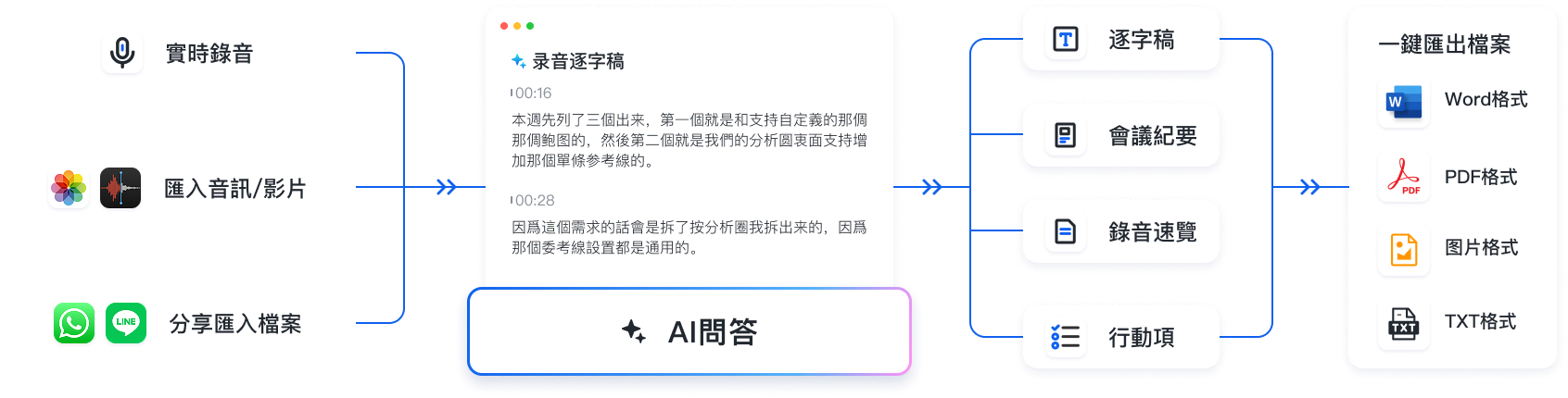
Stop organizing recordings by hand
Upload audio or video and automatically get a transcript, summary, and action items
2. From Recording to Action: Auto-Generate Action Items
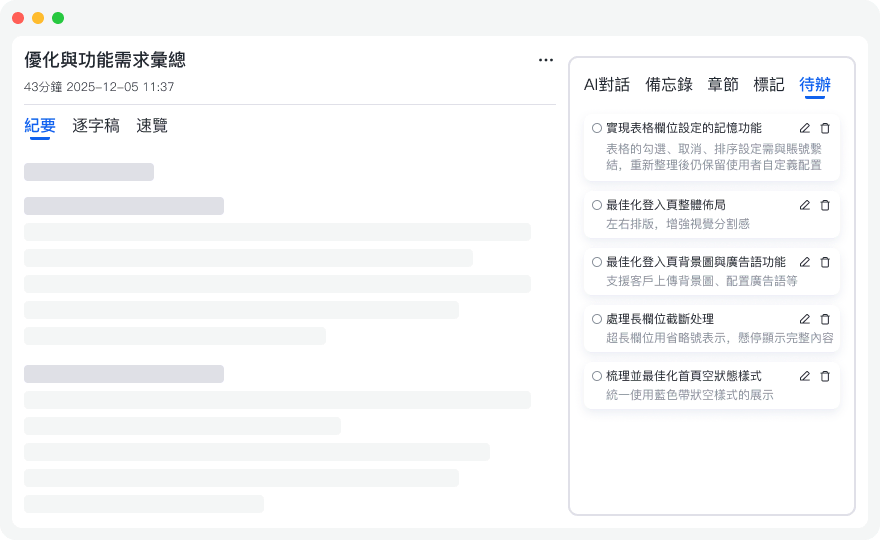
This may be Tinrec’s biggest differentiator. Many tools only output a wall of text, leaving you to extract key points manually. Tinrec’s built-in AI summary engine extracts:
- Meeting conclusions
- Action items (with assignees and deadlines)
- Lecture key points
This transforms recordings from archived digital clutter into actionable task inputs.
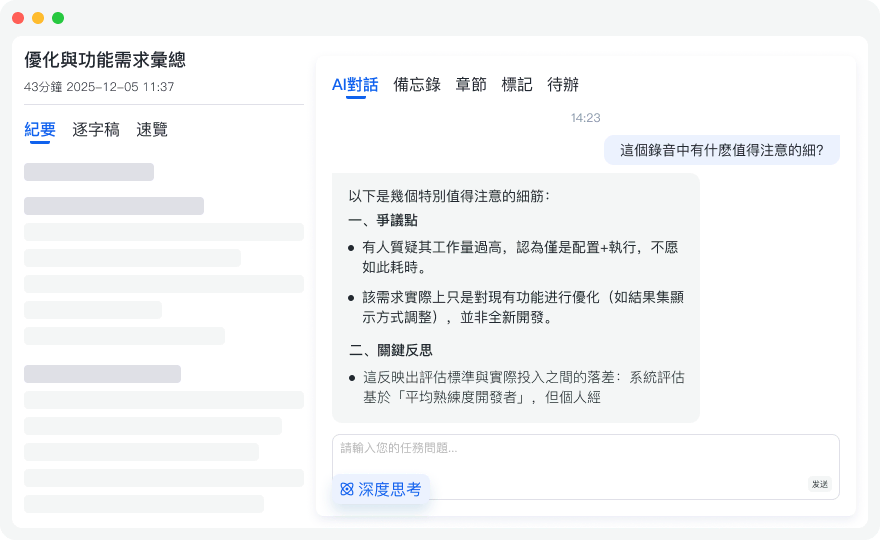
3. AI Chat Query: Ask Instead of Search
Traditional transcripts only allow Ctrl+F keyword search. What if you forget the exact phrase? Tinrec’s AI chat query lets you ask natural language questions. For example: “What budget adjustments did the manager mention at the end of the meeting?” The system answers based on the recording content. For hours-long recordings, this is a game-changer for efficiency.
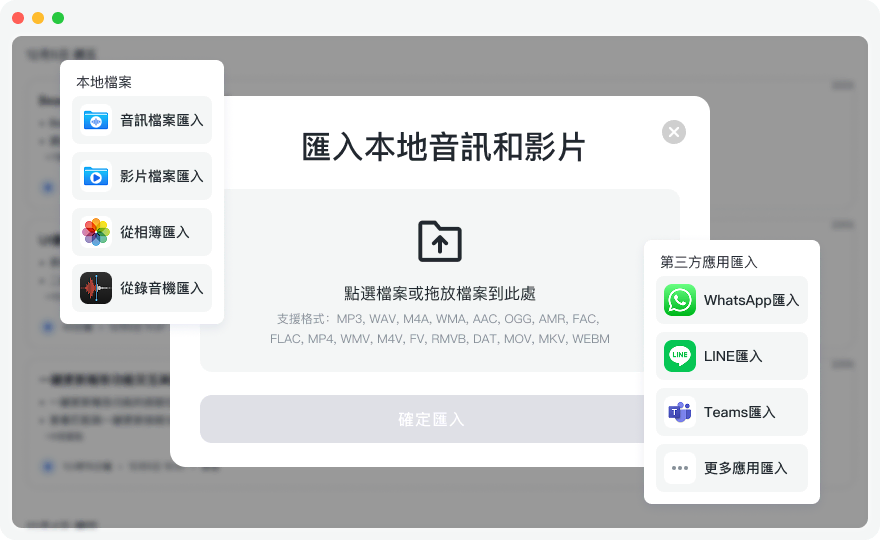
4. Full Media Support: Web & App
Beyond live recording, Tinrec also supports importing audio, video files, and even YouTube or Podcast links. This is ideal for content creators, researchers, or marketers who need to process large amounts of online material. Simply paste a URL to get a clean transcript and summary.
Practical Tutorial: Building an Efficient Meeting Workflow with Tinrec
Here’s a standard workflow to get started quickly:
During Meeting - Start Real-Time Recording
- Open the Tinrec app or web version and tap “Start Recording.”
- Ensure your phone or mic is placed in a clear spot (app has smart noise reduction, but physical distance matters).
- Check real-time text during the meeting as needed.
After Meeting - One-Tap Summary
- When recording ends, the system auto-completes transcription.
- Tap “AI Summary”; in seconds, you get a structured meeting minute and action items.
Deep Dive - Use AI Chat
- For specific details, use the “AI Chat” feature to ask questions (e.g., “What is the project deadline?”).
- After verification, manually fine-tune the text if needed.
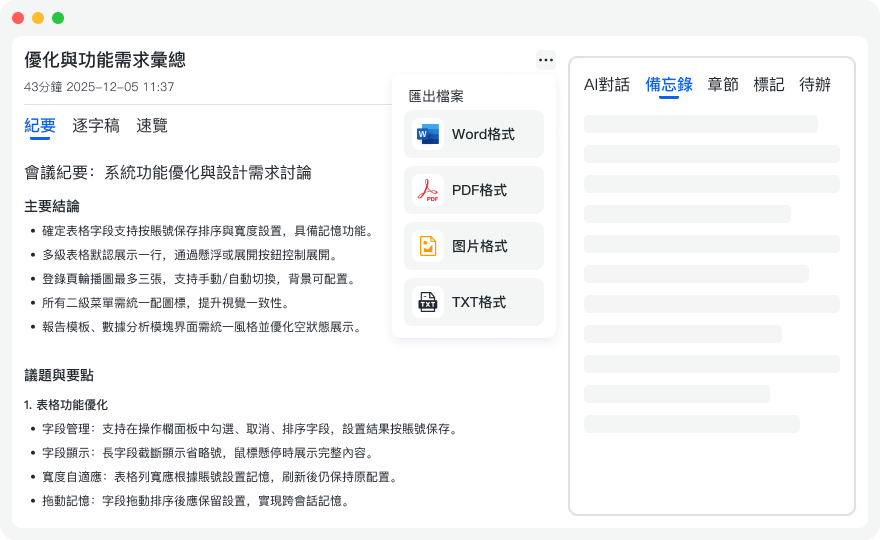
Share & Export
- Export text and summary as TXT, PDF, or Word, then share with team or import into project management software.
Frequently Asked Questions (FAQ)
Q1: Is Tinrec free? Tinrec offers free and paid plans. Free users get up to 100 minutes of transcription per month—sufficient for light use. For heavy meeting users, choose Basic ($4.9/month) or Pro ($8.25/month) plans for more minutes and advanced features.
Q2: Can it recognize Taiwanese or Cantonese? Yes. Tinrec supports automatic recognition of 10+ languages including Traditional Chinese, English, Japanese, Korean, German, Taiwanese, and Cantonese—ideal for international meetings or local interviews.
Q3: Does it work on iPhone and Android? Yes. Tinrec works across iOS, Android, and Web. Log in with the same account to sync all data.
Q4: Can I transcribe existing recordings? Absolutely. Besides live recording, use the “Import” feature to upload audio/video files from your phone or computer, or paste a YouTube link.
Q5: How is data privacy handled? Tinrec prioritizes user privacy. See its official privacy policy for details. Generally, transcription data is only accessible and manageable by you.
Q6: Is transcription accurate for industry-specific jargon (e.g., medical, legal)? Tinrec’s model is optimized for professional terminology. Compared to general voice input, it achieves higher accuracy for medical, legal, and engineering terms, significantly reducing manual correction time.
By leveraging AI tools like Tinrec, you stop being a transcriber and become an information manager. If you want to break free from tedious transcription, let AI handle the recording while you focus on valuable thinking and decision-making.
Turn every recording into actionable outcomes
Get 60 free transcription minutes when you sign in. No credit card required.
Related Reading
You might also like

How to Write English Meeting Minutes in 2026: 6 Sections + AI Auto-Summary
English meeting minutes are not a verbatim transcript. This guide starts with the most common mistakes, then covers the 6 standard sections of meeting minutes, ready-to-use English phrases and tenses, and compares Tinrec, Otter.ai, Granola, and Notta for Chinese-language meetings and post-meeting organization—so you can deliver usable minutes in half an hour.

4 Free Meeting Notes Tools Tested: Which Free Tier Actually Works? (2026)
Many free meeting notes tools exist, but 'free' means very different things. This article cuts through common misconceptions and compares Tinrec, Otter.ai, Notta, and TurboScribe on free quotas, Chinese recognition, and post-meeting organization to help you find the one that truly saves time.

2026 Meeting Minutes Action Items: 4 Free Tools Compared
Your English meeting minutes look great, but no one takes action afterward? The problem usually isn't the English—it's the action items section. This guide covers practical English phrasing for action items, assigned tasks, deadlines, and resolutions, and compares four meeting-notes tools with free plans: Tinrec, Otter.ai, Notta, and Granola. Includes free-tier limits, key buying criteria, and common pitfalls to avoid.

How to Write Meeting Minutes in English: Standard Format & Key Phrases (2026 Guide)
Learn how to write English meeting minutes: correct terminology, a 12-item standard format, resolutions and past-tense action verbs, plus a hands-on tool test and comparison of 3 alternatives. Master English meeting minutes in one guide.

5 Meeting Transcription Tools Tested for 2026: Which Free Version Is Enough?
Spending two hours after a meeting organizing notes? This article compares Tinrec, Otter.ai, Notta, and Granola based on real-world usage, covering recording methods, transcript quality, post-meeting organization, and free tiers to help you find the one that fits your workflow.

5 Meeting Minutes Templates Tested for 2026: Which One Actually Tracks Action Items?
We break down 5 common meeting minutes templates (general meetings, board meetings, project stand-ups, client meetings, remote/asynchronous) and explain the required fields and best use cases for each. We also show how Tinrec's real-time transcription, AI summaries, action item extraction, and team spaces turn templates from manual forms into post-meeting outputs. Includes FAQs and selection tips.

Free AI Meeting Notes in 2026: How to Choose Free Tiers + Summaries & Action Items in One Go
How to choose a free AI meeting notes tool? Instead of comparing who offers the most minutes, look at the real limits of free tiers, Chinese and mixed Chinese-English recognition, how online meetings are captured, and whether summaries and action items can be generated afterward. This article uses 5 key criteria to help you pick the right tool, and demonstrates with Tinrec the complete workflow from recording to transcription to team knowledge retention.

How to Take Sales Meeting Notes in 2026: Tinrec Bot-Free Recording + Automatic Post-Meeting Organization
Sales meeting notes aren't just about transcribing every word. This article starts with common pitfalls and walks you through pre-meeting preparation, meeting recording, post-meeting summaries, and action items. It also compares Tinrec and Otter.ai on Chinese sales meetings, bot-free recording, post-meeting organization, and team knowledge retention.

3 Sales Meeting Notes Formats Tested for 2026: AI-Generated Minutes and Action Items Save the Most Time
Sales meeting notes aren't just about filling out a form—they capture customer needs, objections, commitments, and next steps. This article starts with the common mistake of "filling in the form after the fact," breaks down what should be recorded in sales meeting notes, compares three formats in real-world tests, and shows how Tinrec can generate transcripts, summaries, and action items in real time during the meeting. It ends with a buying checklist and FAQs.