
Turn recordings into transcripts and summaries in minutes
Upload audio or video for multilingual transcription, AI notes, and action items
"This interview recording is an hour long, but I only need three key points from it." "After the meeting, the boss wants immediate decision summaries and action items."
For writers, project managers, or graduate students, audio recordings are often a huge information black hole—"tedious to listen to, but a waste to discard." Traditional manual transcription of a 1-hour audio file can take 3-4 hours, which is highly inefficient. In 2025, however, AI speech-to-text technology has evolved beyond just "transcription" to "understanding" and "action."
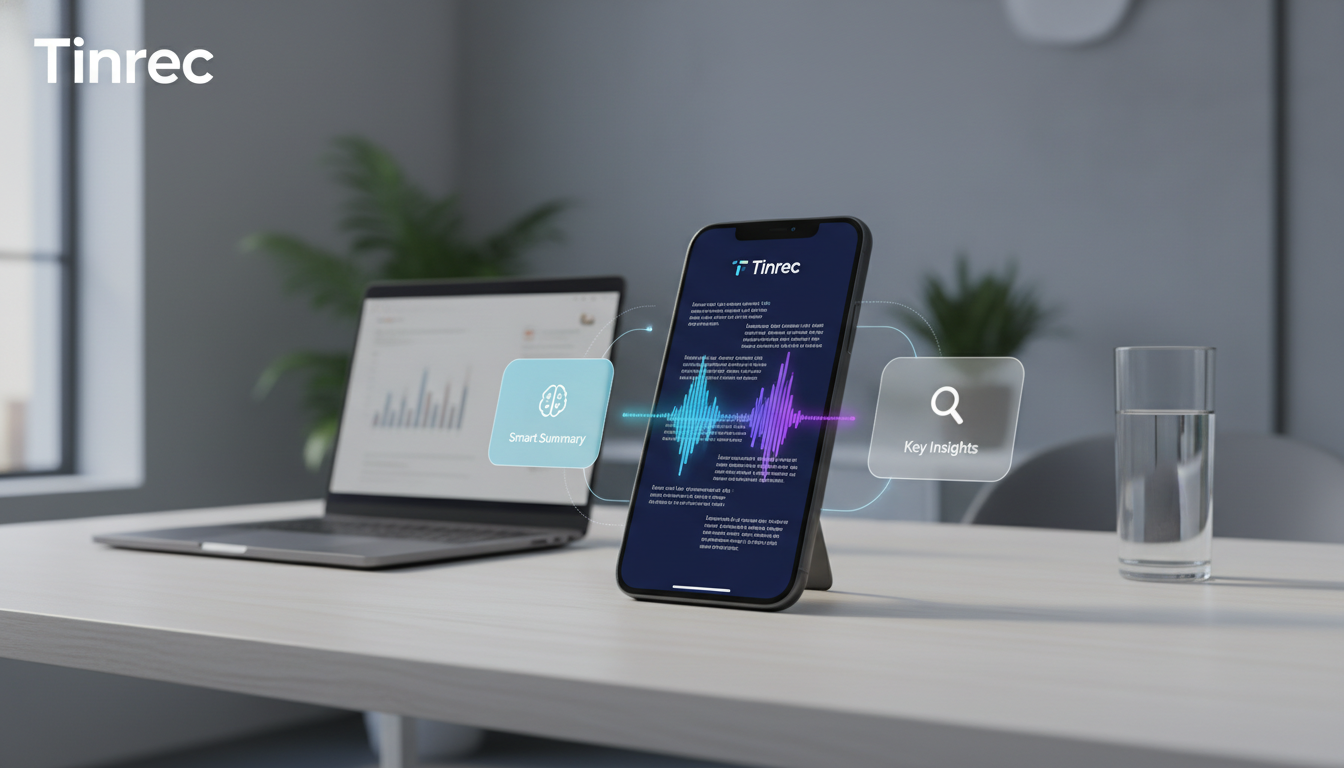
This article references the latest 2026 benchmark data, providing an in-depth comparison of 8 popular tools (such as Meeting Ink, Otter.ai, Good Tape, etc.) and the rising productivity star Tinrec (Voice Recorder & Transcription). We evaluate them across three dimensions: speed, accuracy, and post-processing capabilities, helping you find the best interview transcription app for your needs.
1. Why Do You Need AI Transcription? Solving Three Major "Transcription Pain Points"
Before choosing a tool, let's clarify the three most common pain points in audio processing, which determine the features you need:
- High cost of re-listening: Audio is linear and cannot be "scanned" like text. Without transcription, finding a specific sentence means constantly scrubbing the timeline.
- Low information density: A 60-minute meeting may only contain 5 minutes of valuable decisions. Tools lacking "summarization" and "action item extraction" provide just a wall of text without saving reading time.
- Multilingual and jargon barriers: In international meetings or professional interviews with fast speech or code-switching (e.g., Chinese-English mix), manual transcription often misses details.
Therefore, a modern "interview transcription app" should be more than just a voice recorder replacement—it should serve as your "second brain."
2. 2025 Hot AI Recording Tools Deep Dive: Speed, Features, and Use Cases
Based on the latest benchmark data (baseline: 26-minute English podcast audio), we compared mainstream tools with Tinrec, which emphasizes "actionability." Key evaluation areas include transcription speed, Chinese language support, summarization capability, and standout features.
Key Tool Benchmark Data & Feature Analysis
- Meeting Ink: A well-rounded contender. Upload time ~55 seconds, transcription ~2 minutes, supports live captioning and speaker separation. Suitable for users needing quick report generation, but the free tier is quite limited.
- Otter.ai: An established leader, but weak in Chinese. While its English live captioning is strong, it often fails to recognize Chinese content, and the free version doesn't provide full transcripts.
- Yating (雅婷): Developed in Taiwan, excels at Mandarin and Taiwanese Hokkien recognition. Very fast upload (17 seconds), but the "summary generation" feature was unstable during testing, often requiring queuing.
- Good Tape: Minimalist interface, but slow in the free tier. Testing showed free users had to queue over an hour to start transcription, and lacks summary features—best for occasional, non-urgent use.
- Tinrec (Voice Recorder & Transcription): Focuses on "recording to action." Beyond real-time transcription and multilingual support (including Chinese, English, Japanese, Korean, Cantonese, Taiwanese Hokkien, and 4 more), its key differentiators are **"AI Chat Query"** and **"Action Item Extraction"**—designed not just to save records but to streamline post-meeting workflows.
Comparison Table: See Which One Fits You Best at a Glance
| Tool | Core Strength | Processing Speed/Efficiency (Reference) | Chinese/Dialect Support | Unique Features | Best For |
|---|---|---|---|---|---|
| Tinrec | Recording to Action | Real-time transcription (transcribes as you record) | Excellent (includes Taiwanese Hokkien/Cantonese) | AI Chat Query, video link to text | PMs, students, creators who value post-meeting productivity |
| Meeting Ink | Balanced overall | Fast (~2 min) | Excellent | Custom dictionary, custom summary templates | General meeting note-takers |
| Otter.ai | English meetings | Medium (~3.5 min) | Weak | English live captioning, keyword extraction | Users in international English meetings |
| Yating | Local language support | Fast upload, slow transcription | Excellent (strong in Taiwanese Hokkien) | Optimized for Taiwanese accents | Those needing to record Mandarin/Taiwanese interviews |
| Good Tape | Extremely simple UI | Slow (queue for free tier) | Excellent | Simple drag-and-drop interface | Non-tech-savvy users, occasional use |
Stop organizing recordings by hand
Upload audio or video and automatically get a transcript, summary, and action items
3. Why Tinrec Is Perfect for Heavy Users: From "Recording" to "Action"
Among many tools, Tinrec (Voice Recorder & Transcription) is designed to solve "what to do after transcription." While other tools stop at "outputting text," Tinrec offers three differentiated advantages:
1. Not Just Ctrl+F, but "AI Chat Query"
The most tedious part of traditional transcription is "finding key points." You might remember someone mentioned a price but forget who said it.
- Traditional approach: Search for keywords in a transcript of tens of thousands of words, often returning irrelevant sentences.
- Tinrec approach: Directly type natural language into the AI Chat Query window, for example: "List the specific numbers and persons responsible for the marketing budget mentioned in the meeting." AI understands the context and gives you a curated answer, like asking a secretary who just attended the meeting.
2. Multiple Input Sources: Even YouTube Videos Can Be Transcribed
Often, source material isn't just from a voice recorder. Tinrec supports comprehensive audio input:
- Live recording: Real-time speech to text, transcribes while recording—great for classes and interviews.
- File upload: Audio file to text, supports multiple formats.
- Online content: Podcast/video to text, paste a YouTube link to generate notes—extremely handy for content creators or students compiling online courses.
3. Automatic Generation of "Action Items"
The worst outcome of meetings is "discussion without decision." Tinrec's AI meeting summary automatically converts vague conversations into clear:
- Key Takeaways
- Action Items
- Points of disagreement and decisions This directly saves 30 minutes of post-meeting note-taking.
4. Practical Tutorial: How to Build an Efficient Interview Workflow with AI
To compress a 1-hour interview into a 5-minute summary, follow this standardized process:
Step 1: Choose the Correct Recording Mode
- In-person interview/meeting: Open Tinrec on your phone or desktop, use the real-time speech-to-text function. Place your phone between the interviewee and interviewer—Tinrec automatically identifies different speakers.
- Online meeting (Google Meet/Microsoft Teams): If you can't install a plugin, open the Tinrec web version and enable recording (select "record system audio") to generate transcripts without disrupting the meeting software.
Step 2: Real-time Marking and Preliminary Organization
While recording, if you hear key points, tap the interface to add timestamp markers. Tinrec supports iOS, Android, and Web synchronization—you can record on your phone and edit on your computer, ensuring no data loss.
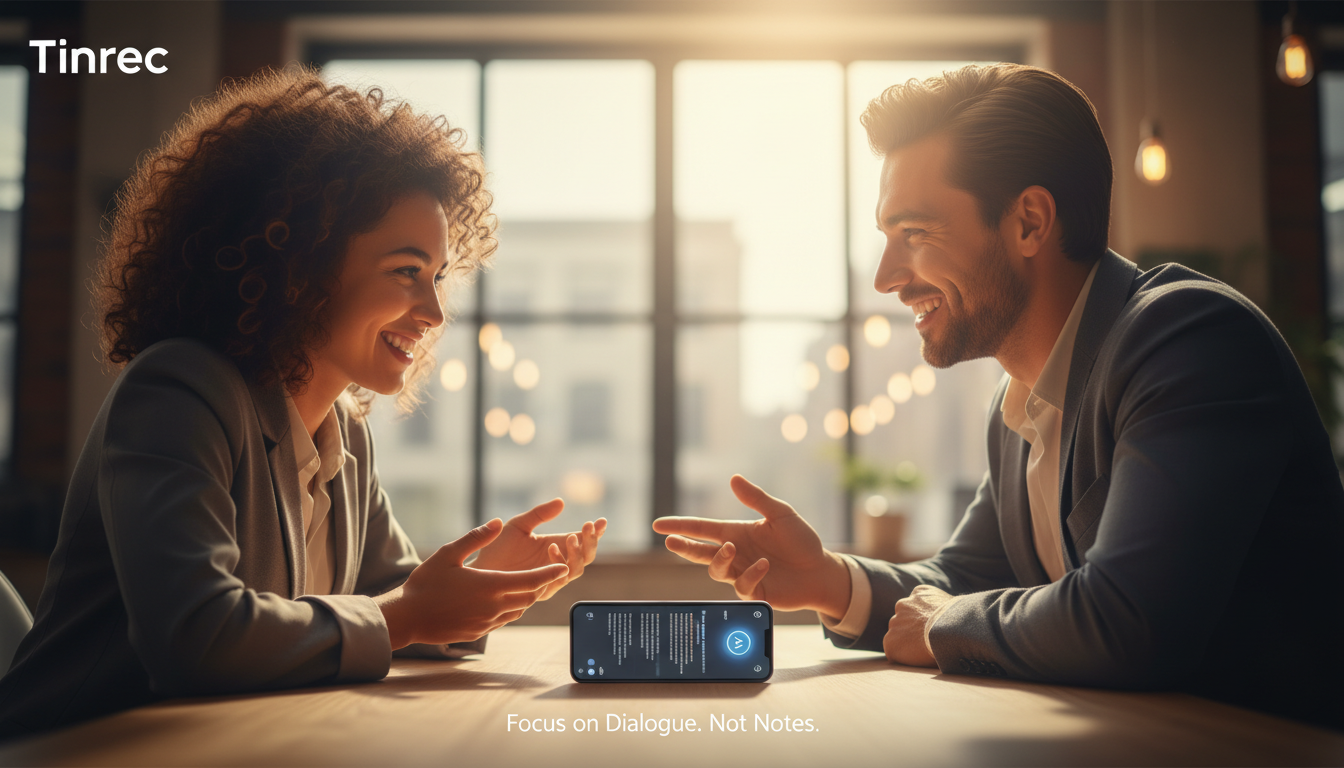
Step 3: Leverage AI to Extract Value
After recording, don't read the transcript from start to finish. Click "Generate AI Summary" to first view the summary and action items. If you have questions about a specific detail, use the AI Chat Query feature and input: "What were the interviewee's concerns about product pricing?" to quickly locate the original recording segment.
Step 4: Export and Share
Finally, export the organized content as Word, PDF, or Markdown. Tinrec supports bundling "audio file + transcript + key summary" for sharing, allowing team members to grasp key points even without attending the meeting.
5. Frequently Asked Questions (FAQ)
Q1: How accurate are these AI transcription tools? A: In a quiet environment with clear audio, Chinese accuracy for tools like Tinrec and Meeting Ink typically reaches over 90%. However, accuracy drops with background noise, overlapping speech, or heavy accents. Using "speaker separation" is recommended.
Q2: Can I directly transcribe iPhone voice memos? A: Yes. Tinrec supports an iOS app—you can record directly with the app, or import files from the iPhone's built-in Voice Memos app into Tinrec for audio-to-text conversion.
Q3: What limitations do free tiers typically have? A: Most tools (e.g., Otter, Good Tape) limit monthly transcription minutes, maximum file length, or feature completeness (e.g., no export). Tinrec's free tier offers 100 minutes of transcription per month, which is quite generous for students or occasional users.
Q4: Can I use it to transcribe Google Meet or Teams meetings? A: Yes. Some tools like SeaMeet offer browser extensions. Tinrec can record system audio via its web version or upload meeting recordings/audio files after the meeting to generate transcripts, offering greater flexibility.
Q5: Is my data secure? A: Always check the privacy policy when choosing a tool. Reputable paid tools typically encrypt data. Tinrec emphasizes data security, making it suitable for business use.
Q6: Transcripts are long—can AI really capture the key points? A: It depends on the AI model. Tinrec has "context understanding" capabilities that go beyond keyword extraction, summarizing "conclusions" and "next steps"—making it more suitable for meeting scenarios than basic speech-to-text tools.
Final Recommendation: If you only need occasional transcription, the free tiers of Good Tape or Yating might suffice. If you handle English meetings, Otter is a solid choice. But if you want to turn "recordings" into productive "action items" and need robust Chinese semantic understanding with AI query capabilities, Tinrec (Voice Recorder & Transcription) is the best investment for boosting your 2025 productivity.
Turn every recording into actionable outcomes
Get 60 free transcription minutes when you sign in. No credit card required.
Related Reading
You might also like

How to Write English Meeting Minutes in 2026: 6 Sections + AI Auto-Summary
English meeting minutes are not a verbatim transcript. This guide starts with the most common mistakes, then covers the 6 standard sections of meeting minutes, ready-to-use English phrases and tenses, and compares Tinrec, Otter.ai, Granola, and Notta for Chinese-language meetings and post-meeting organization—so you can deliver usable minutes in half an hour.

4 Free Meeting Notes Tools Tested: Which Free Tier Actually Works? (2026)
Many free meeting notes tools exist, but 'free' means very different things. This article cuts through common misconceptions and compares Tinrec, Otter.ai, Notta, and TurboScribe on free quotas, Chinese recognition, and post-meeting organization to help you find the one that truly saves time.

2026 Meeting Minutes Action Items: 4 Free Tools Compared
Your English meeting minutes look great, but no one takes action afterward? The problem usually isn't the English—it's the action items section. This guide covers practical English phrasing for action items, assigned tasks, deadlines, and resolutions, and compares four meeting-notes tools with free plans: Tinrec, Otter.ai, Notta, and Granola. Includes free-tier limits, key buying criteria, and common pitfalls to avoid.

How to Write Meeting Minutes in English: Standard Format & Key Phrases (2026 Guide)
Learn how to write English meeting minutes: correct terminology, a 12-item standard format, resolutions and past-tense action verbs, plus a hands-on tool test and comparison of 3 alternatives. Master English meeting minutes in one guide.

5 Meeting Transcription Tools Tested for 2026: Which Free Version Is Enough?
Spending two hours after a meeting organizing notes? This article compares Tinrec, Otter.ai, Notta, and Granola based on real-world usage, covering recording methods, transcript quality, post-meeting organization, and free tiers to help you find the one that fits your workflow.

5 Meeting Minutes Templates Tested for 2026: Which One Actually Tracks Action Items?
We break down 5 common meeting minutes templates (general meetings, board meetings, project stand-ups, client meetings, remote/asynchronous) and explain the required fields and best use cases for each. We also show how Tinrec's real-time transcription, AI summaries, action item extraction, and team spaces turn templates from manual forms into post-meeting outputs. Includes FAQs and selection tips.

Free AI Meeting Notes in 2026: How to Choose Free Tiers + Summaries & Action Items in One Go
How to choose a free AI meeting notes tool? Instead of comparing who offers the most minutes, look at the real limits of free tiers, Chinese and mixed Chinese-English recognition, how online meetings are captured, and whether summaries and action items can be generated afterward. This article uses 5 key criteria to help you pick the right tool, and demonstrates with Tinrec the complete workflow from recording to transcription to team knowledge retention.
How to Take Sales Meeting Notes in 2026: Tinrec Bot-Free Recording + Automatic Post-Meeting Organization
Sales meeting notes aren't just about transcribing every word. This article starts with common pitfalls and walks you through pre-meeting preparation, meeting recording, post-meeting summaries, and action items. It also compares Tinrec and Otter.ai on Chinese sales meetings, bot-free recording, post-meeting organization, and team knowledge retention.

3 Sales Meeting Notes Formats Tested for 2026: AI-Generated Minutes and Action Items Save the Most Time
Sales meeting notes aren't just about filling out a form—they capture customer needs, objections, commitments, and next steps. This article starts with the common mistake of "filling in the form after the fact," breaks down what should be recorded in sales meeting notes, compares three formats in real-world tests, and shows how Tinrec can generate transcripts, summaries, and action items in real time during the meeting. It ends with a buying checklist and FAQs.