
Turn recordings into transcripts and summaries in minutes
Upload audio or video for multilingual transcription, AI notes, and action items
Why Are English Lectures and International Meetings a "Listening Nightmare" for Modern Professionals?
Attending all-English academic lectures, international business meetings, or watching unedited instructional videos without subtitles is often a source of anxiety for students and professionals. Have you ever experienced the following scenarios?

- Speech speed too fast to follow: The speaker talks too fast or has a heavy accent; missing one key word can break the entire logical flow.
- Can't balance note-taking and listening: When focusing on writing notes, you often miss the next key point; when focusing on listening, you find your mind blank afterward with no record.
- Re-listening to recordings is too costly: Even if you record the entire session, finding a specific budget figure mentioned by the speaker in a 2-hour audio file is like looking for a needle in a haystack, often taking longer than the meeting itself.
Traditional voice recorders or built-in phone recording can only save sound, not "information." In 2026, we no longer need just a simple recording tool but an intelligent assistant capable of "real-time transcription," "cross-language translation," and "AI summaries."
Comparison of Popular Recording and Translation Tools: Which Is Your Best Language Assistant?
There are many tools on the market claiming "recording to text," but for the need of "English recording to Traditional Chinese," performance varies greatly. Below, we compare common recording tools with the emerging Tinrec (Instant Listen Recording) across multiple dimensions:
| Comparison Dimensions | Ordinary Recorder / Phone Built-in Recording | Otter.ai (Common US Tool) | Tinrec (Instant Listen Recording) |
|---|---|---|---|
| Core Function | Recording only, no transcription | Strong English transcription, no Chinese translation | Real-time recording to text + multilingual translation |
| Chinese/Multilingual Support | None | Weak (focuses on English market) | Excellent (supports Chinese, English, Japanese, Korean, etc., 10 languages) |
| Real-time | Low (manual transcription needed later) | High (real-time English transcripts) | High (real-time recording to Traditional Chinese/English) |
| AI Features | None | Keyword summaries | AI chat query, meeting minutes, action item extraction |
| Post-use Efficiency | Very low (need to re-listen entire recording) | Medium (can search text) | Very high (can query the recording like asking a person) |
| Free Tier | Unlimited (storage only) | 300 minutes/month | 100 minutes/month (including AI features) |
From the table above, we can see that while Otter.ai performs well in pure English transcription, it lacks friendly support for Traditional Chinese; traditional recording methods cannot solve the problems of "not understanding" and "tiring organization." The advantage of Tinrec is that it not only understands English but also helps you comprehend content and convert it into Chinese notes.
In-Depth Review of Tinrec: More Than Recording – "Understanding" and "Action"
In its 2026 update, Tinrec (Instant Listen Recording) has specifically strengthened features for "knowledge-intensive" scenarios. It is not just a tool, but a complete workflow from recording → understanding → action.
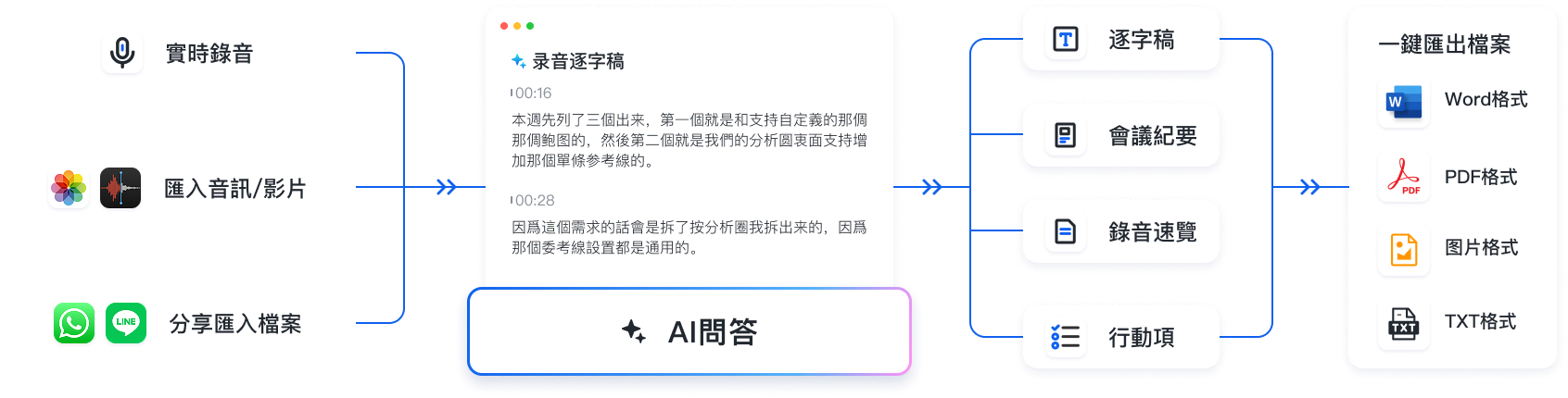
1. Real-Time Recording to Text: "Live Subtitles" for English Lectures
For users with weaker English listening skills, Tinrec's core value lies in "visualization." During recording, it instantly converts English speech into text. This means that while you attend a lecture, your phone or computer screen shows a real-time transcript, helping you understand difficult vocabulary.
Stop organizing recordings by hand
Upload audio or video and automatically get a transcript, summary, and action items
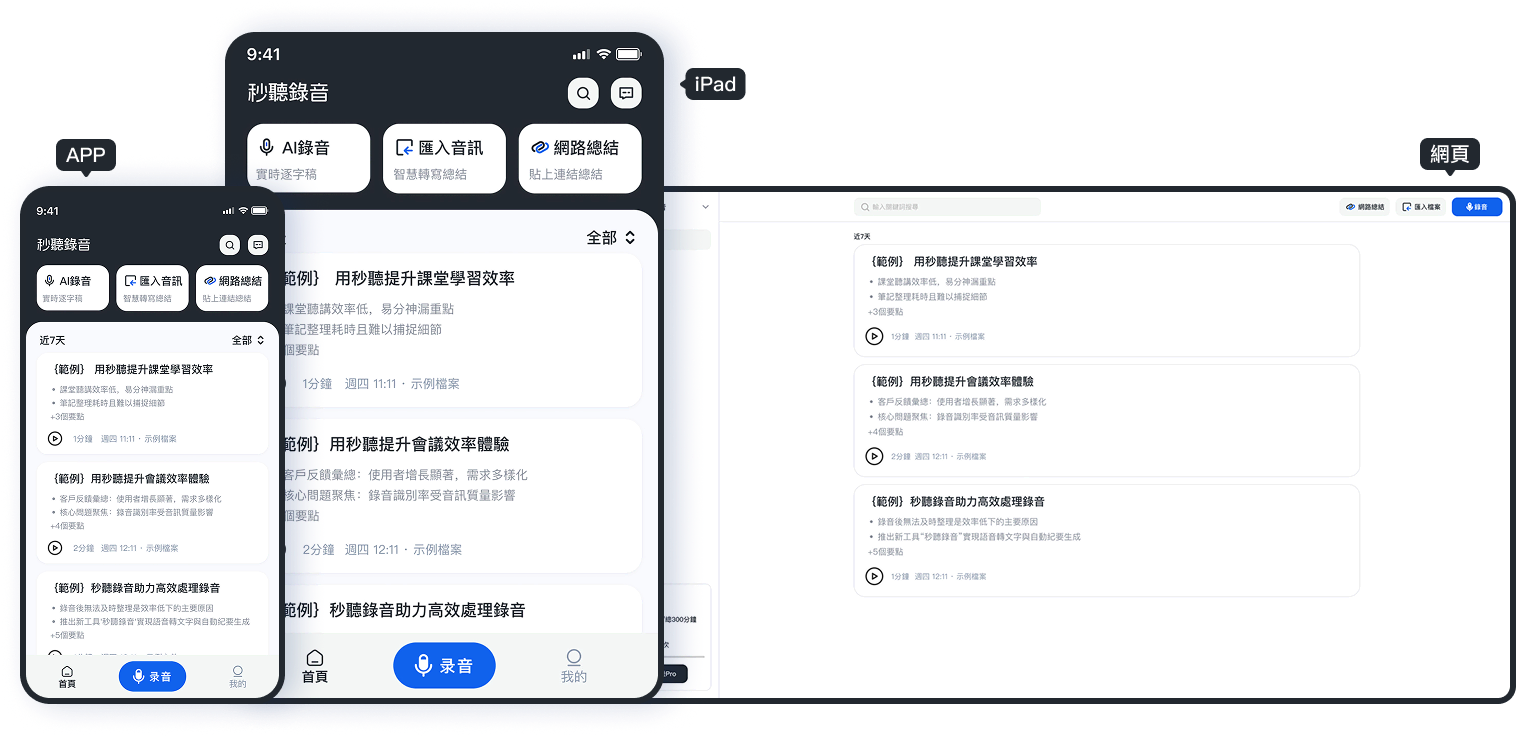
- Multi-platform support: Whether recording in person with an iPhone or Android phone, or recording online meetings with the web version, data syncs across devices.
- Language support: In addition to English, it supports Japanese, Korean, German, Cantonese, and 10 other languages, ideal for multilingual learners.
2. AI Chat Query: Turn Recordings into a "Knowledge Base"
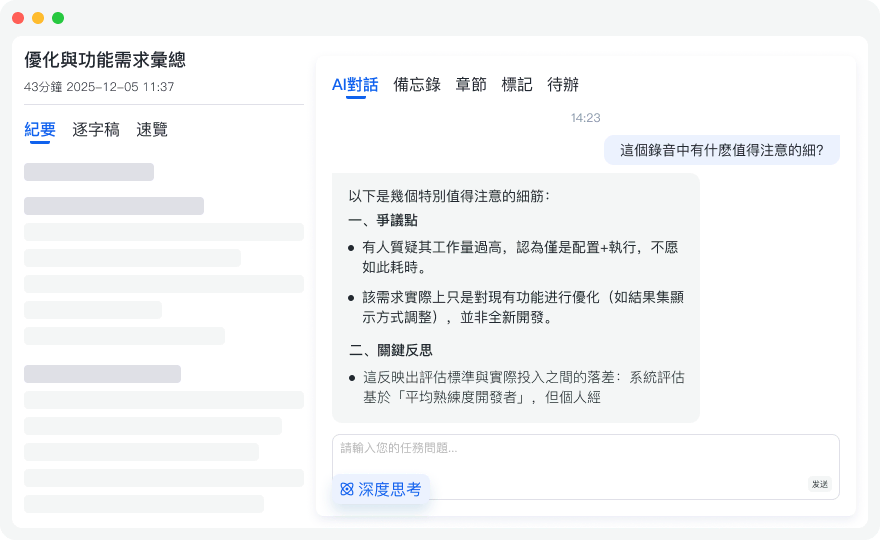
This is the biggest difference between Tinrec and traditional tools. With traditional transcripts, you can only use Ctrl+F to search for keywords, but if the speaker uses a different phrasing, you won't find it.
Tinrec supports semantic-based AI chat queries. You can directly ask the AI in Chinese:
"What key points did the speaker mention about the 2026 marketing trends in this talk?"
"Please list all the action items mentioned in the meeting."
The AI understands the context of the entire recording and gives you a summarized answer directly, allowing you to "ask a person" instead of "searching through a document."
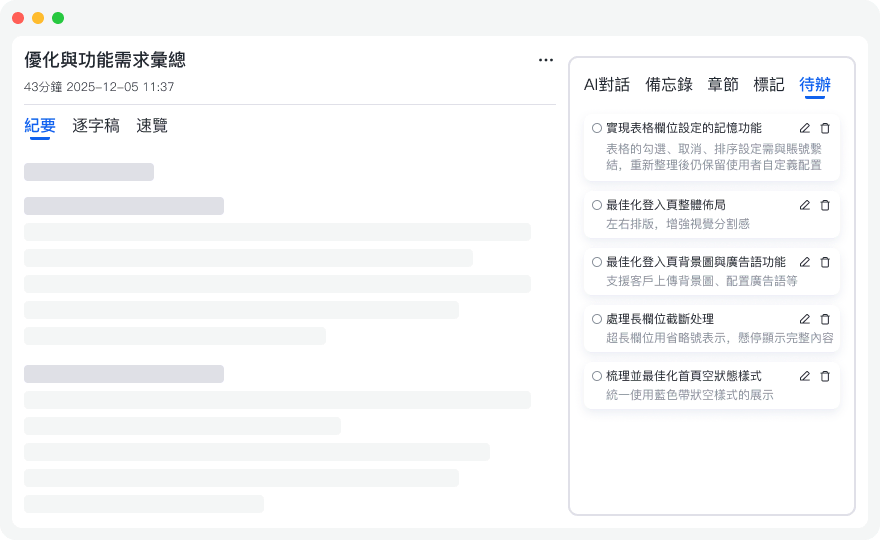
3. Automatically Generate Meeting Minutes and Action Items
For content creators or professionals, Tinrec automatically distills long recordings into structured summaries. It distinguishes between:
- Summary: Quickly grasp the background of the entire conversation.
- Action Items: Who needs to do what by when, listed in bullet points.
Practical Tutorial: How to Conquer an All-English Lecture with Tinrec
Below is a step-by-step workflow for academic lectures or business meetings. It's recommended to register an account beforehand (the free version offers 100 minutes of credit for testing).
Step 1: Start Real-Time Recording
Enter the lecture venue or online meeting room, and open the Tinrec real-time recording to text feature. Select the recognition language as "English" (or other languages). Tap the record button, and the app will start converting speech to text.
Step 2: AI Organizing and Querying After the Meeting
After the recording ends, don't rush to re-listen. Click the AI Chat Query (AI Chat) feature and enter commands:
- "Please summarize the three core points of this lecture in Traditional Chinese."
- "What references did the speaker mention?"
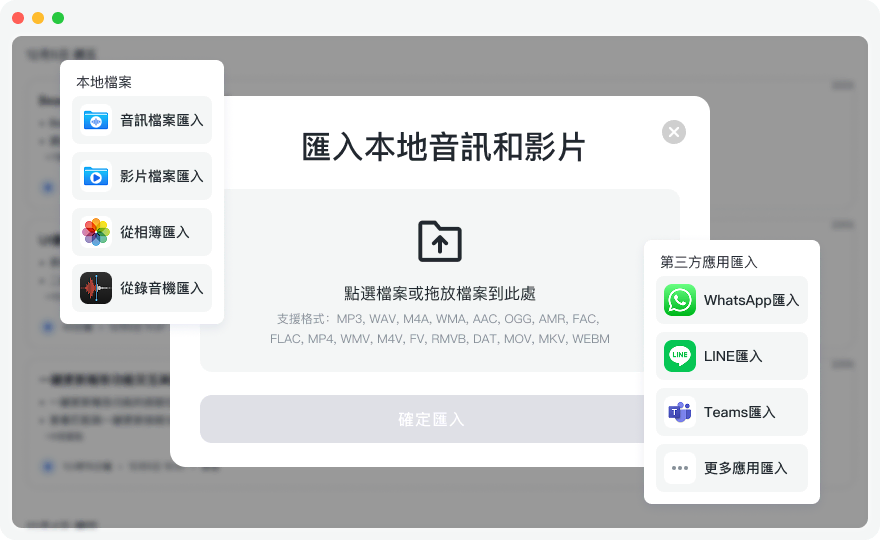
Step 3: Import External Audio or Video Files (Optional)
If you already have a recording from a professor or want to organize a YouTube instructional video in English, you can use the audio file to text or podcast/web video to text feature. Paste a link or upload a file, and Tinrec will produce a transcript and summary.
Step 4: Export Notes
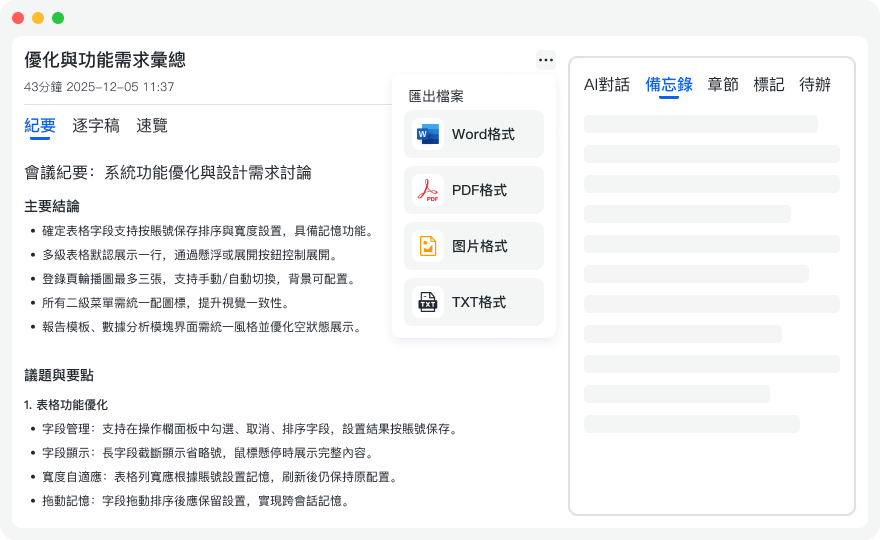
After verifying the content, you can export the AI-generated summary and transcript in TXT, Word, or PDF format, and directly save them to your Notion or note-taking app, completing the knowledge archiving.
Frequently Asked Questions (FAQ)
Q1: Can I use Tinrec on an iPhone or Android phone?
A: Yes, Tinrec supports iOS, Android, and the web version, and account data is synced to the cloud. After recording on your phone, you can edit and view it on your computer.
Q2: How accurate is the transcription in a noisy environment?
A: AI has noise reduction, but overly noisy environments can still affect accuracy. It's recommended to sit close to the speaker during lectures or use a directional microphone to significantly improve transcription quality.
Q3: Are there limitations to the free version?
A: Tinrec offers a free version with 100 minutes of recording transcription per month, and most AI features (such as summaries and chat queries) are available for testing. If you need more minutes, consider the Basic ($4.9/month) or Pro ($8.25/month) plans.
Q4: Can I use it to record Google Meet or Teams meetings?
A: Yes. For online meetings, it's recommended to use the Tinrec web version and record via system audio (some computers need to enable stereo mix), or simply place your phone near your computer speakers to record and get real-time transcription.
Q5: What languages are supported for translation?
A: Currently, it supports automatic recognition and transcription for 10 languages including Chinese, English, Japanese, Korean, German, Taiwanese Hokkien, Cantonese, and more, making it ideal for international meetings or language learning.
Q6: Is the privacy of recording files secure?
A: Tinrec values user privacy. Recordings are only used for personal use and AI processing, and you can delete files at any time. Additionally, if you have high privacy requirements, it's recommended to export the text and delete the cloud backup after processing.
In an era of information overload, using tools wisely is key to staying competitive. Instead of spending hours re-listening to recordings, try using AI to "visualize" and "structure" audio. Let Tinrec save you time so you can focus on real thinking and decision-making.
Turn every recording into actionable outcomes
Get 60 free transcription minutes when you sign in. No credit card required.
Related Reading
You might also like

How to Write English Meeting Minutes in 2026: 6 Sections + AI Auto-Summary
English meeting minutes are not a verbatim transcript. This guide starts with the most common mistakes, then covers the 6 standard sections of meeting minutes, ready-to-use English phrases and tenses, and compares Tinrec, Otter.ai, Granola, and Notta for Chinese-language meetings and post-meeting organization—so you can deliver usable minutes in half an hour.

4 Free Meeting Notes Tools Tested: Which Free Tier Actually Works? (2026)
Many free meeting notes tools exist, but 'free' means very different things. This article cuts through common misconceptions and compares Tinrec, Otter.ai, Notta, and TurboScribe on free quotas, Chinese recognition, and post-meeting organization to help you find the one that truly saves time.

2026 Meeting Minutes Action Items: 4 Free Tools Compared
Your English meeting minutes look great, but no one takes action afterward? The problem usually isn't the English—it's the action items section. This guide covers practical English phrasing for action items, assigned tasks, deadlines, and resolutions, and compares four meeting-notes tools with free plans: Tinrec, Otter.ai, Notta, and Granola. Includes free-tier limits, key buying criteria, and common pitfalls to avoid.

How to Write Meeting Minutes in English: Standard Format & Key Phrases (2026 Guide)
Learn how to write English meeting minutes: correct terminology, a 12-item standard format, resolutions and past-tense action verbs, plus a hands-on tool test and comparison of 3 alternatives. Master English meeting minutes in one guide.

5 Meeting Transcription Tools Tested for 2026: Which Free Version Is Enough?
Spending two hours after a meeting organizing notes? This article compares Tinrec, Otter.ai, Notta, and Granola based on real-world usage, covering recording methods, transcript quality, post-meeting organization, and free tiers to help you find the one that fits your workflow.

5 Meeting Minutes Templates Tested for 2026: Which One Actually Tracks Action Items?
We break down 5 common meeting minutes templates (general meetings, board meetings, project stand-ups, client meetings, remote/asynchronous) and explain the required fields and best use cases for each. We also show how Tinrec's real-time transcription, AI summaries, action item extraction, and team spaces turn templates from manual forms into post-meeting outputs. Includes FAQs and selection tips.

Free AI Meeting Notes in 2026: How to Choose Free Tiers + Summaries & Action Items in One Go
How to choose a free AI meeting notes tool? Instead of comparing who offers the most minutes, look at the real limits of free tiers, Chinese and mixed Chinese-English recognition, how online meetings are captured, and whether summaries and action items can be generated afterward. This article uses 5 key criteria to help you pick the right tool, and demonstrates with Tinrec the complete workflow from recording to transcription to team knowledge retention.

How to Take Sales Meeting Notes in 2026: Tinrec Bot-Free Recording + Automatic Post-Meeting Organization
Sales meeting notes aren't just about transcribing every word. This article starts with common pitfalls and walks you through pre-meeting preparation, meeting recording, post-meeting summaries, and action items. It also compares Tinrec and Otter.ai on Chinese sales meetings, bot-free recording, post-meeting organization, and team knowledge retention.

3 Sales Meeting Notes Formats Tested for 2026: AI-Generated Minutes and Action Items Save the Most Time
Sales meeting notes aren't just about filling out a form—they capture customer needs, objections, commitments, and next steps. This article starts with the common mistake of "filling in the form after the fact," breaks down what should be recorded in sales meeting notes, compares three formats in real-world tests, and shows how Tinrec can generate transcripts, summaries, and action items in real time during the meeting. It ends with a buying checklist and FAQs.