
Turn recordings into transcripts and summaries in minutes
Upload audio or video for multilingual transcription, AI notes, and action items
"Recording" is the easiest way to save information, but "organizing recordings" is often a black hole of productivity. After a one-hour meeting or interview, many people spend two to three times the length relistening and typing. That's why "mobile recording to Traditional Chinese transcription" has become a skyrocketing search term in recent years.
According to long-term observations by Esor, the site owner of Play Ease, and recent updates from Google Pixel, using AI for speech-to-text has become a secret weapon for boosting output efficiency. This article analyzes current recording-to-text solutions and recommends tools suitable for different use cases, helping you break free from tedious transcription.

The Current State and Pain Points of Recording-to-Text in 2025: Why You Need AI?
Traditional voice recorders or built-in phone recorders can perfectly preserve sound, but they have a major "information density" problem:
- High relistening cost: One hour of recording often requires 1.5 to 2 hours of relistening to extract key points.
- No quick search: To find when a decision was discussed, you can only drag the progress bar and guess.
- Lack of action linkage: The recording file sits on your hard drive, disconnected from your to-do list.
Even the powerful built-in "Recorder" app on Google Pixel phones, which supports Traditional Chinese transcription on Pixel 6 and above with offline recognition and automatic punctuation, still has cross-device and functional limitations for non-Pixel users (especially iPhone users) or those needing more advanced "AI conversation query" features.
Therefore, choosing an AI recording app that offers "real-time transcription" and "semantic understanding" is key to solving these pain points.
Tool Comparison: Google Recorder vs. Tinrec
To help you choose the right tool, we compared the representative Google Pixel built-in Recorder and the cross-platform AI recording assistant Tinrec. Both support Traditional Chinese, but differ in use cases and feature depth.
| Dimension | Google Recorder (Pixel Built-in) | Tinrec |
|---|---|---|
| Compatible Devices | Google Pixel series only (Chinese requires Pixel 6+) | iOS, Android, Web cross-platform support |
| Language Support | Chinese, English, Japanese, French, German, etc. (language packs need download) | Chinese, English, Japanese, Korean, German, Taiwanese, Cantonese, etc. (10 languages) |
| Real-time Transcription | Supported (offline) | Supported (cloud-based high accuracy) |
| AI Summary | Supported (more complete on some models/English version) | Supported (auto-generates meeting minutes, conclusions) |
| Action Item Extraction | Weak (plain text mainly) | Strong (auto-extracts to-dos and decisions) |
| AI Conversation Query | No (mainly keyword search) | Yes (ask AI about recording content directly) |
| External File Import | Supported | Supported (audio files, video links) |
As the table shows, if you're a loyal Pixel user, the built-in tool is very convenient for offline recording. But if you use an iPhone, or want to turn recordings into actionable plans with AI Q&A, Tinrec offers a more complete productivity workflow.
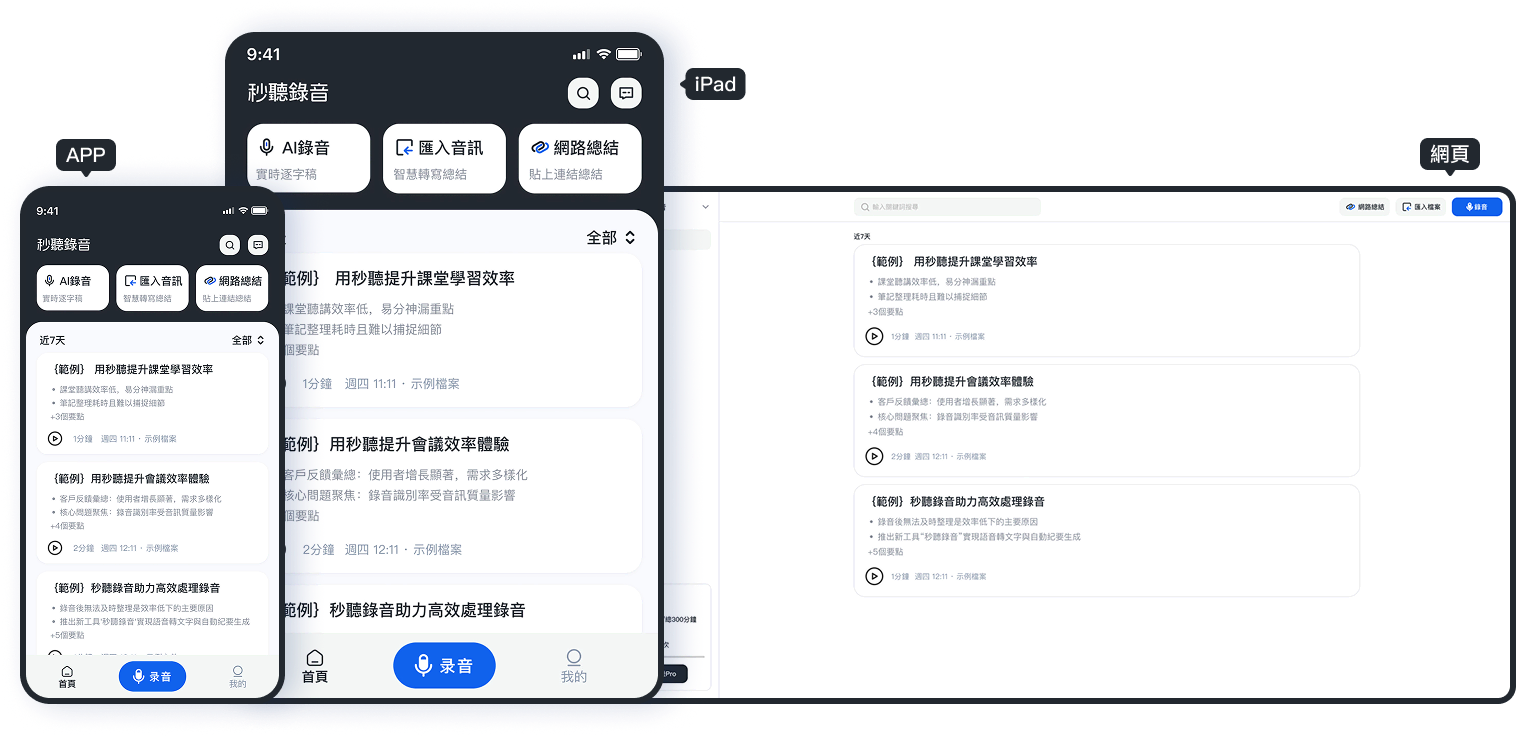
Stop organizing recordings by hand
Upload audio or video and automatically get a transcript, summary, and action items
In-depth Review: How Tinrec Achieves a Complete Recording-to-Action Workflow
Unlike traditional tools that only provide verbatim transcripts, Tinrec's design logic leans more toward an "AI listening assistant." In real tests, it solves the problem of "content too long to read" after simple text conversion. Here are its core highlights:
1. Real-time Transcription and Multilingual Recognition
During international meetings or foreign language classes, Tinrec's real-time transcription can display text simultaneously. This is very useful for language learners or those needing instant confirmation. It supports not only Traditional Chinese but also Taiwanese, Cantonese, and mixed Chinese-English scenarios with reasonable accuracy, reducing post-editing burden.
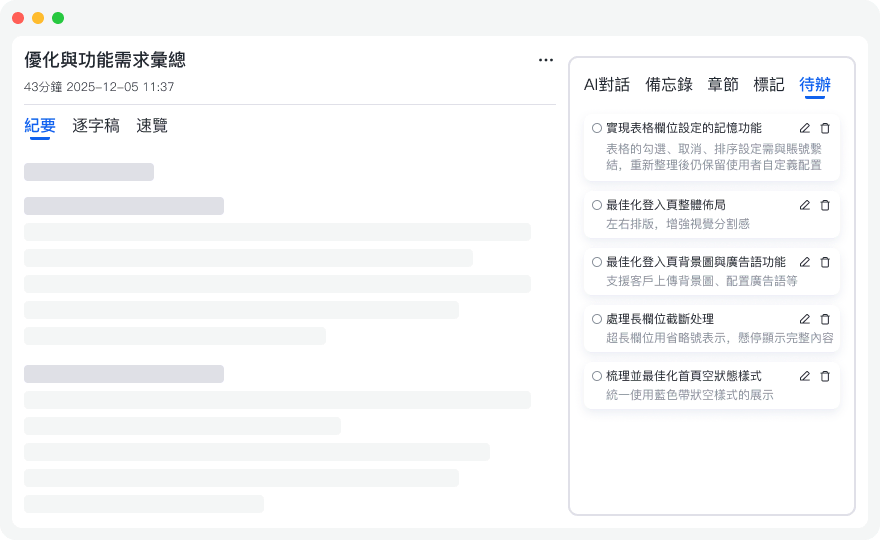
2. AI Smart Summary and Action Items
This is the dividing line between a "recording tool" and a "productivity tool." After recording, Tinrec uses a large language model to analyze the entire conversation and automatically generates:
- Meeting Minutes: Structured key points.
- To-Do Items: Who needs to do what.
- Decisions: Final conclusions.
This lets users grasp next steps without reading thousands of words of transcript.
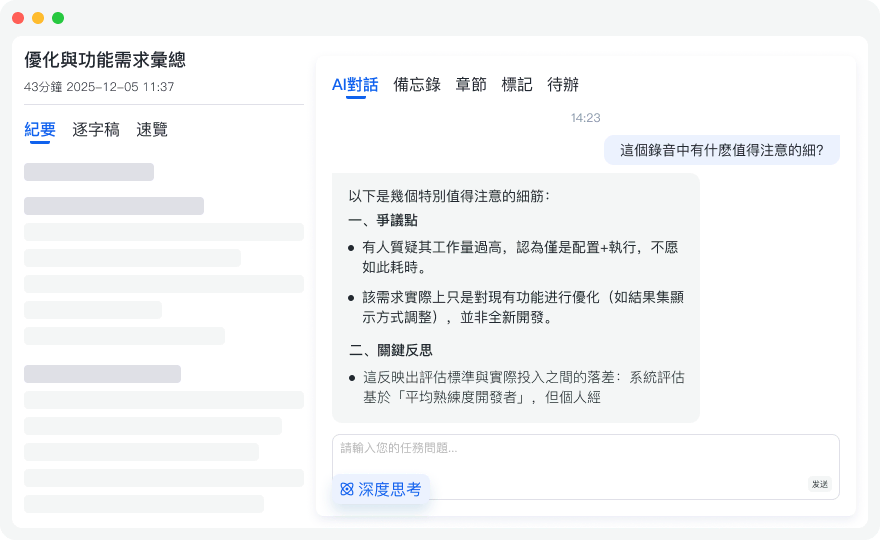
3. AI Conversation Query: Find Answers by Asking
This is Tinrec's most differentiating feature. Traditional tools only allow Ctrl+F keyword search. What if you don't know the keyword? Tinrec lets you open an "AI Chat" window and directly ask:
- "What was the conclusion about the marketing budget in this meeting?"
- "What are the three learning points mentioned by the speaker?"
The AI answers based on the recording content, like asking a secretary who just listened to the meeting, saving huge review time.
Practical Tutorial: Using AI to Handle a 60-Minute Meeting
Below is an efficient meeting note workflow using Tinrec. Follow these steps:
Step 1: Start Real-Time Recording
At the beginning of the meeting, open the Tinrec app (iOS/Android) or web version. Tap "Start Recording" and ensure real-time transcription is on. Focus on eye contact instead of scribbling notes.
Step 2: Auto-Generate Summary After Meeting
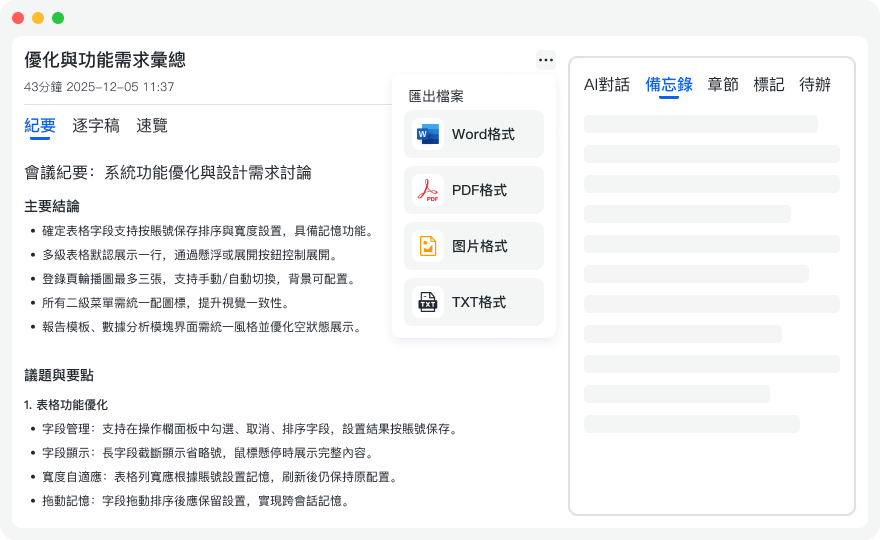
After the meeting ends and you stop recording, the system will process the audio. Wait a few minutes (depending on length), then tap the "AI Summary" tab to quickly review the auto-generated meeting notes and action list, checking for missed points.
Step 3: Use AI to Query Details
If you have a question about a detail while reading the summary (e.g., "Is the project deadline the 15th or 20th?"), no need to scrub the audio. Go to the AI Chat feature, type your question, and the system will precisely locate and answer.
Step 4: Export and Share in Multiple Formats
After confirming the content, you can export the transcript or summary as Word, PDF, or TXT, or even copy it directly into Notion or your company's document system to complete archiving.
Advanced Use: Organizing Audio/Video Content
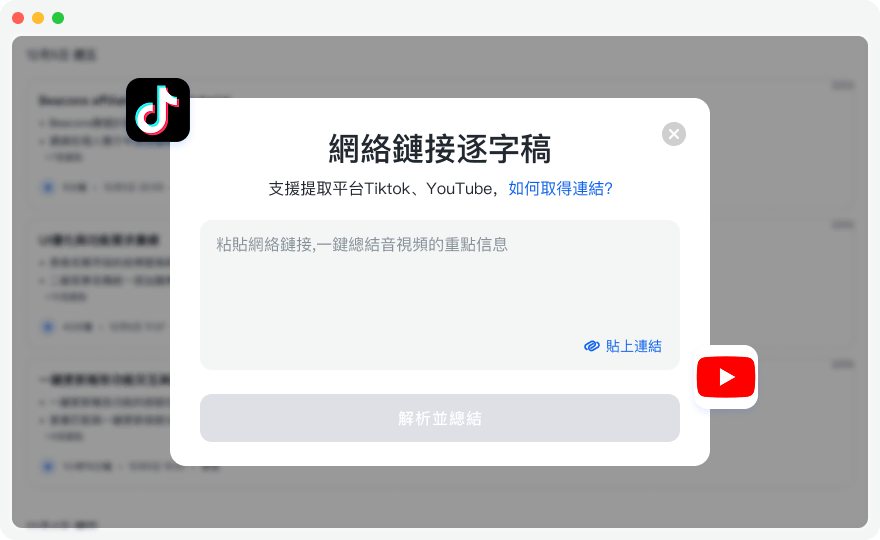
Besides live recording, if you're a creator needing to transcribe YouTube tutorials or podcasts, use the Podcast/Online Video to Text feature. Paste the link to get a transcript and summary—a powerful tool for learning and content creation.
FAQ
Q1: Can these recording-to-Traditional Chinese apps be used on iPhone? Google Recorder is limited to Pixel phones. If you're an iPhone user, we recommend Tinrec (or other third-party apps) that support iOS and provide equal or more advanced AI features.
Q2: Is the transcription accuracy high? Is it affected by accents? Current AI models (like Whisper or Google's) have very high accuracy for Traditional Chinese (usually above 95%). However, strong background noise or heavy accents may still affect results. Keep the phone close to the speaker.
Q3: Can I import existing audio files for transcription? Yes. Tinrec supports audio file to text. You can upload mp3, m4a, wav, etc.
Q4: What are the limits of the free version? Most tools use a "free tier + paid subscription" model. For example, Tinrec's free plan offers 100 minutes of transcription per month, sufficient for occasional meeting notes.
Q5: Do these tools support recording Teams or Google Meet online meetings? Mobile apps typically record ambient sound. For online meetings, use Tinrec's web version or play audio on your computer while recording with your phone (rudimentary but effective), or use dedicated virtual audio cable software.
Q6: Can transcripts distinguish speakers? Both Google Recorder and Tinrec have speaker recognition features that automatically label "Speaker 1," "Speaker 2," etc., in the transcript for easy attribution.
Turn every recording into actionable outcomes
Get 60 free transcription minutes when you sign in. No credit card required.
Related Reading
You might also like

2026 Comparison of 5 Meeting Minutes Formats: Free Templates vs. AI Tools—Which Saves More Time?
There are countless meeting minutes formats—should you download a Word template and fill it in manually, or use AI to generate them automatically? This article compiles 5 common meeting minutes formats and free download sources, and compares manual template filling with Tinrec's instant recording across five dimensions: filling speed, export, search, team collaboration, and price, to help you choose the most time-saving approach.

5 Meeting Minutes Word Templates Tested for 2026: You Filled Out the Table, But Still Missed the Decisions?
Downloaded a bunch of meeting minutes Word templates but still can't write a record you can submit? Starting from real scenarios like student group projects, classes, interviews, and internship weekly meetings, this article compares the field designs of 5 common meeting minutes templates, outlines what a truly useful format should include, and demonstrates how to use Tinrec to turn recordings into transcripts, summaries, and action items, then paste them back into a Word template.

Notion vs Tinrec: Which AI Meeting Notes Tool Is Better for Chinese-Speaking Teams in 2026?
Is taking meeting notes in Notion really easier? This hands-on comparison looks at Notion (templates + Notion AI Meeting Notes) and Tinrec, covering how meeting audio gets in, post-meeting outputs, querying past meetings, team governance, and cross-language meetings, with scenario-based recommendations and FAQs.

5 Meeting Minutes Templates Compared in 2026: Word, PDF, Excel, or AI-Generated?
Downloaded a bunch of meeting minutes templates but can't make them work? This article tackles common pitfalls, breaks down the 5 essential fields a good template should have, compares 5 formats in practice, and shows how to automate the template-filling work with Tinrec.

5 Meeting Minutes Formats Tested for 2026: Which One Is Least Likely to Miss Decisions?
How to choose a meeting minutes format? This article starts with seven essential elements and four meeting types with corresponding formats, then tests and compares the workflows and limitations of tools like Tinrec, Otter.ai, Granola, and Notta for generating meeting minutes, with a pitfalls guide and selection advice.

How to Write English Meeting Minutes in 2026: 6 Sections + AI Auto-Summary
English meeting minutes are not a verbatim transcript. This guide starts with the most common mistakes, then covers the 6 standard sections of meeting minutes, ready-to-use English phrases and tenses, and compares Tinrec, Otter.ai, Granola, and Notta for Chinese-language meetings and post-meeting organization—so you can deliver usable minutes in half an hour.

4 Free Meeting Notes Tools Tested: Which Free Tier Actually Works? (2026)
Many free meeting notes tools exist, but 'free' means very different things. This article cuts through common misconceptions and compares Tinrec, Otter.ai, Notta, and TurboScribe on free quotas, Chinese recognition, and post-meeting organization to help you find the one that truly saves time.

2026 Meeting Minutes Action Items: 4 Free Tools Compared
Your English meeting minutes look great, but no one takes action afterward? The problem usually isn't the English—it's the action items section. This guide covers practical English phrasing for action items, assigned tasks, deadlines, and resolutions, and compares four meeting-notes tools with free plans: Tinrec, Otter.ai, Notta, and Granola. Includes free-tier limits, key buying criteria, and common pitfalls to avoid.

How to Write Meeting Minutes in English: Standard Format & Key Phrases (2026 Guide)
Learn how to write English meeting minutes: correct terminology, a 12-item standard format, resolutions and past-tense action verbs, plus a hands-on tool test and comparison of 3 alternatives. Master English meeting minutes in one guide.