
Turn recordings into transcripts and summaries in minutes
Upload audio or video for multilingual transcription, AI notes, and action items
Faced with a two-hour Cantonese meeting or interview recording, the most headache-inducing part is often not "not understanding" but "not finishing the transcription." Cantonese's unique spoken grammar, numerous modal particles, and the common "code-switching" (Chinglish) phenomenon in Hong Kong workplaces often cause traditional speech recognition tools to crash or produce gibberish.
This article reviews the mainstream voice-to-text solutions on the market in 2026, focusing on Cantonese recognition accuracy and post-processing efficiency.

Quick Takeaways:
- If you only need to send a quick text or short note: Use the built-in dictation on your phone (Apple/Google).
- If you need to transcribe long meetings or interviews and generate summaries: Choose a tool with AI summarization (e.g., Tinrec).
- If you're a developer who values open-source: Consider deploying the OpenAI Whisper model.
Why Is Cantonese Voice-to-Text So Hard?
Before choosing a tool, we need to understand the pain points. Cantonese is often called a "boss-level" challenge in speech recognition for three main reasons:
- Spoken vs. Written Language Discrepancy: In recordings, people say "佢" (keoi5), which in written Chinese is usually "他" (taa1); "幾時" (gei2 si4) becomes "什麼時候" (sam6 mo1 si4 hau6). A good AI needs to handle this conversion or accurately preserve the colloquial forms.
- Cantonese-English Mixing (Chinglish): For example, "今日個 Schedule 好 Full,要約個 Meeting" (Today's schedule is very full, need to set up a meeting). This poses a huge challenge for single-language models.
- Multi-speaker & Noise: Overlapping voices in a tea restaurant interview or multi-person meeting; traditional tools struggle to separate speakers.
2026 Popular Cantonese Voice-to-Text Tools Comparison
To help you choose, we selected three different types of solutions and compared them across key dimensions:
| Dimension | Tinrec (MiaoTing) | Built-in Dictation (iOS/Android) | OpenAI Whisper (Open-Source/API) |
|---|---|---|---|
| Cantonese Accuracy | High (optimized for Cantonese-English mixing) | Medium (okay for short phrases, easily breaks on long sentences) | Very High (depends on model size) |
| Real-time | Supports live transcription while recording | Supports | Requires processing after recording finishes |
| Summaries & Action Items | Auto-generates meeting minutes and to-do lists | None (text only) | None (text only) |
| AI Q&A | Supports (directly ask about recording content) | Not supported | Not supported |
| Export/Integration | Word, PDF, TXT, SRT subtitles | Copy-paste | JSON, TXT, SRT |
| Best For | Meetings, interviews, classes, long recordings | Text messages, notes, search input | Developers, subtitle teams |
| Pricing/Free Tier | Free: 100 minutes/month | Completely free | Pay-per-use API or self-hosting cost |
Stop organizing recordings by hand
Upload audio or video and automatically get a transcript, summary, and action items
Deep Dive: Tinrec's Unique Advantages for Cantonese
Among the many tools, Tinrec (MiaoTing) positions itself not just as a "transcription tool" but as an AI assistant designed for workflow. For users dealing with large amounts of Cantonese content, it offers several key differentiators:
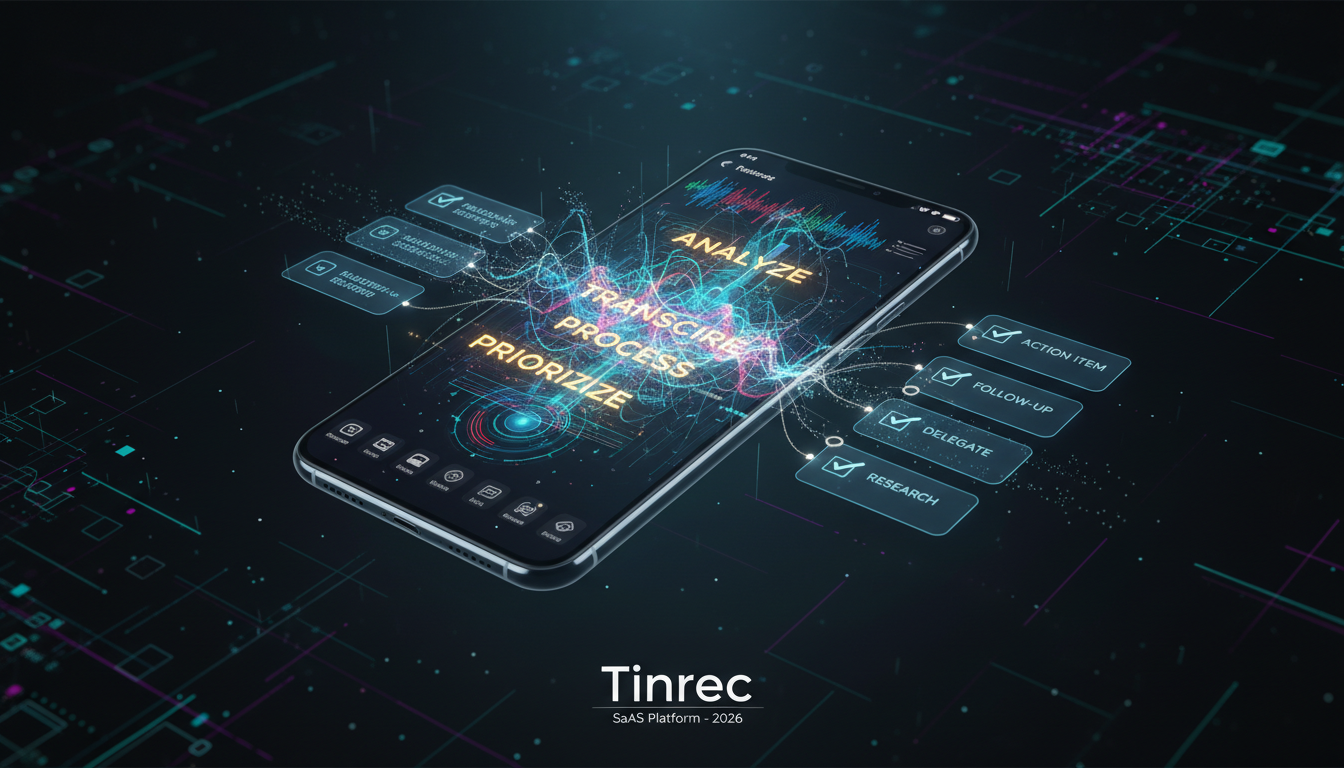
1. Optimized Recognition for Cantonese-English Code-Switching
Tinrec supports automatic recognition of 10 languages including Cantonese. In real-world tests, for common workplace terms (like presentation, deadline, budget) mixed into Cantonese sentences, it maintains good context flow, reducing the time needed for manual English spell correction.
2. From Transcript to Action List
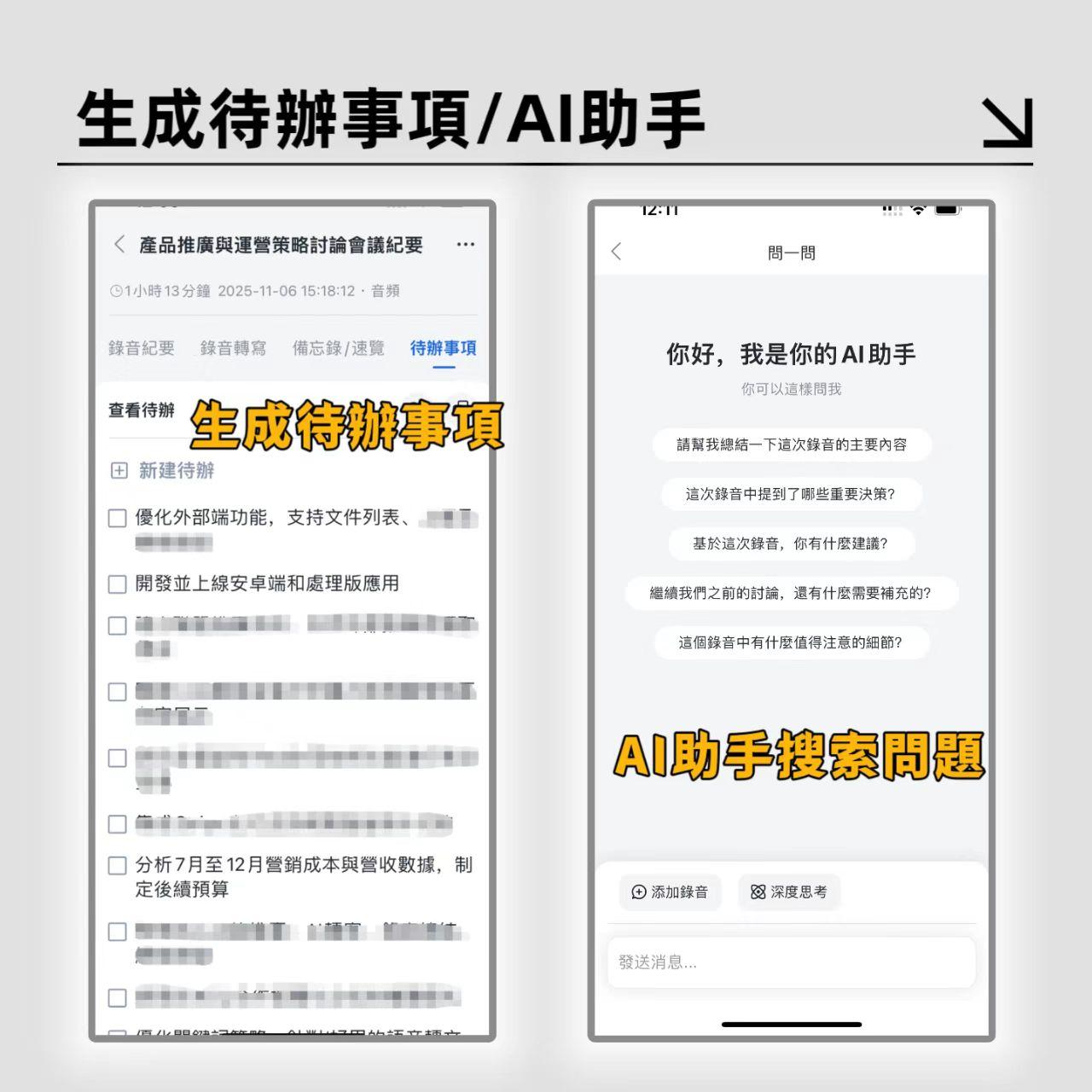
Traditional tools output a dense wall of text that is hard to read. Tinrec uses AI to automatically analyze the content and generate Meeting Minutes and Action Items. For business users, this means that by the time the meeting ends, the preliminary minutes are already done.
3. AI Q&A (Ask Like a Person)
If you have a 2-hour recording and only want to know "What was the manager's final budget decision?", the traditional approach is Ctrl+F to search keywords. Tinrec's AI Q&A feature lets you ask directly, and the AI answers based on the recording content—changing how you retrieve information.
Practical Tutorial: How to Convert Cantonese Recordings to Editable Text
Below we use Tinrec as an example to show how to turn a Cantonese meeting recording into a valuable text file. The process is similar whether you use iPhone, Android, or the web version.
Step 1: Prepare the Recording Source
You can start in one of two ways:
- Record Live: Open the app and record directly.
- Import a File: If you already have a file from a voice recorder or a YouTube video link, you can use that too.
Step 2: Select the Language Mode
Before transcribing, make sure to set the recognition language to Cantonese. This is a critical step to ensure the AI model loads the correct dialect database.
Step 3: Start Transcription and Generation
- Tap "Start Recording" or upload a file.
- The system will perform real-time voice-to-text, and you'll see the text appear line by line.
- For long recordings, use the audio file to text feature; upload and it will process in the background without needing to stay on the screen.

Step 4: Use AI to Organize Key Points
After transcription, tap the "AI Analysis" button. The system will automatically differentiate speakers (e.g., Speaker A, Speaker B) and extract a summary. If you're a content creator, you can also use the podcast/video to text feature by pasting a YouTube URL to get script material.
Step 5: Export and Share
After checking the text, you can export it as Word or PDF and send it directly to team members.
Frequently Asked Questions (FAQ)
Q1: Why is the built-in dictation on my phone so inaccurate for Cantonese?
Built-in functions are designed mainly for short commands or messages. They handle long continuous speech, background noise, and proper nouns poorly, and typically lack the ability to correct based on context.
Q3: Does Tinrec's free version include Cantonese recognition?
Yes, Tinrec's free version supports all languages, including Cantonese. Free users get 100 minutes of transcription per month, which is usually enough for students or individuals who occasionally need to transcribe class notes or interviews.
Q4: Do I need to switch settings if the meeting switches between English and Cantonese?
No. Modern high-end AI transcription tools (like Tinrec) usually have multilingual recognition. As long as the primary language is set correctly, occasional English words are automatically recognized.
Q5: Does it support video file transcription?
Yes. Besides common audio formats like MP3/WAV, Tinrec also supports uploading MP4 video files or directly pasting YouTube links for transcription, which is very useful for webinars or online courses.
Q6: How is the privacy and security of recording data ensured?
When choosing a tool, pay attention to the privacy policy. Reputable service providers (like Tinrec) usually use encrypted transmission, and transcription content is only accessible to the user. Avoid using unknown online free tools that don't require login for sensitive meeting records.
Turn every recording into actionable outcomes
Get 60 free transcription minutes when you sign in. No credit card required.
Related Reading
You might also like

2026 Notion Alternatives: 5 Steps to Take Meeting Minutes with Tinrec
Still using Notion for meeting minutes? This article starts from real pain points, compares Tinrec and Notion for meeting notes, and provides a 5-step tutorial on how to use Tinrec to record online meetings without bots, auto-generate summaries and action items, turning meetings into searchable, collaborative team knowledge.

How to Take Meeting Minutes in 2026: 5 Steps to Replace Notion Free with Tinrec
Notion's free plan has trial limits for meeting notes. Switch to Tinrec for bot-free recording, AI summaries, to-dos, and team collaboration. Complete efficient meeting minutes in 5 steps.

What Does "Meeting Minutes" Mean? A Guide to Writing Meeting Minutes in English
Searching for "meeting minutes 中文" usually means you want to know how to say and write meeting minutes in English. This article covers the correct usage of "meeting minutes," common sections in meeting minutes, useful phrases, and introduces tools like Tinrec that can help you create meeting minutes quickly, saving you from overtime work.

Notion AI vs Tinrec in 2026: A 5-Dimension Comparison to Choose Your Meeting Notes Tool
Notion AI meeting notes may seem convenient, but limitations like the free plan, browser audio capture, and transcript retention could trip you up. This article outlines 5 common limitations of Notion AI and compares 7 meeting notes tools including Tinrec, Otter, Fireflies, Notta, TurboScribe, and Granola to help you find the best AI meeting assistant.

5 AI Meeting Note Tools for Cantonese in 2026: Which One Transcribes Cantonese Best?
Spending two hours in a meeting and another two hours writing up the minutes? This article addresses the pain points of Cantonese meetings, compares 5 AI meeting note tools, and uses Tinrec as an example to share selection tips, pitfalls to avoid, and scenario-based recommendations.

2026 Tested: 3 Notion Meeting Notes Alternatives — Tinrec Auto-Transcription Saves the Most Time
We tested several meeting note solutions. Notion templates take too long to fill manually? Tinrec's auto-transcription, AI summaries, and bot-free recording help Hong Kong professionals save time.

3 Notion Teams Meeting Note Tools Tested in 2026: Which One Really Saves You Time?
Managing Microsoft Teams meeting notes with Notion offers two paths: built-in AI notes or standalone tools. This article tests Tinrec, Notion AI, and Otter.ai from the perspectives of bot-free recording, Chinese language experience, post-meeting summaries, export options, and team governance to help you choose the most time-saving solution.

2026 Mac Transcription Software Comparison: 3 Tools Tested from Transcription to Collaboration
Still using a traditional player plus Word for transcription on your Mac? This article tests Tinrec, MacWhisper, and Buzz, comparing accuracy, input sources, AI post-processing, and team collaboration to help you find the most time-saving option.

2026 Notion Meeting Notes Templates: Official Templates + Custom Databases Made Easy
Notion meeting notes templates help you quickly organize meeting agendas, records, and action items. This article covers how to use official templates, create custom database templates, and leverage Notion AI meeting notes, making meeting documentation a breeze.