
Turn recordings into transcripts and summaries in minutes
Upload audio or video for multilingual transcription, AI notes, and action items
"I need to finish the transcript of this interview by 2 PM."
"The team needs to see the decision summary immediately after the meeting."
Is this your daily work anxiety? Facing an hour-long recording, the traditional "listen and type" method is not only inefficient but also easy to miss key information. Many people are turning to AI tools, but there are many on the market—some excel in English, some require hardware, and some are painfully slow.
This article compiles the most representative speech-to-text tools on the market in 2026, including Meeting Ink, Otter.ai, Yating, and other well-known software, and adds the emerging productivity tool Tinrec for comparison. We will evaluate from dimensions such as processing speed, language support, summarization ability, and pricing plans, and provide practical usage tutorials.
Quick Navigation Conclusion:
- Focus on localization and Taiwanese Hokkien recognition: Choose Meeting Ink or Yating.
- Need hardware recording device: Consider Plaud.
- Value "post-recording query" and action checklists: Try Tinrec's AI conversation feature.
- All-English meeting environment: Otter.ai remains a strong choice.
Why Do Audio Recordings Need AI "Secondary Processing"?
The biggest issues with traditional voice recorders or phone voice memos are "low information density" and "difficult retrieval". For a 60-minute audio file, without converting it to text, you have to spend nearly the same amount of time replaying to find a specific point. AI tools solve three core pain points:
- Visualization: Convert auditory information into visual text; scanning reading speed is 3-5 times faster than listening.
- Structuring: Through LLM (Large Language Models), automatically differentiate speakers, extract summaries, and action items.
- Searchability: No more dragging the progress bar to guess content location; directly locate with keywords.
2026 Popular AI Speech-to-Text Tools Specification Comparison Table
Based on processing stages (upload, transcription, summarization) and functional features, we compiled the comparison data of these 9 tools:
| Tool Name | Core Feature | Supported Languages | Suitable Scenarios | Free Trial Quota |
|---|---|---|---|---|
| Meeting Ink | Fast speed, supports Taiwanese Hokkien/Hakka, Google Calendar integration | Chinese, English, Japanese, Taiwanese Hokkien, Hakka | Mixed-language teams, local enterprises | 20 hours/month (PRO version) |
| Tinrec | Real-time transcription, AI conversation query, action item extraction | Chinese, English, Japanese, Korean, and 10 others | Cross-language meetings, class notes, knowledge management | 100 minutes/month |
| Otter.ai | Strong English recognition, good Zoom/Meet integration | Primarily English | International all-English meetings | 300 minutes/month (limited) |
| Plaud | Combines physical recording card, phone call recording | Multilingual | Business calls, on-site interviews | Hardware purchase required, software subscription |
| Yating | Optimized for Taiwan local accents, fast upload | Mandarin, Taiwanese Hokkien, English | Taiwan local interviews, transcript cleanup | Per-hour pricing (trial available) |
| Vocol.ai | Collaboration features, keyword search | Chinese, English, Japanese | Batch post-meeting processing, team collaboration | V-point credit system |
| Good Tape | Minimalist interface, intuitive operation | Multilingual | Media professionals, file transcription | 3 files/month |
| Vurbo.ai | Real-time translation, unlimited hours (depending on plan) | Multilingual | Simple scenarios needing real-time translation | Subscription-based |
| SeaMeet | Focused on Teams/Meet extensions | Multilingual | Teams using online meeting software regularly | 20 hours/month |
Stop organizing recordings by hand
Upload audio or video and automatically get a transcript, summary, and action items
Deep Dive: Advantages and Differences of Each Tool

Based on actual test data and functional focus, we can categorize these tools as follows:
1. Pursuing Ultimate Speed and Localization: Meeting Ink, Yating
If your meetings contain a lot of Taiwanese expressions or Taiwanese Hokkien, these two are the top choices. According to test data, Meeting Ink processes a 26-minute audio file in about 1 minute 58 seconds for transcription, and generates a summary in just 26 seconds, with real-time captions and speaker segmentation—a smooth workflow. Yating excels in upload speed (only 17 seconds), but occasionally requires queuing for summary generation.
2. Focus on "Understanding and Action" Workflow: Tinrec (Quick Listen Recording)
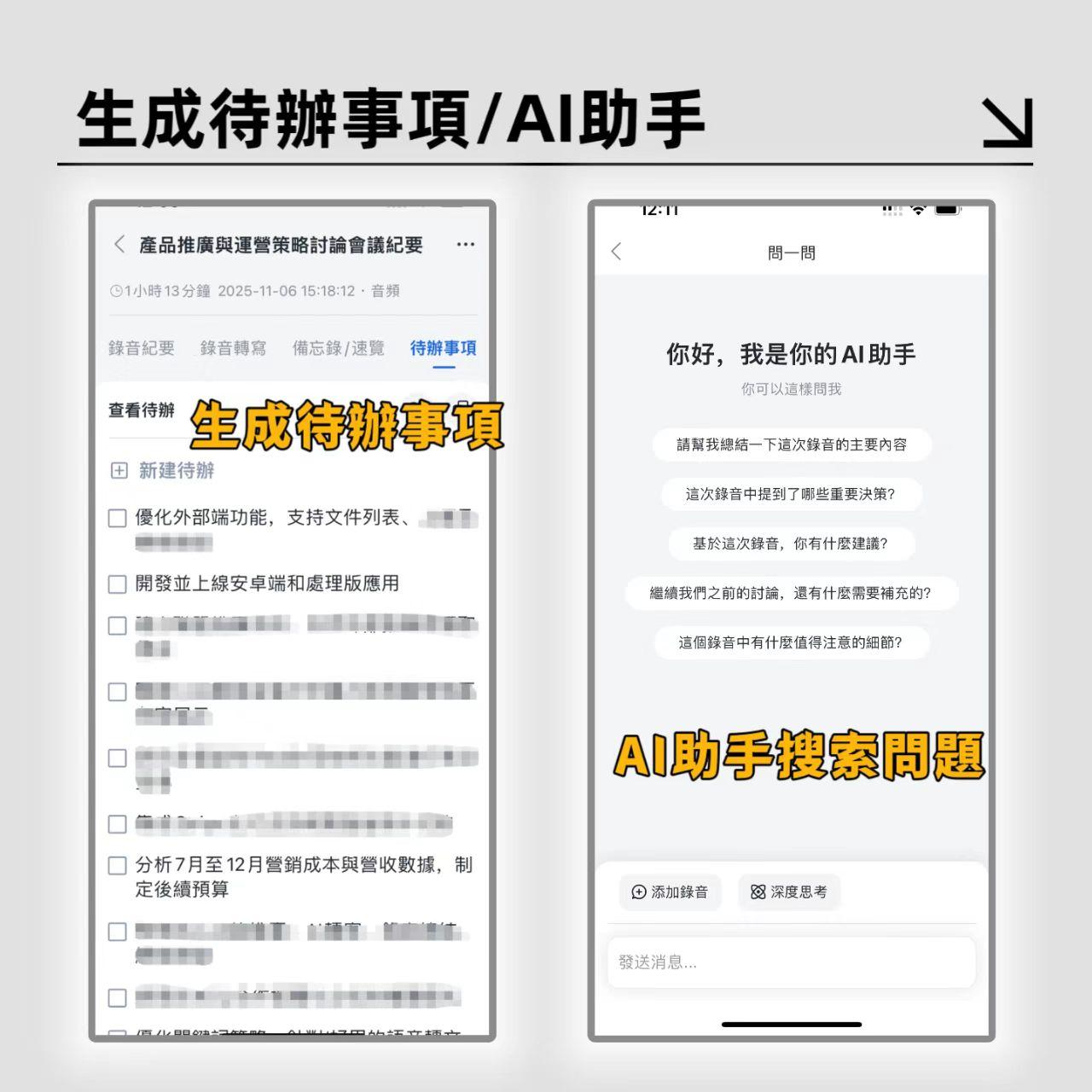
Unlike tools that only provide "transcripts," Tinrec's design philosophy leans more toward "personal knowledge base." In addition to basic recording-to-text, it emphasizes the "AI conversation query" feature. After recording a long meeting or class, you can directly ask AI: "What was the marketing budget mentioned?" or "List all action items," and AI will answer based on the recording content. For project managers or students who need to extract Action Items from recordings, this "conversational" retrieval method significantly reduces review costs.
3. Hardware Integration and Call Recording: Plaud
Plaud's feature is its software-hardware integration, using a card-sized recorder that attaches to the back of your phone, solving the pain point that iPhones cannot directly record phone calls. Tests show the app is stable, but the functionality is relatively limited, mainly focused on recording and transcription, and it does not directly integrate with online meeting software. It is more suitable for salespeople or journalists who need a portable device.
4. Online Meeting Specialists: SeaMeet, Otter.ai
If 90% of your work happens on Google Meet or Teams, SeaMeet is very intuitive with its browser extension built directly in. Otter.ai is the king of English meetings—although its Chinese recognition is weaker, its real-time summaries and keyword extraction in English contexts are still industry benchmarks.
Practical Tutorial: How to Turn Voice Memos into "Actionable Checklists"
Choosing the right tool is only the first step; integrating it into your workflow is key. Below, using Tinrec as an example, we demonstrate the standard process from recording to producing an action checklist (other tools that support upload functions have similar logic):
Step 1: Import or Start Recording
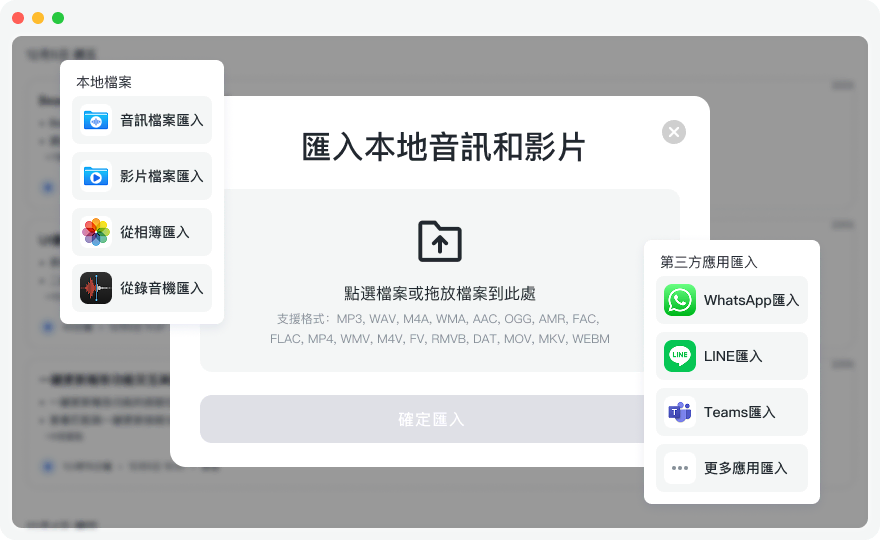
- Scenario A (On-site/Online): Directly open the web version or app, click "Start Recording." Tinrec supports real-time transcription during recording, so you can listen while watching the subtitles to confirm audio quality.
- Scenario B (Existing files): If you use the iPhone's built-in Voice Memos, export the m4a file and upload it via the "Import Audio" function.
- Scenario C (Web videos): If you want to transcribe a YouTube tutorial or podcast, simply paste the link.
Step 2: Differentiate Speakers and Review Transcript
After uploading, the system automatically performs speaker diarization. It is recommended to quickly scan the transcript and rename "Speaker 1, Speaker 2" to real names (e.g., Alex, Kelly) to help AI accurately assign tasks in summaries.

Step 3: Use AI to Extract Key Points
This is the most critical step. Don't just read the transcript; use the AI summary function to generate:
- Full Summary: Quickly understand the meeting context.
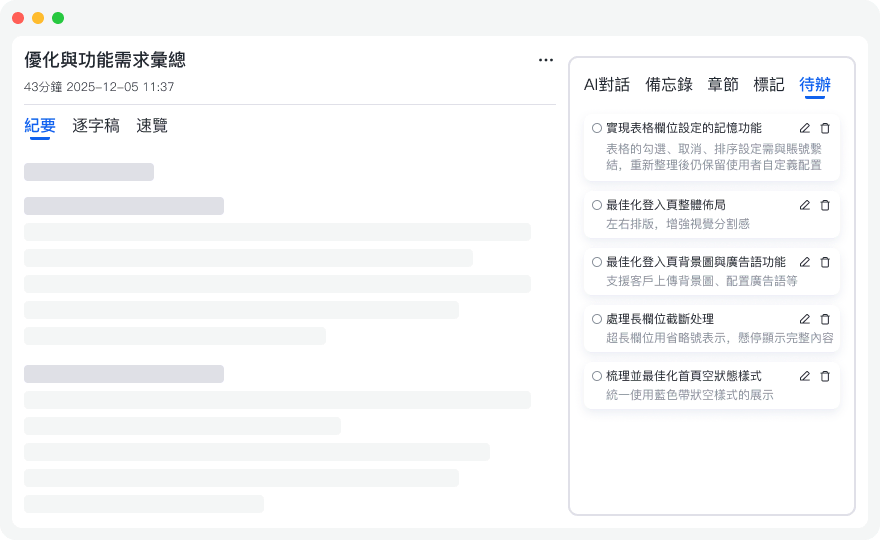
- Action Items: The system will automatically capture phrases like "submit report by next Friday," "contact supplier," etc., and turn them into a list.
Step 4: AI Conversation Query (Advanced Tip)
If the summary doesn't cover details, use the AI conversation feature. For example, ask: "What was Alex's specific opinion on the budget?" The system will search relevant sections and summarize the answer, saving you the hassle of using Ctrl+F to search for keywords.
FAQ
Q1: Can iPhone's Voice Memos be directly transcribed?
iPhone's built-in transcription only supports short recordings and is quite basic. It is recommended to share the memo file (m4a) to apps like Meeting Ink, Tinrec, or Yating for processing to get full punctuation and summaries.
Q2: Are free plan quotas usually sufficient?
It varies greatly. For example, Tinrec offers 100 free minutes per month, suitable for occasional personal use; Meeting Ink's paid version starts at about NT$279/month (20 hours); Good Tape's free version has queue waiting times. We recommend choosing based on your monthly meeting hours.
Q3: Can these tools be used with Google Meet or Teams?
Yes. SeaMeet and Otter integrate via extensions; Meeting Ink supports a bot joining meetings; Tinrec and Plaud can record via computer/phone microphone (capturing speaker audio), offering higher versatility.
Q4: What affects the accuracy of speech-to-text?
Besides the AI model (e.g., Whisper), recording quality is the biggest variable. We recommend keeping the microphone close to the speaker and minimizing background noise to significantly improve recognition.
Q5: Is data secure for confidential meetings?
Most enterprise-grade tools (e.g., Meeting Ink, Tinrec, Otter) have cloud encryption. If you have high security requirements, check if the tool offers a "do not train AI on data" privacy option, or consider hardware-based solutions.
Q6: Does it support code-switching (multilingual mixing)?
Currently, tools like Meeting Ink and Tinrec support multilingual recognition, but performance varies when a sentence mixes Chinese and English. Meeting Ink is specifically optimized for Taiwanese Hokkien/Mandarin mixing; Tinrec supports automatic recognition of 10 languages including Chinese, English, Japanese, and Korean.
Turn every recording into actionable outcomes
Get 60 free transcription minutes when you sign in. No credit card required.
Related Reading
You might also like

2026 Hands-On Comparison of 4 AI Meeting Assistants: Tinrec Is the Easiest to Install and Requires No Bot
A mid-level manager tests 4 AI meeting assistants, from installation to recording to AI summarization, to show you which saves the most time. Tinrec requires no hardware or bot, and you can start in three steps, making Chinese meeting notes the most convenient.

2026 Free AI Meeting Assistant Plans Compared: 3 Options Reviewed
A must-read for students and budget-conscious users! After testing 3 AI meeting assistants, we've compared free quotas, Chinese accuracy, cross-platform support, and AI Q&A to find the best value option.

The Complete Guide to AI Meeting Assistants in 2026: 5 Key Points to Help You Choose a Time-Saving Tool
Tired of working overtime because of meetings? This guide uses 5 key points to help you compare AI meeting assistants, see which one suits you best, and stop guessing.

2026 AI Meeting Assistant Buying Guide: Tinrec Hands-On Review — Is This Tool Worth It?
Hong Kong professionals attend meetings daily, and choosing the wrong AI meeting assistant can lead to even more overtime. We tested Tinrec to see how it uses bot-free recording, Cantonese transcription, automatic summaries, and action items to save you time on meeting minutes. This article also covers common pitfalls to avoid and how to choose the right tool for your needs.
2026 AI Meeting Assistant Free Plans Compared: 4 Tools Reviewed
We tested 4 AI meeting assistants and found Tinrec stands out with bot-free recording and AI Q&A plus team collaboration, while Otter.ai, Notta, and Granola each have weaknesses. Learn how to avoid common pitfalls when choosing the right tool.

2026 AI Meeting Assistant Buying Guide: 4 Tested and Recommended
How to choose the best AI meeting assistant in 2026? This article tests 4 mainstream tools, comparing accuracy, AI features, cross-platform support, and team collaboration, and provides buying advice to help you find the most suitable meeting notes solution.

3 Best AI Meeting Assistants in 2026: From Free to Paid, Explained
How to choose an AI meeting assistant in 2026? From a mid-level manager's practical perspective, this article reviews 3 recommended AI meeting assistants, covering free to paid plans, and takes an in-depth look at Tinrec's bot-free recording, AI summaries, and action item extraction to help you save time on post-meeting tasks and boost team collaboration.

5 Best AI Meeting Assistants Tested in 2026: Which One Really Delivers Actionable To-Do Tracking?
Spending two hours in a meeting and another two organizing notes, only to miss key action items? This hands-on comparison of 5 AI meeting assistants evaluates transcription accuracy, AI summaries, to-do extraction, and team collaboration to reveal which tool truly turns meetings into actionable data.

How to Choose an AI Meeting Notes App in 2026? A 5-Step Guide from Recording to AI Summaries
Using Tinrec as an example, this article teaches you 5 steps to complete meeting minutes: recording, transcription, proofreading, summary generation, and export/sharing. It also compares several AI meeting notes apps to help you quickly choose the right tool.