
Turn recordings into transcripts and summaries in minutes
Upload audio or video for multilingual transcription, AI notes, and action items
After a one-hour meeting, do you spend two hours re-listening to the recording to take notes? This is a common pain point for many administrative staff, students, and journalists. While phones have built-in voice recorders, they often lack "real-time Traditional Chinese transcription" and "automatic key point extraction" features, making post-meeting organization extremely inefficient.
This article evaluates and compares mainstream recording-to-text apps of 2026, helping you choose the right tool based on your needs. We analyze from three dimensions: "recognition accuracy," "AI summarization capability," and "cross-platform integration," and provide step-by-step tutorials.
Quick Buying Guide:
- If you only need simple memos: Use your phone's built-in Notes app or voice input method.
- If you need comprehensive meeting minutes and action items: Choose a tool with AI analysis capabilities (e.g., Tinrec) to turn raw transcripts into structured notes.
- If multilingual mixed recognition matters: Check if the tool supports mixed Chinese-English or automatic multi-language detection.
Why Do You Need a Professional "AI Recording-to-Text" App?
Traditional voice recorders or simple recording apps suffer from "low information density." A 60-minute audio file is a "black box" that can't be searched or quickly scanned. Professional transcription tools solve three main pain points:
- High cost of re-listening: No need to repeatedly drag the progress bar; directly locate key points in the text.
- Lack of decision summaries: Raw word-for-word transcripts are hard to read; AI tools automatically generate conclusions and to-do items.
- Multilingual environment barriers: Real-time translation and transcription significantly lower comprehension barriers for foreign language meetings or lectures.
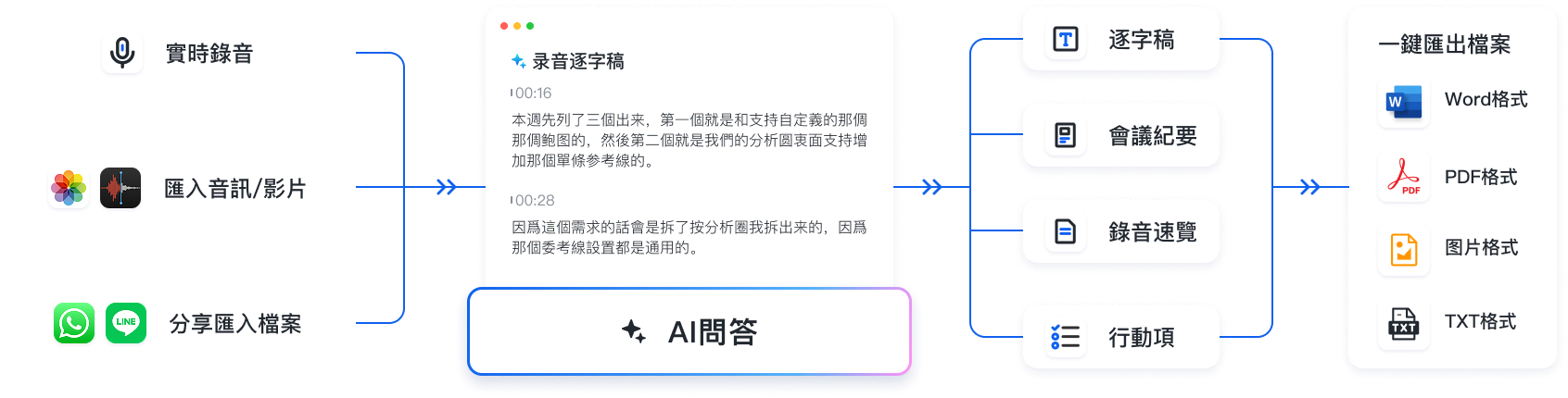
2026 Hot Recording-to-Text Tools Feature Comparison Table
When choosing a tool, don't just focus on "whether it can transcribe," but also "what you can do after transcription." Below we compare representative solutions on the market:
| Dimension | Built-in Recorder/Input Method | Basic Transcription Tool | Tinrec (MiaoRecorder) | Professional Human Transcription |
|---|---|---|---|---|
| Real-time Transcription | Supported (short phrases) | Supported | Supported (real-time display for long recordings) | No (requires waiting) |
| Traditional Chinese Support | Excellent | Good (some only Simplified) | Excellent (supports Taiwanese, Cantonese, Chinese) | Excellent |
| AI Summary/Action Items | None | A few support | Auto-generates meeting minutes and to-dos | None (usually extra cost) |
| AI Chat Query | None | None | Supported (ask questions about the recording) | None |
| Multi-device Sync | Within ecosystem only (e.g., iOS) | Depends on tool | Web / iOS / Android sync | N/A |
| Use Cases | Text messages, short memos | Simple interviews | Meetings, lectures, long interviews | Court, medical, high-precision needs |
From the table, if your goal is "automated organization," tools with AI post-processing (summaries, chat queries) are better choices.
Stop organizing recordings by hand
Upload audio or video and automatically get a transcript, summary, and action items
Deep Dive: Tinrec's Application Differences in Productivity Scenarios
Among many tools, Tinrec (MiaoRecorder) positions itself as an "end-to-end recording assistant." It doesn't just "turn sound into text," but further solves "turning text into action." Here's a neutral analysis of its features:
1. Real-time Transcription and Multilingual Support
For on-site recording scenarios, Tinrec supports real-time transcription while recording. This is very helpful for students or participants who can't keep up with speaking speed. It supports 10 languages including Chinese, Japanese, English, Korean, German, Taiwanese, and Cantonese, suitable for international meetings or multilingual learning environments.
2. From "Verbatim Transcript" to "AI Smart Notes"
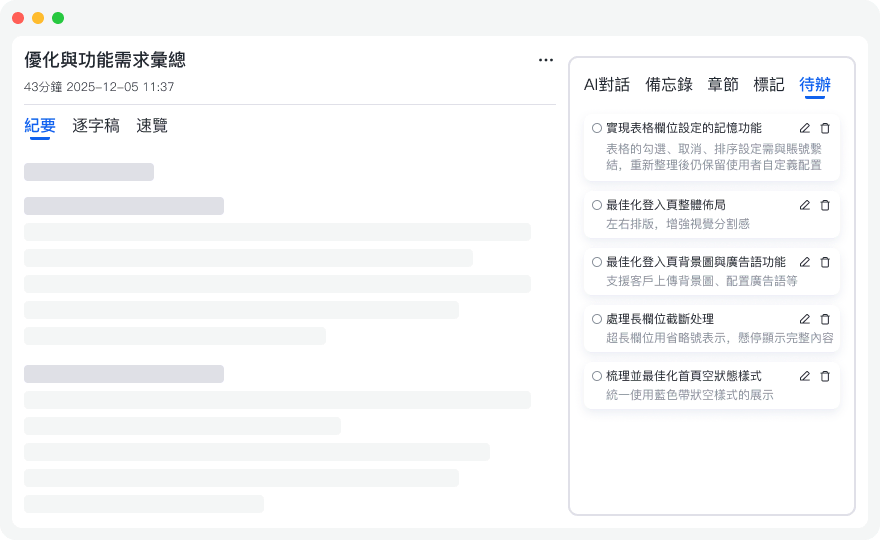
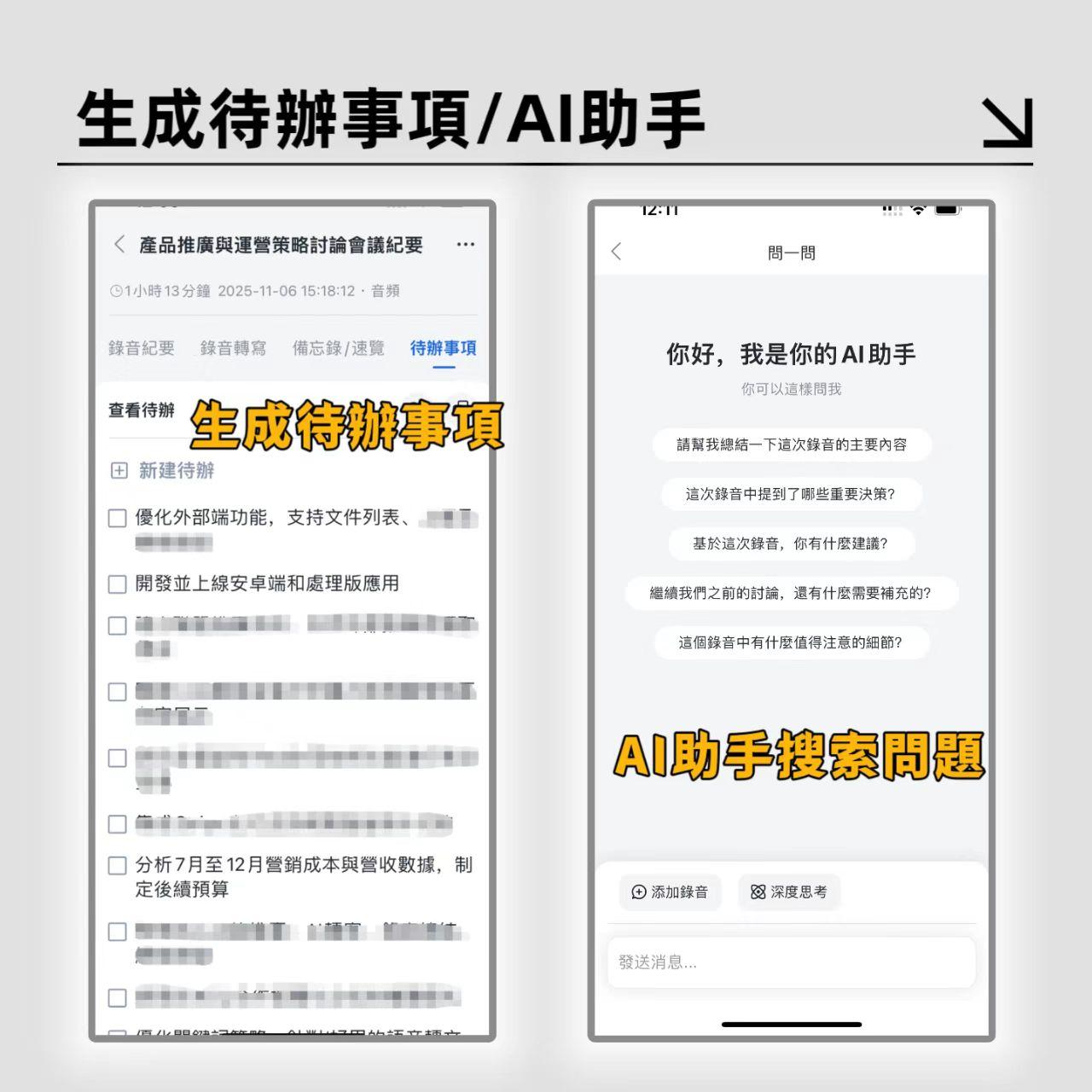
The biggest difference from traditional tools is AI application. After transcription, Tinrec automatically analyzes the content and generates "meeting minutes" and "action items." This means users don't need to read the entire document to grasp key decisions.
3. "Conversational" Content Query
This is a relatively new feature concept. For long recordings (e.g., a 3-hour lecture), even with text it's hard to find answers. Tinrec allows users to ask questions in natural language through "AI chat query" (e.g., "What did the professor say about the final exam scope?"), and the system answers based on the recording content, changing information retrieval.
Hands-on Tutorial: How to Efficiently Organize Meetings/Classes with a Mobile App
Below, using Tinrec as an example, we show how to turn a messy meeting into clear notes. These steps mostly apply to other advanced AI recording tools.
Step 1: Start Real-time Recording & Transcription
When entering a meeting or class, open the app and tap the record button. Make sure to select the correct language (e.g., Traditional Chinese).
- Tip: Place the phone as close to the speaker as possible, or on the center of the table. Tinrec displays text in real-time, allowing you to mark key points anytime.
- Feature Link: Real-time Recording to Text

Step 2: Import External Audio or Video (If Not Recorded Live)
If you already have an audio file (e.g., m4a, mp3) or a podcast/YouTube link from the internet, don't re-record with speaker—directly import the file for best quality.
- Supported Features: Audio File to Text or Podcast/Online Video to Text
Step 3: Speaker Diarization and Editing
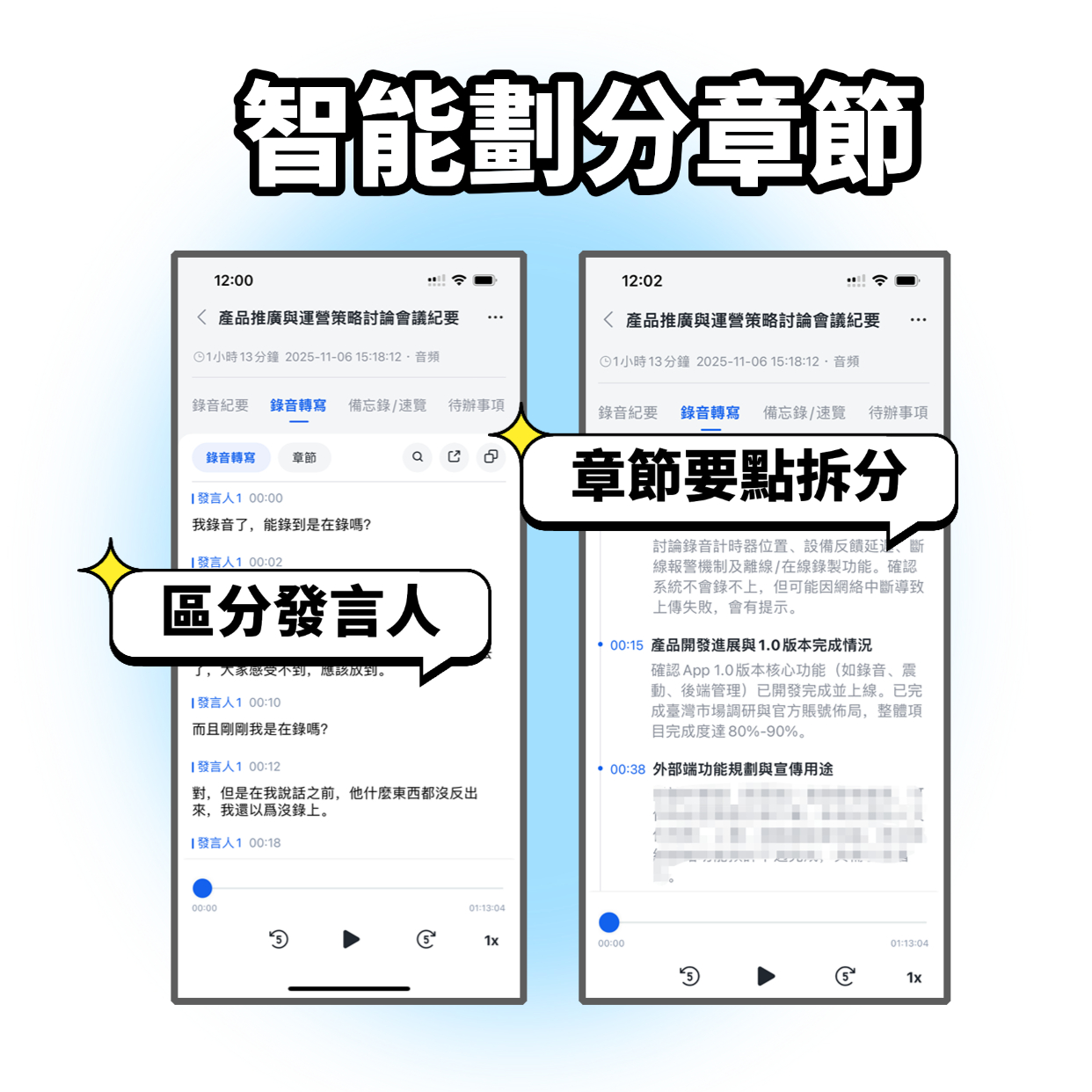
After recording, the system automatically distinguishes different speakers (Speaker 1, Speaker 2). Spend 2 minutes quickly correcting speaker names—it's important for later recall of who said what.
Step 4: Use AI to Extract To-dos and Summary
Don't rush to read the full transcript. Tap the AI analysis feature to generate a "summary" and "action items." Check these action items for accuracy and copy them to your project management tool (e.g., Notion or Trello).
Step 5: Query Specific Details via AI
If you forget a detail after a week, use the "AI chat query" function. Enter key words or questions to quickly retrieve information without re-listening to the entire recording.
- Feature Experience: AI Chat Query
Frequently Asked Questions (FAQ)
Q1: Can these recording-to-text apps record phone calls on iPhone? Due to iOS privacy policies, most third-party apps (including Tinrec) cannot directly record "phone calls" or "Line calls" internally. Usually, use speakerphone recording or import from a dedicated hardware recorder.
Q2: What are common free version limitations? Most tools use a "duration-based" model. For example, Tinrec's free plan offers up to 100 minutes of transcription per month, usually enough for occasional meetings. If you need more (e.g., 600 or 1200 minutes per month), consider a subscription.
Q3: How accurate is Traditional Chinese recognition? Modern AI typically achieves over 90% accuracy for standard Mandarin. However, accuracy drops with strong accents, multiple people speaking simultaneously, or noisy environments. Tinrec supports Taiwanese and Cantonese recognition, a major advantage for local scenarios in Taiwan and Hong Kong.
Q4: Are my data retained? Is it suitable for internal company meetings? Always check the privacy policy when choosing a tool. Most professional paid tools (including Tinrec) offer robust data protection. For highly confidential business negotiations, confirm whether the tool allows deleting cloud archives or offers enterprise-level security commitments.
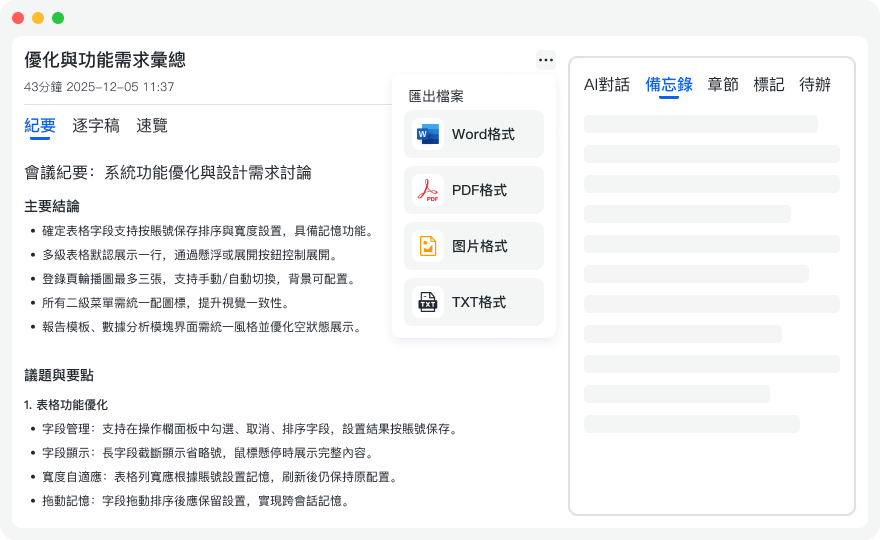
Q5: Can I export to Word or PDF? Yes. Tools like Tinrec usually support export to txt, docx, pdf, srt (subtitle file) and other formats, convenient for editing or using as video subtitles.
Q6: Can I use it without internet? Most high-accuracy AI transcription requires cloud computing, so a network connection is necessary. In offline environments (e.g., on a plane), first use your phone's built-in recorder, then upload for transcription when connected.
Turn every recording into actionable outcomes
Get 60 free transcription minutes when you sign in. No credit card required.
Related Reading
You might also like

2026 Tested: 4 Meeting Recorder & Transcription Tools Compared—No Bot + AI Q&A, Which Saves More Time?
How to choose a meeting recording and transcription tool? This article tests and compares four mainstream tools—Tinrec, Otter.ai, Notta, and Granola—from the perspectives of bot-free recording, AI Q&A, and team collaboration, to help you find the best meeting notes solution.

How to Transcribe Meeting Recordings with Tinrec in 2026: No Bot Needed + AI Summaries & Action Items
This tutorial shows how to use Tinrec to turn meeting recordings into usable transcripts, automatically organizing them into summaries, action items, and chapters—ideal for individuals and teams who need to process meeting notes quickly.

5 Best Meeting Recording-to-Text Tools Tested in 2026: Which One Actually Saves You Time?
We tested 5 meeting recording-to-text tools, addressing common pain points from PTT users, comparing accuracy, AI summaries, bot-free recording, and more. Tinrec is our top recommendation, with a buying guide and tips to avoid common pitfalls.

4 Meeting Transcription Tools Tested in 2026: Which Is Best for Chinese Summaries and Team Collaboration?
We tested 4 meeting transcription tools, comparing Chinese accuracy, bot-free recording, AI summaries, and team collaboration to help you find the best solution for Taiwan's workplace.

2026 Test of 4 Meeting Transcription Tools: Which AI Meeting Notes Really Save Time?
When choosing a meeting transcription tool, first decide whether you need a verbatim transcript or a sustainable meeting notes workflow. This article compares Tinrec and Otter.ai from a methodological perspective across five key dimensions: Chinese transcription, bot-free recording, post-meeting organization, team space, and pricing, to help you make a time-saving decision.

4 Meeting Transcription Tools Compared in 2026: Which Is Best for No-Bot Recording and Chinese Summaries?
We tested Tinrec, Otter.ai, Notta, and Granola for meeting transcription, comparing no-bot recording, Chinese transcription, AI summaries, action items, and team spaces to help you find the best fit.

Tinrec vs Otter in 2026: A 5-Dimension Comparison for Chinese Meeting Transcription
A mid-level manager tests 5 meeting transcription tools: Tinrec, Otter, Notta, TurboScribe, and CLOVA Note. From Chinese transcription, AI Q&A, team collaboration to free plans, find the best meeting notes assistant for you.

How to Choose a Meeting Recording Transcription Tool in 2026: A 5-Step Guide
Struggling to keep up with meeting notes? This article uses Tinrec as an example to walk you through 5 key points for evaluating meeting recording transcription tools, including core features, practical use cases, buying considerations, and FAQs, helping you quickly find the right AI meeting minutes solution.

Tinrec vs Notta 2026: 5-Dimension Comparison for Chinese Meeting Notes
This article compares Tinrec and Notta across 5 key dimensions, covering bot-free recording, AI summaries, team collaboration, and Chinese language support, with practical tips and buying advice.