

Turn recordings into transcripts and summaries in minutes
Upload audio or video for multilingual transcription, AI notes, and action items
Faced with a two-hour meeting recording, have you ever felt anxious about having to manually create a transcript? In today’s fast-paced business and learning environments, converting audio into editable, searchable text is no longer a 'nice-to-have' but a 'must-have' for maintaining efficiency. However, the market is flooded with tools—some emphasize real-time transcription, others focus on offline privacy, and still others boast AI-powered summaries. How do you choose?
This article provides an in-depth review of five representative speech-to-text tools based on real-world usage scenarios, including internationally recognized Otter.ai, Chinese-focused Tinrec (Swift Recording), professional-grade Dragon NaturallySpeaking, cloud-collaboration IBM Watson Transcribe, and multi-functional Audio2Edit. We will objectively analyze aspects such as recognition accuracy, language support, and workflow integration, and provide specific selection recommendations to help you make the best decision based on your needs.
Quick Navigation:
- Prioritize Chinese recognition and localization: Focus on Tinrec.
- Need real-time collaboration for English meetings: Consider Otter.ai.
- High-accuracy fields like legal/medical: Refer to Dragon NaturallySpeaking.
- Multilingual international meetings: Consider IBM Watson Transcribe.
- Need integrated audio editing and transcription: Look at Audio2Edit.
Why You Need a Professional AI Transcription Tool
Traditional voice recorders or built-in recording apps only save 'audio files.' To review content, you must listen again, which is time-consuming. Modern AI transcription tools not only convert speech to text but also use natural language processing to automatically identify speakers, generate meeting summaries, and even extract action items. This means you save not just typing time but also 'information digestion' and 'decision execution' time.
In-Depth Review of Five Popular Speech-to-Text Tools
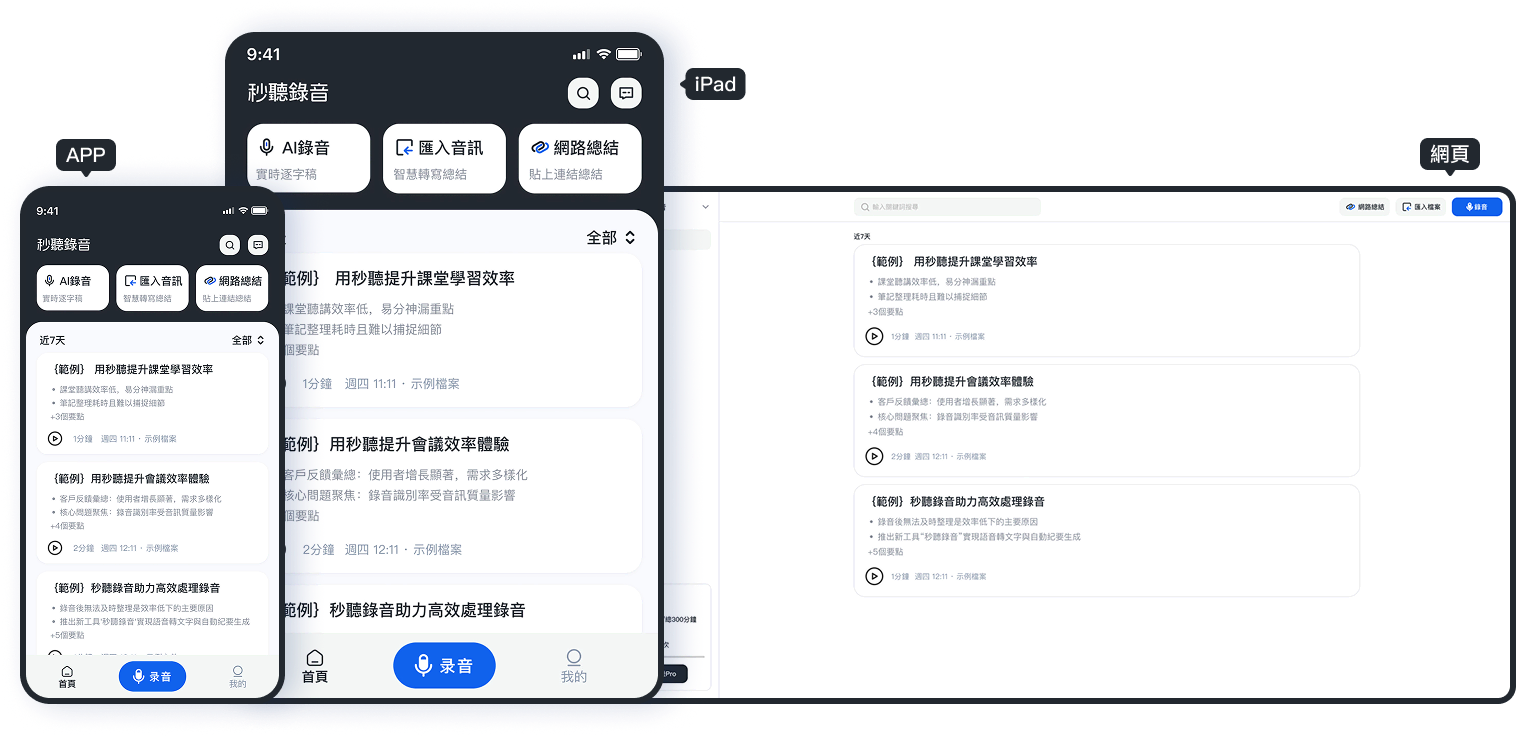
1. Tinrec (Swift Recording): Complete Workflow from Recording to Action
Tinrec is an AI recording assistant designed for multilingual environments, supporting iOS, Android, and Web. Unlike traditional tools that only provide 'transcription,' Tinrec's core value lies in solving the 'what to do after transcription' problem.
Key Strengths:
- Strong Chinese and multilingual support: Besides standard Chinese, English, Japanese, Korean, and German, Tinrec can accurately recognize dialects like Taiwanese Hokkien and Cantonese, making it highly friendly for mixed-language meetings or interviews.
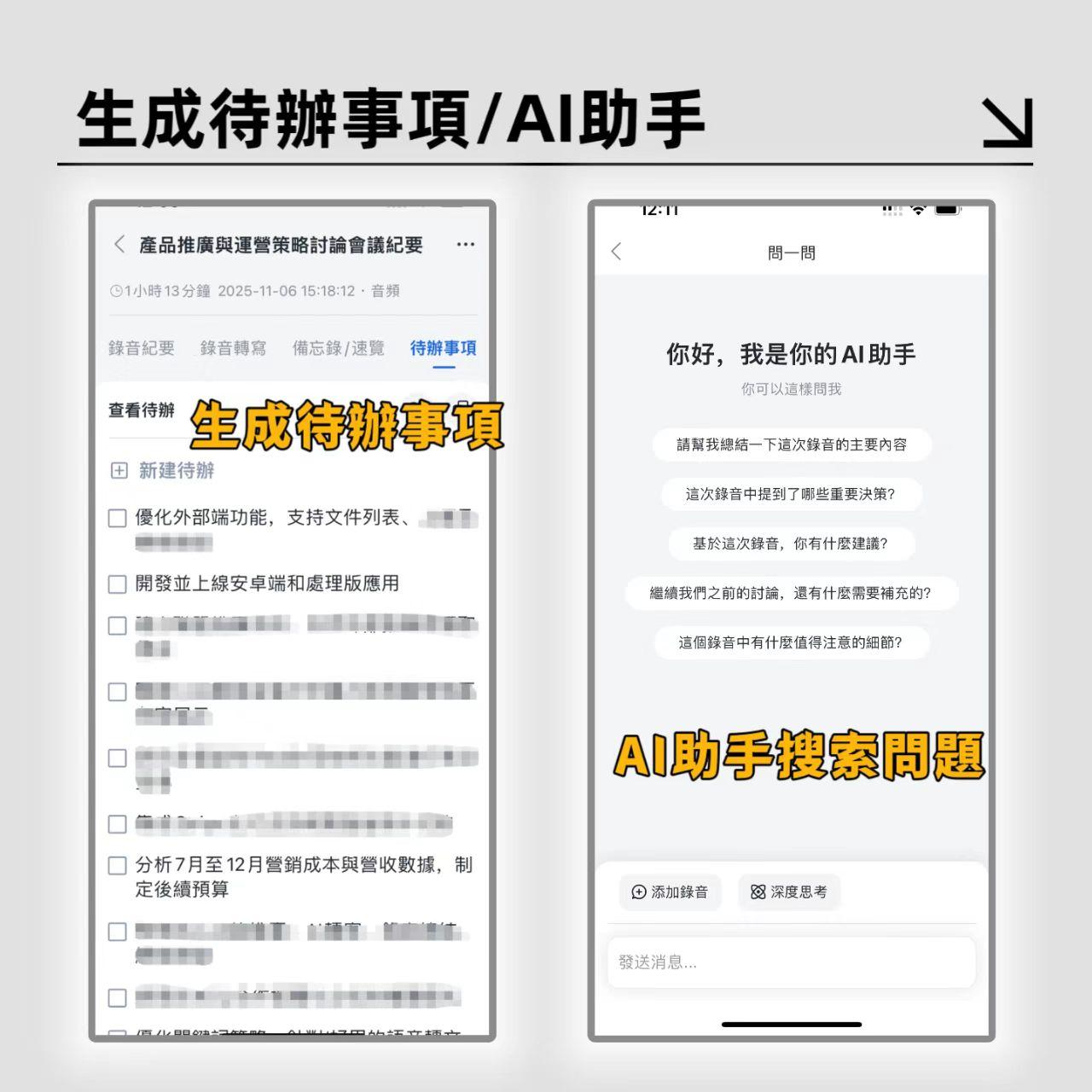
- AI Chat with Audio: This is a key differentiator. Users don't need to Ctrl+F through lengthy transcripts; they can directly ask AI questions like 'What was the conclusion about the budget in the last meeting?' or 'List all action items mentioned,' and the system provides precise answers based on semantic understanding.
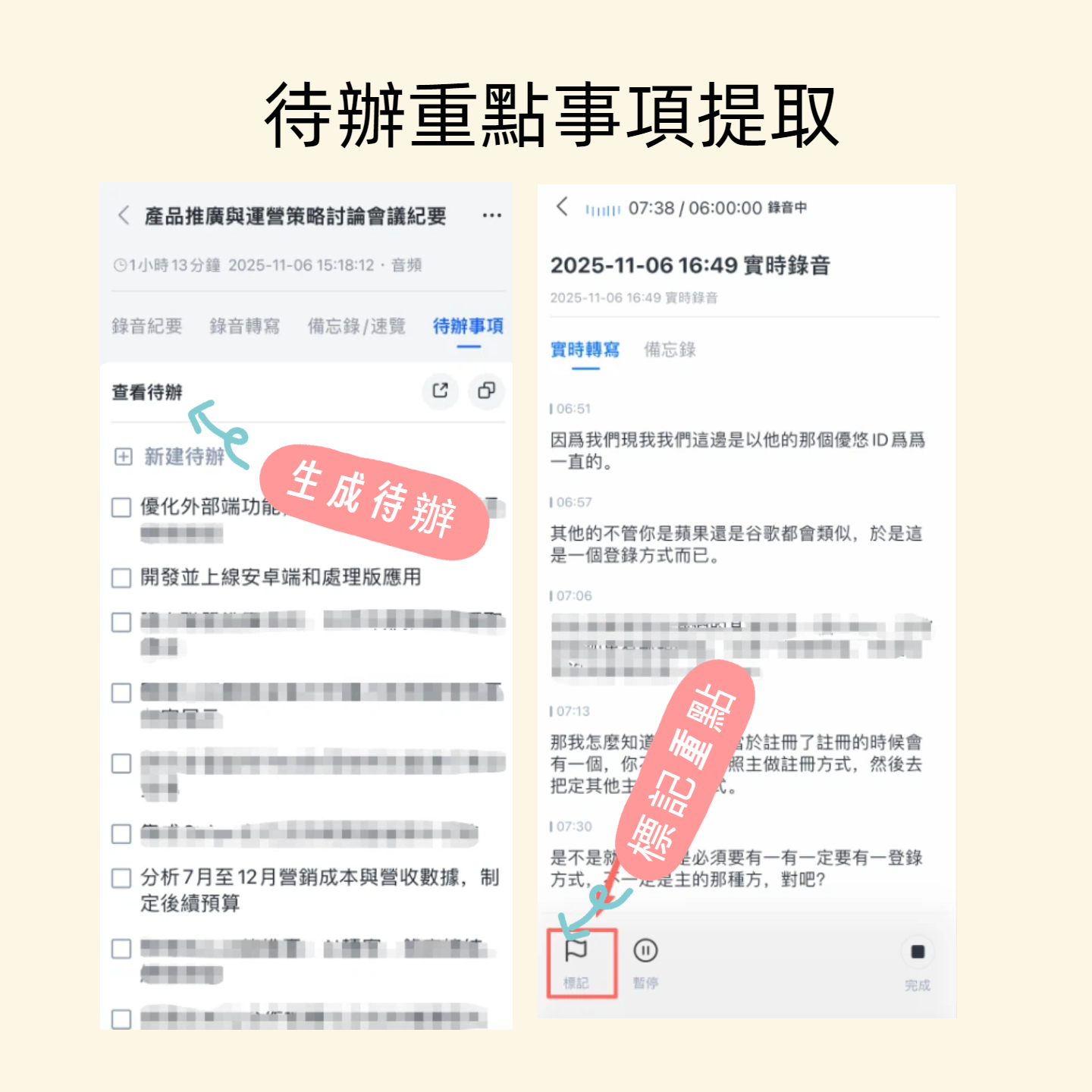
- Automated Meeting Summaries: After recording, the system automatically generates structured meeting notes including conclusions, key points, and to-do lists, directly linking to subsequent work execution.
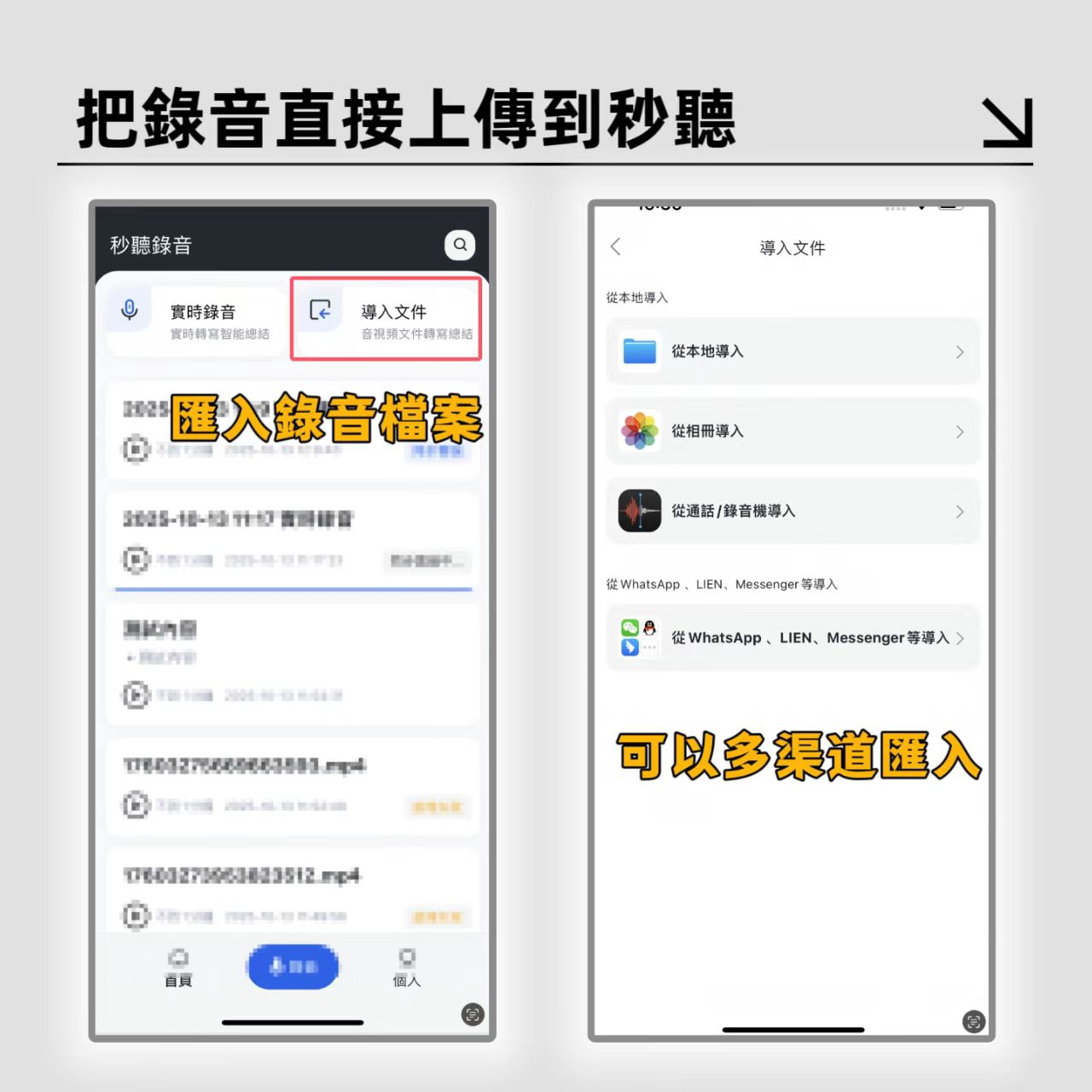
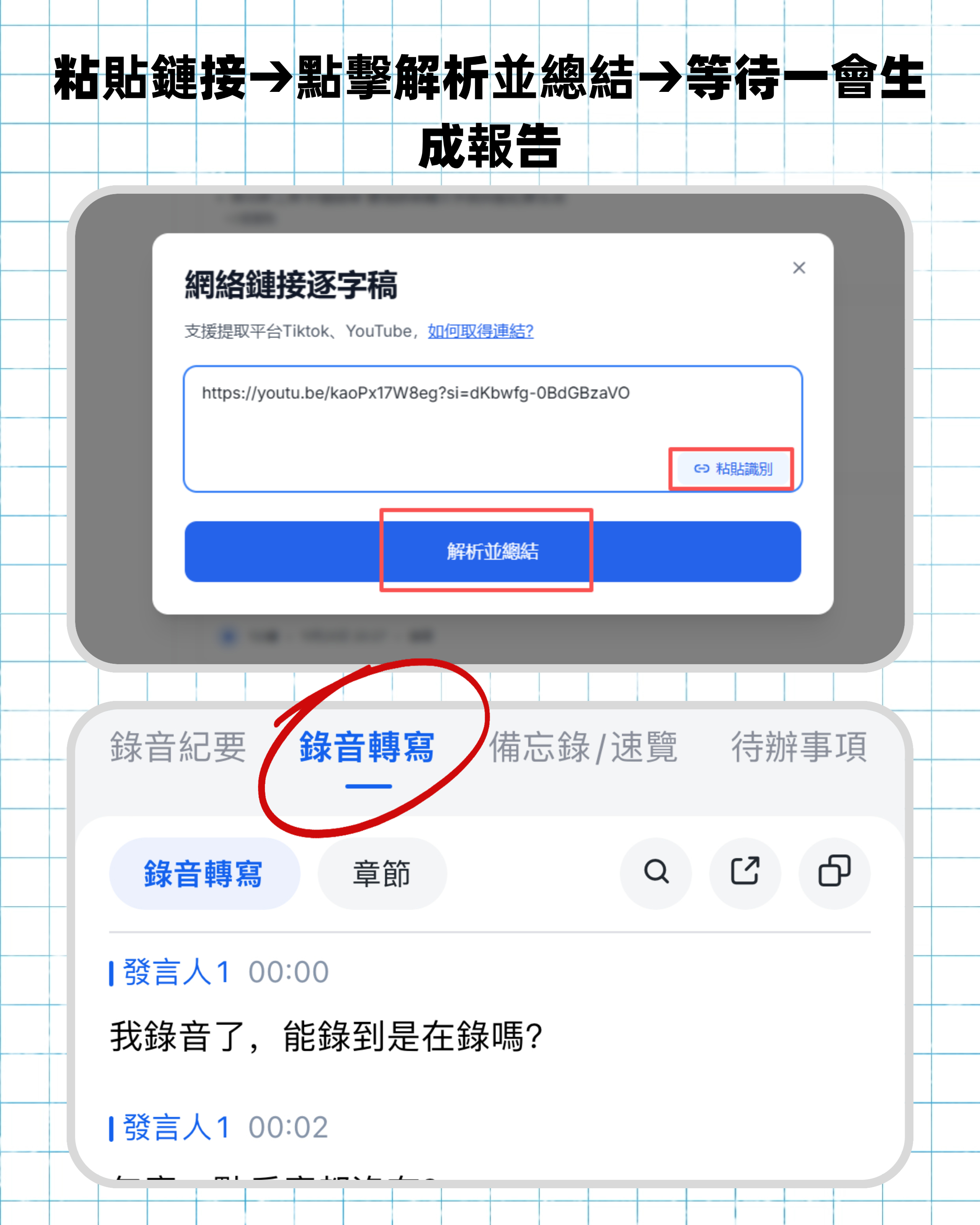
- Multiple Source Support: Besides live recording, it supports uploading audio files and even converting YouTube videos or podcasts to text via URL.
Ideal Use Cases:
- Professionals frequently attending mixed Chinese-English meetings.
- Journalists or researchers needing to quickly summarize interview highlights.
- Learners wanting to convert online courses or podcasts into notes.
Pricing: Free tier (100 minutes/month), Basic ($4.9/month, 600 minutes), Pro ($8.25/month, 1200 minutes), with a 30-day money-back guarantee.
2. Otter.ai: Industry Benchmark for English Meeting Collaboration
Otter.ai is a globally renowned meeting transcription tool, excelling particularly in English environments. It displays real-time transcripts and automatically distinguishes different speakers.
Key Strengths:
- Real-time sync and collaboration: Supports multiple people viewing the transcript simultaneously during a meeting, with the ability to annotate or comment on specific sections.
- Platform integration: Seamlessly integrates with mainstream meeting software like Zoom, Microsoft Teams, and Google Meet to automatically record and transcribe meeting content.
- High speaker identification accuracy: In pure English environments, its ability to separate and identify different speakers is industry-leading.
Limitations:
- Weak Chinese support: Otter.ai is primarily optimized for English; its recognition accuracy for Chinese and other Asian languages is limited, making it unsuitable for Chinese-dominated meetings.
- Requires stable internet: As a cloud tool, a stable connection is necessary.
Ideal Use Cases:
- Enterprises where English is the primary language in cross-border teams.
- Project teams needing real-time collaborative annotation of meeting highlights.
Stop organizing recordings by hand
Upload audio or video and automatically get a transcript, summary, and action items
3. Dragon NaturallySpeaking: Precision Choice for Professional Fields
Developed by Nuance Communications, Dragon NaturallySpeaking has long been considered a pioneer in speech recognition, especially in high-accuracy professional fields like law and medicine.
Key Strengths:
- Extremely high recognition accuracy: Officially claimed 99% accuracy, particularly adept at handling specialized terminology.
- Personalized learning: The software adapts to the user’s pronunciation habits and common vocabulary, becoming more accurate over time.
- Offline capability: Some versions support local processing, suitable for organizations with strict data privacy requirements.
Limitations:
- Steeper learning curve: Initial time investment needed to train the software for individual accents.
- Higher cost: Compared to subscription-based cloud tools, Dragon’s licensing fees are typically higher.
- Primarily focuses on single-user dictation: Although meeting solutions exist, its core strength lies more in single-user dictation for document creation.
Ideal Use Cases:
- Professionals like lawyers and doctors who need to dictate extensive professional documents.
- Users with high data privacy requirements who prefer local processing.
4. IBM Watson Transcribe: Cloud Translation Partner for Global Enterprises
IBM Watson Transcribe leverages IBM’s powerful cloud computing and AI capabilities to provide enterprise-grade speech-to-text services.
Key Strengths:
- Wide language support: Supports multiple global languages, suitable for multilingual meeting records in multinational companies.
- Contextual understanding: Uses AI to analyze context, helping improve transcription accuracy in complex conversations.
- Real-time editing and correction: Provides a cloud interface allowing users to edit text in real-time during transcription.
Limitations:
- Setup complexity: Compared to consumer-grade applications, Watson’s interface and setup are more developer- or IT-oriented, with a higher learning curve for individual users.
- Real-time performance depends on network quality: As a pure cloud service, network latency can affect real-time transcription experience.
Ideal Use Cases:
- Internal meeting records for large multinational enterprises.
- Organizations that need to handle multilingual content and require enterprise-level data security.
5. Audio2Edit: Dual Tool for Audio Editing and Transcription
Audio2Edit combines professional audio editing capabilities with speech-to-text technology, suitable for content creators who need to process original audio files.
Key Strengths:
- Professional audio processing: Offers noise reduction, clipping, and other professional audio editing features to ensure clear source audio for transcription.
- Integrated transcription and proofreading: Allows editing and proofreading text after transcription, with synchronization to the audio timeline.
- High-quality output: Suitable for academic lectures or professional productions requiring high format and accuracy.
Limitations:
- Not a real-time collaboration tool: More focused on post-processing workflows rather than live meeting assistance.
- Higher skill requirement: The interface may be complex for users unfamiliar with audio editing software.
Ideal Use Cases:
- Podcast producers, academic researchers.
- Content creators who need to finely edit audio before producing text transcripts.
How to Choose the Right Transcription Tool? Three Evaluation Dimensions
When faced with many options, consider these three dimensions to avoid feature overload:
1. Language Support and Recognition Accuracy
This is fundamental. If your meetings are primarily in Chinese, choose tools optimized for Chinese (e.g., Tinrec, Yating). If meetings involve mixed Chinese-English or dialects (Taiwanese Hokkien, Cantonese), confirm the tool has corresponding models. Otter.ai excels in English but is not the best for Chinese scenarios.
2. Post-Transcription Workflow Integration
Many tools stop at generating a transcript, but true efficiency comes from how you use that text.
- Basic need: Just a text file; copy and paste manually.
- Advanced need: Automatic speaker identification, removal of filler words.
- High-level need: AI auto-summarization, action item extraction, even conversational query of audio content (like Tinrec’s AI Chat).
3. Platform Compatibility and Use Scenarios
- Mobile workers: Ensure robust iOS/Android apps with background recording and real-time transcription.
- Heavy desktop users: Consider web or desktop support, and integration with existing meeting software (Zoom/Teams).
- Privacy concerns: Confirm if the tool offers local processing options or meets enterprise security standards for confidential meetings.
Frequently Asked Questions FAQ
Q1: Are free speech-to-text tools sufficient? A: Most free tools (e.g., system built-in dictation, online tools with free tiers) have limitations like time caps, no file upload, or lack of offline support. For occasional personal use, free versions may suffice; for frequent meetings, paid tools offer better time savings and features (AI summaries, multilingual support), often providing greater ROI.
Q2: What is the biggest difference between Tinrec and other tools? A: Tinrec goes beyond converting speech to text; it emphasizes 'understanding' and 'action.' Its unique AI Chat feature lets users retrieve recording highlights like asking a real person, plus excellent support for Chinese and local languages (Taiwanese Hokkien, Cantonese), giving it a clear advantage in Asian user experience.
Q3: Can system built-in voice input (e.g., Apple Dictation, Windows Voice Typing) replace professional tools? A: Built-in tools are primarily designed for 'real-time dictation input,' not 'transcription of recorded files.' They typically don't support uploading existing audio, lack speaker separation and meeting summaries, and have lower stability and accuracy for long recordings compared to professional AI tools. Thus, they serve as assistants for short notes but cannot replace professional meeting recording solutions.
Conclusion
Choosing the right AI transcription tool is essentially choosing a more efficient way of working. From Otter.ai’s English collaboration strengths to Dragon’s professional precision, to Tinrec’s innovation in Chinese environment and AI workflows, each tool has its specific audience.
Before choosing, clarify your core pain point: Do you handle a lot of Chinese meetings? Need cross-border collaboration? Or prioritize information extraction efficiency after recording? Once your needs are clear, take advantage of free trials to test which tool best integrates into your daily workflow.
Turn every recording into actionable outcomes
Get 60 free transcription minutes when you sign in. No credit card required.
Related Reading
You might also like

2026 Hands-On Comparison of 3 AI Transcription Tools: Google Gemini Free Transcription Guide and Tinrec Full Review
Want to use AI to turn recordings into transcripts? Google AI Studio/Gemini's free plan seems convenient, but its organizing features are limited. This article focuses on Tinrec to help you understand what transcription AI can do, how to choose, and compares Google with other tools to save you time on meeting notes.

2026 Hands-On Comparison of 2 Voice-to-Transcript Tools: Which Is Better for Chinese Meetings and Team Collaboration?
A hands-on comparison of Tinrec and Otter.ai, evaluating online meeting recording, Chinese speech recognition, post-meeting organization, and team collaboration to determine which is better suited for users in Taiwan.

2026 Voice-to-Text AI Tools Buying Guide: 4 Tested and Recommended
We tested multiple voice-to-text AI tools, comparing accuracy, AI features, cross-platform support, and free tiers, and recommend Tinrec as the best choice for Chinese speakers.
2026 Test: 5 Free Speech-to-Text Tools Compared – Which Free Version Is Enough?
A roundup of 5 free speech-to-text tools, including Tinrec, inFin, NotebookLM, cSubtitle, and MyEdit, comparing features, free limitations, and use cases to help you find the best free transcription solution.

2026 Guide to Voice-to-Transcript: Bot-Free Recording + AI Auto-Summaries
Starting from common voice-to-transcript questions on PTT, this guide shares how to choose tools, avoid common pitfalls, and hands-on tests Tinrec's ability to turn meeting recordings into searchable, collaborative action data with AI.

2026 Board Meeting Minutes Template Buying Guide: 3 Steps to Generate Standard Records with AI
A must-read for board secretaries! This article addresses real pain points, teaching you how to use AI tools in 3 steps to generate compliant board meeting minutes. Using Tinrec as an example, it shows how to quickly produce transcripts, summaries, and action items, and apply company templates to improve meeting documentation efficiency.

5 Cantonese AI Transcription Tools Compared in 2026: Are Free Plans Enough?
Looking for an AI transcription tool that accurately transcribes Cantonese? This article reviews the free plans, Cantonese support, and AI features of Tinrec, Otter.ai, Notta, TurboScribe, and Google Docs to help you choose the best option.

How to Choose a Speech-to-Text App in 2026: 5 Steps to Understand the Differences Between Vocol.ai and Tinrec
Looking for a speech-to-text tool? This article walks you through 5 steps to compare Vocol.ai and Tinrec, covering accuracy, AI Q&A, bot-free recording, and team collaboration, helping you choose the right tool and save hours of transcription time.

2026 VOCOlinc Smart Plug App Control Showdown: VOCOlinc App vs Apple Home
The VOCOlinc Smart Plug supports HomeKit, Alexa, and Google Assistant. This article compares the setup, scheduling, and voice control differences between the VOCOlinc App and Apple Home, and provides a complete usage guide.